Northeast
Hillary Clinton-produced play ‘Suffs’ failing to pack seats during peak Broadway season

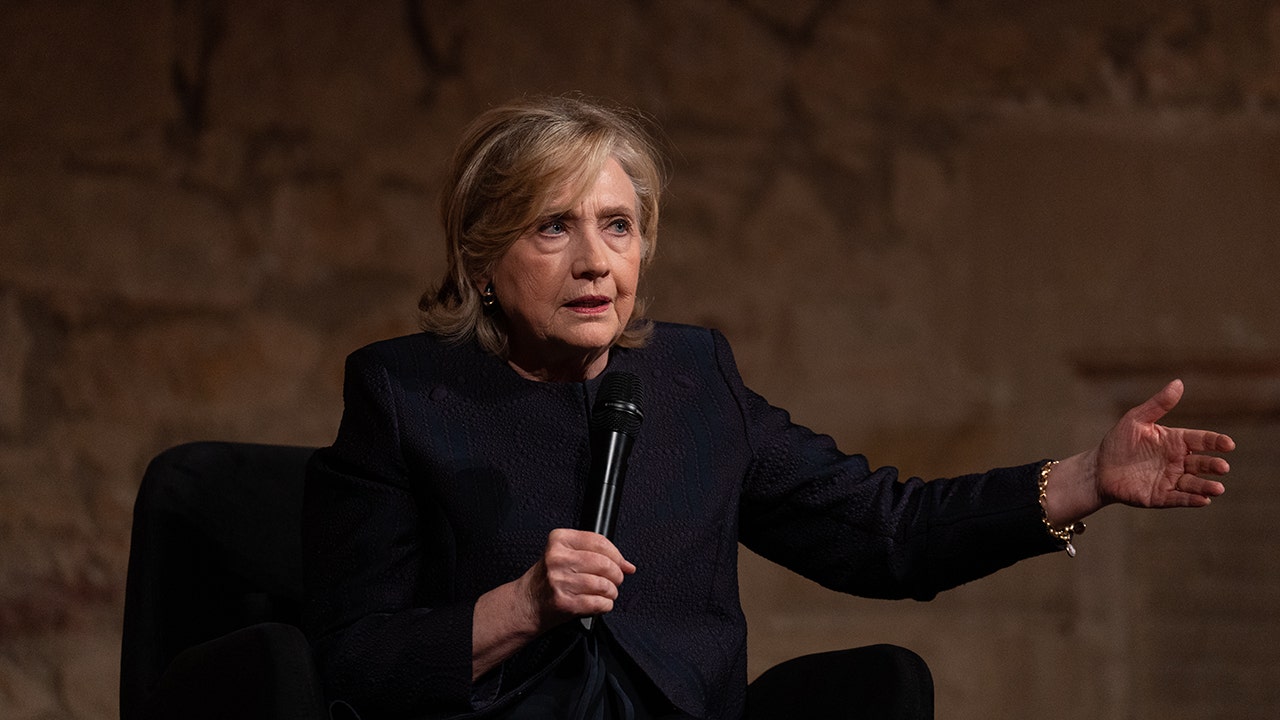
The Broadway box office numbers for the week of May 5 revealed that Hillary Clinton-produced stage play “Suffs” is on the bottom rung of shows in terms of filling capacity.
Broadway Theatre Industry official site “The Broadway League” shared the weekly grosses from the 35 shows currently playing on Broadway, which include “Suffs,” “Harry Potter and The Cursed Child,” and classics like “Romeo & Juliet,” Sweeney Tod” and “Moulin Rouge! The Musical.”
According to the data, Clinton’s play only reached 81% capacity across eight performances that week, placing it among the bottom eight productions in that category – the bottom 23% of all 35 shows for the week.
EX-CLINTON AIDE SAYS HE ‘WET THE BED’ OVER SPECIAL COUNSEL’S REPORT ON BIDEN: ‘TERRIBLE FOR DEMOCRATS’
Hillary Clintons new Broadway “Suffs” has been struggling to fill seats during Broadways busiest season this year. (David Zorrakino/Europa Press via Getty Images)
Noting that the play’s lagging numbers look even worse considering it’s a new show, Breitbart News argued the performance “should still be drawing big crowds during Broadway’s peak season – the month before the Tony Awards,” which is right now.
The play first opened on Broadway last month, following an Off-Broadway run that started in 2022 in New York City’s “The Public” theater. The musical was by singer-songwriter Shaina Taub, directed by Leigh Silverman, and produced by lead producers Jill Furman and Rachel Sussman, along with co-producers Hillary Clinton and Malala Yousafzai.
Breitbart also noted that Vice President Harris’s niece, Meena Harris, is another producer on the stage play.
The three-hour-long play brings the women’s suffrage movement of the early 1900s to the stage. According to the show’s website, Suffs “boldly explores the victories and failures of a struggle for equality that’s far from over.”
HILLARY CLINTON: ‘WHAT TRUMP REALLY WANTS’ IS TO ‘KILL HIS OPPOSITION’
“Suffs,” the play co-produced by Clinton, currently sits around the bottom 25% of Broadway shows in terms of filling seats. (Evan Agostini/Invision/AP, File)
The play features an “entirely female and non-binary cast – among them Tony winner Nikki M. James, Jenn Colella, Emily Skinner, and Grace McLean as President Woodrow Wilson,” according to Playbill.com.
Clinton stated she relates to “all of” the characters in the play, telling the Associated Press last month she knows “how hard it is to make change.”
CLICK HERE FOR MORE COVERAGE OF MEDIA AND CULTURE
“I know how important it is to have relationships with the people you’re working for, as you’re taking risks and you’re doing things that have never been done, whether it’s running for president in my case or having a march on Washington in 1913 to try to convince the president and the Congress to adopt the amendment to let women vote,” she said.
The former U.S. Secretary of State added, “But more than that, I see it as relevant today. We have a lot of challenges in our country.”
BroadwayLeague.com’s numbers also revealed that last week’s numbers for “Suffs” were even worse, with the show only filling 78% of its 7,784 total seats across performances.
Read the full article from Here


Generic police lights (FOX 9)
A 10-year-old boy who allegedly robbed a Dollar Tree store in Pennsylvania is also accused of stabbing multiple times one of the employees trying to detain him.
Big picture view:
The Swatara Township Police Department reported that its officers were called around 5 p.m. on Monday to the discount store in Harrisburg where they found the boy being held by store employees.
Timeline:
After speaking with witnesses, officers determined that the grade-school-age child went into the store holding a fixed-blade knife, threatened an employee, and told her to give him all the money.
Customs officers use Heimlich maneuver to save choking toddler
The employee’s co-workers jumped in to help her. As they struggled to subdue the boy, he stabbed one of them multiple times, the police department reported. Its statement did not indicate how badly that employee was injured, only saying that medical treatment was needed.
Dig deeper:
The suspect was taken by officers to a detention facility where he was booked on counts of robbery, aggravated assault with a deadly weapon, and possessing an instrument of a crime.
The Source: Information for this article was taken from Swatara Township Police Department. This story was reported from Orlando.

Three generations of a family, including a two-year-old girl, have been killed during a driving lesson after their car plunged into a Rhode Island river.
Police received a report that a car had driven into the Seekonk River in Pawtucket on Sunday evening at the small boat-launching area, The Boston Globe reported.
After hours of searching for the submerged car, authorities pulled it out of the water Monday afternoon. The 45-year-old woman, a 22-year-old woman and the two-year-old girl inside the car were found dead.
Pawtucket resident Josue Gomez told The Globe it was his wife, Floridalma Arceno, their daughter, Linora Sucely Gomez, and their granddaughter, Ana Sofia Garcia Gomez, who were killed in the accident.
Gomez said Arceno was teaching their daughter how to drive with their granddaughter in the car when his wife called him in a panic and said, “‘It won’t brake, it won’t brake.’’

“It was the last thing she said to me,” he said.
Pawtucket Police Chief Tina Goncalves told reporters that a “Good Samaritan riding a jet ski in the vicinity heard the car enter the water and attempted to help,” The Providence Journal reported.
“While this was occurring, another individual called 911, and first responders were on scene within 3 minutes,” Goncalves said.
Gomez said he hurried to the boat ramp Sunday evening, but the car was already submerged.
Police tried to find the car, but suspended the search around 1 a.m. Monday due to poor conditions, according to reports.
The search resumed Monday morning, and by around 2:30 p.m. ET, a tow truck pulled the car out of the water.
“They were good people,” Gomez told The Globe.

The Independent has reached out to the Pawtucket Police Department and the Rhode Island Office of the State Medical Examiners for comment.
Authorities called it a “tragic accident,” and said there were no indications of foul play, according to reports.
“Preliminary findings suggest the vehicle was in proper working order,” Pawtucket Detective Sergeant Paul Trout said in an email to The Globe.
Pawtucket Mayor Donald R. Grebien called the incident a “heartbreaking tragedy” in a statement shared with the media.
“Our community mourns alongside them, and we want them to know they are not alone during this unimaginable time,” Grebien said.
Vermont
She moved from Paris to Vermont and found her ‘dream job’ opening a bakery – The Boston Globe

BURLINGTON, Vt. — Shelley MacDonald and her husband, both Canadian citizens, had been living in Paris for over a decade when the pandemic hit. She’d been selling baked goods and hosting a dinner club called Paris Bread in their apartment. She wanted to open a business in the United States, where she could operate in English. It was time to leave, except that, at the moment, only American passport holders could fly into the United States.
With ingenuity and grit, the couple discovered a visa for foreign entrepreneurs and secured one from the American Embassy the day it reopened after lockdown. Once their passports were stamped, they had 30 days to fly out and move everything they owned to this picturesque college town.
Since 2022, MacDonald has run Belleville Bakery & Catering near City Hall in Burlington, Vt., down the street from the University of Vermont. She’s training staff, including students, and offering confections you might see in a Parisian patisserie, most not as fancy. She has different varieties of all-butter croissants, cinnamon snails and feta-garlic snails made with croissant trimmings, tempting lunch items such as bacon cheddar quiche and tuna sandwiches with smoked Gouda on homemade onions buns, and dinners such as lasagna, rigatoni, and chicken pot pie to take home.
“I think the town is adorable with kind people who help you when you don’t need to be helped,” says MacDonald, sitting in the bright bakery. “There’s something very special about Vermont.”
She and her husband — the hyperrealist painter André Beaulieu — picked Burlington because they had visited often when they lived in his hometown, Montreal. “The real reason is so that I could open a business in English,” she told her 48,000 Instagram followers, “so that I could function in my native language, for all of the reading and writing and dealing with lawyers and accountants and plumbers that you need to do when you own a business.”
MacDonald describes their new situation as “the best of both possible worlds, where I get to live in English in a really cute space, and he gets to live with me in English in a really cute space and he’s really close to home.” She describes her business as her “dream job.”
The 100-year-old building whose storefront she renovated is large and airy, with bakers in the kitchen in full view making croissant and brioche doughs, prepping cookie batters and galette pastry.

MacDonald moves quickly, laughs easily, and greets customers warmly. “People come into a bakery looking for a treat and some kind of care,” she says. When you’ve finished eating, you don’t have to take your plates and cups to various bins for recycle and trash. That system horrifies her. “No bussing,” she says. “We take care of you.”
Her clientele skews older, she has noticed, and they’re looking for somewhere to go. “The demand is enormous,” she says. She describes her personality as “Shelley takes care of people.” Remembering her days running an underground restaurant, MacDonald now offers twice-monthly Sunday brunches and dinners, both served at a long table farmhouse-style so everyone talks to their neighbors.
MacDonald, who is willing to throw everything at the wall and see what sticks, also has a successful mail-order arm to send cookies across the country. They’re thick and perfectly round in flavors such as orange gingersnap, pistachio chocolate, and lemon pistachio shortbread.
She also gives classes in the bakery and writes a weekly newsletter, which she snail-mails for free. “People are lonely,” she says. They want to receive real mail.

Born and raised in Halifax, Nova Scotia, MacDonald, 59, also lived in Vancouver. She met Beaulieu in Montreal. His large, striking artworks hang in the bakery.
In order to get a US E-2 Investor Visa, they had to invest $15,000 in a new US company (some applicants invest considerably more) and have secured premises in the destination city. Sight-unseen, they rented a painting studio in The Soda Plant in Burlington for Beaulieu, which qualified them.
The bakery’s name is the English version of Beaulieu’s surname. Beaulieu means “beautiful place,” she says. Belleville, which means “beautiful city,” is easier for Americans to spell.
Burlington Mayor Emma Mulvaney-Stanak, who happened to be there when I was — she said she stops by often since her office is so close — describes the bakery as “loveliness in this corner. [MacDonald] draws people into this community.”

The bakery has become known for its I am Proud of Me Banana Cake. It’s really banana bread, but when MacDonald made it in France, customers wondered why it was called bread.
When you buy one, MacDonald asks you what you’re proud of. She’s heard many comments, mostly emotional. One woman in her 20s was going to drive on the highway for the first time, someone else was excited to have completed exams. Then a man came in to say he was proud of his wife for finishing chemo.
“She’d been planning this cake during her treatment,” MacDonald told a local TV reporter who did a segment on her. Donations started coming in so other cancer patients at the local hospital could get a banana cake; MacDonald also sends cakes to a palliative care center and a teen drop-in center.
Those efforts came to the attention of a program director at the University of Vermont, who called MacDonald in the middle of Vermont’s dark, cold February winter. The administrator was running a mental health day for freshmen. She bought 100 banana cakes from MacDonald and asked her to come and hand them out.
The line was an hour long. Students waited patiently, not just to get an I am Proud of Me Banana Cake, but also for a moment to tell MacDonald what was on their mind.
Belleville Bakery & Catering, 217 College St., Burlington, Vt., www.bellevillevt.com
Sheryl Julian can be reached at sheryl.julian@globe.com.
-

 Oregon3 minutes ago
What the Supreme Court’s transgender sports ruling means for Oregon
-

 Pennsylvania6 minutes ago
10-year-old stabbed Dollar Tree employee during robbery in Pennsylvania, police say
-

 Rhode Island11 minutes ago
Three generations killed during driving lesson after car plunges into river
-

 South-Carolina18 minutes ago
South Carolina Lottery Mega Millions, Pick 3 results for June 30, 2026
-

 South Dakota21 minutes ago
Vermillion’s Reuvers commits to South Dakota
-

 Tennessee26 minutes ago
Tennessee’s heat wave flirting with records
-

 Texas33 minutes ago
Phoenix Merchant Partners and Texas Capital Alternative Asset Management Form Strategic Relationship
-

 Utah36 minutes ago
Therapy dogs offer a welcome break for firefighters battling Utah’s Iron, Cherry fires

