Sign up for The Dish
Stay up to date on the latest food and drink news from Boston.com.
Three people have been arrested in the killing of a man on a New York City subway car last week, police said Tuesday.
William Alvarez, a 45-year-old Bronx resident, was fatally shot after getting into an argument with one of the suspects on a D Train in the Bronx around 5 a.m. Friday.
Police said what happened was captured on surveillance videos on the trains, subway station and on the street.
SEVERED HUMAN LEG FOUND ON NYC SUBWAY TRACKS IN BRONX: POLICE
The three have been charged with murder and criminal possession of a weapon. They were found by members of the U.S. Marshals Regional Fugitive Task Force at an apartment in the Bronx on Monday.
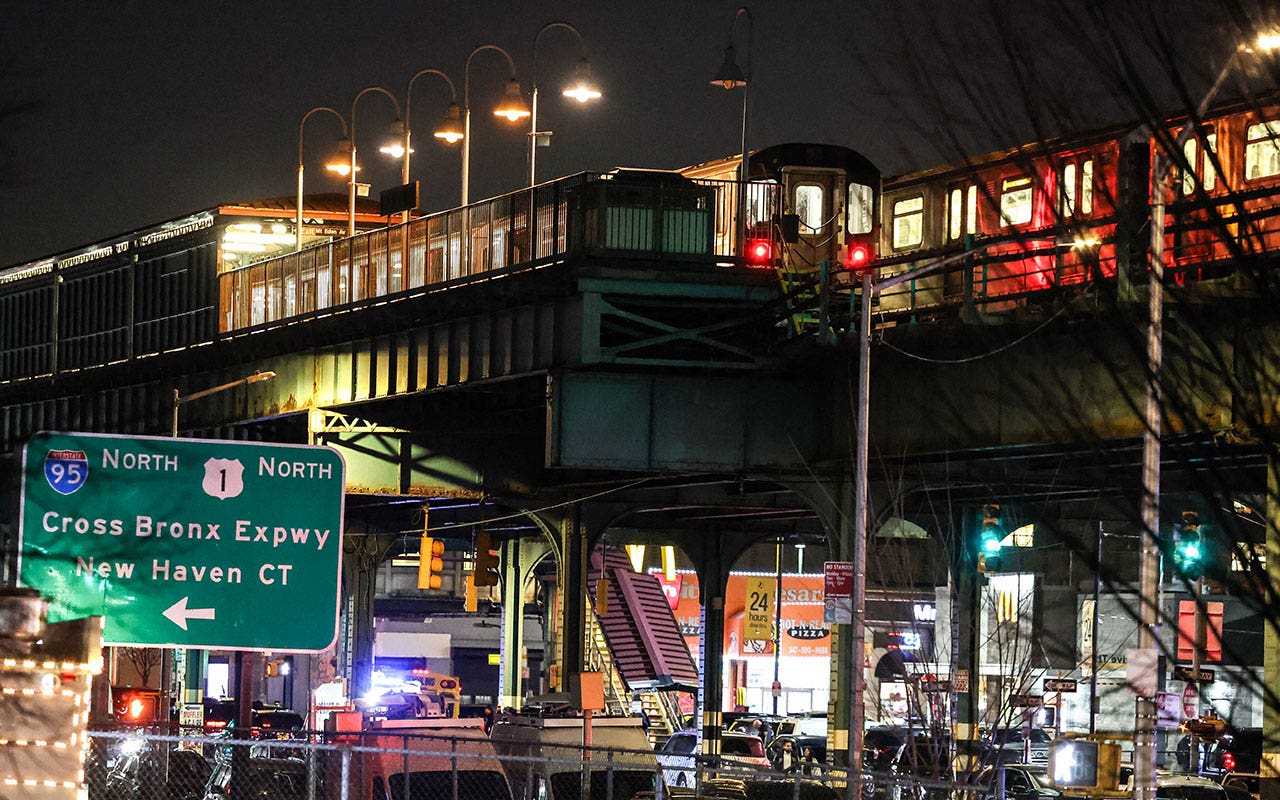
A train is seen at Mt. Eden Avenue subway station in the Bronx borough of New York. Three people have been arrested in the killing of a man on a New York City subway car last week, police said on Tuesday. (CHARLY TRIBALLEAU/AFP via Getty Images)
The fatal shooting is the third killing in the subway system this year. It came soon after a 35-year-old man was killed and five others were wounded during a shooting at a different subway station in the Bronx earlier this month.
MAN SHOT DEAD ON NYC SUBWAY AS DA BRAGG DEFENDS RECORD IN ARIZONA EXTRADITION BATTLE: ‘WE ARE SERIOUS’
Transit crimes are up 13% compared with this time last year, WABC-TV reports.
The NYPD has implemented longer, 12-hour shifts for police officers assigned to the subway system in response to the uptick in crime.
Read the full article from Here
The provocative painting seemed like an authentic work by Andy Warhol, depicting a nude man and woman gazing at each other with colorful shading around their bodies.
But the piece was a well-disguised counterfeit, among more than 200 fakes of works by artists like Banksy, Picasso and the Native American painter Fritz Scholder, which sold for a total of more than $2 million. Many of the works were made by an artist in Poland, and commissioned by a father and daughter living in New Jersey.
On Tuesday, the father and daughter, Erwin Bankowski and Karolina Bankowska, pleaded guilty in Federal District Court in Brooklyn to running a scheme to sell the counterfeit works.
The duo “painted themselves as purveyors of fine art while selling lies on canvas to unsuspecting collectors,” Joseph Nocella Jr., the U.S. attorney in Brooklyn, said in a statement.
Federal guidelines call for a prison sentence of 33 to 41 months for each defendant. Both Mr. Bankowski and Mr. Bankowska are citizens of Poland and face deportation after serving their sentences. They are set to be sentenced on Aug. 5.
Todd Spodek, a lawyer for Ms. Bankowska, 26, said his client had accepted responsibility for her crimes. Jeffrey Chabrowe, a lawyer for Mr. Bankowski, 50, said his client also accepted responsibility and had “made a terrible decision to support his family.”
Counterfeit art schemes date back thousands of years. Many forgers in recent decades have pulled off their operations by faking a work’s provenance, or documented ownership history, which elite art collectors check to determine authenticity.
Famous art forgers include Wolfgang Beltracchi, a German man who says he painted in the style of more than 100 artists, and Mark Landis, who has donated numerous fakes to dozens of museums. Two art forgery rings in Thunder Bay, Ontario, manufactured thousands of fake paintings presented as works by Norval Morrisseau, one of Canada’s most celebrated Indigenous artists.
Mr. Bankowski and Ms. Bankowska went to great lengths to conceal their efforts. In addition to creating the fake provenances, sometimes by using forged stamps from art galleries, they told buyers that the pieces were from art galleries that had since closed, prosecutors said. That made it harder for buyers to verify that the pieces were real.
The pair’s collection included splotchy pieces, often with strong political overtones, that were sold to reputable galleries and auction houses around the United States. One fake of a work by Banksy, the anonymous British street artist, that protested the Iraq War sold for $2,000. A knockoff of a painting by Raimonds Staprans, a Latvian American visual artist who died in January, sold for $60,000.
Mr. Bankowski and Ms. Bankowska also sold works that they claimed were made by Native American artists, earning a rarely used federal charge: the misrepresentation of Indian goods and services. One of the counterfeits was a fake of a landscape by Richard Mayhew, a painter of Black and Native American heritage; it sold for $160,000, prosecutors said.
Mr. Spodek, who has represented many people accused of elaborate scams, said his clients had taken great care to ensure the knockoffs looked authentic. He said the replicas that the father and daughter commissioned were “identical” to the originals.
“It’s not just selling on eBay,” Mr. Spodek said.
Food News
A beloved New England chain restaurant’s last Boston location may close as developers eye the lot around it for future apartments at Charlestown’s Bunker Hill Mall.
Universal Hub first reported the news that the 99 Restaurant on Austin Street could shutter as part of a proposal to replace much of the site with a six-story, 240-unit apartment complex.
A spokesperson for the restaurant said the 99 has been at its 31 Austin St. location for 33 years.
“We are aware that the owners of Bunker Hill Mall property are considering a redevelopment of the entire site, and as such, we are exploring our options to remain in this community far into the future,” a spokesperson said. “We will continue to serve our loyal guests in our current location as long as our lease remains in place.”
The property owner, New England Development, originally proposed a plan in 2021 that would build apartments around the 99 in a U-shape design, according to previous documents and members of the Charlestown Neighborhood Council who spoke to Boston.com. But the neighborhood council development chair Nancy Johnson said the community had a hard time envisioning that design.
Since then, a key zoning change has reshaped the project. In late 2023, the Boston Planning Department changed the Bunker Hill Mall site’s zoning from neighborhood shopping to mixed-use, clearing the way for residential builds. New England Development now proposes replacing the 99 entirely, with construction to be finished by 2028.
In a statement, New England Development said the restaurant “will remain in operation through at least the end of 2026.”
“The residential development, which adheres to zoning, will provide needed housing, and also complement and support the existing grocery and commercial uses with no reduction in parking for those businesses,” the statement read.
In a March meeting, some public comments opposed the project because of the likely shuttering of the 99.
“The 99 is one of the few family-friendly restaurants in Charlestown,” said one commenter. “We have celebrated numerous end-of-season sports events there. We need these kind of community spaces in Charlestown.”
Residents also raised broader concerns about the development, including parking and the potential loss of retail in addition to the 99. It isn’t immediately clear which stores will stay. A draft project impact report filed this year indicates redevelopment would only be considered after the “expiration of long-term retail leases.”
But along with zoning changes, Boston’s planning department approved a modification to the urban renewal plan to allow for the residential build. Johnson said the community is worried it could mean less retail stores at the site, which is the opposite of what the community wants.
The Bunker Hill Mall currently includes a Whole Foods, CVS, an Ace Hardware, and other stores. The 99 and a Dunkin’ are the last remaining restaurant spaces on site — the 99 being the last full-service option. The mall previously housed a Papa Gino’s and a Friendly’s.
The Charlestown Neighborhood Council expressed frustration mostly with the Boston Planning & Development Agency over the lack of a community process during the 2023 zoning change and a subsequent update to the site’s urban renewal plan.
“We want our neighbors and other residents to have good, affordable housing that’s safe and well-made,” Johnson said. “But you have to plan for the future, and a neighborhood is going to need retail spaces.”
The 99’s long history in Charlestown includes a 1995 shooting that killed four people. More recently, the chain has maintained a loyal following: It topped a Boston.com reader poll in 2020 and drew a wave of praise from readers in 2024 reacting to a Reddit post declaring the chain was underrated.
If the Charlestown location ultimately closes at the Bunker Hill Mall site, the closest 99 locations to Boston proper would be in Revere and Quincy.
Stay up to date on the latest food and drink news from Boston.com.
A judge Tuesday sentenced the last of three defendants in the fatal 2024 stabbing of a mentally ill man at an abandoned Pittsburgh house.
Carlena Wells, 20, was sentenced to 2½ to 5 years in prison on a conspiracy to commit aggravated assault charge in the March 2024 death of Marc Kovach, 37.
Police said Kovach, who was schizophrenic, was beaten and stabbed, then his corpse was hidden under the porch of an empty West End house.
Attorney Thomas N. Farrell, who represented Wells, said his client is autistic. He asked Allegheny County Common Pleas Judge Simquita R. Bridges to help rehabilitate Wells by sending her to a group home with around-the-clock care.
Prosecutors pushed back.
“Her role was admittedly less than anybody else’s but that doesn’t change the fact that a family is left without a son,” Allegheny County Assistant District Attorney John Fitzgerald said.
While Bridges opted for incarceration, the victim’s older sister said the three people involved in the killing did not face adequate justice.
“Even if she did not kill my brother, she stood there and watched and did nothing,” Misty Kovach, 46, of Port Vue, said while speaking during the sentencing. She criticized the defendants’ sentences.
Dominic Johnson, now 21, Wells’ boyfriend at the time of the attack, negotiated a guilty plea in April 2025 to third-degree murder and conspiracy, according to police and court records. Bridges sentenced him to 13 to 26 years in prison.
Just three months later, Logan Smetanka, also now 21, negotiated a guilty plea on conspiracy to commit third-degree murder, court records show. Bridges sentenced him to 4 to 8 years in prison.
Attorneys for both men declined comment Tuesday.
Police initially said the crime unfolded on March 16, 2024, when Johnson was hanging out with Kovach in a home on Steuben Street. Johnson attacked Kovach for touching Wells, according to a criminal complaint.
At least two witnesses whom police did not identify in court records told authorities they were present during the attack.
One witness told police that Johnson and Wells were “stomping” on Kovach at the house, the complaint said. Investigators said they were told by a witness that Johnson and Smetanka knocked Kovach unconscious. Johnson then dragged an unconscious Kovach toward the porch of the house, according to the complaint.
Pittsburgh police were dispatched to Steuben Street five days after the crime when someone called 911 to report a body. Responding officers found Kovach dead in a dried pool of blood under the front porch of the home, the complaint said.
He had been stabbed multiple times in the abdomen. Kovach was lying face-up on the ground, with a black jacket covering his chest.
Misty Kovach told TribLive Tuesday that her younger brother was diagnosed with schizophrenia after he started growing increasingly paranoid while studying at Indiana University of Pennsylvania.
Smoking marijuana appeared to exacerbate his mental health issues, she said. Marc Kovach, one of three children, was involuntarily committed to a hospital for mental health treatment at least once, his sister said.
Misty Kovach said she helped her brother get an apartment in Glassport. The family, however, did not know where he was living at the time of his death.
Farrell, Wells’ attorney, told the judge his client “had a rough life, a very difficult life.”
Wells herself briefly apologized to Kovach’s family.
“I just want to say I do feel remorseful for what I’ve done,” Wells said. “I’m just sorry.”
“My brother was mentally ill and we really didn’t figure that out until a couple years ago,” Misty Kovach said on the witness stand. “He also had a rough life. But he did not hurt people. That’s not an excuse.”
Panic Fest 2026 Film Review: “Buffet Infinity” – MediaMikes
Acid Attack in Indonesia Evokes Brutality of Suharto Era
Beneath King Charles’s Jokes and Decorum, Some Subtle Rebuttals to Trump
Full Guest List for Trump’s State Dinner With Charles and Camilla
Prime Minister Mark Carney Says Canada’s Economy Is Expected to Grow and Deficit to Fall
Could At-Home Brain Stimulation Reduce Psychiatry’s Reliance on S.S.R.I.s?
Book Review: ‘The Rolling Stones,’ by Bob Spitz
Fashion Can’t Get Over Michael Jackson