News
What’s it like to negotiate with Iran? We asked people who have done it


A Pakistani Ranger walks past a billboard for the U.S.-Iran peace talks in Islamabad on April 12, 2026. The talks, led by Vice President JD Vance, produced no concrete movement toward a peace deal.
Farooq Naeem/AFP via Getty Images
hide caption
toggle caption
Farooq Naeem/AFP via Getty Images
Despite stalled talks with Iran and a fragile ceasefire nearing its end, President Trump expressed optimism this week that a permanent deal is within reach — one that may include Iran relinquishing its enriched uranium. However, experts who spent months negotiating a nuclear agreement during the Obama administration say mutual mistrust, starkly different negotiating styles make a quick truce unlikely.

Referring to Vice President Vance’s whirlwind negotiations in Islamabad last week that appear to have produced little beyond dashed expectations, Wendy Sherman, the lead U.S. negotiator on the Joint Comprehensive Plan of Action (JCPOA) nuclear deal finalized in 2015, says the administration’s approach was all wrong.
“You cannot do a negotiation with Iran in one day,” she told NPR’s Here & Now earlier this week. “You can’t even do it in a week.” To get agreement on the JCPOA, she said, it took “a good 18 months.”
The talks leading to that deal highlighted Iran’s meticulous style of negotiation, says Rob Malley, who was also part of the JCPOA negotiating team and later served as a special envoy to Iran under President Joe Biden.
Summing up the two sides’ differing styles, Malley said: “Trump is impulsive and temperamental; Iran’s leadership [is] stubborn and tenacious.”
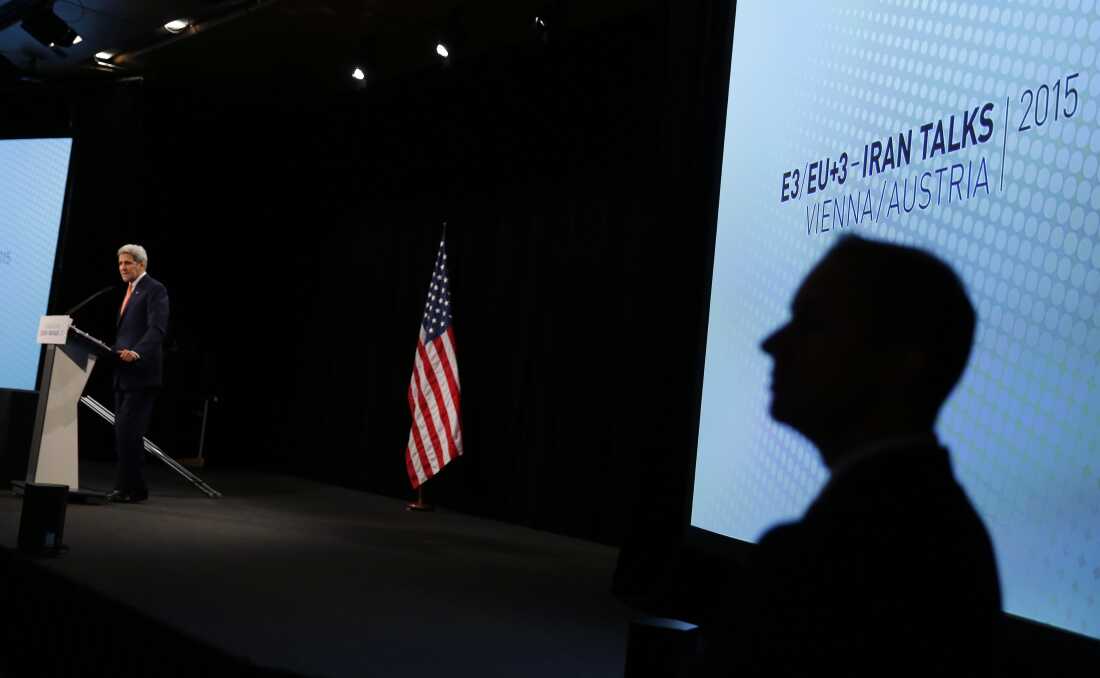
U.S. Secretary of State John Kerry speaks during a news conference on the Iran nuclear talks deal at the Austria International Centre in Vienna, Austria on July 14, 2015.
Pool/AFP via Getty Images
hide caption
toggle caption
Pool/AFP via Getty Images
In 2015, patience led to a deal
The talks in 2015, led by Secretary of State John Kerry and Iran’s Foreign Minister Mohammad Javad Zarif, culminated with a marathon 19-day session in Vienna to finish the deal, says Jon Finer, a former U.S. deputy national security adviser in the Biden administration. Finer was involved in the negotiations as Kerry’s chief of staff. He said his boss’s patience “was a huge asset” in getting the deal to the finish line, he said.

Mohammad Javad Zarif, Iran’s foreign minister during the negotiations for the Obama-era nuclear deal, speaks on April 22, 2016 in New York.
AFP/via Getty Images
hide caption
toggle caption
AFP/via Getty Images
“He would endure lectures … ‘let me tell you about 5,000 years of Iranian civilization’… and just keep plowing ahead,” Finer said, adding that a tactic of Iranian negotiators seemed to be “to say no to everything and see what actually matters” to the U.S.
“They’re just maddeningly difficult,” he said. “You need to go back at the same issue 10 or 12 times over weeks or months to make any progress.”
Even so, Finer called the Iranian negotiators “extremely capable” — noting that, unlike the U.S., they often lacked expert advisers “just outside the room,” yet still mastered the details of nuclear weapons, nuclear materials and U.S. sanctions.
“They were also negotiating not in their first language,” Finer added. “The documents were all negotiated in English, and they were hundreds of pages long with detailed annexes.”
Vance’s trip to Islamabad suggests that the U.S. doesn’t have the patience for a negotiation to end the conflict that could be at least as complex and time-consuming. “The Trump administration came in with maximalist demands and actually just wanted Iran to capitulate,” Sherman, who served as deputy secretary of state during the Biden administration, told Here & Now. “No nation – even one as odious as the Iran regime – is going to capitulate.”
Distrust but verify
Iran was attacked twice in the past year. First in June of last year, as nuclear negotiations were ongoing, Israel and the U.S. struck the country’s nuclear facilities. Months later, at the end of February, Iran was attacked again at the start of the latest conflict. This time around, “the level of trust is probably almost at an all-time low,” Malley said.
“It’s hard for them to take at their word what they’re hearing from U.S. officials,” Malley said. The Iranians, he said, have to be wondering how long any commitment will last and “will be very hesitant to give up something that’s tangible” – such as their enriched uranium – in exchange for anything that isn’t ironclad or subject to suddenly be discarded by Trump or some future president.
“Once they give up their stockpile … they can’t recapture it the next day,” Malley said.
Even during the 2013-2015 nuclear deal talks, the decades of mistrust between Tehran and Washington were impossible to ignore, Finer said. “Our theory was not trust but verify — it was distrust but verify,” he said, adding: “I think that was their theory too.”
Malley cautions about relying on the JCPOA as a guide to how peace talks to end the current war might go. The leadership in Tehran that agreed to the deal is now gone — killed in Israeli airstrikes, he says. The regime’s military capabilities are also greatly diminished and “whatever lessons were learned in the past … have to be viewed with a lot of caution, because so much has changed,” he said.
Negotiations have a leveling effect
Mark Freeman, executive director of the Institute for Integrated Transitions, a peace and security think tank based in Spain that advises on conflict negotiations, says several factors shape the U.S.-Iran relationship. Going into talks, one side always has the upper hand, he says, but negotiations have a leveling effect. “The weaker party gains just by virtue of entering into a negotiation process,” he said.
Each side is looking for leverage, he adds.
In Iran’s case, it has used its closure of the Strait of Hormuz to exert such leverage, while the White House has shown an eagerness to resolve the conflict quickly. “If one side perceives the other needs an agreement more … that shapes the entire negotiation,” he said.

News
A day after Alito’s testy response to Sotomayor’s dissent, court says it was a ‘misunderstanding’

The justices of the U.S. Supreme Court, with Justice Sonia Sotomayor (seated left) and Justice Samuel Alito (seated second from right).
Alex Wong/Getty Images
hide caption
toggle caption
Alex Wong/Getty Images
As the Supreme Court heads into the announcement of its final and hugely important opinions next week, there are reverberations from this week’s announcements, and Justice Samuel Alito’s public rebuke of his colleague Justice Sonia Sotomayor.
On Thursday, Justice Alito summarized from the bench three very big opinions he authored for the court’s six justice conservative majority. Alito, unlike most of his colleagues, doesn’t spend much time on these summaries. And it is rare that a justice has three big opinions to announce, but it is almost the end of the term, and there are a lot of big cases still outstanding.
The first case he announced came and went. Alito then moved on to a second case, this one tests whether migrants may apply for asylum in the U.S. by going to one of several ports of entry along the U.S.-Mexican border, and presenting themselves for admission. This entails presenting documents that persuade an asylum officer that applicants’ fear of persecution in their home country is credible enough to allow them to enter the U.S. while their asylum application is processed. Alito’s opinion ruled in favor of the Trump administration’s policy of refusing all such applicants by blocking them at the border. It was a policy also followed at one time by the Obama administration until it was blocked by the lower courts.
After Alito finished his summary of the opinion, he paused, at which point Justice Sotomayor read a summary of her contrary views in dissent. When she finished, however, Justice Alito did not move on to the announcement of his third opinion. Instead, he did something that nobody in the press corps ever remembers happening before. Looking much as if he had just bitten into a lemon, Alito said, “There is much that I would have added to my bench statement had I known there would be a dissent read.” And he then went on to a short extemporaneous rebuttal.
What caused the hissy fit? Did Sotomayor really fail to tell him she would have an oral dissent? That really would have been a breach of the court’s practices. A justice typically notifies the chief justice and the author of the majority opinion in writing if there is to be an oral dissent.
In response Friday to an inquiry from NPR came this terse statement from the court’s public information office.
“Justice Alito was notified in advance by Justice Sotomayor’s chambers that she would be reading a dissent from the bench. It was a misunderstanding on Justice Alito’s part.”
News
“It’s blood money”: Family of exonerated man in Texas yogurt shop murders speaks out after settlement

The widow and the daughter of Maurice Pierce, one of the four men wrongfully accused in the 1991 Texas yogurt shop murders, have confirmed they signed a multimillion-dollar settlement with the city of Austin.
Kimberli and Marisa Pierce spoke with correspondent Erin Moriarty in a new episode of the podcast “48 Hours: Case by Case.” Moriarty has reported on the yogurt shop murders for over 30 years.
Maurice Pierce’s widow Kimberli made clear that their priority has never been financial compensation. “It’s blood money for us. He died for this money,” Kimberli Pierce said. “It’s about the reform and the changes that need to happen, not only in Austin, but apparently across the country.”
They also went into great detail about what they believe happened when Maurice Pierce was shot and killed by police in 2010.
Maurice Pierce was one of four men, along with Michael Scott, Robert Springsteen and Forrest Welborn, who were wrongfully accused in the murders of four teenage girls in Austin on Dec. 6, 1991. Eliza Thomas, Amy Ayers, and sisters Jennifer and Sarah Harbison were tied up, shot and left inside the yogurt shop as it was set ablaze.
The four men were exonerated in February after investigators linked another man, Robert Eugene Brashers, to the killings. The city of Austin subsequently offered a $35 million settlement. Because Maurice Pierce died in 2010, his share of $10 million will go to Kimberli and Marisa Pierce.
Eight days after the killings, 16-year-old Maurice Pierce was arrested at a mall, carrying a .22, the same caliber handgun connected to the crime. Kimberli Pierce said police told Maurice Pierce that his gun was the murder weapon. He responded by mentioning his friend Forrest Welborn. Maurice Pierce was then wired up and sent to speak with Welborn, but investigators ultimately determined that Welborn and the others knew nothing about the murders, and no charges were filed at that time.
Marisa Pierce has said there was no evidence when her father was questioned, “only a detective and a narrative, a narrative so completely false. It feels evil.”
Nearly eight years later, in 1999, all four men were arrested after Scott and Springsteen confessed to the murders. They later recanted, saying they had been coerced. Springsteen and Scott were tried and convicted, but later those convictions were overturned on constitutional grounds. A subsequent DNA test excluded all four men. Maurice Pierce was never convicted but spent three years in jail before his release in 2003.
Kimberli Pierce said her husband came home a hardened man. She believes police continued to harass Maurice and their family after his release. In 2010, Maurice Pierce was stopped for a routine traffic stop, fled on foot, and was shot and killed by an Austin police officer who said Pierce had stabbed him with a knife.
Marisa and Kimberli Pierce told “48 Hours” that they intend to review the circumstances surrounding the night of Maurice Pierce’s death. Marisa Pierce revealed in new, emotional detail that she was on the phone with her father at the time. She believes he panicked and was only trying to get away, not to hurt anyone. She described her father’s last breaths: “And in those last moments, he had just said I’m sorry, I don’t think you’re gonna see me again, and I love you.”
“48 Hours” reached out to the Austin Police Department about the Pierces’ allegations of harassment and their questions about Maurice Pierce’s death in 2010. The police department said they had no additional comment.
For the Pierce family, the settlement is a starting point, not an end point. They have put forward seven proposed reforms they hope the city of Austin will approve, including appointing a child advocate whenever a minor is questioned, prohibiting deceptive interrogation tactics, educating juveniles about their rights and establishing accountability measures to address tunnel vision in police investigations.
In a statement shared with “48 Hours,” the Pierces wrote: “Real justice is not only about acknowledging harm after the fact but about creating safeguards that prevent future families from enduring the same pain.”
This year, Maine nearly became the first state to pass a statewide moratorium on new data centers. But before the law could take effect, supporters of an A.I. data center project in the small town of Jay rallied to fight the ban — and won. So why do residents there want one? We traveled to Jay to find out.
-

 Virginia4 minutes ago
Vandals smash windows of nearly 3 dozen cars in Arlington Mill
-

 Washington11 minutes ago
The Washington Capitals Select Oliver Suvanto | Washington Capitals
-
 Wisconsin14 minutes ago
From bodybuilding to business: Wisconsin entrepreneur builds success with Bulk Butter
-

 West Virginia19 minutes ago
West Virginia First Foundation advances key initiatives at second quarterly board meeting
-

 Wyoming26 minutes ago
At 6,000-year-old crossing, Gov. Gordon OKs Wyoming’s first-ever designated pronghorn migration route – WyoFile
-

 Crypto29 minutes ago
SpaceX Lands Nasdaq-100 Spot Weeks After Record IPO
-

 Finance34 minutes ago
Hong Kong vows stronger exchange with reforms, bond futures and gold push
-

 Fitness41 minutes ago
Health Watch: Fitness Friday – exercise and dementia

