News
U.S. military bombs Kharg Island, Iran’s main oil export hub, Trump says

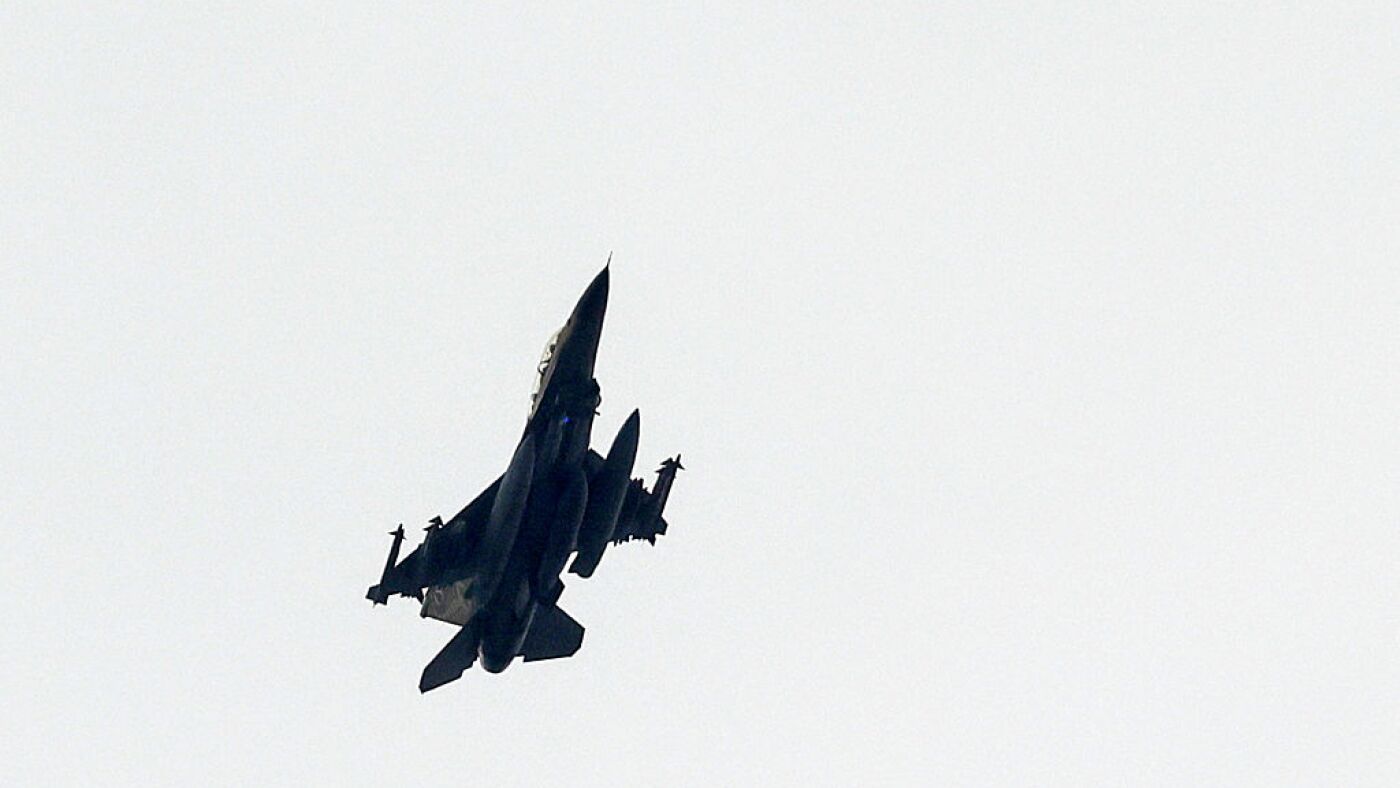
This picture, taken a position in northern Israel, shows an Israeli Air Force fighter jet flying over the border area with southern Lebanon on March 13, 2026.
Jalaa Marey/AFP via Getty Images
hide caption
toggle caption
Jalaa Marey/AFP via Getty Images
President Trump said on Friday the U.S. military had “totally obliterated every MILITARY target in Iran’s crown jewel, Kharg Island.”

In a Truth Social post Friday evening, Trump added that “for reasons of decency, I have chosen NOT to wipe out the Oil Infrastructure on the island.” The president warned that if Iran “or anyone else” interfere with the passage of ships in the Strait of Hormuz, “I will immediately reconsider this decision.”
Kharg Island sits 15 miles off Iran’s coast and is critical to Iran’s oil infrastructure and the country’s economy. Roughly 90 percent of Iran’s export crude oil passes through the island.
On his way to Mar-a-Lago in Florida shortly before his post, Trump told reporters, “The situation in Iran is going very well. A lot of big hits today, a lot of big wins today.” Asked how long he thinks the war would last, he said, “I can’t tell you that. I mean, I have my own idea, but what good does it do? It will be as long as it’s necessary. They’ve been decimated. The country — their country’s in bad shape. The whole thing is collapsing.”
Earlier on Friday, the U.S. military had said that all six crew members were killed when a KC-135 refueling aircraft went down in Iraq, raising the American death toll after two weeks of war with Iran.
The news came as President Trump and his defense secretary touted the success of what they call Operation Epic Fury but complained about negative media coverage of the U.S.-Israeli war with Iran.
Defense Secretary Pete Hegseth said Friday that joint U.S.-Israeli military strikes have hit more than 15,000 targets and injured the new Iranian supreme leader.
President Trump, in a post on Truth Social, said the U.S. is “totally destroying” Iran’s regime, militarily and economically.

A woman looks at a building where an apartment was targeted by an Israeli airstrike in the Burj Hammoud area on the northern outskirts of Beirut on March 14, 2026.
Ibrahim Amro/AFP via Getty Images
hide caption
toggle caption
Ibrahim Amro/AFP via Getty Images
Iranian and Lebanese health officials and Israeli authorities reported more than 1,300 people killed in Iran, 773 people in Lebanon and 12 civilians in Israel, as well as two Israeli soldiers killed in Lebanon. Wednesday’s aircraft crash over Iraq brings the U.S. military death toll to 13, seven of whom were killed by enemy fire. Eight U.S. service members are severely injured, according to the Pentagon.
The humanitarian toll also deepened as the total number of people displaced by the fighting in Iran and Lebanon reached into the millions.
Here are further updates about the conflict.
To jump to a specific coverage topic, click on the links below:
U.S. casualties | More war ahead
U.S. casualties rise and additional Marines head to Mideast
The U.S. Central Command (CENTCOM) said Friday all six crew members died when their refueling aircraft went down over Iraq.
CENTCOM, which oversees the military’s Middle East operations, initially reported an unspecified incident involving two aircraft Thursday. It said the U.S. KC-135 refueling aircraft was lost in western Iraq, while the other landed safely. It is investigating the circumstances but confirmed the “loss of the aircraft was not due to hostile fire or friendly fire.”
That brings the U.S. military death toll to 13, seven of whom were killed by enemy fire, according to the Pentagon.
NPR has also confirmed that an additional 2,200 U.S. Marines are heading to the Middle East.
The 31st Marine Expeditionary Unit based in Okinawa, Japan, aboard the USS Tripoli, an amphibious assault ship, will join an armada of ships taking part in the Iran war, a source told NPR on condition of anonymity because they were not authorized to speak publicly. The source did not specify what role the Marines will play.
The deployment was first reported by The Wall Street Journal.
— NPR’s National Security Desk
Officials brace for an end without a deal — and the risk of a “war routine”
A senior official in the region, speaking on condition of anonymity because they were not authorized to discuss internal deliberations, told NPR they expected the war to last at least another week, and that Israeli leaders increasingly believe the U.S. and Israel will end the war unilaterally, without a negotiated agreement. In such a scenario, the official said, Iran and allied groups, including the Lebanese militant group Hezbollah and Houthi rebels in Yemen, could establish a new normal of intermittent fire at Israel, prompting repeated Israeli retaliation.
The official said that kind of tit-for-tat exchange would leave Israelis living with an intolerable “war routine” even if the intensity of the conflict fades.
The official also said Israel is not ruling out an expanded ground operation in southern Lebanon, but described Israel as holding back so far from striking broad civilian infrastructure, largely because the U.S. sees Lebanon as a partner.
— Daniel Estrin, Carrie Kahn
Arezou Rezvani contributed to this report from Erbil in Iraq’s Kurdish region.

This year, Maine nearly became the first state to pass a statewide moratorium on new data centers. But before the law could take effect, supporters of an A.I. data center project in the small town of Jay rallied to fight the ban — and won. So why do residents there want one? We traveled to Jay to find out.

The U.S. Supreme Court
Drew Angerer/AFP via Getty Images
hide caption
toggle caption
Drew Angerer/AFP via Getty Images
The U.S. Supreme Court on Thursday handed the Trump administration a tool that could make it far more difficult for asylum seekers to enter the United States.
Asylum is a form of legal protection available to people fleeing persecution in their home countries if they meet certain criteria. Under U.S. law, an asylum seeker who “arrives in” the U.S. is entitled to apply for asylum and generally cannot be removed from the country until their asylum application is processed.
By a 6-3 vote, the high court ruled that federal law allows the government to stop asylum seekers from physically setting foot in the country, effectively keeping them from applying for asylum.
The Obama administration was the first to try stemming the flow of asylum seekers that way. But the lower courts blocked the policy on grounds that it violated federal law by denying asylum to people who otherwise would have qualified for it, had they been permitted to literally put one foot over the border.
The Trump administration, however, sought to revive the policy, contending that the lower court’s ruling “deprives the Executive Branch of a critical tool for addressing border surges and preventing overcrowding at ports of entry.” And on Thursday, the Supreme Court agreed.
Writing for the majority, Justice Samuel Alito ruled that because asylum seekers are not in the U.S. when they are turned away at the border, they did not “arrive in” the country. Therefore, he continued, the legal protections for asylum seekers have not kicked in.
Writing for the liberal dissenters, Justice Sonia Sotomayor noted that Border Patrol agents speak with all immigrants at legal entry points and speaking with an agent is effectively the first step in “arriving in” the U.S.

BOSTON (AP) — A federal judge on Thursday halted President Donald Trump’s executive order that sought to create a federal voter list and limit who can receive a mail ballot.
U.S. District Court Judge Indira Talwani, who was nominated by Democratic President Barack Obama, sided with a coalition of nearly two dozen states that challenged the Republican president’s order in granting a summary judgment. Her ruling applies to this year’s midterm election cycle.
Plaintiffs argued in two lawsuits, both filed in federal court in Boston, that Trump’s order should be found unconstitutional because the states and Congress, not the president, have the power to set election rules. The judge agreed, noting in her ruling that the provisions of Trump’s order “unconstitutionally violate the separation of powers.”
It was the second ruling in as many days against executive orders Trump has signed seeking oversight of the nation’s elections. A separate ruling Wednesday prohibited an executive order he had signed last year that would have required people to show documents proving their citizenship when registering to vote.
The administration, in its motions to dismiss the lawsuits challenging the order seeking to establish a federal voter list, argued that the motions are premature and that plaintiffs lacked the legal basis to bring their claim based on the Administrative Procedure Act, which governs how federal agencies develop and issue regulations.
But in an interim order before Thursday’s ruling, Talwani said the motions pertaining to this year’s election cycle were relevant: “In light of the EO’s specific deadlines over the next three months, and the reality that elections will be occurring throughout this period with the November 3, 2026 midterm occurring in just five months, postponing judicial review is impracticable and may inflict significant hardship on Plaintiffs,” she wrote. That order denied the Trump administration’s motion to dismiss the challenges.
Trump’s executive order, the second one aimed at elections during his second term, comes as he continues to raise the specter of widespread voting by noncitizens as a reason to change election rules. But states already have detailed processes aimed at keeping their voter rolls accurate, and voting by noncitizens has been shown to be rare. It also is a felony that can be punishable by deportation.
Trump issued his second order in March after a bill he supported to overhaul voting stalled in Congress. The order would have had the federal government create a list of eligible voters and then directed the U.S. Postal Service to deliver mail ballots only to those on the list. Election officials argued that it was ripe for abuse and could cause chaos, and the postal union has objected to the idea of mail carriers policing ballots.
The Postal Service has published a proposed rule required by Trump’s executive order in the Federal Register. Among other things, the rule would not apply to primary elections or overseas ballots.
The lawsuit seeking summary judgment was filed by Democratic attorneys general representing 22 states and the District of Columbia. Also signing on were attorneys representing Democratic Gov. Josh Shapiro of Pennsylvania, which has a Republican attorney general.
The states also told the court that the move imposes a costly burden on election officials to comply and would spread fear about the possibility of prosecution. Stephen Pezzi, a lawyer for the Trump administration, had argued that no one would be prosecuted for violating the order.
In a separate lawsuit filed against the executive order, a federal judge in Washington, D.C., in May agreed with the Trump administration that it was too early to block the order because it had yet to be implemented. That lawsuit was brought by Democratic and civil rights groups, who have appealed.
Since his 2020 presidential election loss to Democrat Joe Biden, Trump has groundlessly claimed mail voting is rife with fraud and has launched a federal investigation into that year’s vote, even though repeated audits and investigations, including ones run by Republicans, found it was free of widespread fraud. Trump also has said he wants to “take over” election administration in Democratic areas.
-

 North Carolina2 minutes ago
Former Madison County chief deputy in North Carolina custody after Arizona arrest
-

 North Dakota9 minutes ago
North Dakota composer launches statewide virtual choir project
-

 Ohio12 minutes ago
UC Bearcats baseball playing Ohio State, Vanderbilt in Nashville in 2027
-

 Oklahoma17 minutes ago
Four arrested after 30 pounds of meth, dozens of animals seized from Oklahoma City home
-
Oregon24 minutes ago
Oregon Lottery Pick 4 results for June 25
-

 Pennsylvania27 minutes ago
Measles detected in two more counties in Pennsylvania as health department recommends early vaccination
-
 South-Carolina39 minutes ago
A 1776 midnight battle in Laurens County: The Battle of Fort Lindley
-
South Dakota42 minutes ago
SD Lottery Millionaire for Life winning numbers for June 25, 2026

