News
Tornado damages homes as Texas and Oklahoma residents told to seek shelter

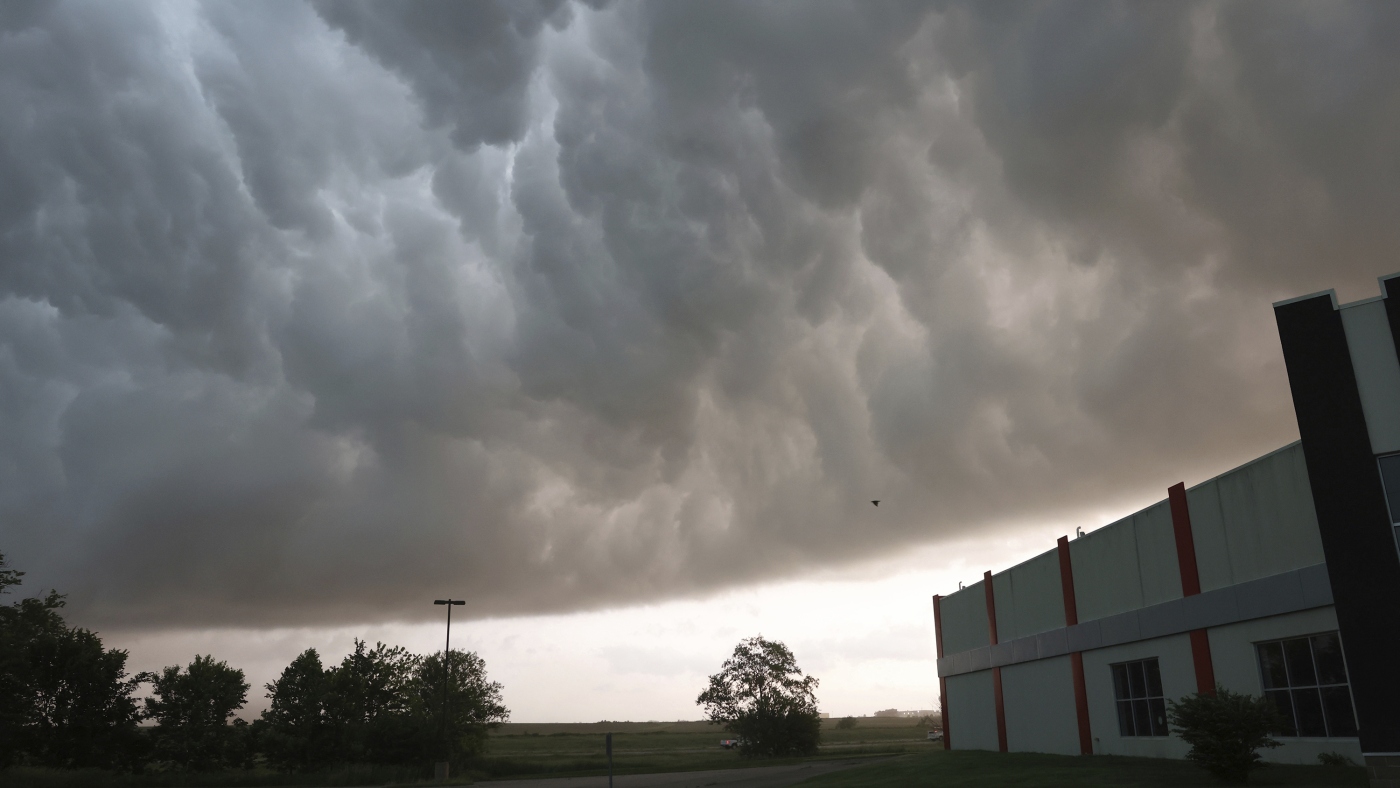
Severe storm clouds move across the northwest edge of Davenport, Iowa on Friday, May 24, 2024. Several tornadoes were reported in Iowa and Illinois as storms downed power lines and trees on Friday, just after a deadly twister devastated one small town.
Roy Dabner/AP/Quad City Times
hide caption
toggle caption
Roy Dabner/AP/Quad City Times
OKLAHOMA CITY — A tornado touched down and crossed an interstate in Texas, causing damage and possible injuries as scattered severe storms moved through Texas and Oklahoma Saturday night.
Forecasters issued tornado and severe thunder storm warnings for parts of both states, as some heat records were broken during the day in South Texas and residents received triple-digit temperature warnings over the long holiday weekend.
A tornado crossed into northern Denton County in Texas late Saturday and overturned tractor-trailer trucks, stopping traffic on Interstate 35, Denton County Community Relations Director Dawn Cobb said in a statement.
The tornado was confirmed near Valley View, moving east at 40 mph (64 kph), prompting the National Weather Service to issue a tornado warning for northern Denton County, Cobb said.
The storm damaged homes, overturned motorhomes and knocked down power lines and trees throughout the area including points in Sanger, Pilot Point, Ray Roberts Lake and Isle du Bois State Park, Cobb said, adding that the number of injuries in the county was not immediately known.
The fire department in the city of Denton, about 37 miles (59.5 kilometers) north of Forth Worth, Texas, posted on X that emergency personnel were responding to a marina “for multiple victims, some reported trapped.”
The Claremore, Oklahoma, police announced on social media that the city about 28 miles (45 kilometers) east of Tulsa was “shut down” as a result of storm damage including downed power lines and trees and inaccessible roads.
Earlier Saturday night, the National Weather Service’s office in Norman, Oklahoma, said via the social platform X that the warning was for northern Noble and far southern Kay counties, an area located to the north of Oklahoma City. “If you are in the path of this storm take cover now!” it said.
A following post at 10:05 p.m. said storms had exited the area but warned of a storm moving across north Texas that could affect portions of south central Oklahoma.
At 10:24 p.m., the weather service office in Fort Worth posted a message warning residents in Era and Valley View they were in the direct path of a possible tornado and to immediately seek shelter. The Forth Worth office continued to post notices and shelter warnings tracking the movement of the storm through midnight and separately issued a severe thunderstorm warning with “golf ball sized hail” possible.
The weather service office in Tulsa, Oklahoma, warned on X of a dangerous storm moving across the northeast part of the state through 2 a.m. and issued severe thunderstorm notices for communities including Hugo, Boswell, Fort Towson, Grainola, Foraker and Herd.
The Norman office had compared conditions Saturday to “ a gasoline-soaked brush pile.” Forecasters said any storms that form could explode with large hail, dangerous winds and tornadoes.
“There’s a small chance most of the matches are duds and we only see a few storms today. Still, that’s not a match I would want to play with. It only takes one storm to be impactful,” it said via Facebook.
Excessive heat, especially for May, was the danger in South Texas, where the heat index was forecast to approach 120 degrees Fahrenheit (49 degrees Celsius) in some spots during the weekend. Actual temperatures will be lower, although still in triple-digit territory, but the humidity will make it feel that much hotter.
The region is on the north end of a heat dome stretching from Mexico to South America, National Weather Service meteorologist Zack Taylor said.
Sunday looks like the hottest day with record highs for late May forecast for Austin, Brownsville, Dallas and San Antonio, Taylor said.
Brownsville and Harlingen near the Texas-Mexico border already set new records Saturday for the May 25 calendar date — 99 degrees Fahrenheit (37 degrees Celsius) and 100 degrees Fahrenheit (38 degrees Celsius), respectively — according to the weather service.
Red Flag fire warnings were also in place in West Texas, all of New Mexico and parts of Oklahoma, Arizona and Colorado. Humidity was very low, under 10%, and wind gusts of up to 60 mph (97 kph) were recorded.
“We’ve got very dry air, warm temperatures and strong winds creating a high fire danger over a wide area … that can lead to rapidly spreading or uncontrollable fires,” Taylor said.
Meanwhile, several inches of snow fell Friday into early Saturday in Rolla, North Dakota, about 10 miles (16 kilometers) from the Canadian border.
April and May have been a busy month for tornadoes, especially in the Midwest. Climate change is heightening the severity of storms around the world.
April saw the United States’ second-highest number of tornadoes on record. So far for 2024, the country is already 25% ahead of the average number of twisters, according to the Storm Prediction Center in Norman.
Iowa was hit hard this week, when a deadly twister devastated Greenfield. And other storms brought flooding and wind damage elsewhere in the state.
The storm system causing the severe weather was expected to move east as the Memorial Day weekend continues, bringing rain that could delay the Indianapolis 500 auto race Sunday in Indiana and more severe storms in Illinois, Indiana, Missouri and Kentucky.
The risk of severe weather moves into North Carolina and Virginia on Monday, forecasters said.



News
Trump claims US stockpiles mean wars can be fought ‘forever’; Kristi Noem testifies before Congress – US politics live

Trump says US stockpiles mean “wars can be fought ‘forever’”
In a late night post on Truth Social, Donald Trump said that the US munitions stockpiles “at the medium and upper medium grade, never been higher or better”.
He added that the US has a “virtually unlimited supply of these weapons”, meaning that “wars can be fought ‘forever’”.
This comes after Trump said that the US-Israel war on Iran could go beyond the four-five weeks that the administration initially predicted. The president also did not rule out the possibility of US boots on the ground in Iran during an interview with the New York Post on Monday.
“I rebuilt the military in my first term, and continue to do so. The United States is stocked, and ready to WIN, BIG!!!,” he wrote.
Key events
During his opening remarks, Senate judicicary committee chairman, Chuck Grassley, blamed Democrats for the ongoing shutdown Department of Homeland Security (DHS) but highlighted four agencies: the Secret Service, Federal Emergency Management Agency (FEMA), the Transportation Security Administration (TSA), and the Coast Guard.
Democrats are demanding tighter guardrails for federal immigration enforcement, but a sweeping tax bill signed into law last year conferred $75bn for Immigration and Customs Enforcement (ICE), which means the agency is still functional amid the wider department shuttering.
In a late night post on Truth Social, Donald Trump said that the US munitions stockpiles “at the medium and upper medium grade, never been higher or better”. He added that the US has a “virtually unlimited supply of these weapons”, meaning that “wars can be fought ‘forever’”.
This comes after Trump said that the US-Israel war on Iran could go beyond the four-five weeks that the administration initially predicted. The president also did not rule out the possibility of US boots on the ground in Iran during an interview with the New York Post on Monday.
“I rebuilt the military in my first term, and continue to do so. The United States is stocked, and ready to WIN, BIG!!!,” he wrote.
The embattled homeland security secretary, Kristi Noem, will answer questions from lawmakers on the Senate judiciary committee today.
This will be the first time she’s addressed members of Congress since federal immigration officers fatally shot two US citizens – Renee Good and Alex Pretti – during a surge of law enforcement in Minneapolis. The actions of Immigration and Customs Enforcement (ICE) and Customs and Border Protection (CBP) throughout the crackdown drew condemnation from both parties. Now, a funding bill to keep Noem’s department open remains stalled on Capitol Hill. Democrats have pushed for stronger guardrails on immigration enforcement agents, while Republicans have called many of their demands (like the need for officers to appear visible and no longer wear masks while patrolling and making arrests) non-starters.
Several Democrats have also called for Noem to resign or risk impeachment.
We’ll bring you the latest lines as things get underway.
Donald Trump is in Washington today. We will hear from him at 11am when he welcomes German chancellor Friedrich Merz to the White House for a bilateral meeting. We’ll bring you the latest lines from that summit, particularly the president’s first in-person meeting with a close ally since the US-Israel war on Iran began. The conflict enters its fourth day, with six US service members killed and 787 Iranian casualties since strikes started on Saturday.
Later Trump will meet with energy secretary Chris Wright at 2pm ET. That will be closed to the press but we’ll let you know if the opens up. President Donald Trump said on Tuesday that Tehran wanted to talk but it was too late, as the United States continued its military operation against Iran.
“Their air defense, Air Force, Navy, and Leadership is gone. They want to talk. I said “Too Late!” Trump said in a Truth Social post commenting on an opinion piece.
Jessica Elgot Donald Trump has criticised Keir Starmer again over the UK’s refusal to aid the offensive strikes on Iran, saying the “relationship is obviously not what it was”.
Starmer had issued his strongest rebuke yet of Trump’s action in Iran, saying the UK did not believe in “regime change from the skies” and defended his decision not to allow the use of British bases to conduct the strikes.
But the prime minister said the UK would allow the use of its bases for defensive action to protect allied forces and nations in the Gulf and Middle East who have been hit by a wave of retaliatory strikes after the US-Israeli attacks on Iran. Speaking to the Sun, Trump compared Starmer’s actions unfavourably with France’s support for the strikes and with the backing of the Nato secretary general, Mark Rutte. “He has not been helpful. I never thought I’d see that. I never thought I’d see that from the UK. We love the UK,” he said.
“It’s a different world, actually. It’s just a much different kind of relationship that we’ve had with your country before. It’s very sad to see that the relationship is obviously not what it was.”
Dharna Noor
A North Carolina congressional primary on Tuesday is an early test of datacenter politics – a fight increasingly shaping elections nationwide.
In the Durham-area fourth district, Congresswoman Valerie Foushee is seeking her third term against progressive challenger Nida Allam, a Durham county commissioner she defeated in 2022. The heated rematch comes against the backdrop of a major datacenter battle in the district. Allam has come out staunchly against a massive new proposed facility, and is supporting a federal datacenter moratorium. Foushee, meanwhile, said she does not personally support the new development, but that datacenter decisions should be left to local leaders, not federal ones.
Until mid-February, Allam’s campaign donations dwarfed Foushee’s, thanks to Pacs such as Justice Democrats and gun control activist David Hogg’s Leaders We Deserve. In the last two weeks, that picture has changed dramatically as major Pacs have raced to back the incumbent.
Chief among them is Jobs and Democracy, a Super Pac whose sole disclosed donor is Anthropic, the AI firm behind Claude. The group has spent about $1.6m on Foushee’s re-election campaign since February 21.
Though Anthropic has no known links to the local datacenter proposal, opposition to it has left some local residents especially skeptical of all political funding tied to big tech.
Anthropic brands itself as safety-focused, making headlines in recent days for refusing the Pentagon’s demand for unfettered use of its products, though its tools have since reportedly been used in strikes on Iran. The company has backed some state AI safeguards and last year helped defeat a federal ban on state AI regulations. George Chidi The marquee matchup for the open US Senate seat in North Carolina will begin to resolve into focus Tuesday, with a well-known former Democratic governor and a Donald Trump-endorsed but untested Republican appearing to lead the field.
In the Democratic primary, former two-term governor Roy Cooper is ahead in recent polling against the slate of other candidates who have never held elected office. Cooper is widely seen among North Carolina’s Democrats as their best chance at flipping a Republican-controlled seat, now held by retiring US senator Thom Tillis, a conservative who has turned hard against the Trump administration on its handling of healthcare, defense and the Epstein file disclosures.
For Republicans, Michael Whatley, the former Republican National Committee chair, leads the field in polling, with his closest competitor, representative Don Brown, in the single digits.
Polling in both primaries has been relatively scant and may have masked softness in conservative support for Whatley. About half of the Republican electorate remains undecided heading to voting booths Tuesday.
Whatley has Trump’s endorsement, but that hasn’t stopped the grumbling on the right.
“The president made a horrible mistake forcing Whatley on us,” said Brant Clifton, who publishes the Daily Haymaker, a conservative news site in North Carolina. Whatley has been closely connected to Tillis over the years, which sullies him among voters for whom Tillis has become unpopular, Clifton said. “Trump spends a lot of time talking about how bad Tillis sucks and expressing his anger at Tillis, but here he is. He’s got the RNC working to shove Mike Whatley down our throats, but Tom Tillis and his wife are responsible for elevating Whatley out of obscurity to the state Republican party chairmanship.”
Homeland security secretary Kristi Noem is expected to testify before the Senate Judiciary Committee later today, with funding for her department still stalled due to Democratic objections to its aggressive tactics.
It will be the first time Noem has appeared before the committee since two people were killed by federal immigration officers in Minneapolis in January.
Noem, appointed by Trump last year, also may field questions on other matters including possible threats to the United States after the US attacks on Iran and reports of disorder within her department.
The former South Dakota governor has overseen Trump’s immigration agenda, including the deployment of thousands of masked federal agents to US cities, where they have swept through neighborhoods in search of possible immigration offenders and clashed with residents. Noem is scheduled to testify before the Senate Judiciary Committee on Tuesday and the House of Representatives Judiciary Committee on Wednesday.
President Trump hosts Germany’s Friedrich Merz later today for his first visit with a foreign leader since joining Israel in strikes on Iran.
The long-scheduled White House meeting was supposed to focus on the war in Ukraine and rocky EU-US trade relations, part of a wider effort to salvage frayed transatlantic ties.
But Trump’s signal that airstrikes against Iran could go on for weeks has upended the global agenda, with Tehran striking back against US bases and allies in the region, AFP reported.
Merz, a harsh critic of the Islamic republic’s leadership, said Berlin shared the Iranian people’s “relief” that the “mullah regime is coming to an end”. Yet he declined to “lecture” the United States and Israel on the legality of the Iran strikes aimed at ending Tehran’s nuclear and missile programs.
Hello and welcome to the US politics live blog.
With all members of Congress across both houses due to be briefed today on the Iran strikes, the Trump administration has presented a shifting new justification for its war.
Secretary of state Marco Rubio, defense secretary Pete Hegseth and general Dan Caine will brief the full membership of the House and Senate on Tuesday, with a possisble vote on parallel war powers measures to follow.
It comes after House speaker Mike Johnson suggested on Monday that the White House believed Israel was determined to act on its own, leaving the president with a “very difficult decision”. The Republican was speaking following a classified briefing at the Capitol, the first for congressional leaders since the start of the conflict, a joint US-Israel military campaign that killed Iran’s supreme leader Ayatollah Ali Khamenei.
The strikes have quickly spiraled into a wider Middle East conflict, leaving hundreds of people dead, including at least six US military service personnel.
Johnson said the attack on Iran was a “defensive operation” because Israel was ready to act against Iran, “with or without American support”.
“The commander in chief has said this is going to be an operation that is short in duration,” Johnson said. “We certainly hope that’s true.”
Politico is reporting that he Senate could vote as early as Tuesday on senators Tim Kaine and Rand Paul’s measure to limit Trump’s strikes, followed by a separate House vote on a resolution from Thomas Massie and Ro Khanna. The Democrats’ strategy of forcing votes on war power resolutions has been portrayed as a way for Congress to reclaim its constitutional powers to declare war but have, so far, all failed.
In other developments:
In his first conference since the joint US-Israel operation against Iran, Donald Trump laid out his administration’s objectives moving forward. This includes destroying Iran’s missile capabilities, annihilating their navy, preventing Iran from ever having nuclear weapons, and ensuring the country “cannot continue to arm, fund and direct terrorist armies outside their borders”.
In a heated Pentagon press conference, Pete Hegseth initially said that US troops wouldn’t be in Iran, but later said he wouldn’t get into details. “We’re not going to go into the exercise of what we will or will not do,” he said. “This is not Iraq. This is not endless … Our generation knows better, and so does this president.”
US Central Command (Centcom) said that six service members have been killed in action, and eighteen have been seriously wounded in the US-Israel war on Iran.
The US state department is urging Americans to “depart now” from more than a dozen Middle Eastern countries, following the US-Israel strikes on Iran. Hundreds of thousands of travelers are currently stranded in the Gulf states, as the airspace over some of the world’s busiest airports, such as Dubai and Abu Dhabi, closed over the weekend.
Kuwait air defences mistakenly shot down three US F-15 fighter jets flying in Iran-related operations, the US Central Command (Centcom) said on Monday. All six crew members ejected safely, were safely recovered and in stable condition.
In an appearance on Fox News, Israeli prime minister Benjamin Netanyahu said Iran’s “ballistic missile program and their atomic bomb program” would have been “immune within months” if the United States and Israel had not struck the country this weekend.
Trump says US stockpiles mean “wars can be fought ‘forever’”
DHS secretary to testify before Congress
Trump rebukes Starmer over UK refusal to back strikes on Iran
North Carolina kicks off some of first midterm primaries for key Senate and House races

Noem to face questions over immigration enforcement and DHS shutdown
Trump hosts Germany’s Merz for talks eclipsed by Middle East war
Congress to be briefed on Iran strikes ahead of vote over president’s war powers

The Supreme Court
Win McNamee/Getty Images
hide caption
toggle caption
Win McNamee/Getty Images
The Supreme Court on Monday intervened in New York’s redistricting process, blocking a lower court decision that would likely have flipped a Republican congressional district into a Democratic district.
At issue is the midterm redrawing of New York’s 11th congressional district, including Staten Island and a small part of Brooklyn. The district is currently held by a Republican, but on Jan. 21, a state Supreme Court judge ruled that the current district dilutes the power of Black and Latino voters in violation of the state constitution.
GOP Rep. Nicole Malliotakis, who represents the district, and the Republican co-chair of the state Board of Elections promptly appealed to the U.S. Supreme Court, asking the justices to block the redrawing as an unconstitutional “racial gerrymander.” New York’s congressional election cycle was set to officially begin Feb. 24, the opening day for candidates to seek placement on the ballot.
As in this year’s prior mid-decade redistricting fights — in Texas and California — the Trump administration backed the Republicans.
Voters and the State of New York contended it’s too soon for the Supreme Court to wade into this dispute. New York’s highest state court has not issued a final judgment, so the voters asserted that if the Supreme Court grants relief now “future stay applicants will see little purpose in waiting for state court rulings before coming to this Court” and “be rewarded for such gamesmanship.” The state argues this is an issue for “New York courts, not federal courts” to resolve, and there is sufficient time for the dispute to be resolved on the merits.
The court majority explained the decision to intervene in 101 words, which the three dissenting liberal justices summarized as “Rules for thee, but not for me.”
The unsigned majority order does not explain the Court’s rationale. It says only how long the stay will last, until the case moves through the New York State appeals courts. If, however, the losing party petitions and the court agrees to hear the challenge, the stay extends until the final opinion is announced.
Dissenting from the decision were Justices Sonia Sotomayor, Elena Kagan, and Ketanji Brown Jackson. Writing for the three, Sotomayor said that if nonfinal decisions of a state trial court can be brought to highest court, “then every decision from any court is now fair game.” More immediately, she noted, “By granting these applications, the Court thrusts itself into the middle of every election-law dispute around the country, even as many States redraw their congressional maps ahead of the 2026 election.”
Monday’s Supreme Court action deviates from the court’s hands-off pattern in these mid-term redistricting fights this year. In two previous cases — from Texas and California — the court refused to intervene, allowing newly drawn maps to stay in effect.
Requests for Supreme Court intervention on redistricting issues has been a recurring theme this term, a trend that is likely to grow. Earlier last month the high court allowed California to use a voter-approved, Democratic-friendly map. California’s redistricting came in response to a GOP-friendly redistricting plan in Texas that the Supreme Court also permitted to move forward. These redistricting efforts are expected to offset one another.
But the high court itself has yet to rule on a challenge to Louisiana’s voting map, which was drawn by the state legislature after the decennial census in order to create a second majority-Black district. Since the drawing of that second majority-black district, the state has backed away from that map, hoping to return to a plan that provides for only one majority-minority district.
The Supreme Court’s consideration of the Louisiana case has stretched across two terms. The justices failed to resolve the case last term and chose to order a second round of arguments this term adding a new question: Does the state’s intentional creation of a second majority-minority district violate the constitution’s Fourteenth and Fifteenth Amendments’ guarantee of the right to vote and the authority of Congress to enforce that mandate?
Following the addition of the new question, the state of Louisiana flipped positions to oppose the map it had just drawn and defended in court. Whether the Supreme Court follows suit remains to be seen. But the tone of the October argument suggested that the court’s conservative supermajority is likely to continue undercutting the 1965 Voting Rights Act.

Note: Map shows the area with a shake intensity of 3 or greater, which U.S.G.S. defines as “weak,” though the earthquake may be felt outside the areas shown. The New York Times
A minor earthquake with a preliminary magnitude of 3.5 struck in Central California on Monday, according to the United States Geological Survey.
The temblor happened at 7:17 a.m. Pacific time about 6 miles northwest of Pinnacles, Calif., data from the agency shows.
As seismologists review available data, they may revise the earthquake’s reported magnitude. Additional information collected about the earthquake may also prompt U.S.G.S. scientists to update the shake-severity map.
Source: United States Geological Survey | Notes: Shaking categories are based on the Modified Mercalli Intensity scale. When aftershock data is available, the corresponding maps and charts include earthquakes within 100 miles and seven days of the initial quake. All times above are Pacific time. Shake data is as of Monday, March 2 at 10:20 a.m. Eastern. Aftershocks data is as of Monday, March 2 at 11:18 a.m. Eastern.

Seniors over 80 who eat specific diet may be less likely to reach 100 years old

Former NFL Players Of Iranian Descent Speak Up For Freedom From Islamic Regime

China’s compact humanoid robot shows off balance and flips

Commentary: Trump Media’s financial report revives doubts for investors

How a mural of Altadena became a symbol of resilience for one small store, through fire and flood

Florida High School Football Rankings: Top 25 teams – Oct. 21

Cleary's 21 help Le Moyne down Central Connecticut State 69-64 in OT

How old is Bo Nix? What to know about Oregon quarterback ahead of 2024 NFL Draft

99th annual Pony Swim held in Virginia

Indiana Members Credit Union announced as new anchor tenant at Bottleworks District

Is Iran expanding attacks to target energy and civilian sites in the Gulf?

Trump claims US stockpiles mean wars can be fought ‘forever’; Kristi Noem testifies before Congress – US politics live

War in the Middle East: Iran’s broad retaliation in the Gulf • FRANCE 24 English

Trump sends official notification to Congress on strikes against Iran

Unexpected birth brings hope to near-extinct Amazon tribe
-

 World5 days ago
Exclusive: DeepSeek withholds latest AI model from US chipmakers including Nvidia, sources say
-

 Massachusetts6 days ago
Mother and daughter injured in Taunton house explosion
-

 Denver, CO6 days ago
10 acres charred, 5 injured in Thornton grass fire, evacuation orders lifted
-

 Louisiana1 week ago
Wildfire near Gum Swamp Road in Livingston Parish now under control; more than 200 acres burned
-

 Oregon4 days ago
2026 OSAA Oregon Wrestling State Championship Results And Brackets – FloWrestling
-

 Technology1 week ago
Arturia’s FX Collection 6 adds two new effects and a $99 intro version
-

 News1 week ago
Video: How Lunar New Year Traditions Take Root Across America
-

 Florida2 days ago
Florida man rescued after being stuck in shoulder-deep mud for days