News
They disagree about a lot, but these singers figure out how to stay in harmony


The North Fork Community Choir practices at the North Fork Baptist Church in Paonia, Colo., on Nov. 6 — the day after Election Day.
Luna Anna Archey for NPR
hide caption
toggle caption
Luna Anna Archey for NPR
Over the last few years and through this year’s contentious campaign season, which was rooted in America’s deep divisions, there has been a coarsening in the way people talk to each other. We wanted to explore how some are trying to bridge divides. We asked our reporters across the NPR Network to look for examples of people working through their differences. We’re sharing those stories in our series Seeking Common Ground.
PAONIA, Colo. — On a Wednesday night at a spacious, contemporary-looking church on the edge of Paonia, a small town in western Colorado, the 40 or so members of the North Fork Community Choir ran through their regular warmups.
“Really pay attention to that ‘E’ vowel,” said music director Stephanie Helleckson, as she guided the singers through various scales and arpeggios from behind a music stand. “See if you can make that a little bit rounder as a group.”
Helleckson listened carefully to how the singers’ voices blend; the details matter in an art form that’s all about achieving harmony.
Helleckson, who comes from a musical family and has spent most of her life in Paonia, said harmony is important — not just musically, but also socially.

“Because we’re all coming from different backgrounds and different perspectives, and we’re coming together to do something together, we have to learn how to not agree with somebody, but still work with them,” said the vivacious and businesslike music director.

A view of Paonia, Colo., and the surrounding West Elk Mountains.
Luna Anna Archey for NPR
hide caption
toggle caption
Luna Anna Archey for NPR
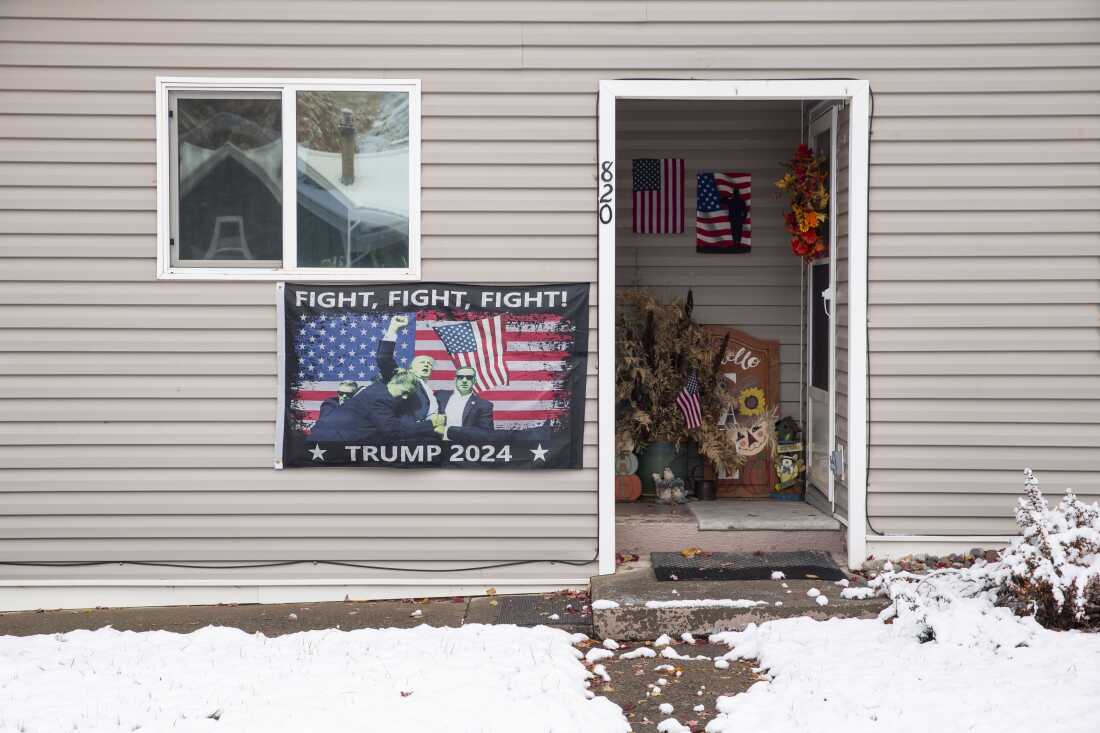
The North Fork Community Choir is based in a part of the country where the politics are all over the map.
Luna Anna Archey for NPR
hide caption
toggle caption
Luna Anna Archey for NPR
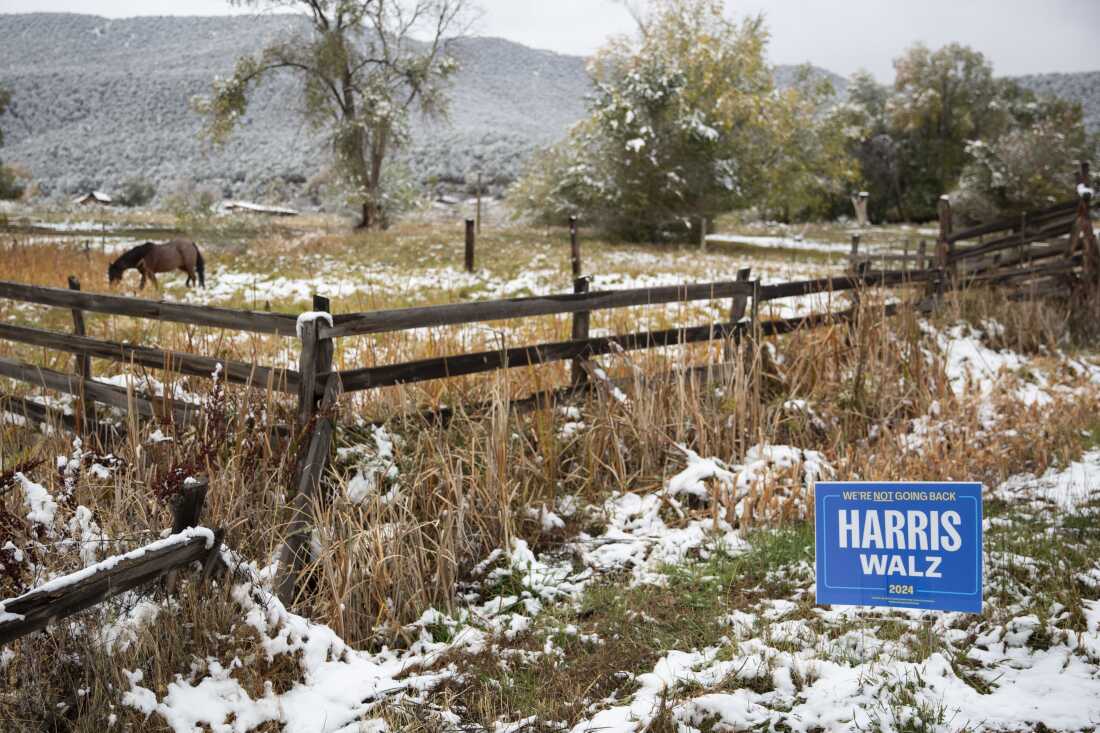
Paonia has farming and ranching families, artists, winemakers, remote workers — and a mix of political views, one choir member says.
Luna Anna Archey for NPR
hide caption
toggle caption
Luna Anna Archey for NPR
The North Fork is an ideologically diverse community
Cooperation is not a given, since the North Fork Community Choir is based in a part of the country where the politics are all over the map. The singers have had to come up with creative ways to continue to sing in harmony.
“We’ve got people from pretty far right to pretty far left in the chorus,” said choir member Jan Tuin.
Tuin has been living in the area since 1964. He said his dad, an auto body repairman, moved the family from near Denver in search of a slower pace of life. Over coffee at Paonia Books, a hip, newish bookstore and cafe in downtown Paonia, Tuin said the mining, farming and ranching families who’ve been around for generations have in recent decades been joined by an influx of artists, winemakers and remote workers in fields like tech.
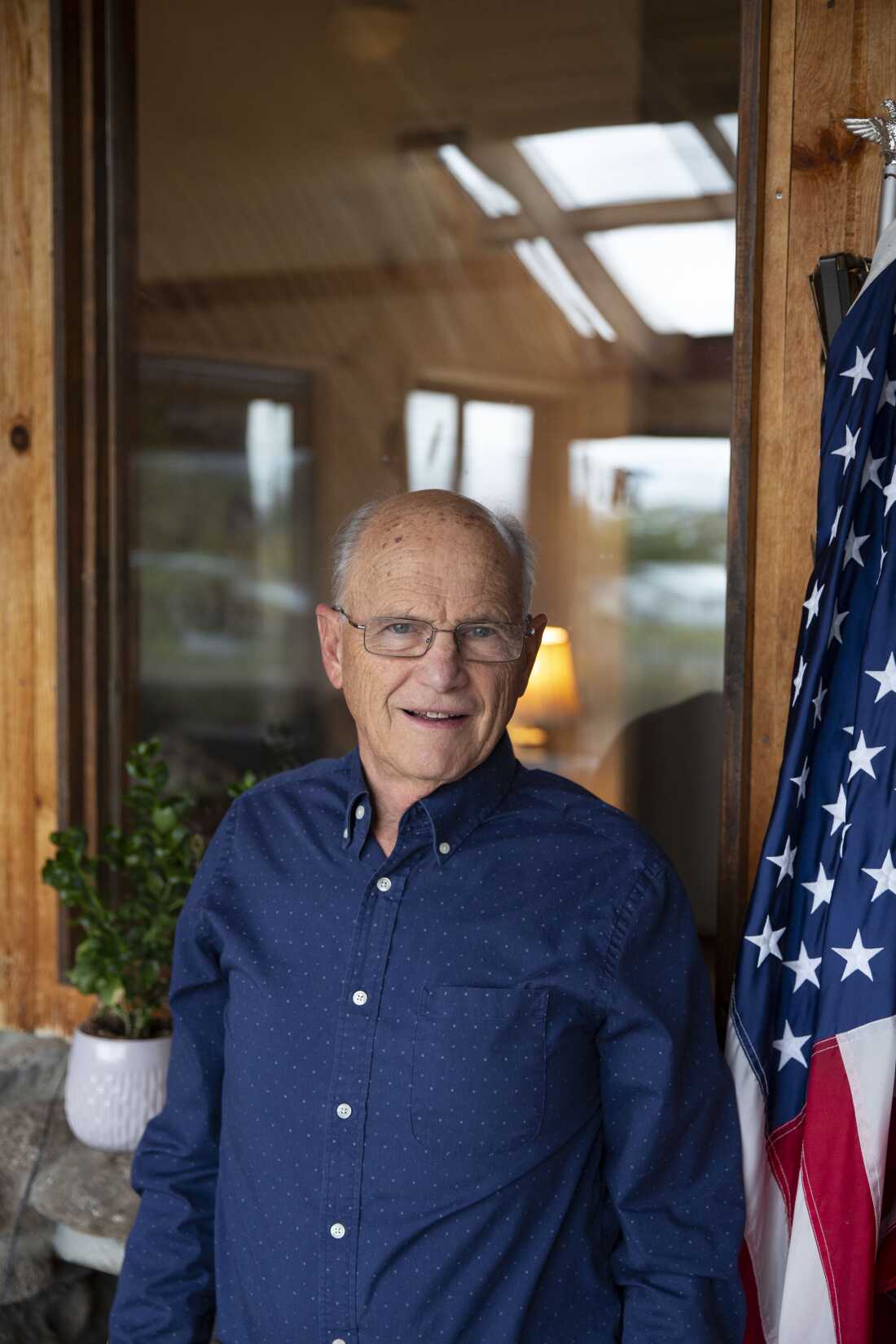
Choir member Jan Tuin, who helped found the first community singing group in the area, at his home in Hotchkiss, Colo.
Luna Anna Archey for NPR
hide caption
toggle caption
Luna Anna Archey for NPR
“And so the people here now are much more diverse, I would say,” Tuin said.
Nearly everyone in the choir is white, reflecting the area’s racial demographics. But the members range in age from 11 to 87. Some of the singers believe in God; others do not. Some own guns; others do not. When the choir required masks and/or vaccines for rehearsals at various points during the COVID-19 pandemic in accordance with federal recommendations, some were happy to comply. But at least one member quit.
Tuin said people avoid bringing up potentially controversial topics during rehearsal. “We talk about our gardens a lot,” he said, laughing.
No matter their politics and values, all of the 20 or so singers NPR spoke with for this story said they focus on music-making as a uniting force and as a way to at least temporarily forget differences. This includes choir members Mary Bachran, the recently retired mayor of blue-leaning Paonia (“We make harmonies together. It’s just so wonderful.”) and Chris Johnson, the recently appointed mayor of red-leaning Crawford, a nearby ranching community. (“We’re just all there to sing.”)

Mary Bachran, community choir member and former mayor, in downtown Paonia, Colo.
Luna Anna Archey for NPR
hide caption
toggle caption
Luna Anna Archey for NPR
Everything’s not good in “America”
Yet the music itself sometimes draws the differences out.
The choir’s Broadway program back in the spring is a case in point. It involved medleys from well-known musicals such as My Fair Lady, Rent, Pippin, Dear Evan Hansen — and West Side Story.
The song “America” from the latter, which premiered in 1957, might be one of the most famous in the American musical canon. But some of the lyrics describing Puerto Rico as an “ugly island” rife with disease and poverty did not sit well with singers like Ellie Roberts.
“I really struggled with that because it sort of implies that Puerto Rico stinks and why wouldn’t they leave?” Roberts said. “And it just sort of encouraged some of those stereotypes.”
Roberts, a local schoolteacher, said the chorus discussed the issue at rehearsal. “What are we celebrating and what do we not want to celebrate?” she said.
They thought about changing the lyrics, but ended up doing the song with a disclaimer that music director Helleckson made from the stage.
“You have to think about context for this piece,” Helleckson said in a video of the performance captured in May. “This piece has some things that are maybe not as acceptable in today’s day and age as they were when it first came out.”
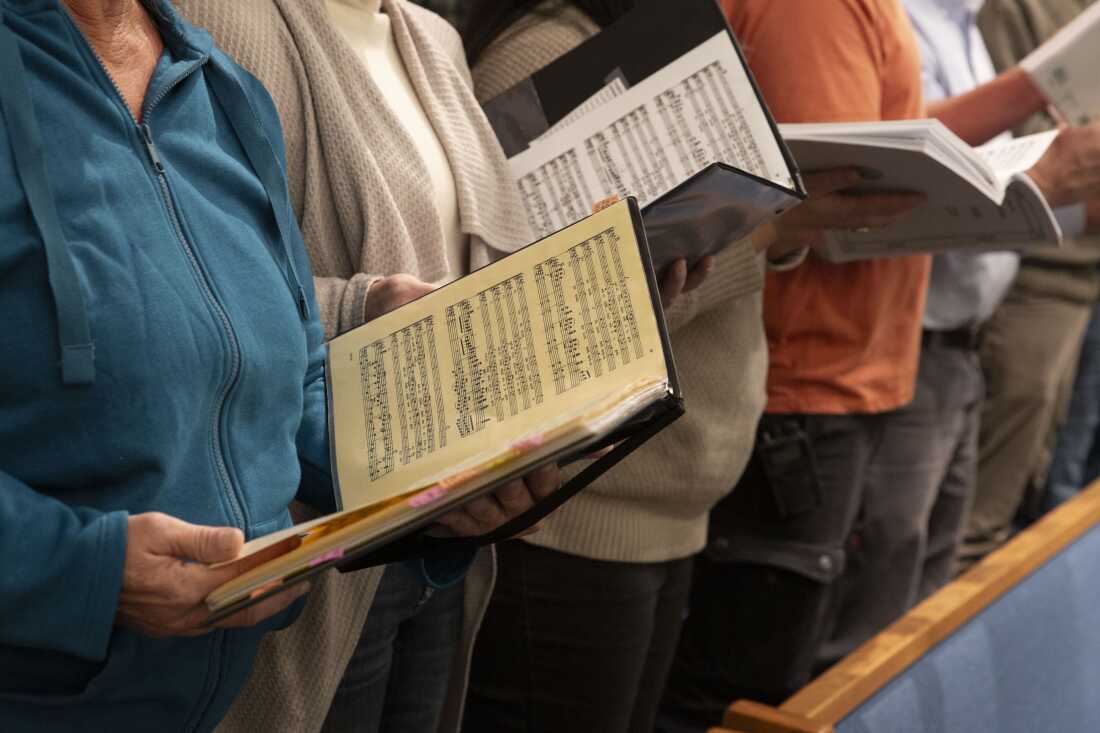
The North Fork Community Choir practices at the North Fork Baptist Church in Paonia, Colo.
Luna Anna Archey for NPR
hide caption
toggle caption
Luna Anna Archey for NPR

Music director Stephanie Helleckson, who has spent most of her life in Paonia, leads community choir practice at the church.
Luna Anna Archey for NPR
hide caption
toggle caption
Luna Anna Archey for NPR

During community choir practice at the North Fork Baptist Church in Paonia.
Luna Anna Archey for NPR
hide caption
toggle caption
Luna Anna Archey for NPR
“Master of the House” an issue too
Meanwhile, other members of the ensemble brought up a different concern to do with the raucous showstopper from Les Misérables, “Master of the House.”
In the song, a seedy innkeeper and his entourage of petty criminals invoke Jesus as they fleece their customers.
“It bothered me, because I did not want to use the Lord’s name that way,” said singer Kim Johnson, a Christian counselor. Johnson said she and some others from the group discussed the matter with Helleckson and came up with alternatives to singing “Jesus.”
“I sang ‘cheeses’ instead of ‘Jesus,’” said Johnson. “It worked.”
Pushing boundaries to launch conversations
Helleckson said she knew the Broadway program would be a little bit provocative.
“It’s pushing boundaries that some people are not comfortable with in our little rural pocket of America,” Helleckson said. “And so part of programming some of this music is to actually have those conversations. So we don’t just assume that everybody’s the same as us and everybody believes the same things and acts the same way.”
According to a Chorus America report assessing the impact of group singing, choir members are more adaptable and tolerant of others than the general population. “Almost two-thirds of singers (63%) believe participating in a chorus has made them more open to and accepting of people who are different from them or hold different views,” the study noted.
New York University sociology professor Eric Klinenberg said the mere act of coming together to undertake a regular, shared activity with others, such as choral singing, can promote bridge-building. But it’s possible for such groups to go further.
“If your objective is to just get a group of people together to sing well, forget about everything else in the world, maybe you don’t need to encourage those other conversations about politics,” said Klinenberg, who studies how people gather and connect both within and across ideological lines.
But, he said, if the objective is also to create a more decent society and bridge differences by using the relationships that you build while making music together as a foundation of trust to advance a conversation about something like politics, “that could be an amazing thing.”
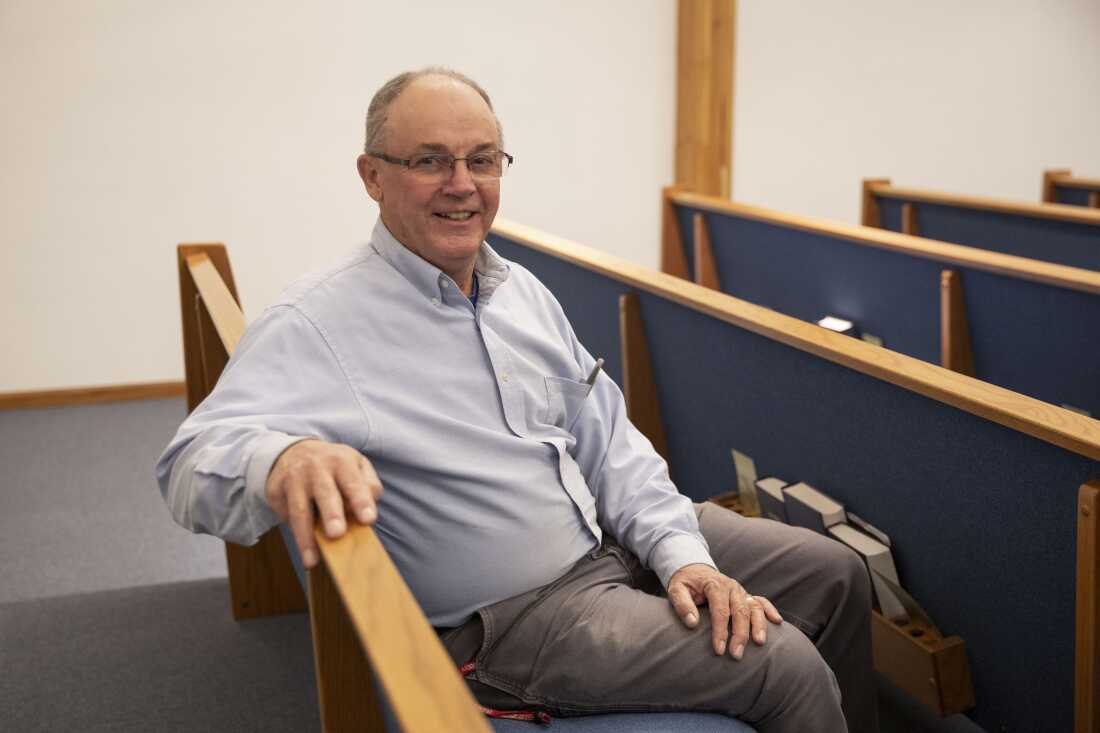
Choir member Chris Johnson, the recently appointed mayor of Crawford, Colo., says: “We’re just all there to sing.”
Luna Anna Archey for NPR
hide caption
toggle caption
Luna Anna Archey for NPR
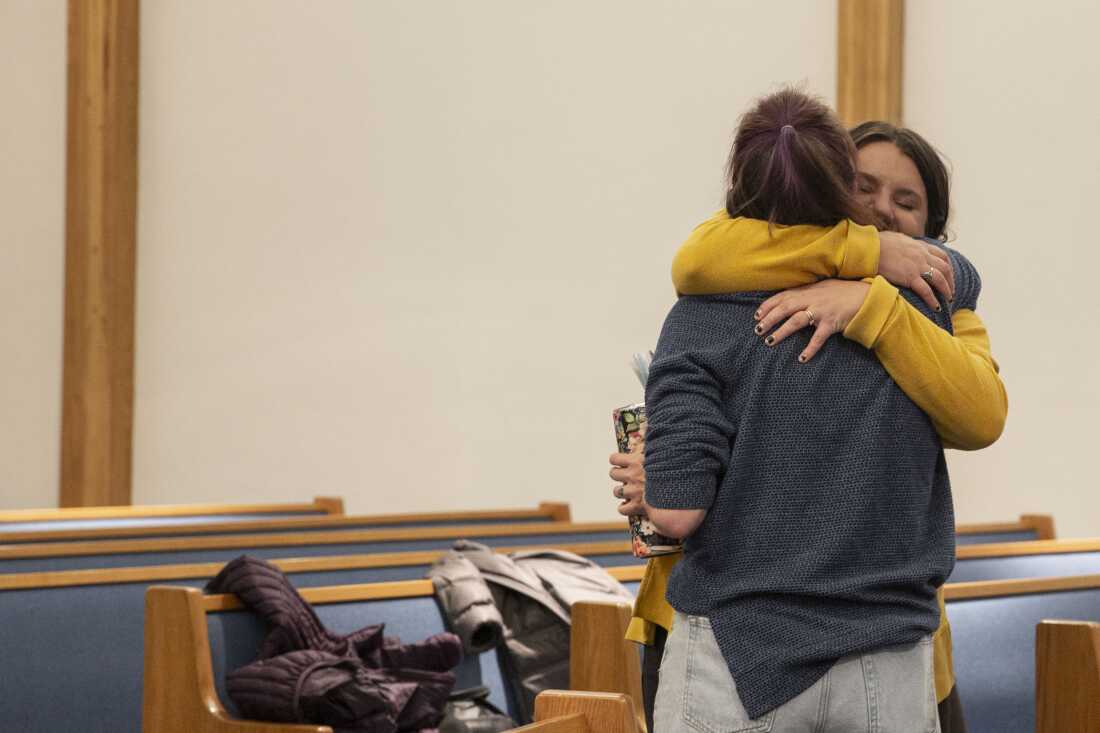
Choir members hug at practice the day after Election Day.
Luna Anna Archey for NPR
hide caption
toggle caption
Luna Anna Archey for NPR
Small steps toward greater understanding
In a small way, the issues that arose with the Broadway concert point toward this aspiration. Choir member Chris Johnson, for example, said he didn’t have a problem with West Side Story. But he doesn’t fault those who pushed for the disclaimer.
“I don’t think that explanation was necessary, but it’s OK,” he said.
And singer Linda Talbott said her mind has been expanded as a result of the faith-based objections other singers in the group had to Les Mis.
“I think I’m much more aware now of what could be objectionable to certain people,” she said. “I don’t think I thought about it. There it was in front of me, I wanted to sing it, and I did.”
Helleckson said she would like to continue to program more material that inspires these types of conversations.
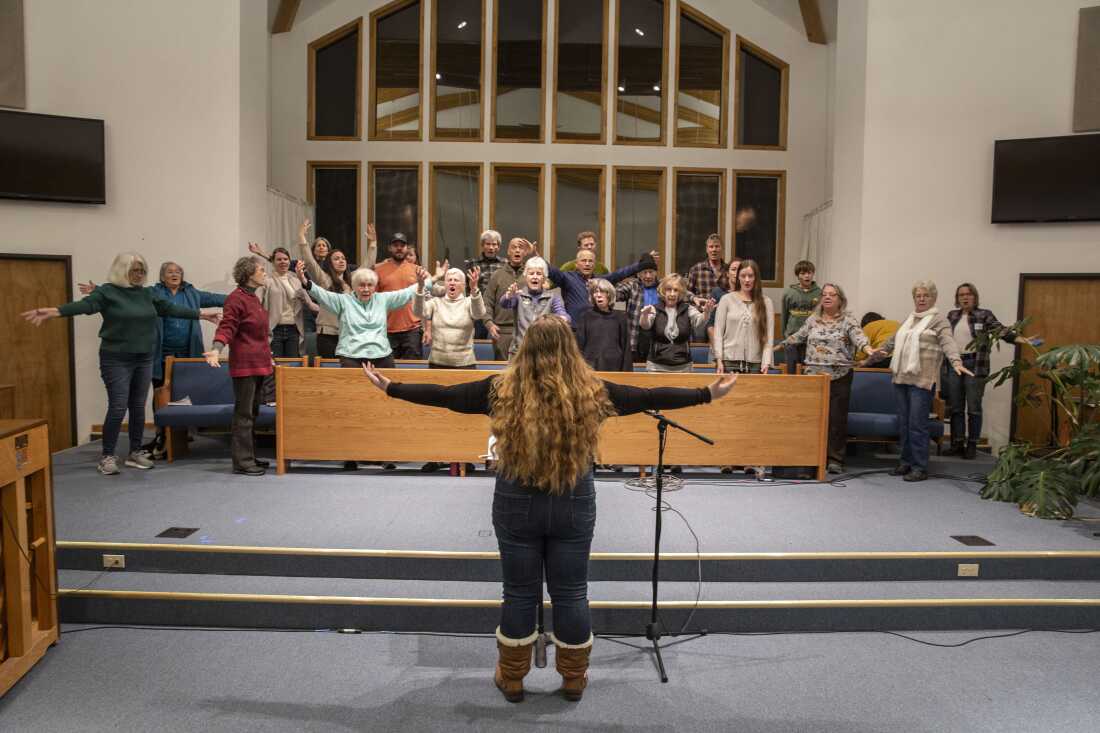
The North Fork Community Choir has been prepping for upcoming holiday performances.
Luna Anna Archey for NPR
hide caption
toggle caption
Luna Anna Archey for NPR
In the meantime, the ensemble is prepping for a pair of holiday performances of Handel’s Messiah. The singers said the music is challenging. But so far it’s not been too controversial.






The Supreme Court
Win McNamee/Getty Images
hide caption
toggle caption
Win McNamee/Getty Images
The Supreme Court on Monday intervened in New York’s redistricting process, blocking a lower court decision that would likely have flipped a Republican congressional district into a Democratic district.
At issue is the midterm redrawing of New York’s 11th congressional district, including Staten Island and a small part of Brooklyn. The district is currently held by a Republican, but on Jan. 21, a state Supreme Court judge ruled that the current district dilutes the power of Black and Latino voters in violation of the state constitution.
GOP Rep. Nicole Malliotakis, who represents the district, and the Republican co-chair of the state Board of Elections promptly appealed to the U.S. Supreme Court, asking the justices to block the redrawing as an unconstitutional “racial gerrymander.” New York’s congressional election cycle was set to officially begin Feb. 24, the opening day for candidates to seek placement on the ballot.
As in this year’s prior mid-decade redistricting fights — in Texas and California — the Trump administration backed the Republicans.
Voters and the State of New York contended it’s too soon for the Supreme Court to wade into this dispute. New York’s highest state court has not issued a final judgment, so the voters asserted that if the Supreme Court grants relief now “future stay applicants will see little purpose in waiting for state court rulings before coming to this Court” and “be rewarded for such gamesmanship.” The state argues this is an issue for “New York courts, not federal courts” to resolve, and there is sufficient time for the dispute to be resolved on the merits.
The court majority explained the decision to intervene in 101 words, which the three dissenting liberal justices summarized as “Rules for thee, but not for me.”
The unsigned majority order does not explain the Court’s rationale. It says only how long the stay will last, until the case moves through the New York State appeals courts. If, however, the losing party petitions and the court agrees to hear the challenge, the stay extends until the final opinion is announced.
Dissenting from the decision were Justices Sonia Sotomayor, Elena Kagan, and Ketanji Brown Jackson. Writing for the three, Sotomayor said that if nonfinal decisions of a state trial court can be brought to highest court, “then every decision from any court is now fair game.” More immediately, she noted, “By granting these applications, the Court thrusts itself into the middle of every election-law dispute around the country, even as many States redraw their congressional maps ahead of the 2026 election.”
Monday’s Supreme Court action deviates from the court’s hands-off pattern in these mid-term redistricting fights this year. In two previous cases — from Texas and California — the court refused to intervene, allowing newly drawn maps to stay in effect.
Requests for Supreme Court intervention on redistricting issues has been a recurring theme this term, a trend that is likely to grow. Earlier last month the high court allowed California to use a voter-approved, Democratic-friendly map. California’s redistricting came in response to a GOP-friendly redistricting plan in Texas that the Supreme Court also permitted to move forward. These redistricting efforts are expected to offset one another.
But the high court itself has yet to rule on a challenge to Louisiana’s voting map, which was drawn by the state legislature after the decennial census in order to create a second majority-Black district. Since the drawing of that second majority-black district, the state has backed away from that map, hoping to return to a plan that provides for only one majority-minority district.
The Supreme Court’s consideration of the Louisiana case has stretched across two terms. The justices failed to resolve the case last term and chose to order a second round of arguments this term adding a new question: Does the state’s intentional creation of a second majority-minority district violate the constitution’s Fourteenth and Fifteenth Amendments’ guarantee of the right to vote and the authority of Congress to enforce that mandate?
Following the addition of the new question, the state of Louisiana flipped positions to oppose the map it had just drawn and defended in court. Whether the Supreme Court follows suit remains to be seen. But the tone of the October argument suggested that the court’s conservative supermajority is likely to continue undercutting the 1965 Voting Rights Act.

Note: Map shows the area with a shake intensity of 3 or greater, which U.S.G.S. defines as “weak,” though the earthquake may be felt outside the areas shown. The New York Times
A minor earthquake with a preliminary magnitude of 3.5 struck in Central California on Monday, according to the United States Geological Survey.
The temblor happened at 7:17 a.m. Pacific time about 6 miles northwest of Pinnacles, Calif., data from the agency shows.
As seismologists review available data, they may revise the earthquake’s reported magnitude. Additional information collected about the earthquake may also prompt U.S.G.S. scientists to update the shake-severity map.
Source: United States Geological Survey | Notes: Shaking categories are based on the Modified Mercalli Intensity scale. When aftershock data is available, the corresponding maps and charts include earthquakes within 100 miles and seven days of the initial quake. All times above are Pacific time. Shake data is as of Monday, March 2 at 10:20 a.m. Eastern. Aftershocks data is as of Monday, March 2 at 11:18 a.m. Eastern.

The U.S. and Israel have been conducting strikes against targets in Iran since Saturday morning, with the aim of toppling Tehran’s clerical regime. Iran has fired back, with retaliatory assaults featuring missiles and drones targeting several Gulf countries and American bases in the Middle East.
“All six aircrew ejected safely, have been safely recovered, and are in stable condition. Kuwait has acknowledged this incident, and we are grateful for the efforts of the Kuwaiti defense forces and their support in this ongoing operation,” Central Command said.
“The cause of the incident is under investigation. Additional information will be released as it becomes available,” it added.
In a separate statement later Monday, Central Command said that American forces had been killed during combat since the strikes began.
“As of 7:30 am ET, March 2, four U.S. service members have been killed in action. The fourth service member, who was seriously wounded during Iran’s initial attacks, eventually succumbed to their injuries,” it said.
Major combat operations continue and our response effort is ongoing. The identities of the fallen are being withheld until 24 hours after next of kin notification,” Central Command added.
This story has been updated.

Ohio courtroom devolves into chaos after sentencing in death of teen

Travis County DA faces renewed ‘soft on crime’ criticism after career criminal charged with murder

Alleged criminal history of missing mom found after 24 years catches up with her

Millionaire philanthropist allegedly gunned down by worker in female wig; ambushes Maryland trooper: police

War in the Middle East: Iran’s broad retaliation in the Gulf • FRANCE 24 English

Florida High School Football Rankings: Top 25 teams – Oct. 21

Cleary's 21 help Le Moyne down Central Connecticut State 69-64 in OT

How old is Bo Nix? What to know about Oregon quarterback ahead of 2024 NFL Draft

99th annual Pony Swim held in Virginia

Indiana Members Credit Union announced as new anchor tenant at Bottleworks District
War in the Middle East: Iran’s broad retaliation in the Gulf • FRANCE 24 English

Trump sends official notification to Congress on strikes against Iran

Unexpected birth brings hope to near-extinct Amazon tribe
Supreme Court blocks redrawing of New York congressional map, dealing a win for GOP

Map: Earthquake Shakes Central California
-

 World5 days ago
Exclusive: DeepSeek withholds latest AI model from US chipmakers including Nvidia, sources say
-

 Massachusetts6 days ago
Mother and daughter injured in Taunton house explosion
-

 Denver, CO6 days ago
10 acres charred, 5 injured in Thornton grass fire, evacuation orders lifted
-

 Louisiana1 week ago
Wildfire near Gum Swamp Road in Livingston Parish now under control; more than 200 acres burned
-

 Oregon4 days ago
2026 OSAA Oregon Wrestling State Championship Results And Brackets – FloWrestling
-

 Technology1 week ago
Arturia’s FX Collection 6 adds two new effects and a $99 intro version
-

 News1 week ago
Video: How Lunar New Year Traditions Take Root Across America
-

 Florida2 days ago
Florida man rescued after being stuck in shoulder-deep mud for days