Connect with us

News

Tesla and Musk antagonists face off over multibillion-dollar lawyer fee

Published

on

Tesla and Musk antagonists face off over multibillion-dollar lawyer fee

Unlock the Editor’s Digest for free

Tesla on Monday urged a judge not to award billions of dollars in shares to the lawyers who successfully challenged Elon Musk’s record pay package, painting them as freeriding opportunists attempting to cash in on the CEO’s hard-fought successes.

“It’s a real-life lawyer joke,” John Reed, a partner at DLA Piper, who represents Tesla, told Chancellor Kathaleen McCormick during the day-long hearing in the Delaware Court of Chancery. An expert witness for Tesla described the fee request as an “unjustifiable windfall”.

The hearing was the first in-court gathering of the parties since a June vote in which 72 per cent of Tesla’s shareholders, excluding Elon Musk and his brother Kimbal, overwhelmingly approved the same pay package terms that McCormick rejected in January. Tesla has said that vote is grounds for McCormick to reverse her previous decision.  

Advertisement

The court is set to hear arguments later this summer on how the June “ratification” vote affects the January ruling. Observers expect that McCormick will decide on the fee and ratification consequences in a single ruling later this year.

When it was cancelled by the court in January, Musk’s pay package was worth about $56bn, but since then Tesla shares have risen, giving it a value of more than $75bn. The 29mn shares requested by plaintiffs’ lawyers has similarly risen in value, from more than $5bn originally to more than $7bn now.

Greg Varallo, the lead plaintiff’s lawyer from the Bernstein Litowitz firm, described Musk’s efforts since the January ruling to reinstate the pay plan as a “clown show”. Varallo claimed that his client, Richard Tornetta, a shareholder holding fewer than 200 shares, has faced death threats from Tesla partisans.

The Wilmington courtroom was packed with dozens of lawyers on Monday. Tesla and its directors have collectively hired around 10 top law firms, both from Delaware and New York, to plead their case. Lawyers representing some Tesla shareholders, including Calpers and Cathie Wood’s Ark Invest, also registered appearances with the court.

McCormick occasionally asked questions but mostly listened intently as the sides conceded their arguments were diametrically opposed.

Advertisement

In 2018, Tesla’s board granted Musk that chance to earn shares equal to more than a tenth of the company’s equity if Tesla was able to hit a series of aggressive stock price and operational milestones. Tesla’s market value went from less than $100bn when the package was granted to top $1tn just a few years later. By 2021, with each of the targets met, Musk was awarded 304mn shares.

Tornetta, the Tesla shareholder who sued, argued that the award was excessive, resulting from a Tesla board too intertwined with Musk to represent ordinary shareholders. McCormick agreed, and the plaintiff’s lawyers, led by Varallo, subsequently requested a fee equivalent to roughly 29mn Tesla shares, as remuneration for saving shareholders the 300mn shares of dilution from the rejected Musk pay package. 

Tesla and its board argued to the court that the benefit to the electric vehicle maker stemming from McCormick’s cancellation of the share grant was “unquantifiable” and that, rather receiving several billion dollars of shares, the winning lawyers were entitled to less than $15mn.

“Plaintiff’s counsel [say] that they are entitled to part of the economic miracle even though they didn’t have any role in it,” testified Daniel Fischel, a University of Chicago professor who was an expert witness for Tesla. “The rescission of the grant didn’t save Tesla $1.”

Varallo conceded that the fee would be record-shattering in absolute terms, but told the court that precedent cases allowed him to ask for one-third of the benefit to shareholders. He characterised his request of roughly 10 per cent as deliberately conservative.

Advertisement

Varallo said in court papers that he would also agree to a cash fee of $1.4bn, a figure he based on the implied hourly rate from another case similar to the Tesla lawsuit.

“We are just receiving a slice of the value pie,” he told McCormick, deflecting Tesla’s claims of a windfall.

Robert Jackson, a NYU law professor and former commissioner at the Securities and Exchange Commission who testified on behalf of Tornetta, challenged Tesla’s contention that avoiding share dilution did not benefit a company: “We don’t distinguish between shares and cash, none of this [distinction] makes economics or governance sense.”

As it fights for its fee, Bernstein Litowitz is also seeking to keep the original ruling from being set aside after the Tesla shareholder vote.

Tesla, which had formed an independent committee to approve the latest pay package, wrote in court papers that the vote “may have been one of the most well-informed stockholder votes in Delaware history”. With shareholders’ stamp of approval, “Delaware law should respect that vote because it reflects the will and sound ‘business judgment’ of Tesla’s stockholder-owners”, it argued.

Advertisement

Varello has maintained that there was no basis in Delaware case law for a shareholder vote to retroactively upend a court ruling.

“To put it bluntly, litigating against Tesla is never easy,” he said to the court during Monday’s hearing.

News

Three more people charged with damaging Reflecting Pool after Trump’s multimillion-dollar restoration | CNN Politics

Published

on

Three more people charged with damaging Reflecting Pool after Trump’s multimillion-dollar restoration | CNN Politics

Three more people have been criminally charged with destruction of property at the Lincoln Memorial Reflecting Pool.

Officers say they detained Cameron Thiers, Sophie Dennison-Gibby and Justin Carreno one Saturday afternoon in June and described in court documents witnessing them peeling and removing pieces of blue paint from the Reflecting Pool.

One officer “witnessed Carreno reach down into the reflecting pool and pull up a piece of the blue paint,” according to the court documents.

The officer who detained Dennison-Gibby “found 1 additional piece of the reflecting pool liner” in her purse, the documents said.

All three incidents were recorded on the officers’ body worn cameras, they said in the court documents.

Advertisement

Several “partnering law enforcement agencies assigned to the Reflecting Pool” working with US Park Police were involved in detaining the two men and one woman — including officers from Texas, Oklahoma, Montana and California.

One of the officers said in court documents that Thiers “admitted to removing a piece of blue sealant from the Reflecting Pool and still had it in his hand when I made contact with him.”

The three defendants were arraigned in court Wednesday and pleaded not guilty to the misdemeanor charges of destruction of property with a value less than $1,000. The judge ordered them to stay away from the Reflecting Pool.

Lawyers for Thiers and Dennison-Gibby declined to comment. CNN has reached out to Carreno’s attorney.

If found guilty of destruction of property, the defendants could be fined up to $1,000 and face a maximum of 180 days behind bars.

Advertisement

The New York Times first reported that three additional people had been charged with damaging the Reflecting Pool.

President Donald Trump has repeatedly claimed that vandals caused major damage to the pool by gashing the lining after his administration spent more than $14 million on renovations, though he has not provided evidence to support that claim. The officers who charged Carreno, Thiers and Dennison-Gibby did not accuse them of gashing the lining.

Former Olympic canoeist David Hearn was indicted by a grand jury in Washington, DC, last week for allegedly damaging the Reflecting Pool. Hearn — unlike Carreno, Thiers and Dennison-Gibby – was charged with destruction of property with a value of more than $1,000 which carries a maximum penalty of 10 years in prison, if convicted. He is set to be arraigned in court Thursday.

Crews began draining the Reflecting Pool over the weekend to make repairs, according to Interior Secretary Doug Burgum, for the second time in three months.

The move comes after weeks of problems – algae blooms, green-hued water, a chipping bottom and the administration’s allegations of vandalism – that have plagued the iconic landmark, making its woes the subject of national interest.

Advertisement
Continue Reading

News

Supreme Court financial disclosures reveal how their books add to their income

Published

on

Supreme Court financial disclosures reveal how their books add to their income

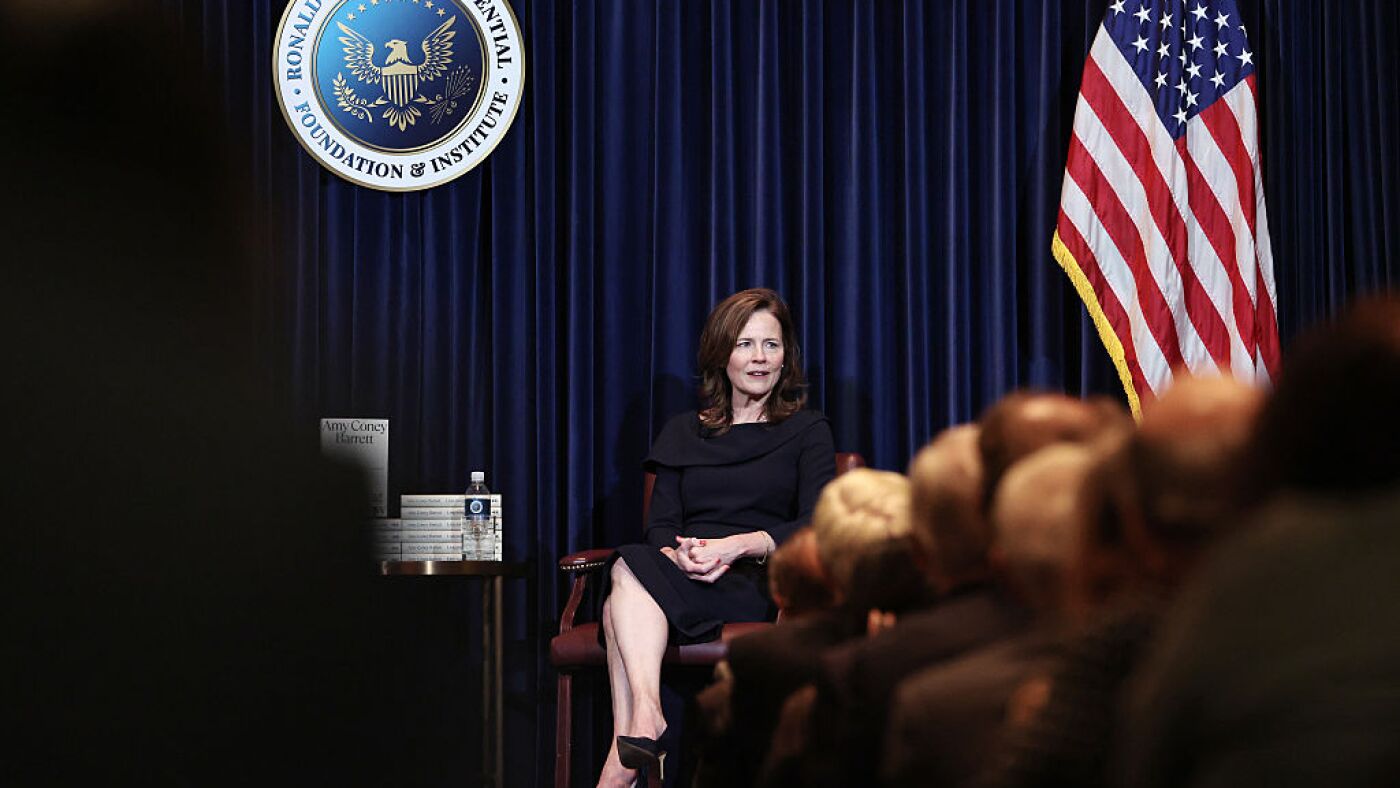
Supreme Court Justice Amy Coney Barrett speaks at the Reagan Library on Sept. 9, 2025, in Simi Valley, Calif. Barrett discussed and signed copies of her new book, Listening to the Law: Reflections on the Court and Constitution.

Mario Tama/Getty Images


hide caption


toggle caption

Advertisement

Mario Tama/Getty Images

Even as the Supreme Court was handing down one legal thunderbolt after another last week, the justices were quietly releasing their annual financial reports. Justice Samuel Alito was the only sitting justice to request an extension, which he has done for 15 years. The disclosures do not give a complete account of the justices’ total income and wealth, but they give insights into their concertgoing, guest professorships and even their involvement in youth sports.

In addition to their salaries, much of the justices’ reported income came from their book deals. Justice Ketanji Brown Jackson led the pack earning more than $1.1 million last year for a total of roughly $4 million since her memoir, Lovely One, was published in 2024.

Justices Sonia Sotomayor, Neil Gorsuch, Amy Coney Barrett and retired Justice Anthony Kennedy also reported income from published books. Earnings from their books ranged from $849,000 for Barrett, to $300,000 for Gorsuch and $88,000 for Sotomayor, whose books include her 2013 autobiography and five children’s books. Justice Clarence Thomas, who previously earned $1.5 million for his 2007 memoir, listed no publisher payments last year, and Justice Brett Kavanaugh, one of 13 co-authors of a 2016 legal treatise, also received no payments last year. Kavanaugh is said to be working on a memoir but he listed no payments for the anticipated book. Alito does have a book coming out in the fall, but with his financial report still outstanding, there is no data on how much he was paid for the work in 2025.

Advertisement

The only two sitting justices who have not written books are Chief Justice John Roberts and Justice Elena Kagan.

Many justices also earned income from teaching at law schools. Roberts reported income from New England Law, located in Boston, and Gorsuch reported teaching income from George Mason University in Virginia. Thomas taught classes at Catholic University in Washington, D.C., and Barrett and Kavanaugh taught at Notre Dame Law School. Barrett graduated from the school and began teaching there 23 years ago; Kavanaugh has family connections to Notre Dame.

Continue Reading

News

Manhattan Building’s Columns Buckled Beneath New Addition, Images Show

Published

on

Manhattan Building’s Columns Buckled Beneath New Addition, Images Show

At least two structural columns buckled and failed in a 37-story office tower in Midtown Manhattan on Tuesday, prompting evacuations of nearby streets and buildings. While city officials asserted that the tower was in no danger of collapsing completely, outside engineers said further failures in the structure could not be ruled out.

A pair of columns that failed completely were part of the tower’s existing structure. A New York Times review of images and videos from inside the building has found that several floors were added atop these columns.

Advertisement

City officials said in a news conference on Tuesday that the building was continuing to move, while they simultaneously assured the city that the building would not suffer “total collapse.” “The way this building is constructed, it’s a steel-frame building,” John Esposito, a chief in the Fire Department in New York, said at the afternoon news conference. “So, it would not be a total collapse. It would be more of a localized collapse.” Still, he said, “that remains our concern, that it’s moved.”

Advertisement

Engineers said that the movement itself was cause for concern. In a properly designed steel building, they said, loads should redistribute quickly to surviving structural supports if columns failed.

Joe DiPompeo, a former president of the Structural Engineering Institute at the American Society of Civil Engineers, said that if the structure had been overloaded, he would expect any movement “to happen very quickly,” rather than gradually.

“Generally when a column buckles, it’s a sudden failure,” Mr. DiPompeo said. He said that a full collapse remained unlikely given the redundancies built into the building codes.

Advertisement

Engineers often refer to the most dangerous possibility as a progressive collapse, a process in which structures near the initial failure become overstressed and also fail, potentially bringing down the building if the sequence continues. While unlikely, it cannot be ruled out, Mr. DiPompeo said.

Footage recorded from inside the building shows at least two structural columns appear to have failed completely, Mr. DiPompeo said. Other nonstructural, interior walls — or at least the metal “studs” that were in place to hold them up — also appear to have deformed.

Advertisement

“The only way that really happens is if the floor above them dropped. It looks like the floor above could have dropped a foot or two, which is obviously not a good situation,” Mr. DiPompeo said.

@fernando40tiktok.commarc via Storyful

Advertisement

Advertisement

Image from @fernando40tiktok.commarc via Storyful

Advertisement

Image from @Bogs4NY via X

Advertisement

The 37-story building is in the process of being converted from office space into residential units. Four new floors and a large vertical portion were added onto the existing building in recent months. The vertical portion consists of a stack of over a dozen new floors cantilevered out over the existing building below.

Engineers said that there was nothing inherently wrong with adding residential floors or the cantilevered section above the columns that failed, as long as the original structure and the modifications had properly accounted for the added weight and wind loads.

“The cantilever alone doesn’t change anything,” Mr. DiPompeo said, but it does put additional load on the columns underneath — a factor that should have been reflected in the design.

Advertisement

Nathan Berman, managing principal and founder of MetroLoft, the developer overseeing the conversion, said on Tuesday that “this incident is nothing more than a typical construction mishap.”

He said two columns near the northwest corner of the tower had bent under the weight of additions to the building above, most likely because those columns had not been properly reinforced, though he said an investigation would determine the cause. The rest of the columns, he said, “picked up the weight.” He estimated the affected floors above the failed columns had sagged by a maximum of four inches.

Advertisement

Mr. Berman said that he expected the problems to be fixed and the project to be completed with, at most, a slight delay.

On Tuesday evening, installation of temporary shoring was set to begin shortly, in order to help stabilize the 20th and 21st floors of the building.

Advertisement
Continue Reading
Advertisement

Trending