News
Supreme Court sides with administration over Education Department grants


The Supreme Court
Andrew Harnik/Getty Images
hide caption
toggle caption
Andrew Harnik/Getty Images
The U.S. Supreme Court on Friday sided with the Trump administration, at least for now, in a dispute over the Department of Education’s freeze of DEI-related grants. The administration has taken several grievances to the high court recently, but this was the first of its legal theories to stick.
By a 5-4 vote, the justices allowed the administration to keep frozen $65 million for teacher training and professional development, halting a lower court order that had temporarily reinstated the grants.
The court’s unsigned opinion comes about a month after a similar dispute in which the justices left in place a lower court order to pay USAID contractors for services already performed.
This time, however, with education grants on the line, the court majority ruled that even though Congress had already appropriated money for the programs, the Education Department could stop funding them while the case is litigated in the lower courts.

The Education Department had frozen the grants in anticipation of trying to claw back unspent funds that had been appropriated by Congress.
A federal district judge had issued two consecutive 14-day temporary restraining orders to consider the question of the frozen funds. While such 14-day orders are rarely appealable, the Supreme Court majority viewed this case differently, and granted the administration’s request to block the lower court order from going into effect. In an unsigned 2-1/2-page opinion, the majority wrote that the lower court may actually not have had the authority to issue its order in the first place.
Justice Elena Kagan dissented, saying that the Court had made a serious “mistake” when it intervened too swiftly, effectively changing the court’s rules with only a “barebones briefing, no argument and scarce time for reflection.” Justice Ketanji Brown Jackson, joined by Justice Sonia Sotomayor, noted that it was exceptional for the Court to intervene when the temporary restraining order would expire in only three days, and that that the administration had not presented a convincing enough argument as to why such an extraordinary intervention was necessary.
While Chief Justice John Roberts noted his disagreement with the majority, he did not join either dissenting opinion.

Universities accused of violating civil rights law
The Education Department funding went to two grant programs targeting teacher shortages. Recipients included “high need” institutions, nonprofits, Historically Black Colleges and Universities, and Tribally Controlled Colleges and Universities.
The Department of Education cut nearly all of the existing grants in February, notwithstanding the fact that Congress had already appropriated the funds to be spent for these specific purposes. The administration said it eliminated 104 of 109 grants because they “fund discriminatory practices–including in the form of DEI.”
The Department also sent letters to the recipients stating that their programs violated federal civil rights laws by discriminating based on race, sex, or other protected characteristics.

Eight states whose universities and nonprofits had their grants terminated–California, Massachusetts, New Jersey, Colorado, Illinois, Maryland, New York, and Wisconsin–sued in federal district court. The challengers argued that the Department of Education’s decision to cancel the grants violated federal law. In response, the government argued that it was well within its broad regulatory authority to cancel the grants because the so-called “DEI initiatives” were no longer aligned with government policy.
A federal judge in Boston issued a temporary restraining order, which reinstated the funding for up to 28 days while he considered the states’ claims. After a failed attempt to overturn the order in the federal court of appeals, the Department of Education asked the Supreme Court to stop the lower courts from reinstating the grant money, at least for now.
The Department insisted that it should not be forced to continue funding millions of dollars in “taxpayer money that may never be clawed back” while the lawsuit plays out in the courts. It pointed out that, even if it eventually wins this case, it would have a hard time getting the millions in federal dollars back once the “federal funding spigots” had been turned back on.

The eight states that are part of the lawsuit against the administration countered that it would make little sense for the Supreme Court to intervene at this stage, given that the grant reinstatement would expire soon anyway. And, they pointed out, the order’s limited shelf life gave grant recipients little time to continue receiving government funds.
In that sense, the schools would be getting a drop in the bucket compared to the government’s image of a “funding spigot.” And that would still be less than they were promised in their five-year grant.
The Supreme Court didn’t see things that way, and instead sided with the Trump administration, delivering a major win to an executive branch trying to amass greater power as it continually clashes with the lower federal courts.
More cases in the pipeline
Friday’s case is only the latest of what is expected to be a tsunami of cases that the Trump administration is bringing to the Supreme Court. Among those already in the pipeline at early stages of litigation is a lower court order that reinstated roughly 16,000 previously terminated federal employees.
Another court stopped the administration from denying birthright citizenship for some children born in the United States, a case in which the government complained at length about the use of universal injunctions, a wide-reaching order that applies to everyone impacted across the country. And most recently, the administration asked the court to allow it to continue deporting U.S. residents, without a hearing, who it alleges are Venezuelan members of the Tren de Aragua gang.
Bubbling under the surface in these cases is the government’s ongoing critique of sweeping court orders that bind the administration’s actions beyond the confines of the courtroom. Judges’ grants of nationwide relief have been a thorn in the administration’s side since Trump took office in January.

They were also a thorn in the side of the Biden administration. But as frustrated as that administration sometimes was, it rarely complained of unfair treatment. In contrast, the Trump administration, and President Trump himself, have cried foul repeatedly and loudly over these lower court decisions.
Attorney General Pam Bondi in a statement said Friday’s ruling “vindicates what the Department of Justice has been arguing for months: local district judges do not have the jurisdiction to seize control of taxpayer dollars, force the government to pay out billions, or unilaterally halt President Trump’s policy agenda.”
—NPR’s Ryan Lucas contributed to this report.




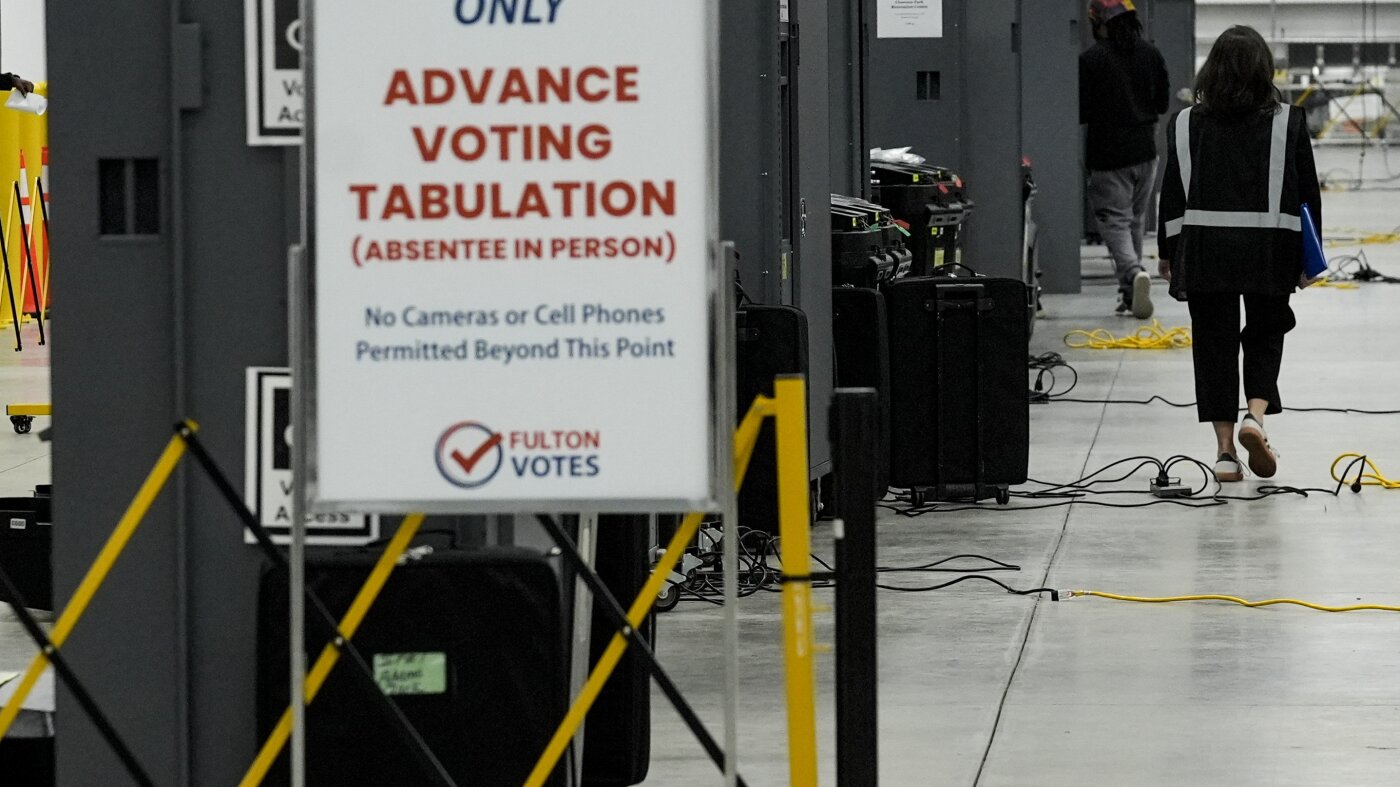
An election worker walks near voting machines at the Fulton County Election Hub and Operation Center on Nov. 5, 2024.
John Bazemore/AP
hide caption
toggle caption
John Bazemore/AP
The FBI says it’s executing a “court authorized law enforcement action” at a location in Georgia that is home to the Fulton County election office.
When asked about the search, the FBI would not clarify whether the action is tied to the 2020 election, but last month the Department of Justice announced it’s suing Fulton County for records related to the 2020 election.
In its complaint, the DOJ cited efforts by the Georgia State Election Board to obtain 2020 election materials from the county.
On Oct. 30, 2025, the complaint says, the U.S. attorney general sent a letter to the Fulton County Board of Registration and Elections “demanding ‘all records in your possession responsive to the recent subpoena issued to your office by the State Election Board.’ “
A Fulton County judge has denied a request by the county to block that subpoena.
Since the 2020 election, Fulton County has been at the center of baseless claims of election fraud by President Trump and others.
In November the sweeping election interference case against Trump and allies was dismissed by a Fulton County judge.

A man is tackled after spraying an unknown substance at US Representative Ilhan Omar (D-MN) (L) during a town hall she was hosting in Minneapolis, Minnesota, on January 27, 2026. (Photo by Octavio JONES / AFP via Getty Images)
OCTAVIO JONES/AFP via Getty Images/AFP
hide caption
toggle caption
OCTAVIO JONES/AFP via Getty Images/AFP
Rep. Ilhan Omar, D-Minn., was rushed by a man during a town hall event Tuesday night and sprayed with a liquid via a syringe.
Footage from the event shows a man approaching Omar at her lectern as she is delivering remarks and spraying an unknown substance in her direction, before swiftly being tackled by security. Omar called on Homeland Security Secretary Kristi Noem to resign or face impeachment immediately before the assault.
Noem has faced criticism from lawmakers on both sides of the aisle in the aftermath of the fatal shooting of 37-year-old intensive care nurse Alex Pretti by federal officers in Minneapolis Saturday.
Omar’s staff can be heard urging her to step away and get “checked out,” with others nearby saying the substance smelled bad.
“We will continue,” Omar responded. “These f******* a**holes are not going to get away with it.”
A statement from Omar’s office released after the event said the individual who approached and sprayed the congresswoman is now in custody.
“The Congresswoman is okay,” the statement read. “She continued with her town hall because she doesn’t let bullies win.”
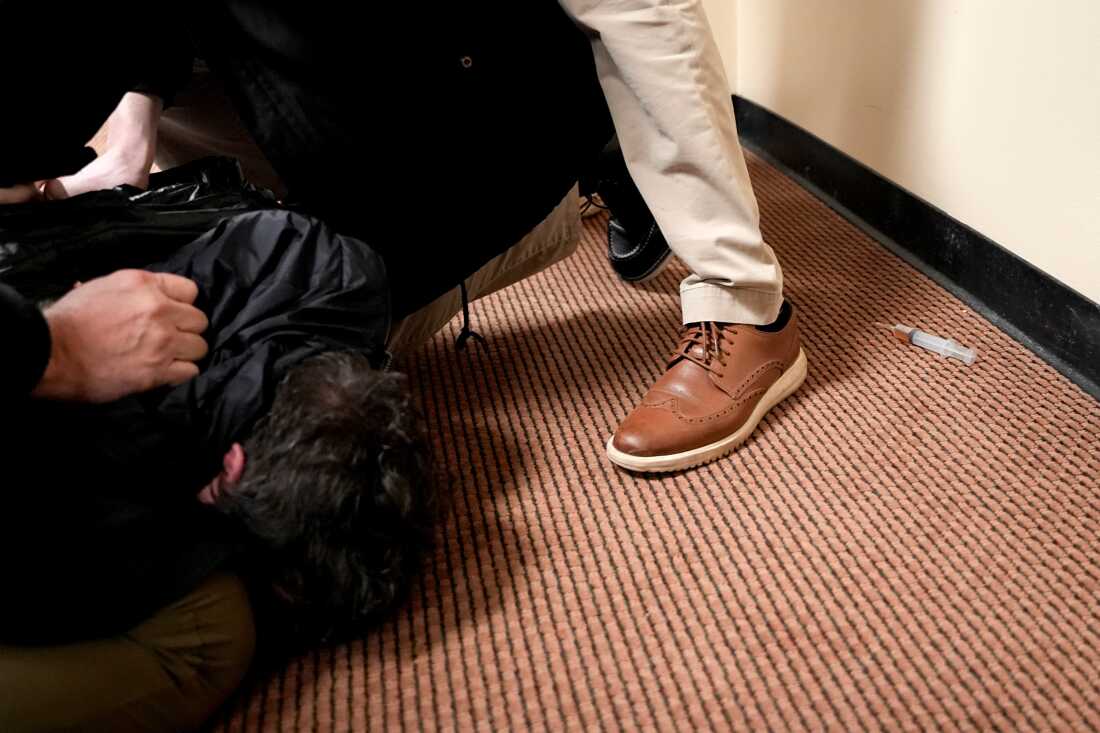
A syringe lays on the ground after a man, left, approached Representative Ilhan Omar, a Democrat from Minnesota, during a town hall event in Minneapolis, Minnesota, US, on Tuesday, Jan. 27, 2026. The man was apprehended after spraying an unknown substance according to the Associated Press. Photographer: Angelina Katsanis/Bloomberg via Getty Images
Bloomberg/Bloomberg via Getty Images/Bloomberg
hide caption
toggle caption
Bloomberg/Bloomberg via Getty Images/Bloomberg
Omar followed up with a statement on social media saying she will not be intimidated.
I’m ok. I’m a survivor so this small agitator isn’t going to intimidate me from doing my work.
I don’t let bullies win.
Grateful to my incredible constituents who rallied behind me. Minnesota strong.
— Ilhan Omar (@IlhanMN) January 28, 2026
As Omar continued her remarks at the town hall, she said: “We are Minnesota strong and we will stay resilient in the face of whatever they might throw at us.”
Just three days ago, fellow Democrat Rep. Maxwell Frost of Florida said he was assaulted at the Sundance Festival by a man “who told me that Trump was going to deport me before he punched me in the face.”
Threats against Congressional lawmakers have been rising. Last year, there was an increase in security funding in the wake of growing concerns about political violence in the country.
According to the U.S. Capitol Police, the number of threat assessment cases has increased for the third year in a row. In 2025, the USCP investigated 14,938 “concerning statements, behaviors, and communications” directed towards congressional lawmakers, their families and staff. That figure represents a nearly 58% increase from 2024.

new video loaded: F.A.A. Ignored Safety Concerns Prior to Collision Over Potomac, N.T.S.B. Says
transcript
transcript
F.A.A. Ignored Safety Concerns Prior to Collision Over Potomac, N.T.S.B. Says
The National Transportation Safety Board said that a “multitude of errors” led to the collision between a military helicopter and a commercial jet, killing 67 people last January.
-
“I imagine there will be some difficult moments today for all of us as we try to provide answers to how a multitude of errors led to this tragedy.” “We have an entire tower who took it upon themselves to try to raise concerns over and over and over and over again, only to get squashed by management and everybody above them within F.A.A. Were they set up for failure?” “They were not adequately prepared to do the jobs they were assigned to do.”
By Meg Felling
January 27, 2026
The FBI conducts a search at the Fulton County election office in Georgia

Knife-wielding nut allegedly asked Christian his religion – then stabbed him and dog before police shot him

House Republicans blast Noem impeachment resolution as ‘partisan stunt,’ as Dems fail to reach across aisle

Brother killed after teen becomes ‘enraged’ over video game, stabs sibling: police

Rep Maxwell Frost allegedly assaulted at Sundance Film Festival in racially charged incident

Florida High School Football Rankings: Top 25 teams – Oct. 21

Cleary's 21 help Le Moyne down Central Connecticut State 69-64 in OT

How old is Bo Nix? What to know about Oregon quarterback ahead of 2024 NFL Draft

99th annual Pony Swim held in Virginia

Indiana Members Credit Union announced as new anchor tenant at Bottleworks District
The FBI conducts a search at the Fulton County election office in Georgia

Graham pushes back on Tillis’ criticism of Noem, Miller for labeling man killed by Border Patrol a ‘terrorist’

North Korea’s Kim to outline plans to boost nuclear arsenal
Rep. Ilhan Omar rushed by man on stage and sprayed with liquid at town hall event

Video: F.A.A. Ignored Safety Concerns Prior to Collision Over Potomac, N.T.S.B. Says
-

 Illinois6 days ago
Illinois school closings tomorrow: How to check if your school is closed due to extreme cold
-

 Pittsburg, PA1 week ago
Sean McDermott Should Be Steelers Next Head Coach
-

 Pennsylvania2 days ago
Rare ‘avalanche’ blocks Pennsylvania road during major snowstorm
-

 Lifestyle1 week ago
Nick Fuentes & Andrew Tate Party to Kanye’s Banned ‘Heil Hitler’
-

 Sports1 week ago
Miami star throws punch at Indiana player after national championship loss
-

 Cleveland, OH1 week ago
Northeast Ohio cities dealing with rock salt shortage during peak of winter season
-

 Technology6 days ago
Ring claims it’s not giving ICE access to its cameras
-
 Science1 week ago
Contributor: New food pyramid is a recipe for health disasters