News
Speaker Johnson pleads with Republicans to keep concerns private after tumultuous week


Washington (AP) — House Speaker Mike Johnson is imploring his fellow Republicans to stop venting their frustrations in public and bring their complaints to him directly.
“They’re going to get upset about things. That’s part of the process,” Johnson told reporters Thursday. “It doesn’t bother me. But when there is a conflict or concern, I always ask all members to come to me, don’t go to social media.”
Increasingly, they’re ignoring him.
Cracks inside the GOP conference were stark this week as a member of Johnson’s own leadership team openly accused him of lying, rank-and-file Republicans acted unilaterally to force votes and a leadership-backed bill faltered. It’s all underscored by growing worries that the party is on a path towards losing the majority next year.
“I certainly think that the current leadership and specifically the speaker needs to change the way that he approaches the job,” GOP Rep. Kevin Kiley of California said Thursday.
Kiley, who has grown vocally critical of Johnson after the GOP’s nationwide redistricting campaign backfired in California, said the speaker has been critical of rank-and-file Republicans, so “he needs to be prepared to accept any criticism that comes with the job.”
“And I think, unfortunately, there’s been ample reason for criticism,” he added.
GOP lawmaker asks, ‘Why do we have to legislate by discharge petitions?’
For the first part of 2025, Johnson held together his slim Republican majority in the House to pass a number of President Donald Trump’s priorities, including his massive spending and tax cut plan.
But after Johnson kept members out of session for nearly two months during the government shutdown, they returned anxious to work on priorities that had been backlogged for months — and with the reality that their time in the majority may be running out.
First was a high-profile discharge petition to force the vote on releasing the Jeffrey Epstein files, which succeeded after it reached the 218-signature threshold. Other lawmakers are launching more petitions, a step that used to be considered a major affront to party leadership.
“The discharge petition, I think, always shows a bit of frustration,” said GOP Rep. Dusty Johnson of South Dakota.
Another discharge petition on a bill that would repeal Trump’s executive order to end collective bargaining with federal labor unions reached the signature threshold last month, with support from seven Republicans.
And this week, GOP Rep. Anna Paulina Luna of Florida brought a long-anticipated discharge petition for a bill to bar members of Congress from trading stock. A number of Republicans have already signed on, in addition to Democrats.
“Anxious is what happens when you get nervous. I’m not nervous. I’m pissed,” Luna wrote on social media late Thursday, responding to leadership comments that she was overly anxious.
GOP Rep. Nancy Mace of South Carolina signed both Luna’s petition and the one to release the Epstein files. She told reporters Thursday that she expressed her frustrations directly to Johnson in a phone call, and in what she described as “a deeply personal, deeply passionate letter, that we are legislating by discharge petition.”
“We have a very slim majority, but I want President Trump’s executive orders codified,” Mace said. “I want to see his agenda implemented. Why do we have to legislate by discharge petitions?”
Speaker Johnson’s own leadership team is going after him
At the center of Johnson’s pleas for members to bring concerns to him privately instead of on social media is the chairwoman of House Republican leadership, New York Rep. Elise Stefanik.
Angered that a provision she championed wasn’t included in a defense authorization bill, Stefanik blasted Johnson’s claims that he wasn’t aware of the provision as “more lies from the Speaker.” She conducted a series of media interviews criticizing Johnson, including one with The Wall Street Journal in which she said he was a “political novice” who wouldn’t be reelected speaker if the vote were held today.
Johnson told reporters Thursday that he had a “great talk” with Stefanik the night before.
“I called her and I said, ‘Why wouldn’t you just come to me, you know?’” Johnson said. “So we had some intense fellowship about that.”
Asked if she had apologized for calling him a liar, Johnson said, “Um, you ask Elise about that.”
Illinois Rep. Mary Miller released a statement Thursday providing support for Johnson, saying that while there are differences among members “our mission is bigger than any one individual or headline.”
Democrats, who have had leadership criticisms of their own, have reveled in the GOP’s disarray. House Republican leaders attempted to muscle through an NCAA-backed bill to regulate college sports after the White House endorsed it, before support within Republican ranks crumbled. Some GOP lawmakers pointedly said they had bigger priorities before the end of the year.
“It’s not that Congress can’t legislate, it’s House Republicans that can’t legislate. It’s the gang that can’t legislate straight. They continue to take the ‘my way or the highway’ approach,” said House Democratic Leader Hakeem Jeffries.
There is underlying GOP unease about losing the chamber in 2026
All eyes in the U.S. House were on a special election Tuesday night in a Tennessee district that a Republican had won in 2024 by nearly 21 percentage points, with Trump carrying the area by a similar margin.
Republicans hoped the contest would help them regain momentum after losing several marquee races across the country in November. Democrats, meanwhile, argued that keeping the race close would signal strong political winds at their backs ahead of next year’s midterms, which will determine control of both chambers.
Republican Matt Van Epps ultimately won by nearly 9 percentage points.
“I do think to have that district that went by over 20 points a year ago be down to nine, it should be a wakeup call,” said GOP Rep. Don Bacon of Nebraska.
He argued that Republicans need “to get some economic progress, like immediately,” adding that “the president and his team have got to come to grips” that tariffs are not driving economic growth.
“I just feel like they’re going to have to get out of their bubble,” Bacon said of the White House. “Get out of your bubble. The economy needs improving. Fix Ukraine and we do need a temporary health care fix.”
Bacon is among a growing number of House Republicans who have announced they will retire after this term. Republican Rep. Marjorie Taylor Greene of Georgia abruptly declared last month that she would resign in January, citing multiple reasons, including that “the legislature has been mostly sidelined” this year.
Those retirements add to the GOP’s challenge in holding the House, as the party must now defend more open seats. Republicans have also seen a redistricting battle — sparked by Trump’s pressure on Texas Republicans and then more states — backfire in part. In November, California voters handed Democrats a victory by approving a new congressional map.
“That’s living in a fantasy world if you think that this redistricting war is what’s going to save the majority,” said Kiley, now at risk of losing his seat after redistricting in California.
He added, “I think what would make a lot bigger impact is if the House played a proactive role in actually putting forward legislation that matters.”
___
Associated Press reporter Meg Kinnard in Columbia, South Carolina, contributed to this report.




Seth Bodnar, the former president of the University of Montana, is now running for Senate as an independent
Kirk Siegler/NPR
hide caption
toggle caption
Kirk Siegler/NPR
BUTTE, Mont. – It’s long been an adage in Montana politics that if you’re running for office, you’d better have a float in the Butte St. Paddy’s Day Parade, which draws thousands to the mining city’s historic uptown, soaking up the nostalgia – and the Guiness.
Here, you’re just steps from the towering old mining headframes and the one mile long and half mile wide Berkeley Pit. Now shuttered, it was once one of the world’s largest copper deposits.
Larry Carden, in a Notre Dame sweatshirt, never misses the parade.
“You’ll see a lot more boos for the Republicans than you will the Democrats, I can guarantee you that,” he says.
That’s a nod to Butte’s long history of Democratic politics and a strong labor movement going back to around 1900, when the “Copper King” mine owners ruled Montana business and media, and bribed their way into political office. Today, Carden, who’s retired, is worried that the mega rich are again influencing politics here, and how expensive life is in his home state.
“Between health care and gas and food, and you go to the store the other day, there’s rib steaks $19.99 a pound, you know,” Carden says.

A political group marches in the St. Patrick’s Day parade in Butte, Montana, March 17 2026
Kirk Siegler/NPR
hide caption
toggle caption
Kirk Siegler/NPR
This year’s parade followed an unusually turbulent few days in Montana’s political scene – half of its congressional delegation abruptly retired. Despite the state’s recent tilt from purple to deep red, the races for their seats could be more in play now because of the way Senator Steve Daines and Congressman Ryan Zinke, both Republicans, gave up them up and chose their successors. In Daines’ case, he withdrew his candidacy just minutes before the filing deadline.
Like a lot of people in Butte, Carden is a longtime Democrat. But he says he’s grown disillusioned with party politics.
“I would rather everything be independent where there is no party designation and then you have to pay more attention to who the person actually is,” Carden says.
New Candidate opts to go independent
That’s exactly what Seth Bodnar, a former Green Beret running for U.S. Senate, is trying to capitalize on. He joined other candidates mixed in with Irish dancing troupes and fire department floats, as he walked the parade route along Park Street shaking the occasional hand and tossing candy.
In an interview with NPR earlier in Missoula, Bodnar, who recently resigned his post as University of Montana president, pitched what he says would be his bi-partisan appeal.
“I’m an independent,” Bondar says. “When I raised my right hand at the age of 18 and I swore an oath to this Constitution when I joined the military, not to a political party.”.
Person over party used to be the playbook in Montana, which some call just one long Main Street. It’s how former Senator Jon Tester used to win despite being a Democrat as the state got redder.
The day after Bodnar formally announced he was gathering signatures to get on the ballot, his long shot bid got taken a lot more seriously.
Sen. Steve Daines, who was elected to the Senate in 2014, sent shockwaves through the state’s political scene when he announced in a video posted to X that he’d decided not to seek reelection.
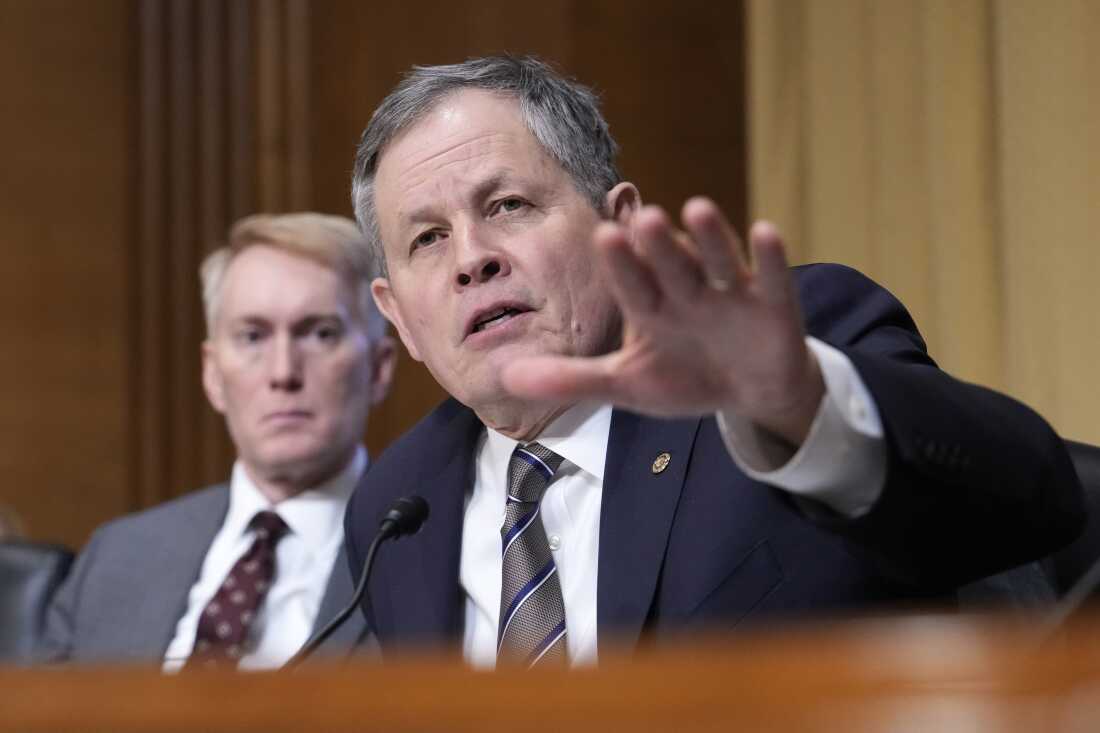
Sen. Steve Daines, R-Mont., speaks at the Senate Finance Committee confirmation hearing for Scott Bessent, President-elect Donald Trump’s choice to be Secretary of the Treasury, at the Capitol in Washington, Thursday, Jan. 16, 2025.
Ben Curtis/AP/AP
hide caption
toggle caption
Ben Curtis/AP/AP
“I’m also very thankful to have served alongside President Trump and my colleagues in the Senate,” Daines said in the video. “Together we built a conservative majority on the Supreme Court, we delivered the largest tax cut in U.S. history, we unleashed American energy dominance and secured our southern border.”
Daines’ late hour withdrawal presumably clears the way for his chosen successor, Kurt Alme, the U.S. Attorney for Montana until he declared his candidacy for Daines’ seat. Daines later said withdrawing earlier could have enticed a prominent Democrat like Tester to enter the race.
Independent Seth Bodnar says it reminds him of the Montana of old.
“We have direct election of senators in the United States in part because of political corruption in this state 125 years ago, Copper Kings trying to buy U.S. Senate seats,” Bodnar says. “That didn’t work back then and it’s not going to work right now.”
But Democrats say Bodnar’s entry as an independent will just split the liberal vote.
The GOP base is angry too
“Montanans are getting very indignant about what they see as out and out dishonesty,” says Roger Koopman, a former Republican legislator and Montana Public Service commissioner from Bozeman.
Koopman says the party establishment’s backroom dealing is a gift to Democrats and especially Seth Bodnar, who he says is a liberal running as an independent.
“They’re going to say, ‘hey, I’m over these Republicans playing games with me, you can’t do that and expect me to vote for you, I’m not going to vote Democrat, but here’s this guy out here who says he’s independent, let me give him a try,’” Koopman says.
Alme has been keeping a low profile. Political pundits say that might be by design. A campaign spokesperson sent NPR this statement: “Anyone could run for this seat. Kurt is running on his record as the Trump-endorsed candidate of common sense who knows how to be tough on violent crime, dismantle drug cartels, and deliver historic tax relief. Voters will decide, and Kurt is confident in his work serving Montana and helping President Trump put America First.”
At Montana State University, political science department chair Eric Austin says he expects party tensions will cool and Republicans will rally around their nominee by November.
“I think in part that speaks to the changes in the electorate in the state,” Austin says. “As the state has become more red, people have more strongly affiliated themselves with the Republican Party and less as independents.”
However, Austin says the midterms will be a referendum on President Trump and there’s growing economic anxiety in Montana. Farmers are getting hurt by Trump’s tariffs. His Iran War has sent fertilizer prices soaring, raised interest rates and the cost of gas.
Back in Butte, at the St. Paddy’s Day parade, longtime Democratic activist Evan Barrett says there’s a resurgence in populist resentment in Montana.

Longtime Montana Democratic party activist Evan Barrett at the St. Patrick’s Day parade in Butte, Montana, March 17 2026
Kirk Siegler/NPR
hide caption
toggle caption
Kirk Siegler/NPR
“It’s almost like a repetition of the past,” says Barrett, a one time economic aide to former Governor Brian Schweitzer.
Ducking into an old storefront to take a break from the spectacle of the parade, Barrett told NPR there’s a feeling in the electorate that a lot of outside money is coming into influence politics, but not staying in Montana and being invested into things like schools.
“So this is a really wild and different year,” Barrett says. “Anybody that tells you they know what’s gonna happen, well, be a bit skeptical.”
President Trump has endorsed last minute Senate candidate Kurt Alme but it’s not clear what kind of effect that might have on voters in November.

new video loaded: Savannah Guthrie Says She Believes Her Mother Was Taken for Ransom
transcript
transcript
Savannah Guthrie Says She Believes Her Mother Was Taken for Ransom
Savannah Guthrie spoke on the “Today” show in her first interview since her mother, Nancy Guthrie, was abducted from her home near Tuscon, Ariz.
-
“The ransom note, notes for ransom requests came. Did you believe those to be real?” “The two notes that we received that we responded to — I tend to believe those are real.” “Really?” “We still don’t know. Honestly, we don’t know anything. We don’t know anything. So I don’t know that it’s because she’s my mom. But yeah, that’s probably — which is too much to bear to think that I brought this to her bedside, that it’s because of me. And I just say, I’m so sorry, Mommy. I’m so sorry. We need answers. We cannot be at peace without knowing. And someone can do the right thing. And it is never too late to do the right thing.”
By Christina Kelso
March 26, 2026

Kim says GOP offer is “not where we want it to be”
Democratic Sen. Andy Kim of New Jersey said Democrats are continuing to evaluate the Republicans’ offer but said it does not go far enough.
“We’re talking through it right now but it’s not where we want it to be,” Kim said off the Senate floor. “We just continue to be stuck here.”
Kim said “we’re hunkered down” and “hopefully we can just continue to hash it out.” He did not give details about the latest offer, noting that conversations are “evolving in real time.”
“But for me, it’s not good enough for me,” he added.
Senate now voting on advancing DHS funding
The Senate is taking a procedural vote on funding for DHS. The vote marks the seventh attempt to advance the measure, which needs 60 votes.
Asked whether the vote would be considered a response to the latest GOP offer, Thune said, “Hopefully there will be, yeah, there will be some finality in this real soon.”
“We’re going to know real soon,” he added.
Photo ID amendment fails in party-line vote
The amendment that would have required voters to show photo identification to cast a ballot failed to advance. The vote was 53-47, falling short of the 60 votes needed to succeed.
The vote came during the second week of a marathon debate over a controversial elections bill known as the SAVE America Act, which would require proof of citizenship to register to vote and certain forms of photo ID to cast a ballot. The legislation does not have enough support to clear the 60-vote threshold in the upper chamber, but President Trump has dialed up the pressure on Senate Republicans to find a way to force it through.
Read more here.
.
Britt says Republicans have had “very fruitful conversations” with Democrats
GOP Sen. Katie Britt of Alabama, who has been involved in talks to end the stalemate, told reporters that Republicans have had productive conversations with Democrats.
“We had very fruitful conversations last night with some of our Democrat colleagues and this morning. So, you know, I hope that we can find that pathway. I think that’s what’s best,” she said. “These missions don’t need to go unfunded, particularly at such a critical time in our nation’s history, and also the men and women that are working need to get paid.”
Senate begins vote on advancing amendment on photo ID for voting
The Senate has begun a vote on invoking cloture on an amendment that would require a photo ID to cast a ballot in federal elections. It needs 60 votes to succeed.
The vote on advancing DHS funding is expected next.
King says Democrats are reviewing GOP offer
Sen. Angus King, an independent who caucuses with Democrats and has been involved in the talks over DHS funding, said Democrats are going over the latest Republican proposal.
“We’re reviewing that offer now,” King told reporters.
Thune: “Hopefully we can find a pathway to drive this to the finish”
Leaving the floor, Thune didn’t share details about the latest GOP offer, noting that the text is now in front of Democrats. But he stressed that “it’s important that we try and close this down and get it done today.”
“Let’s let the Dems react to what’s out there, and hopefully we can find a pathway to drive this to the finish,” Thune said.
He said the White House has been involved in “the back-and-forth that has occurred overnight and all morning.” He also suggested that the offer is close to what Republicans offered early this week, which Democrats rejected because it didn’t include reforms to ICE.
Asked about the possibility of delaying the Senate’s recess, Thune said If DHS funding isn’t resolved, “I suspect we’ll probably be around here.”
Thune says Republicans sent Democrats “last and final” offer
Entering the Senate chamber, Thune told reporters that Republicans have made a final offer to Democrats.
“The Dems are now in possession of what I think is our last and final,” Thune said. “So let’s hope this gets it done.”
Senate moves up votes to 1 p.m.
The votes that were originally scheduled for 1:30 p.m. — on the voter ID amendment and advancing DHS funding — will now take place at 1 p.m., according to Majority Whip John Barrasso’s office.
House to vote for third time on DHS funding
The House will vote this afternoon on legislation to fund DHS as movement on the issue remains stalled in the Senate.
The lower chamber has twice passed legislation to fund the entire department through September, but it’s been effectively dead on arrival in the Senate as it’s been unable to overcome the 60-vote threshold to advance.
A vote is also planned on a resolution “expressing the support of the House” for the department. The resolution would do little beyond offer gratitude for DHS employees.
Votes are expected to begin around 2 p.m.
House Democrats, meanwhile, are trying to force a vote on legislation to fund all of DHS except ICE and CBP. But their discharge petition, introduced last week, is short of the 218 signatures needed to move forward. So far, 205 of 214 Democrats have backed it. It would also need the support of four Republicans.
GOP senator says talks to end impasse have increased
Sen. John Hoeven, a North Dakota Republican involved in the DHS negotiations, told reporters at the Capitol that talks continue and have increased.
“We put options in front of the Democrats, and they just need to quit backing up on us and vote to get DHS funded and TSA agents paid,” Hoeven said.
He cited developments since the initial Democratic opposition to funding DHS, including the new leadership at the department and the deescalation in Minneapolis, along with some of the reforms within the initial DHS bill that remain on the table.
“I’m hoping that as we get to the end of this week — you know how it works around here with deadlines — that that’s going to get us to a point where we get it done,” he said. “But we’re still working.”
Hoeven said it’s a good thing that the Senate has begun voting, with a failed vote Wednesday on advancing the DHS bill and another vote set for later this afternoon. He said “I think that helps get some movement.”
“We’re just trying to find what it’s going to take to bring folks together and get it done,” Hoeven said.
Thune: “We’re trying to narrow it in and home in on a deal”
Thune, appearing on Fox News on Thursday morning, accused Democrats of moving the goalposts and “talking in circles” on DHS funding.
“Every single day they move the goalpost,” Thune said. “They said we don’t want to fund ICE. And now they’re saying we don’t want to fund ICE and we want reforms.”
The majority leader said “we’re trying to narrow it in and home in on a deal” that can be struck in the “very near future.” But he argued that for Democrats, it’s “all about politics.”
“I think they’re just playing politics with this, have been from the beginning,” Thune said. “They think it’s really good with their base.”
Thune said “this has got to stop,” adding that “I think they’re going to come to their senses — I hope they do.”
Asked whether the Senate will go on its scheduled recess, Thune reiterated that “it’s very hard to take off if we don’t have DHS funded.”
“Obviously we’re looking at optionality in terms of what it would take if we have to be here,” Thune said. “But one way or the other, we have to get this done.”
Trump warns of “very drastic measures” without end to shutdown
At the beginning of a Cabinet meeting at the White House, President Trump blasted Democrats for the ongoing impasse, saying they are “really punishing the American people.”
“They need to end the shutdown immediately, or we’ll have to take some very drastic measures,” the president said, without elaborating.
Senate to take up voter ID amendment, DHS funding beginning at 1:30 p.m.
The Senate is scheduled to convene at noon and will take two votes at 1:30 p.m, according to a notice from Majority Whip John Barrasso’s office.
The first vote will be on advancing an amendment to the SAVE America Act, which would require photo ID to cast a vote. The second vote will be on advancing the DHS funding measure. Additional votes are possible later in the day.
Sen. Ron Johnson renews call to end the filibuster
GOP Sen. Ron Johnson of Wisconsin wrote an op-ed Thursday advocating for changing the Senate rules to end the 60-vote threshold required to advance most legislation in the chamber, a position he has been reiterating in recent days.
“I’m not sure how things could get much worse by ending the filibuster,” Johnson wrote in the Daily Wire. “The status quo certainly isn’t working. I think it’s obvious things must change — we need a paradigm shift.”
Johnson described dysfunction in the Senate, pointing particularly to the funding process and the five shutdowns that have occurred since he came to Congress in 2011. He compared the Senate to “plaque clogging an artery leading to a heart attack.”
He acknowledged those in his party who wish to preserve the filibuster and argue that it fosters bipartisanship. But the Wisconsin Republican said that, if the filibuster ends, “we all might be surprised to find senators attempting to find common ground on more issues to help ensure bills pass with bipartisan support.”
Johnson opposed ending the filibuster until last fall’s 43-day shutdown, the longest in U.S. history. In 2022, Johnson said Democrats who wanted to abolish the practice were attempting a “naked power grab.”
Trump floats ending the filibuster to open DHS
President Trump floated ending the Senate’s 60-vote threshold to reopen DHS, asking, “When is ‘enough, enough’ for our Republican Senators.”
“There comes a time when you must do what should have been done a long time ago, and something which the Lunatic Democrats will do on day one, if they ever get the chance,” Mr. Trump said in a post on Truth Social. “TERMINATE THE FILIBUSTER, and get our airports, and everything else, moving again.”
The president urged the Senate to also add the SAVE America Act, an election bill he has repeatedly pushed Congress to pass. Earlier this week, he threw a wrench into DHS talks when he told Republicans not to make a deal with Democrats and to instead link the elections bill to DHS funding.
Thune has repeatedly said there isn’t support for ending the filibuster within the GOP conference.
The president claimed in another post that Senate Minority Leader Chuck Schumer “will make a deal now because he thinks that if he doesn’t, Republicans will TERMINATE THE FILIBUSTER, something which they should do whether he makes a deal or not!!!”
Senate schedule up in the air as recess looms
The Senate is scheduled to be on recess for two weeks starting next week. But Thune has kept the door open to keeping the chamber in town if the impasse persists.
The majority leader told reporters as the Senate convened Wednesday that no decisions had been made yet on whether senators would stay in town if they’re unable to reach a deal.
“I think it’s awfully hard not to have the government funded if we’re not here,” Thune said.
Later Wednesday, Thune suggested that the deadline could put pressure on senators, who often leave town on Thursday nights, to reach a deal.
“You know how it is around here. It’s not Thursday yet,” Thune said. “And sometimes you’ve got to let things run. We’ll see where the deal might land.”
Senate to vote again on advancing DHS funding
The Senate is set to vote Thursday afternoon on advancing a DHS funding measure. The motion fell short of the 60-vote threshold needed to succeed on Wednesday for the sixth time.
It was the first time the chamber took the vote with the promise of the GOP offer, which would amend the measure funding all of DHS by stripping out the funds for ICE’s Enforcement and Removal Operations division. Just one Democrat, Sen. John Fetterman of Pennsylvania, voted in favor of moving forward. But Republicans are hoping to peel off more support on Thursday.
Democrats pushing for reforms after GOP offers to forgo ICE deportation funding
Republicans quickly rejected Democrats’ counterproposal to fund the government and secure ICE reforms like boosting training standards and requiring immigration officers to wear identification on Wednesday. They criticized the offer as unserious, arguing that if Democrats refuse to fund ICE, they don’t have grounds to seek reforms to the agency.
Democrats see things differently.
Independent Sen. Angus King of Maine, who struck a deal with Republicans to end the last shutdown, outlined that ICE’s Homeland Security Investigations division and Customs and Border Protection would be funded under the GOP offer. He claimed that “right now, most of HSI is in ICE doing ERO work.”
“It’s an illusory solution, if they can man ICE with people from … CBP and HSI,” King said. “I don’t have any problem with HSI and CBP doing their jobs. But not if they’re doing ICE’s job.”
Despite the GOP pushback on Democrats’ effort to secure reforms, Thune suggested later in the day that there is some room for negotiation, saying if Democrats “get a more realistic set of proposals, or a more realistic offer on the table, then we’ll be back in business.”
The majority leader also didn’t rule out the possibility of a short-term measure to fund the government while conversations continue on a long-term solution.
LAPD chief backed cops who shot at author, Weezer bassist’s ex; commission overruled him

What European Luxury Can Learn From American Fashion

Bill Maher on getting the Mark Twain Prize for humor: ‘Like an Emmy, except I win’

Prep sports roundup: Redondo Union takes down No. 1 Mira Costa in boys volleyball

Rubio joins crucial G7 talks as Iran war set to dominate second day

Florida High School Football Rankings: Top 25 teams – Oct. 21

How old is Bo Nix? What to know about Oregon quarterback ahead of 2024 NFL Draft

Cleary's 21 help Le Moyne down Central Connecticut State 69-64 in OT

99th annual Pony Swim held in Virginia

Indiana Members Credit Union announced as new anchor tenant at Bottleworks District
Rubio joins crucial G7 talks as Iran war set to dominate second day
A surprise resignation could open the door for an independent to win a Montana Senate seat

Video: Savannah Guthrie Says She Believes Her Mother Was Taken for Ransom

Stefanik grills University of Michigan leader on lack of audit after string of Chinese national arrests

Photos: More than one million displaced by Israel’s evacuations in Lebanon
-

 Detroit, MI1 week ago
Drummer Brian Pastoria, longtime Detroit music advocate, dies at 68
-

 Science1 week ago
How a Melting Glacier in Antarctica Could Affect Tens of Millions Around the Globe
-

 Movie Reviews1 week ago
‘Youth’ Twitter review: Ken Karunaas impresses audiences; Suraj Venjaramoodu adds charm; music wins praise | – The Times of India
-
 Science1 week ago
I had to man up and get a mammogram
-

 Sports6 days ago
IOC addresses execution of 19-year-old Iranian wrestler Saleh Mohammadi
-

 New Mexico4 days ago
Clovis shooting leaves one dead, four injured
-

 Texas7 days ago
How to buy Houston vs. Texas A&M 2026 March Madness tickets
-

 Tennessee3 days ago
Tennessee Police Investigating Alleged Assault Involving ‘Reacher’ Star Alan Ritchson