News
Power outages and canceled flights as winter storm brings snow, sleet and ice

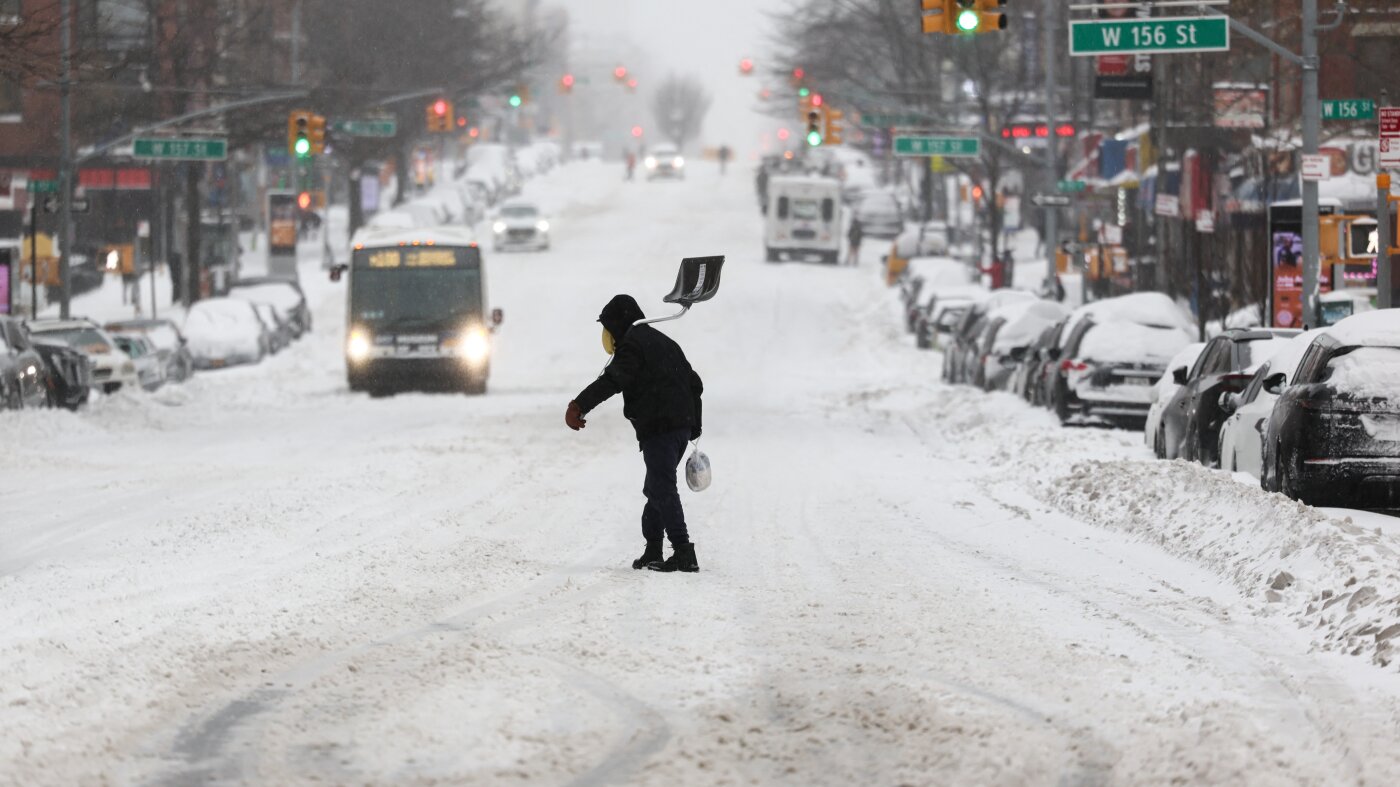
A man carries a shovel as he crosses a street in the Hamilton Heights neighborhood in New York on Sunday.
Charly Triballeau/AFP via Getty Images
hide caption
toggle caption
Charly Triballeau/AFP via Getty Images
An immense and powerful winter storm is blanketing the eastern two-thirds of the United States with a mix of heavy snow, dangerous ice and frigid temperatures, affecting tens of millions of people from New Mexico to New England.
Nearly a million customers across the South were without power on Sunday evening, as the effects of the weekend’s massive weather system began to take hold. Tennessee, Mississippi, Louisiana and Texas were among the hardest hit.
States from Missouri to Maine were under a winter storm warning on Sunday. National Weather Service forecasters were particularly concerned about freezing rain and ice.
“Whenever we see these big ice events, we’ll see various hazards; obviously bridges and overpasses being frozen over, and with trees and various different things that could fall into the roadways or potentially fall on houses,” Nicholas Price, an NWS meteorologist in Texas, told NPR earlier.
The storm severely disrupted air travel. By Sunday evening, over 11,000 flights had been canceled in the U.S. and more than 4,700 were delayed, according to FlightAware.
Officials in multiple states also warned drivers to stay off the roads unless absolutely necessary.
Reporters from across the NPR Network are covering the storm in each state — the impact and how officials are responding. We’ve also got tips for interpreting different weather notices, protecting your home or vehicle ahead of time, and for staying safe once the storm hits.
Alabama
- Northwest portions of the state, including Lauderdale County, are some of the areas impacted most by the storm.
- Under 2,000 people are without power in western parts of Lauderdale County, according to Lauderdale County Emergency Management Agency Director Brad Holmes. Up to an inch of ice has accumulated on power lines and trees, with over 100 trees reported down across roadways throughout the county, Holmes told NPR on Sunday.
- About 11 vehicles got stuck or slid off the road, with at least three crashes, while five people have been transported to the hospital because of falls, Holmes also said.
- Alabama Gov. Kay Ivey issued a state of emergency and activated the Alabama National Guard. More than 350 service members have been activated and are assisting efforts in North Alabama, according to the Alabama National Guard.
- The Alabama Department of Transportation on Sunday urged people to “avoid travel after temperatures drop and wait for conditions to improve.”
Arkansas
- Gov. Sarah Huckabee Sanders declared a state of emergency Thursday and deployed at least 170 national guard service members to assist with the storm. The Arkansas National Guard said it was assisting Arkansas State Police.
Connecticut
Delaware
- By Sunday afternoon, several areas had recorded more than 6 inches of snow.
- Gov. Matt Meyer urged residents to stay home. “This is not a let-me-run-out-to-the-convenience-store-real-quick kind of storm,” he said in a video on social media. “Let’s do everything we can to keep each other safe.”
- Beginning Sunday morning in New Castle and Kent Counties, driving was limited to emergency workers, public utilities, health care providers, snow removal operations, food and fuel deliveries and those with approved waivers.
- Department of Transportation Community Relations Director C.R. McLeod said staff brined roads statewide on Friday to get ahead of freezing conditions once precipitation began.
District of Columbia
Georgia
- The storm brought freezing rain, sleet, and snow to parts of northern and middle Georgia. A winter storm warning is in effect through Monday.
- The University of Georgia closed its campus and announced that all in-person classes, campus events and activities will be canceled on Monday. The impacts of the storm will likely be felt days after the worst of the weather has passed, as officials say hazardous road conditions could affect Monday morning commutes.
For more information, head to WUGA.
Illinois
- A snow emergency has been declared by the City of Springfield’s Office of Public Works through Monday at noon.
- There have been eight collisions with snowplows, according to the Illinois Department of Transportation. “That’s 8 fewer plows clearing roads. If you can, please stay home. If you must drive, slow down, don’t crowd the plow, and give our crews plenty of space to work safely,” the agency said on Sunday.
Indiana
- The NWS warned of frostbite and said wind chills could reach 20 degrees below zero on Monday in northern Indiana.
- The Indiana Department of Transportation said Sunday there have been “multiple reports of crashes and slide-offs” and is urging people to stay off the roads.
- Indiana’s electric grid operator declared a conservation alert, asking customers to conserve energy and prepare for the possibility of “planned outages.”
- Parts of Indiana recorded more than 12 inches of snow by mid-day Sunday and forecasters warned of another 1-3 inches late Sunday into Monday in the northern part of the state.
Kentucky

A vehicle drives through snowy conditions on Sunday in Louisville, Ky.
Jon Cherry/Getty Images
hide caption
toggle caption
Jon Cherry/Getty Images
- At least 75,000 people were without power “and that number is expected to increase as ice accumulates,” Gov. Andy Beshear said on Sunday.
- There are 113 warming centers across the commonwealth, according to officials.
- The NWS says central and eastern Kentucky could get the most snow they’ve seen in 10 years. Ice accumulations are more than expected, Beshear said.
- In the city of Lexington, the storm “will more than likely take its place among the top 10” since 1887, says Emergency Management Director Rob Larkin.
- Kentucky Utilities has an instant text and call alert service to inform customers about outages.
Louisiana
- More than 140,000 customers were without power on Sunday afternoon.
- Louisiana Gov. Jeff Landry declared a state of emergency, which his office says “activates the State’s emergency response and recovery program, allowing for direct state assistance to support operational measures at the parish level.”
- In the northern city of Monroe, Mayor Friday Ellis declared a state of emergency.
For more resources on Louisiana, head to KEDM.
Maine
- Snow was expected to pick up in the far northern state Sunday afternoon, but the NWS office in Gray said Sunday morning that it had already received reports of light snow and flurries.
- Wind chills could reach 25 below zero on Sunday through Monday. “Probably the coldest temperatures are going to be seen up north and across the Western Maine mountains,” said Steven Baron, a meteorologist in Gray.
- Snow was forecast to fall Sunday afternoon through Monday evening.
Maryland
- Gov. Wes Moore declared a state of emergency and urged people to stay off the roads and to check on neighbors.
- Hundreds of flights were canceled at Baltimore/Washington International Thurgood Marshall Airport on Sunday.
- The Baltimore Animal Rescue and Care Shelter is looking for people to foster dogs.
Massachusetts
Mississippi
- More than 150,000 customers were without power on Sunday afternoon. Gov. Tate Reeves said power restoration was hindered by icy roads across the state.
- Todd Jordan, mayor of Tupelo, told NPR’s Ayesha Rascoe that the state has been experiencing power outages. He said the biggest issue the state is seeing is downed trees due to freezing rain.
Missouri
Nebraska
- Several cities, including Lincoln and Omaha, are activating warming centers for people seeking a reprieve from the frigid temperatures.
New Hampshire
- As the Granite State braces for extreme cold, including temperatures of -30 degrees and wind gusts of up to 100 miles per hour, New Hampshire Public Radio has resources for finding shelters and staying safe in the frigid weather.
- Warming centers were open across the state, with people encouraged to call 211 to find the nearest location, Gov. Kelly Ayotte said.
- New Hampshire Fish and Game Sergeant Matthew Holmes is warning hikers against venturing out during the storm, but also offered recommendations on how to stay safe in hazardous conditions. “Although [hiking] is something that I worry about, and often drives me nuts, I know it’s going to happen and we’re going to have folks out there,” he said.
New Jersey
- On the heels of her inauguration, Gov. Mikie Sherrill announced an emergency declaration that went into effect for all 21 counties. Sherrill also announced a commercial vehicle travel restriction on interstate highways.
- Snow fell steadily across New Jersey on Sunday. Trenton had received more than 7 inches of snow by early afternoon, the NWS reported.
- State offices were set to be closed Monday, and New Jersey Transit temporarily suspended bus, light rail and Access Link on Sunday.
- Acting Attorney General Jennifer Davenport warned businesses not to violate the state’s price gouging law during the snowstorm.
New York
- State officials said most of New York is expected to receive 1-2 feet of snow, while New York City and Long Island could get sleet.
- Gov. Kathy Hochul urged residents to stay indoors, layer to stay warm and check on their neighbors.
- The largest school district in the U.S. will hold remote classes on Monday. New York City Mayor Zohran Mamdani said city schools would operate remotely, though school buildings would be closed.
- Parts of the North Country could see wind chills as low as 50 below zero. Much of Central New York is also preparing for a week-long winter cold snap.
- Bonus: Gothamist has recommendations for how to make the most of the snowstorm.
For more resources by region in New York, head to WSKG.
North Carolina
For more resources in North Carolina, including where to find shelter, head to WUNC.
Ohio
- The National Weather Service is predicting a total snowfall of eight inches to a foot in central Ohio this weekend.
- Rock salt shortages may make driving in Northeast Ohio this winter more treacherous than usual.
- As extremely cold temperatures grip Northeast Ohio, emergency doctors are warning that frostbite can develop faster than many parents realize, especially in children. “Thirty minutes or less typically is all the time that’s required to develop frostbite in exposed individuals when the windchill is near zero,” said MetroHealth emergency physician Dr. Jeremiah Escajeda. She advises dressing children in layers, keeping extremities covered and changing out of wet clothing.
For the latest in Ohio, head to WVXU.
Oklahoma
- The winter storm has exited Oklahoma, as the state saw multiple rounds of snow on Sunday.
- While the storm has largely passed, officials say hazardous road conditions remain and the biggest danger going forward will be the cold temperatures that are forecast to drop as low as -15.
Pennsylvania
- By early afternoon Sunday, multiple Pennsylvania cities had already seen more than half a foot of snow. Philadelphia received 7.4 inches as of 1 p.m. ET, while 8.4 inches fell in Reading and Allentown received 9.2 inches.
- Philadelphia Mayor Cherelle Parker urged residents to “please remain off the roads unless you absolutely have to travel.” City schools will be closed Monday. SEPTA suspended all bus and light rail operations.
- Photos show the extent of Philadelphia’s first major storm of the year.
- Pittsburgh Mayor Corey O’Connor said he’s “expecting the worst” from the storm, which is projected to drop between 9-14 inches of snow on the area. He said he is prepared to call in additional contractors and haulers to deal with the snow.
- This could be the most significant winter storm in Pittsburgh in five years. “We’ll be on the northwest fringe of this storm track where the heavy snow will be occurring,” NWS meteorologist Chris Leonardi said of Pittsburgh.
- Central Pennsylvania will also see double-digit snowfall and cold temperatures.
- Gov. Josh Shapiro said Sunday that 2,600 plow trucks were out clearing Pennsylvania roads.
South Carolina
- NWS offices across the state issued a variety of alerts, including an ice storm warning and a winter weather advisory, which will run through Monday morning.
- Gov. Henry McMaster urged South Carolinians to heed emergency warnings.
- State Transportation Secretary Justin Powell said 3,000 road crew personnel will work statewide through the storm’s duration. Powell said 1.5 million gallons of brine have already been put on the roads.
- Forecast models show ice thickness between 0.5 and 1 inches occurring around Greenville and Rock Hill by the time the winter storm’s precipitation ends on Monday. Low temperatures on Tuesday morning are expected to reach the single digits across parts of the Upstate.
Tennessee

Memphis residents shovel snow from a sidewalk in downtown Memphis, Tenn., on Sunday.
Kevin Wurm/AFP via Getty Images
hide caption
toggle caption
Kevin Wurm/AFP via Getty Images
- The Tennessee Emergency Management Agency (TEMA) said Sunday that much of the state is experiencing snow or sleet, with freezing rain set to come later. Much of the state will also receive a quarter-inch of ice, while some areas will see a half-inch, TEMA said.
- More than 316,000 customers have lost power in Tennessee, and power restoration could take days. WPLN’s Rose Gilbert told NPR’s Weekend Edition that Nashville had seen a spike in outages. “People have reported hearing these loud cracking noises, with trees coming down — as well as what looks like lightning, but is related either to transformers blowing out or arcing from the power lines,” Gilbert said.
- But there were also moments of levity as the storm beared down. On Saturday, Gilbert observed dozens of people sledding at the Tennessee State Capitol in Nashville “with everything from old-fashioned wooden sleds to pool floaties and cardboard boxes. It was a bit of a party scene. There was kind of an ad hoc après-ski sort of feel.”
For the latest in Tennessee, head to WKNO.
Texas
- At least one person is confirmed to have died from extreme cold, according to Austin Mayor Kirk Watson.
- The Austin area is experiencing a thicker than anticipated layer of frozen precipitation, making road conditions treacherous.
- Colder temperatures are still to come: “Tonight, it is going to get very, very cold, so any moisture that’s left out there … it is going to refreeze,” Brian Mason, the city of Houston’s emergency management director, said on Sunday. “When the sun goes down, please make sure you’re off the roads and take the burden off our first responders that will be out in the field.” Southeast Texas is under an extreme cold warning through Tuesday morning.
- Early voting in the Houston City Council election was initially scheduled to continue through Tuesday, but the polls are closed Sunday and Monday because of inclement weather. Schools across the state also announced closures.
For more resources in Texas, head to Texas Public Radio.
Vermont
- Forecasters predict snowfall reaching 8 to 16 inches, with up to 2 feet possible in some areas.
- Seven extreme cold weather shelter locations will be open over the weekend. Most are part of a state-funded network of overflow shelters that activate when temperatures fall into the negatives.
- The Vermont Department of Motor Vehicles has also placed a travel restriction on Route 9 through 7:00 p.m. Monday.
Virginia
- Gov. Abigail Spanberger issued an emergency declaration and said it will take time for state agencies to clear roads in the coming days and asked people to stay home.
- The Virginia State Police on Sunday urged people to avoid travel, saying wet roads across the state will turn icy overnight.
- Virginia State Police also told NPR that as of Sunday night they had responded to 378 crashes, 28 of which had injuries. There had been one fatal crash, which Virginia State Police was investigating in northern Virginia in Fairfax County, although weather was not being looked at as a factor in this crash.
West Virginia
- As temperatures drop, the West Virginia Department of Transportation urged people to be aware of black ice: “We need you to PAY ATTENTION and SLOW DOWN when traveling in these conditions.”
- Warming centers for unhoused people have opened across the state. “We won’t turn anybody away,” said shelter director Crystal Neff. “We’ll find ’em a sleeping bag or a blanket, whatever we have, to make sure everybody’s safe.”


Lionel Messi #10 of Argentina celebrates scoring his team’s second goal during their World Cup match against Egypt in Atlanta on Tuesday.
Elsa/Getty Images
hide caption
toggle caption
Elsa/Getty Images
They looked beaten. And out. Argentina, the defending World Cup champion and No. 1-ranked team, was down 2-0 late against Egypt.

Then, in a span of 13 remarkable minutes, Argentina scored not once, not twice, but three times, capping a comeback for the ages and leaving Egypt stunned and shellshocked.
For much of the game in Atlanta, Egypt was in control, hobbling Argentina early. The Egyptian attack began almost immediately with a stunning header goal delivered by Yasser Ibrahim in the 15th minute. After that, Egypt’s defense closed ranks, making it practically impossible for Argentina to equalize.
It was downhill from there for the Argentines: team captain Lionel Messi failed to convert a penalty kick, and in the 67th minute, Egypt got a second goal from Mostafa Ziko (after an earlier Egyptian goal had been disallowed after a video review). It looked like Argentina was finished. On the brink of elimination.
But no one told the Argentine players that.
In the 79th minute, Lionel Messi began doing his thing. He fired a cross near the Egyptian goal, and Cristian Romero headed it in. Messi was not done. Four minutes later, he powered a shot past the Egyptian keeper. It was his eighth goal of this tournament, the most of any player. The score was 2-2.
Then, in stoppage time, yet another Argentina header and another goal, this time from Enzo Fernandez.
“This is the World Cup for you,” said Messi after the game. “It wasn’t easy to come back from two goals down. But as I always say, this group never gives up. We always try to fight until the end.”

French referee François Letexier speaks with Egypt forward Mohamed Salah during the World Cup Round of 16 match between Argentina and Egypt in Atlanta.
Roberto Schmidt/AFP via Getty Images
hide caption
toggle caption
Roberto Schmidt/AFP via Getty Images
Afterward, Egypt coach Hossam Hassan complained about the French referee and the officiating. “I am not convinced. I am not convinced with this outcome. I’m not convinced with the way things unfolded during this match,” said Hassan in a post-match news conference. “We have been treated unfairly today. We have suffered injustice.”
“We would have deserved to earn this win, but we are leaving with honor, with pride, regardless of this defeat,” said Hossan.
African soccer teams have been the stars of this World Cup. Morocco has yet to lose a game. Cape Verde qualified for the first time in its history and stymied Spain, Uruguay and Saudi Arabia. Argentina barely beat them in a nail-biter of a match.
For Egypt, getting this far in the tournament is historic in itself: it’s the first time the team has made it this far. For Argentina, it was a terrifying yet relieving victory: several players, including Messi himself, cried after the game.
Next, they move to the quarterfinals and will play the winner of today’s Switzerland-Colombia match.

Top Senate Democrats are pushing for answers on whether a provision in a controversial settlement agreement between President Trump and his own administration applies to companies co-founded by or affiliated with the Trump family.
As part of a deal struck in May by the Justice Department to resolve a lawsuit brought by Mr. Trump, the Internal Revenue Service is permanently barred from pursuing claims against Mr. Trump, his oldest sons Don Jr. and Eric, and the Trump Organization based on prior tax returns.
In a one-page document signed by Acting Attorney General Todd Blanche and dated May 19, the Justice Department said the defendants in the president’s lawsuit — the IRS and the Treasury Department — are “FOREVER BARRED and PRECLUDED” from “prosecuting or pursuing, any and all claims” arising from tax returns filed before the settlement took effect. Blanche also wrote that the settlement applies to “parties including trusts, parent, sister, or related companies, affiliates, and subsidiaries.”
Now, Senators Elizabeth Warren of Massachusetts, Senate Minority Leader Chuck Schumer of New York, and Ranking Member of the Senate Finance Committee Ron Wyden of Oregon are pushing 11 businesses and organizations with ties to the Trump family to get answers for the “significant questions” the settlement raises relating to the tax audit provision, and whether the companies are included in the deal.
“Under the guise of a so-called legal settlement, the Trump administration has attempted to decree that the President, his family, and their entire business empire — potentially including entities with even the vaguest ‘affiliation’ to the family — are to face zero consequences if they have committed a range of financial crimes or misdeeds — regardless of the severity of the violation,” the senators wrote in letters transmitted to the companies Monday night.
The letters were sent to mining company Kaz Resources, defense firm Powerus, cryptocurrency companies World Liberty Financial and American Bitcoin, robotics startup Foundation Future Industries, investment firm 1789 Capital, private aviation company Tag Air, and prediction markets Polymarket and Kalshi.
All of the companies either were founded by Mr. Trump and his two adult sons, or list members of the Trump family as advisers, board members, or partial owners. Donald Trump Jr. sits on Polymarket’s advisory board and 1789 Capital, where he’s a partner, has invested in Polymarket. Days before Mr. Trump took office for his second term, Kalshi also announced Trump Jr. would be a strategic adviser.
The Democrats, who are in the minority, lack subpoena power, so Mr. Trump, his children and his companies can’t be forced to answer the questions posed by the senators.
According to recent financial disclosures, the president earned more than a billion dollars from cryptocurrency ventures alone last year, including from his meme coin business and World Liberty Financial, his family’s cryptocurrency firm.
Separately, the senators also asked the Trump Organization in a separate letter if it believes it has “immunity from all audits, civil penalties or federal prosecution” for any crimes that could have occurred before the settlement.
Trump Media and Technology Group, which is majority owned by a trust that lists Mr. Trump as the sole beneficiary and operates the Truth Social platform he uses daily, also received a letter from the Democratic senators.
“The public deserves transparency about the scope of this get-out-of-jail free card for Trump-aligned businesses, and about whether you intend to rely on this settlement as a free pass for any possible violations of the law,” the senators continued in their letter, which also seeks any communications that executives at the companies have had with the Justice Department and White House leading up to or after the settlement was signed.
The settlement was announced months after Mr. Trump and two of his sons and the Trump Organization accused the IRS and Treasury Department of unlawfully allowing a government contractor to leak tax returns to media outlets in 2020.
In a statement, a Justice Department spokesperson said “the IRS routinely provides releases as part of resolving taxpayer reviews and audits. This settlement follows that same standard practice.”
The spokesperson did not provide specific information about which companies are covered by the audit provision, or whether the Trump Organization and Trump family are the only entities covered by that addendum.

Charles De Ketelaere #17 of Belgium celebrates after scoring his team’s second goal during the World Cup Round of 16 match against the United States on Monday in Seattle.
Alex Grimm/Getty Images
hide caption
toggle caption
Alex Grimm/Getty Images
SEATTLE — This time was supposed to be different.
The U.S. men’s national team came into this FIFA World Cup with a lineup full of players with key roles in Europe’s top leagues. They had the name-brand coach — Mauricio Pochettino, of Tottenham, PSG and Chelsea fame. And they had homefield advantage, with every game on U.S. soil for the first time in three decades.

For weeks, the hype seemed like it might be real: The team’s three wins over Paraguay, Australia and Bosnia-Herzegovina were the most ever by a U.S. men’s squad in a World Cup. A new generation of American fans filled stadiums by the tens of thousands and tuned in on TV by the tens of millions.
But in the end, the Americans’ exit was the same as it ever was: Eliminated yet again in the Round of 16 at the hands of a European team — this time, Belgium, by a score of 4-1.
From the moment they stepped onto the Seattle field, the U.S. was outclassed by their opponent, No. 9-ranked Belgium. Countless turnovers and defensive lapses were seized on by the Belgians, who needed only nine minutes to take a 1-0 lead.
Then, once the Americans equalized on a free kick by midfielder Malik Tillman, Belgium scored yet again in barely a minute of play. Belgian forward Charles De Ketelaere scored both his team’s first-half goals.
After halftime, came an embarrassing nail in the coffin that silenced the Seattle sellout crowd for good — a 57th minute roll-in by Hans Vanaken after a slip-up by goalkeeper Matt Freese outside of the penalty area left the goal unguarded. Belgian forward Romelu Lukaku added a stoppage-time goal to seal the final score at 4-1.

Malik Tillman #17 of the United States celebrates scoring his team’s only goal during their World Cup match against Belgium. In what was one of the few bright spots of the game, the U.S. pulled even with Belgium at 1-1. The tie lasted less than two minutes before Belgium scored again.
Luke Hales/Getty Images
hide caption
toggle caption
Luke Hales/Getty Images
“It stinks,” said U.S. midfielder Tyler Adams. “Tonight was not a good performance overall. It’s not what we look to achieve. There [were] a lot of things that we could have done better.”
The U.S. had entered Monday’s game under a cloud of controversy around their striker Folarin Balogun, who was shown a red card in last week’s Round of 32 match against Bosnia-Herzegovina. An automatic one-game suspension was set to sideline Balogun, the Americans’ leading scorer at the World Cup, for Monday’s game.
Then, the day before the game, a FIFA disciplinary panel took the highly unusual step of delaying Balogun’s suspension by a year to allow him to participate. Then, news broke that President Trump had personally called FIFA president Gianni Infantino to encourage him to review the red card.
The Royal Belgian Football Association said it would protest Balogun’s inclusion in the lineup. But even at full strength, the U.S. were never real contenders in Monday’s game.
U.S. defender and team captain Tim Ream said the controversy swirling around the team had no impact. “We were fully focused on us as a group and as a team and fully focused on the game and not really worrying about what was being said or debated in the outside world.”
Belgium will advance to the quarterfinals for the third time in the past four World Cups, where it will face Spain on Friday in Los Angeles.

Mauricio Pochettino, Head Coach of the United States, walks down the touchline during the Round of 16 World Cup match between the USA and Belgium in Seattle on Monday.
Carl Recine/Getty Images
hide caption
toggle caption
Carl Recine/Getty Images
-

 Boston, MA2 minutes ago
Can’t afford Boston’s priciest restaurants? Try these instead. – The Boston Globe
-

 Denver, CO5 minutes ago
City of Denver says images of piling waste a case of illegal dumping
-

 Seattle, WA10 minutes ago
14-year-old dies in electric motorcycle crash at Seattle bike park
-

 San Diego, CA17 minutes ago
Serial sex abuser sentenced to over 300 years for crimes against young relatives
-

 Milwaukee, WI20 minutes ago
13 Things to Do in Milwaukee This Weekend: July 9-12
-

 Atlanta, GA25 minutes ago
Atlanta City Council member proposes citywide heat safety plan as temperatures climb
-

 Minneapolis, MN32 minutes ago
I-394 traffic shift between Minneapolis and St. Louis Park starts on Wednesday
-
 Indianapolis, IN35 minutes ago
Indiana officials call for action after 2 children die in retention ponds

