Connect with us

News

Pakistan to suspend peace treaty with India as tensions grow over Kashmir killings

Published

on

Pakistan to suspend peace treaty with India as tensions grow over Kashmir killings

Unlock the Editor’s Digest for free

Pakistan has closed its airspace to India’s airlines, said it would suspend a 1972 peace treaty with its larger neighbour, and warned that any diversion of shared river waters would be “considered an act of war”.

Islamabad’s moves against India on Thursday marked a sharp escalation of the dispute between the two nuclear-armed nations over an attack that killed 26 tourists in the disputed northern region of Kashmir.

India had already downgraded diplomatic relations with Pakistan and suspended its participation in a crucial cross-border water treaty over the attack. On Thursday, India’s Prime Minister Narendra Modi vowed to “identify, track and punish” the backers of the gunmen responsible for an atrocity that shocked Indians and fanned fears of a conflict with Pakistan.

Advertisement

Pakistan has denied any involvement in the attack in Pahalgam, a tourist destination in the Indian-controlled territory of Jammu and Kashmir, and on Thursday levelled India’s accusations of supporting terrorism back at Modi’s government.

The Islamic republic’s National Security Committee denounced India’s suspension of the 1960 treaty under which the two countries share water from the Indus river system.

“Any attempt to stop or divert the flow of water belonging to Pakistan as per the Indus Waters Treaty . . . will be considered as an act of war and responded [to] with full force across the complete spectrum of national power,” the committee said in a press release after meeting.

Some content could not load. Check your internet connection or browser settings.

It said Pakistan would suspend all bilateral treaties with its neighbour, including a 1972 peace accord, “till India desists from . . . fomenting terrorism inside Pakistan [and] transnational killings”. The remarks were an apparent reference to Indian agents’ alleged involvement in the killing of separatist Sikh activists in Canada and Pakistan.

Advertisement

The committee also said Pakistan would hold “in abeyance” the Simla Agreement, which has governed relations between the two countries since it was signed after their 1971 war. The pact’s provisions included establishing the “Line of Control” along which they face off in Kashmir.

Michael Kugelman, a Washington-based South Asia analyst, said the Indus Water Treaty and Simla accord had served as “safety nets” ensuring a baseline of co-operation and communication at times of high tension between Pakistan and India. “The relationship risks entering uncharted territory,” Kugelman said.

Police in Jammu and Kashmir said on Thursday that two of the three suspects in the Pahalgam massacre were Pakistani nationals, identifying them as part of a militant group behind one of India’s worst mass murders of civilians. 

In a “Wanted” notice published online, the police described the men as “LeT terrorists”, a reference to Pakistan-based Lashkar-e-Tayyaba, which was responsible for the killing of 175 people in Mumbai in 2008.

India’s Prime Minister Narendra Modi addresses a rally
Indian Prime Minister Narendra Modi said the Pahalgam attack would ‘not go unpunished’ © Reuters

Speaking in the Indian state of Bihar on Thursday, Modi said his government would pursue “to the ends of the earth” the people responsible for an attack that was the deadliest on Indians in Kashmir since a 2019 suicide bombing that killed 40 paramilitaries.

“I say to the whole world, India will identify, track and punish every terrorist and their backers,” Modi said. “India’s spirit will never be broken by terrorism. Pahalgam will not go unpunished.”

Advertisement

India has ordered the closing of its only border crossing with Pakistan, the expulsion of military advisers from Pakistan’s diplomatic missions in India, the withdrawal of its own advisers from Pakistan, and a reduction in the number of diplomats in each country to 30 from 55.  

Its suspension of participation in the Indus Waters Treaty was an unprecedented measure that could be deeply damaging to farming in Pakistan at the start of the sowing season of a country mired in a deep economic crisis.

Ishaq Dar, Pakistan’s foreign minister, told local television on Wednesday that Islamabad was not involved in the Pahalgam attack and that “no evidence” had been provided to show otherwise. Pakistan would retaliate against any Indian action over the attack, Dar said.

“There will be a tit-for-tat reply, and not an iota less than they have done,” he said in an interview with Dunya News. 

The diplomatic crisis threatens Pakistan’s fragile economic recovery after two years of stagflation and surging power costs have shredded household finances and badly affected industries.

Advertisement

The Indus Waters Treaty is vital to Pakistan because it guarantees access to the three western rivers of the Indus basin — its main source of water for agriculture, power, and daily life.

Farooq Tariq, a farmer and activist from Toba Tek Singh in central Punjab, said any disruption to water supply could have a “devastating impact on the agriculture of Pakistan”. “[Farmers in Sindh and Punjab] are in much more danger of losing water while there is already . . . water scarcity,” he said.

News

Three more people charged with damaging Reflecting Pool after Trump’s multimillion-dollar restoration | CNN Politics

Published

on

Three more people charged with damaging Reflecting Pool after Trump’s multimillion-dollar restoration | CNN Politics

Three more people have been criminally charged with destruction of property at the Lincoln Memorial Reflecting Pool.

Officers say they detained Cameron Thiers, Sophie Dennison-Gibby and Justin Carreno one Saturday afternoon in June and described in court documents witnessing them peeling and removing pieces of blue paint from the Reflecting Pool.

One officer “witnessed Carreno reach down into the reflecting pool and pull up a piece of the blue paint,” according to the court documents.

The officer who detained Dennison-Gibby “found 1 additional piece of the reflecting pool liner” in her purse, the documents said.

All three incidents were recorded on the officers’ body worn cameras, they said in the court documents.

Advertisement

Several “partnering law enforcement agencies assigned to the Reflecting Pool” working with US Park Police were involved in detaining the two men and one woman — including officers from Texas, Oklahoma, Montana and California.

One of the officers said in court documents that Thiers “admitted to removing a piece of blue sealant from the Reflecting Pool and still had it in his hand when I made contact with him.”

The three defendants were arraigned in court Wednesday and pleaded not guilty to the misdemeanor charges of destruction of property with a value less than $1,000. The judge ordered them to stay away from the Reflecting Pool.

Lawyers for Thiers and Dennison-Gibby declined to comment. CNN has reached out to Carreno’s attorney.

If found guilty of destruction of property, the defendants could be fined up to $1,000 and face a maximum of 180 days behind bars.

Advertisement

The New York Times first reported that three additional people had been charged with damaging the Reflecting Pool.

President Donald Trump has repeatedly claimed that vandals caused major damage to the pool by gashing the lining after his administration spent more than $14 million on renovations, though he has not provided evidence to support that claim. The officers who charged Carreno, Thiers and Dennison-Gibby did not accuse them of gashing the lining.

Former Olympic canoeist David Hearn was indicted by a grand jury in Washington, DC, last week for allegedly damaging the Reflecting Pool. Hearn — unlike Carreno, Thiers and Dennison-Gibby – was charged with destruction of property with a value of more than $1,000 which carries a maximum penalty of 10 years in prison, if convicted. He is set to be arraigned in court Thursday.

Crews began draining the Reflecting Pool over the weekend to make repairs, according to Interior Secretary Doug Burgum, for the second time in three months.

The move comes after weeks of problems – algae blooms, green-hued water, a chipping bottom and the administration’s allegations of vandalism – that have plagued the iconic landmark, making its woes the subject of national interest.

Advertisement
Continue Reading

News

Supreme Court financial disclosures reveal how their books add to their income

Published

on

Supreme Court financial disclosures reveal how their books add to their income

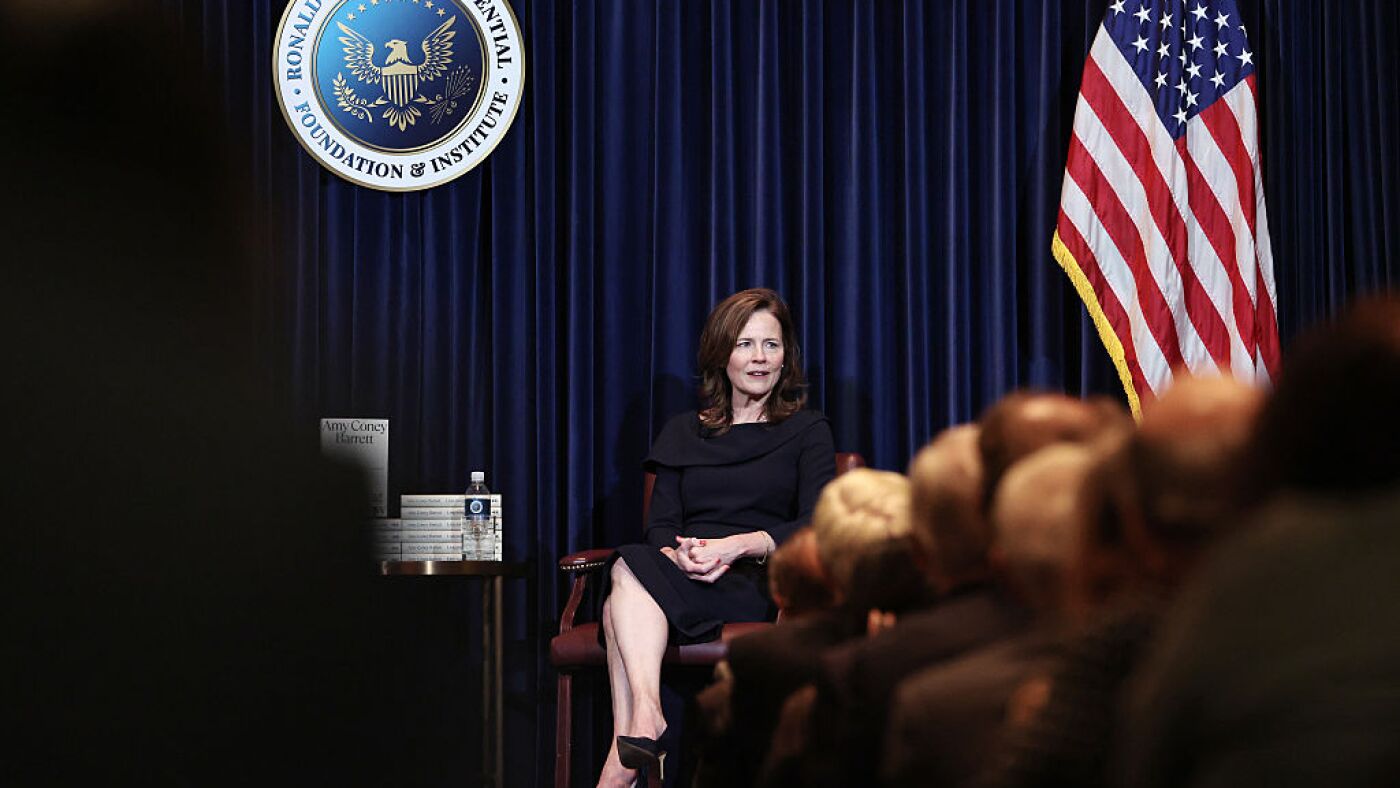
Supreme Court Justice Amy Coney Barrett speaks at the Reagan Library on Sept. 9, 2025, in Simi Valley, Calif. Barrett discussed and signed copies of her new book, Listening to the Law: Reflections on the Court and Constitution.

Mario Tama/Getty Images


hide caption


toggle caption

Advertisement

Mario Tama/Getty Images

Even as the Supreme Court was handing down one legal thunderbolt after another last week, the justices were quietly releasing their annual financial reports. Justice Samuel Alito was the only sitting justice to request an extension, which he has done for 15 years. The disclosures do not give a complete account of the justices’ total income and wealth, but they give insights into their concertgoing, guest professorships and even their involvement in youth sports.

In addition to their salaries, much of the justices’ reported income came from their book deals. Justice Ketanji Brown Jackson led the pack earning more than $1.1 million last year for a total of roughly $4 million since her memoir, Lovely One, was published in 2024.

Justices Sonia Sotomayor, Neil Gorsuch, Amy Coney Barrett and retired Justice Anthony Kennedy also reported income from published books. Earnings from their books ranged from $849,000 for Barrett, to $300,000 for Gorsuch and $88,000 for Sotomayor, whose books include her 2013 autobiography and five children’s books. Justice Clarence Thomas, who previously earned $1.5 million for his 2007 memoir, listed no publisher payments last year, and Justice Brett Kavanaugh, one of 13 co-authors of a 2016 legal treatise, also received no payments last year. Kavanaugh is said to be working on a memoir but he listed no payments for the anticipated book. Alito does have a book coming out in the fall, but with his financial report still outstanding, there is no data on how much he was paid for the work in 2025.

Advertisement

The only two sitting justices who have not written books are Chief Justice John Roberts and Justice Elena Kagan.

Many justices also earned income from teaching at law schools. Roberts reported income from New England Law, located in Boston, and Gorsuch reported teaching income from George Mason University in Virginia. Thomas taught classes at Catholic University in Washington, D.C., and Barrett and Kavanaugh taught at Notre Dame Law School. Barrett graduated from the school and began teaching there 23 years ago; Kavanaugh has family connections to Notre Dame.

Continue Reading

News

Manhattan Building’s Columns Buckled Beneath New Addition, Images Show

Published

on

Manhattan Building’s Columns Buckled Beneath New Addition, Images Show

At least two structural columns buckled and failed in a 37-story office tower in Midtown Manhattan on Tuesday, prompting evacuations of nearby streets and buildings. While city officials asserted that the tower was in no danger of collapsing completely, outside engineers said further failures in the structure could not be ruled out.

A pair of columns that failed completely were part of the tower’s existing structure. A New York Times review of images and videos from inside the building has found that several floors were added atop these columns.

Advertisement

City officials said in a news conference on Tuesday that the building was continuing to move, while they simultaneously assured the city that the building would not suffer “total collapse.” “The way this building is constructed, it’s a steel-frame building,” John Esposito, a chief in the Fire Department in New York, said at the afternoon news conference. “So, it would not be a total collapse. It would be more of a localized collapse.” Still, he said, “that remains our concern, that it’s moved.”

Advertisement

Engineers said that the movement itself was cause for concern. In a properly designed steel building, they said, loads should redistribute quickly to surviving structural supports if columns failed.

Joe DiPompeo, a former president of the Structural Engineering Institute at the American Society of Civil Engineers, said that if the structure had been overloaded, he would expect any movement “to happen very quickly,” rather than gradually.

“Generally when a column buckles, it’s a sudden failure,” Mr. DiPompeo said. He said that a full collapse remained unlikely given the redundancies built into the building codes.

Advertisement

Engineers often refer to the most dangerous possibility as a progressive collapse, a process in which structures near the initial failure become overstressed and also fail, potentially bringing down the building if the sequence continues. While unlikely, it cannot be ruled out, Mr. DiPompeo said.

Footage recorded from inside the building shows at least two structural columns appear to have failed completely, Mr. DiPompeo said. Other nonstructural, interior walls — or at least the metal “studs” that were in place to hold them up — also appear to have deformed.

Advertisement

“The only way that really happens is if the floor above them dropped. It looks like the floor above could have dropped a foot or two, which is obviously not a good situation,” Mr. DiPompeo said.

@fernando40tiktok.commarc via Storyful

Advertisement

Advertisement

Image from @fernando40tiktok.commarc via Storyful

Advertisement

Image from @Bogs4NY via X

Advertisement

The 37-story building is in the process of being converted from office space into residential units. Four new floors and a large vertical portion were added onto the existing building in recent months. The vertical portion consists of a stack of over a dozen new floors cantilevered out over the existing building below.

Engineers said that there was nothing inherently wrong with adding residential floors or the cantilevered section above the columns that failed, as long as the original structure and the modifications had properly accounted for the added weight and wind loads.

“The cantilever alone doesn’t change anything,” Mr. DiPompeo said, but it does put additional load on the columns underneath — a factor that should have been reflected in the design.

Advertisement

Nathan Berman, managing principal and founder of MetroLoft, the developer overseeing the conversion, said on Tuesday that “this incident is nothing more than a typical construction mishap.”

He said two columns near the northwest corner of the tower had bent under the weight of additions to the building above, most likely because those columns had not been properly reinforced, though he said an investigation would determine the cause. The rest of the columns, he said, “picked up the weight.” He estimated the affected floors above the failed columns had sagged by a maximum of four inches.

Advertisement

Mr. Berman said that he expected the problems to be fixed and the project to be completed with, at most, a slight delay.

On Tuesday evening, installation of temporary shoring was set to begin shortly, in order to help stabilize the 20th and 21st floors of the building.

Advertisement
Continue Reading
Advertisement

Trending