Connect with us

News

Netanyahu says ‘we’ll do what we need to do’ with Iran’s leader

Published

on

Netanyahu says ‘we’ll do what we need to do’ with Iran’s leader

Unlock the White House Watch newsletter for free

Benjamin Netanyahu has warned his armed forces will “do what we need to do” with Iran’s leadership as he claimed regime change could “certainly be the result” of Israel’s attacks on the Islamic republic.

The Israeli premier’s remarks — in response to a question about assassinating Iran’s supreme leader Ayatollah Ali Khamenei — came after a weekend of escalating hostilities where the bitter foes traded strikes on cities and energy infrastructure.

Since launching its surprise assault on Friday, Israel has killed key figures Iran’s military and nuclear programme and has launched air strikes across the country, pitching the two of the Middle East’s most powerful militaries into outright war.

Advertisement

Asked in an interview with Fox News whether ousting Khamenei’s regime was one of the goals of Israel’s assault, Netanyahu said it “could certainly be the result because the leadership is very weak”. 

“Eighty per cent of the people would throw these theological thugs out,” Israel’s prime minister continued. “The decision to act, to rise up, is the decision of the Iranian people.”

A US official confirmed a Reuters report that Donald Trump had vetoed an Israeli plan to kill Khamenei. Netanyahu declined to comment on the report.

“But I can tell you, I think that we do what we need to do, we’ll do what we need to do. And I think the United States knows what is good for the United States,” he added.

Israel has long pursued an assassination policy against its enemies in the region. Its armed forces have decimated the top ranks of the Iran-backed militant groups Hamas and Hizbollah since Israel was attacked by Hamas on October 7, 2023.

Advertisement

Netanyahu spoke after Trump earlier on Sunday called for a deal between the warring parties, saying “many calls and meetings” were now taking place that would lead to peace soon. “Iran and Israel should make a deal, and will make a deal,” he wrote on Truth Social.

In a later call to ABC News, Trump said also Russian President Vladimir Putin was “ready” to mediate — adding that he was “open” to the idea and had discussed it with his Russian counterpart.

But despite Trump’s remarks Israel and Iran continued to trade strikes on Sunday.

Israeli officials said Israel’s armed forces had carried out strikes on more than 80 targets, including the ministry of defence, military and nuclear sites, as well as at least two energy facilities. Scores of Iranians have been killed in the attacks but authorities have not released a total figure for deaths and injuries.

Iranian state media reported that Israel had carried out numerous attacks across Tehran including at least two in residential neighbourhoods in the city centre, and struck a major water pipeline, causing leaks in northern parts of the capital.

Advertisement

Online videos also showed columns of fire and smoke rising in downtown Tehran and other parts of the city, and police reported heavy traffic at Tehran’s exit routes, signifying many residents were leaving the capital for safer cities. Explosions were reported in Mashhad, Iran’s easternmost city, in a sign of Israel expanding its assault across the country.

Meanwhile, Iran continued to fire barrages at Israel, including one on Sunday afternoon, and three during the night that killed 11 people and injured more than 200, as well as hitting refining infrastructure in the port of Haifa, according to a regulatory filing from the Bazan group.

Officials from the two countries also continued to trade threats, with Israel’s defence minister Israel Katz threatening to inflict similar destruction on Tehran as it did on Beirut in its offensive against the Lebanese militant group Hizbollah last year. Iran’s President Masoud Pezeshkian pledged a “more painful” response should Israel continue its onslaught.

News

Manhattan Building’s Columns Buckled Beneath New Addition, Images Show

Published

on

Manhattan Building’s Columns Buckled Beneath New Addition, Images Show

At least two structural columns buckled and failed in a 37-story office tower in Midtown Manhattan on Tuesday, prompting evacuations of nearby streets and buildings. While city officials asserted that the tower was in no danger of collapsing completely, outside engineers said further failures in the structure could not be ruled out.

A pair of columns that failed completely were part of the tower’s existing structure. A New York Times review of images and videos from inside the building has found that several floors were added atop these columns.

Advertisement

City officials said in a news conference on Tuesday that the building was continuing to move, while they simultaneously assured the city that the building would not suffer “total collapse.” “The way this building is constructed, it’s a steel-frame building,” John Esposito, a chief in the Fire Department in New York, said at the afternoon news conference. “So, it would not be a total collapse. It would be more of a localized collapse.” Still, he said, “that remains our concern, that it’s moved.”

Advertisement

Engineers said that the movement itself was cause for concern. In a properly designed steel building, they said, loads should redistribute quickly to surviving structural supports if columns failed.

Joe DiPompeo, a former president of the Structural Engineering Institute at the American Society of Civil Engineers, said that if the structure had been overloaded, he would expect any movement “to happen very quickly,” rather than gradually.

“Generally when a column buckles, it’s a sudden failure,” Mr. DiPompeo said. He said that a full collapse remained unlikely given the redundancies built into the building codes.

Advertisement

Engineers often refer to the most dangerous possibility as a progressive collapse, a process in which structures near the initial failure become overstressed and also fail, potentially bringing down the building if the sequence continues. While unlikely, it cannot be ruled out, Mr. DiPompeo said.

Footage recorded from inside the building shows at least two structural columns appear to have failed completely, Mr. DiPompeo said. Other nonstructural, interior walls — or at least the metal “studs” that were in place to hold them up — also appear to have deformed.

Advertisement

“The only way that really happens is if the floor above them dropped. It looks like the floor above could have dropped a foot or two, which is obviously not a good situation,” Mr. DiPompeo said.

@fernando40tiktok.commarc via Storyful

Advertisement

Advertisement

Image from @fernando40tiktok.commarc via Storyful

Advertisement

Image from @Bogs4NY via X

Advertisement

The 37-story building is in the process of being converted from office space into residential units. Four new floors and a large vertical portion were added onto the existing building in recent months. The vertical portion consists of a stack of over a dozen new floors cantilevered out over the existing building below.

Engineers said that there was nothing inherently wrong with adding residential floors or the cantilevered section above the columns that failed, as long as the original structure and the modifications had properly accounted for the added weight and wind loads.

“The cantilever alone doesn’t change anything,” Mr. DiPompeo said, but it does put additional load on the columns underneath — a factor that should have been reflected in the design.

Advertisement

Nathan Berman, managing principal and founder of MetroLoft, the developer overseeing the conversion, said on Tuesday that “this incident is nothing more than a typical construction mishap.”

He said two columns near the northwest corner of the tower had bent under the weight of additions to the building above, most likely because those columns had not been properly reinforced, though he said an investigation would determine the cause. The rest of the columns, he said, “picked up the weight.” He estimated the affected floors above the failed columns had sagged by a maximum of four inches.

Advertisement

Mr. Berman said that he expected the problems to be fixed and the project to be completed with, at most, a slight delay.

On Tuesday evening, installation of temporary shoring was set to begin shortly, in order to help stabilize the 20th and 21st floors of the building.

Advertisement
Continue Reading

News

DOJ warns of criminal charges for state election officials if noncitizens vote

Published

on

DOJ warns of criminal charges for state election officials if noncitizens vote

The Justice Department sent letters warning election officials in all 50 states and the District of Columbia that they could face criminal prosecution over noncitizen voting, a spokesperson for the Justice Department confirmed Tuesday.

The letters, signed by Assistant Attorney General Harmeet Dhillon, who heads up the department’s Civil Rights Division, give states five days to explain how they will comply with federal voter eligibility laws and how they will maintain “clean voter lists.”

Advertisement

“The Department sent these letters to all 50 states and the District of Columbia, asking for voluntary compliance in a timely manner with their obligations under federal law to ensure only citizens vote in federal elections,” a Justice Department spokesperson said in a statement.

Noncitizen voting in federal elections is extremely rare, but Trump and his administration have falsely portrayed it as a widespread issue.

Michigan Secretary of State Jocelyn Benson, Nevada Secretary of State Francisco Aguilar and Utah Lt. Gov. Deidre Henderson are among those who said they received the letters from the Justice Department.

The letters say state election officers “could be criminally prosecuted for aiding and abetting” noncitizen voting. They further specify that any election officer who knowingly retains noncitizens on a statewide voting registration list or who facilitates noncitizens’ receiving and casting ballots could be subject to criminal liability.

“An intentional act that is aimed at diluting the votes of citizens could also constitute a violation” of federal law, the letters said.

Advertisement

Henderson wrote on social media that the threats constitute “truly bizarre behavior.”

“Got another love letter this morning from the DOJ sprinkled throughout with threats of criminal prosecution,” she wrote. “I’m sure I’m not the only chief election officer of a state who is being targeted for following state and federal laws by resisting DOJ’s demands for private voter data that have thus far been ruled illegal by at least a dozen courts.”

The letters are the latest move in the Justice Department’s campaign to assert more federal control over state elections.

While some states have complied with the administration’s demands that they hand over voter roll data, the Justice Department has sued 30 states and Washington, D.C., for resisting. So far, 11 different federal courts have dismissed the Justice Department’s efforts to seize voter rolls.

Advertisement
Continue Reading

News

Reigning champion Argentina escapes with remarkable World Cup victory over Egypt

Published

on

Reigning champion Argentina escapes with remarkable World Cup victory over Egypt

Lionel Messi #10 of Argentina celebrates scoring his team’s second goal during their World Cup match against Egypt in Atlanta on Tuesday.

Elsa/Getty Images


hide caption


toggle caption

Advertisement

Elsa/Getty Images

They looked beaten. And out. Argentina, the defending World Cup champion and No. 1-ranked team, was down 2-0 late against Egypt.

Then, in a span of 13 remarkable minutes, Argentina scored not once, not twice, but three times, capping a comeback for the ages and leaving Egypt stunned and shellshocked.

For much of the game in Atlanta, Egypt was in control, hobbling Argentina early. The Egyptian attack began almost immediately with a stunning header goal delivered by Yasser Ibrahim in the 15th minute. After that, Egypt’s defense closed ranks, making it practically impossible for Argentina to equalize.

Advertisement

It was downhill from there for the Argentines: team captain Lionel Messi failed to convert a penalty kick, and in the 67th minute, Egypt got a second goal from Mostafa Ziko (after an earlier Egyptian goal had been disallowed after a video review). It looked like Argentina was finished. On the brink of elimination.

But no one told the Argentine players that.

In the 79th minute, Lionel Messi began doing his thing. He fired a cross near the Egyptian goal, and Cristian Romero headed it in. Messi was not done. Four minutes later, he powered a shot past the Egyptian keeper. It was his eighth goal of this tournament, the most of any player. The score was 2-2.

Then, in stoppage time, yet another Argentina header and another goal, this time from Enzo Fernandez.

“This is the World Cup for you,” said Messi after the game. “It wasn’t easy to come back from two goals down. But as I always say, this group never gives up. We always try to fight until the end.”

Advertisement
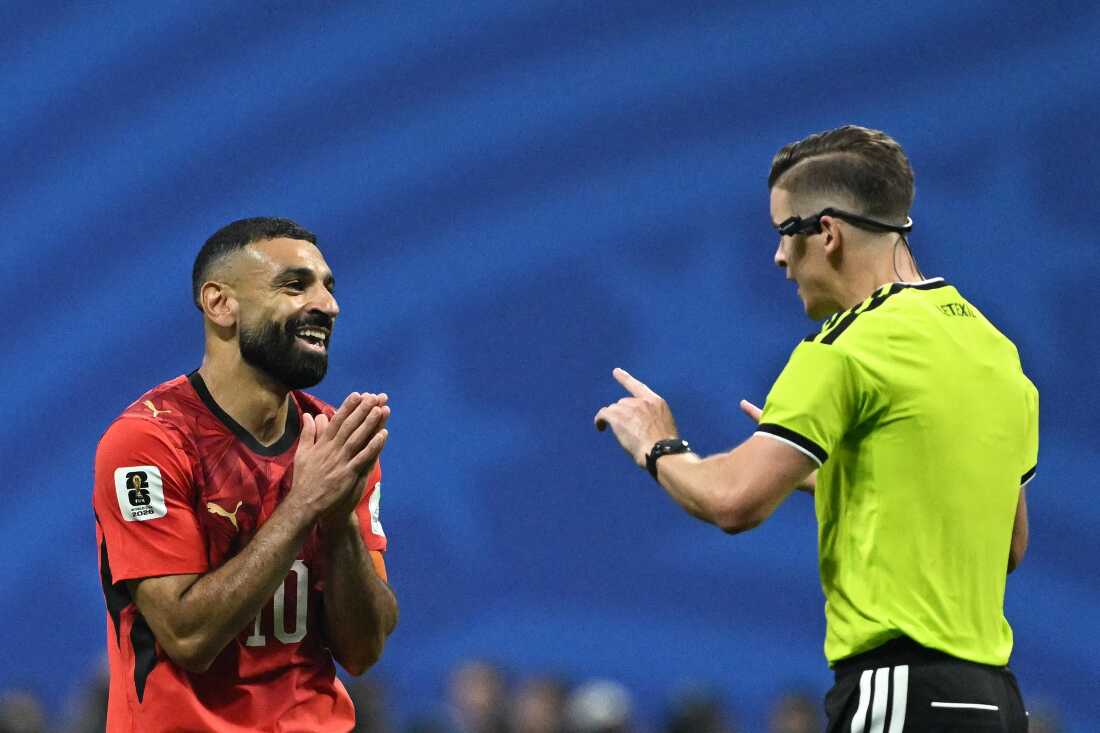
French referee François Letexier speaks with Egypt forward Mohamed Salah during the World Cup Round of 16 match between Argentina and Egypt in Atlanta.

French referee François Letexier speaks with Egypt forward Mohamed Salah during the World Cup Round of 16 match between Argentina and Egypt in Atlanta.

Roberto Schmidt/AFP via Getty Images


hide caption


toggle caption

Roberto Schmidt/AFP via Getty Images

Advertisement

Afterward, Egypt coach Hossam Hassan complained about the French referee and the officiating. “I am not convinced. I am not convinced with this outcome. I’m not convinced with the way things unfolded during this match,” said Hassan in a post-match news conference. “We have been treated unfairly today. We have suffered injustice.”

“We would have deserved to earn this win, but we are leaving with honor, with pride, regardless of this defeat,” said Hossan.

African soccer teams have been the stars of this World Cup. Morocco has yet to lose a game. Cape Verde qualified for the first time in its history and stymied Spain, Uruguay and Saudi Arabia. Argentina barely beat them in a nail-biter of a match.

Continue Reading
Advertisement

Trending