News
Minnesota becomes first state to ban prediction markets

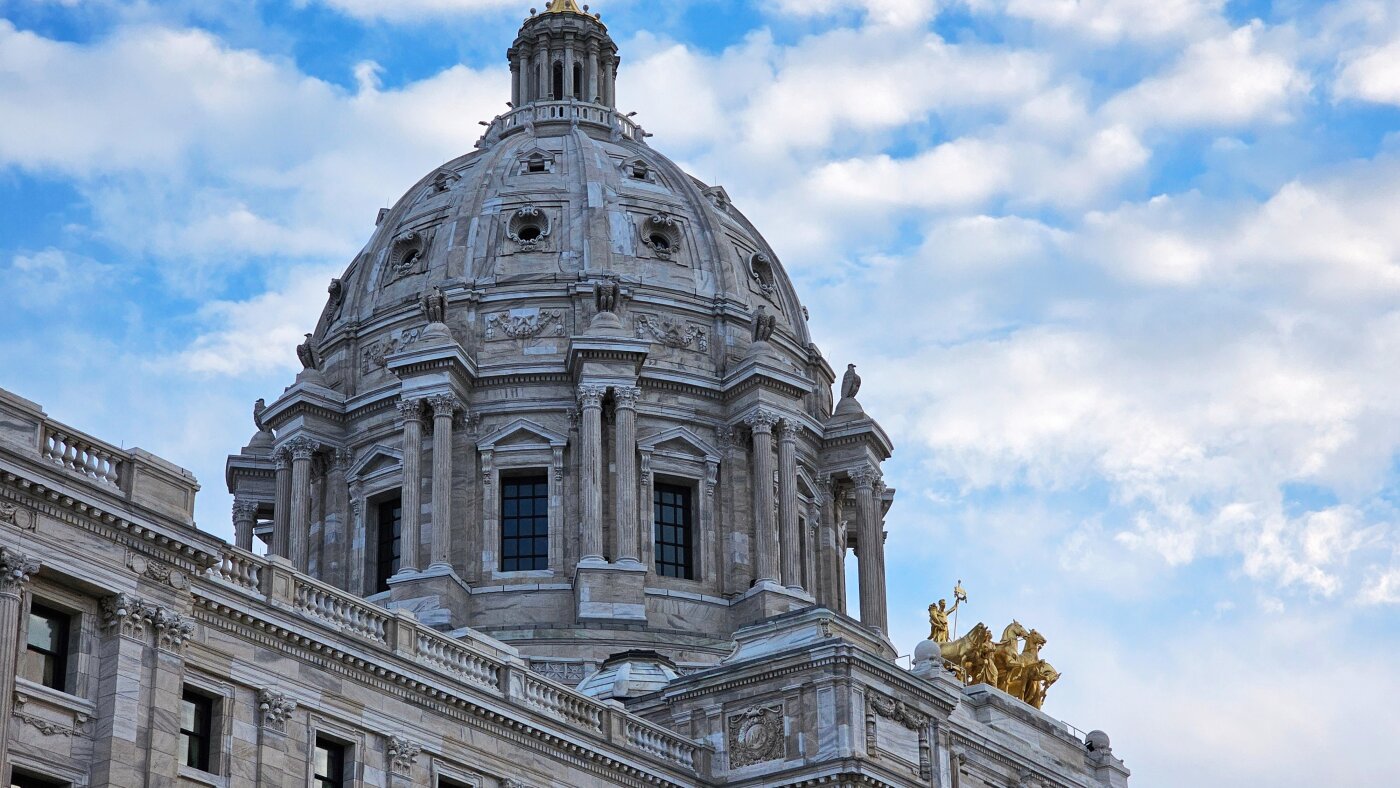
Minnesota has enacted the most far-reaching crackdown on massively popular services like Kalshi and Polymarket.
Steve Karnowski/Associated Press
hide caption
toggle caption
Steve Karnowski/Associated Press
Minnesota Gov. Tim Walz has signed the nation’s first law banning prediction market sites from operating in the state, and in response, the Trump administration has sued, teeing up a legal battle over the most far-reaching crackdown on popular services like Kalshi and Polymarket.
It comes as states confront a growing standoff with the Trump administration over how to regulate the industry, which allows people to bet on virtually anything.

The new state law makes it a crime to host or advertise a prediction market, which it defines as a system that lets consumers place a wager on a future outcome, like sports, elections, live entertainment, someone’s word choice and world affairs.
The prohibition extends to services supporting prediction markets, like virtual private networks, that could allow consumers to disguise their location and get around the ban.
It would force prediction market sites like Kalshi and Polymarket to leave the state, or face possible felony charges. The law takes effect in August.

“We as a state should decide how best and what regulations we think should attach to gambling, to protect public safety, to protect our kids,” said Minnesota Rep. Emma Greenman, the Democrat who introduced the measure.
The law has a carve-out for event contracts that serve as an insurance policy in the event of “harm, or loss sustained” and for the purchase of securities and other commodities.
The Commodity Futures Trading Commission’s lawsuit seeks to block the law before it starts, arguing the prediction market industry should be exclusively regulated by federal officials.
“This Minnesota law turns lawful operators and participants in prediction markets into felons overnight,” said CFTC Chairman Michael Selig. “Minnesota farmers have relied on critical hedging products on weather and crop-related events for decades to mitigate their risks. Governor Walz chose to put special interests first and American farmers and innovators last.”
Besides Minnesota, bills cracking down on the prediction market industry have been introduced in seven other states, according to the National Conference of State Legislators. Two of those states, Hawaii and North Carolina, have pending bills seeking to ban the industry statewide.

Experts say the cloud of legal uncertainty hanging over prediction markets apps have not slowed their rapid growth.
“The states are using any tactic they can to go after the prediction market companies,” said Melinda Roth, a professor at Washington and Lee University’s School of Law, who studies the industry. “But they’ve embarked on a too big to fail strategy and have become quite mainstream,” she said. “It will be hard to put that genie back in the bottle.”
A legal fight over the Minnesota ban is expected. Questions over whether states or the federal government should oversee the prediction market industry have already triggered more than 20 lawsuits. One of those cases, in Nevada, led to Kalshi pausing its sports betting in the state after a judge found it “indistinguishable” from state-regulated sports gambling.
The Commodity Futures Trading Commission has filed federal lawsuits against five states, including Arizona, Wisconsin and New York, attempting to override state regulators’ attempts to rein in the betting sites.

The CFTC has argued it has exclusive jurisdiction over prediction markets, even though former CFTC members and legal experts say bets on football games, words President Trump might say during a press conference and whether Ricky Martin will make an appearance at the Super Bowl are matters far outside its traditional scope.
In a statement to NPR, Kalshi spokeswoman Elisabeth Diana said banning prediction markets is a “blatant violation” of the law.
“Minnesota banning prediction markets is like trying to ban the New York Stock Exchange,” said Diana, adding that “this actively harms users because it reduces competition and drives activity offshore.”
A Polymarket spokesman told NPR that Minnesota’s ban runs counter to the federal government’s “established framework” for regulating prediction markets.
Tribal-owned casinos operate in Minnesota, but online gambling and sports betting are not legal in the state.
Prediction markets like Kalshi and Polymarket have given access to sports betting to people in states where the activity is prohibited, since the Trump administration regulates the sites as a type of “event contract,” rather than gambling, which typically is overseen by state gaming authorities.
Nonetheless, sports gambling powers the sites. On Kalshi, for instance, more than 85% of trading activity is related to a sporting event, some of those trades being “parlays,” high-risk wagers that multiple things, points scored, fouls, passes, will all happen.

Bettors on the sites are making billions of dollars in trades every week, even as questions around insider trading and how the markets can create perverse incentives for people to manipulate real world outcomes continue to vex the companies.
Minnesota Public Radio News reporters Dana Ferguson and Peter Cox contributed reporting to this story.


ICE agents stand guard outside a immigrant detention center in Newark, New Jersey in May 2026. Medicaid officials improperly shared data about millions of people with ICE, who then shared that data with the data analytics firm Palantir, according to new court filings.
Adam Gray/Getty Images
hide caption
toggle caption
Adam Gray/Getty Images
After Medicaid officials improperly shared data about millions of people in January with immigration officials, ICE then shared that data with the data analytics firm Palantir, according to new court filings. Palantir operates an app called ELITE that is used by ICE agents to show the addresses of noncitizens who may be subject to deportation.
That revelation was made public in a motion filed Thursday by more than 20 Democratic attorneys general who sued the Trump administration last year over its data-sharing agreement between the Centers for Medicare and Medicaid Services and ICE.

U.S. District Judge Vince Chhabria in California ruled in December that health officials could share with ICE certain details from Medicaid data about immigrants without lawful status from the states that had sued, such as home addresses, dates of birth and immigration status.
Chhabria, who was appointed by former President Obama, then temporarily paused data sharing between CMS and ICE for immigration enforcement purposes in late May after federal officials admitted CMS had shared data with ICE in January that went beyond what the court order allowed. One dataset of refugees in Minnesota included U.S. citizens, and another that was transferred on Jan. 7 contained data of millions of people, including those in the country legally.

ICE was supposed to delete the improperly shared data. Chhabria set a hearing for August to further clarify his order and clear up ambiguity regarding which categories of noncitizens’ data could be lawfully shared with ICE.
But in recent days, federal officials have admitted to additional instances of improper data sharing.
In a court filing last week, the Justice Department said that CMS again inadvertently reshared with ICE the dataset with millions of names that CMS had first improperly shared with ICE in January. The government said the error occurred during an effort to share data from states not involved in the lawsuit.
Alberto Briseno, a section chief for ICE’s Homeland Security Investigations, wrote in a declaration that ICE personnel deleted the file after it was discovered and it was not used for law enforcement purposes.

Then Briseno revealed that a day later, the agency had done a broader search and discovered that half a dozen users still had a copy of the Jan. 7 dataset.
In that most recent declaration, Briseno said he was not aware of any additional copies of the dataset, but said the recent searches have “highlighted technological difficulties of making a representation that every possible variation of the file has been searched for and located.” He added, “ICE will continue to make good faith efforts to delete any copies that may be found in the future.”
Meanwhile, the Department of Justice is asking the judge to expand his order to allow ICE to receive data on a broader category of noncitizens – to potentially include all immigrants who are not legal permanent residents, citizens or have another form of permanent status.
“ICE’s inability to identify Medicaid records in its possession undercuts any claim that the agency should be entitled to more access to that data,” the Democratic attorneys generals wrote in their motion filed late Thursday.
Their motion continued, “Each successive revelation of a violation of the Order makes it more difficult for Plaintiff States to have confidence in Defendants’ ability to maintain and secure this data in compliance with the Order, and more difficult for Plaintiff States to communicate assurances to Medicaid providers, enrollees (and their counsel), and the public at large about the privacy and confidentiality of their healthcare data.”

Palantir did not immediately return a request for comment about whether the company had deleted the Jan. 7 dataset that ICE had shared after improperly receiving it from CMS. DHS also didn’t immediately return a request for comment about its transfer of data to Palantir.
According to a declaration filed by California deputy attorney general Anna Rich, when plaintiffs asked what federal officials did to ensure Palantir and other contractors had purged the data, defendants responded that the data had been shared over a Microsoft Teams chat and the shared data was deleted from the chat. Rich shared in her declaration a document turned over in discovery from federal officials that shows a redacted transcript of what appears to be ICE personnel asking Palantir to delete the file.
In an April 30 hearing, Chhabria had warned the federal government would not be able to continue using Medicaid data for deportation efforts if it continued improperly sharing the data of citizens and legal immigrants.
“If the federal government cannot be sufficiently careful then it can’t use the information, ok?” Chhabria had said.
ICE has been trying to continue its mass deportations without drawing headlines. Our White House correspondent Zolan Kanno-Youngs explains how two fatal shootings at traffic stops raise the question of whether the Trump administration can continue its campaign without deadly consequences.

Topline
The National Weather Service is cautioning people in states as far south as South Carolina to monitor local air quality as smoke from hundreds of Canadian wildfires pours over the border and American politicians rail against the country as the fires burn out of control.
People sit near the Brooklyn Bridge as wildfire smoke from Canada causes hazy conditions on July 16, 2026 in New York.
AFP via Getty Images
Key Facts
The National Weather Service issued air quality alerts Friday due to wildfire smoke in parts of North Dakota, Minnesota, Michigan, Wisconsin, Illinois, Indiana, Ohio, Pennsylvania, West Virginia, Virginia, Kentucky, North Carolina, South Carolina, New Jersey, Delaware, Rhode Island, New York, Connecticut, Maryland and Washington D.C.
Air quality in parts of Michigan has been declared “hazardous”—the most extreme category—and Wisconsin, Minnesota, Illinois and Indiana are experiencing “very unhealthy” levels of air pollution.
New York, including New York City, New Jersey, Pennsylvania, Ohio, Connecticut, Rhode Island, Delaware and Maryland are warning of “unhealthy” air and a widespread haze from the smoke, and states further south and east are warning sensitive populations may be at risk.
The smoke is spilling across borders from roughly 850 wildfires burning in Canada, many of the largest in Ontario, and more than a dozen fires in northern Minnesota.
Republican members of Congress are slamming Canada’s government for what they perceive as inaction in preventing and stopping the wildfires causing the smoke and poor air quality, with one even calling for sanctions.
Four Michigan Republicans—Reps. John James, Jack Bergman, John Moolenaar and Lisa McClain—said in a letter this week that Canada “has the tools to prevent” the smoke from pouring into the U.S. and “has chosen not to,” and Sen. Bernie Moreno (R-Ohio) said in a post on X that he will table a bill next week to “sanction Canada and the responsible Canadian government officials for this atrocity.”
CRUCIAL QUOTE
“Our constituents are breathing the consequences of this failure right now, and they deserve better than to be told, again, that it will be handled,” the Michigan lawmakers said in their letter.
HOW TO STAY SAFE FROM WILDFIRE SMOKE
Those in states with extreme air quality warnings are being cautioned to limit outdoor activity and, in states with very unhealthy and hazardous warnings, to stay inside altogether with windows closed. Doctors advise anyone with heart or lung disease to stay indoors, and other groups to take precautions. For people who work outside, health officials have recommended wearing an N95 mask, which can filter at least 95% of airborne particles.
WHY IS WIDLFIRE SMOKE SO DANGEROUS?
Smoke from wildfires is made of water vapor, pollutants and particulate matter, which can penetrate the lungs and bloodstream, trigger systemic inflammation, exacerbate conditions like asthma and increase the risk of heart attacks and strokes. Smoke also contains a mix of harmful gases, most notably carbon monoxide. Wildfire smoke has been linked to respiratory and cardiovascular health problems, with children and teenagers, older adults, pregnant people and anyone with pre-existing heart or lung conditions at a particular risk.
SHOULD PEOPLE IN WILDFIRE SMOKE STATES WEAR A MASK?
When the Air Quality Index rises to unhealthy levels—as it has in Michigan, Wisconsin, Minnesota, Illinois, New York, New Jersey, Massachusetts and Connecticut on Thursday—masks are recommended for people who must spend time outside. Respirator masks worn correctly may provide some protection against fine particles in the smoke, but they do not help with hazardous gases. Staying inside is considered the safest option, but those who must go outside can mitigate some risk by wearing a mask. N95 or P100 respirators are considered the most effective.
Key background
Scientists say climate change is creating hotter, drier conditions and longer fire seasons, increasing the likelihood of large, intense wildfires across North America. NASA says human-caused warming is driving more frequent and severe wildfire conditions in many regions, and that extreme wildfire activity has more than doubled worldwide over the past two decades. Research shows fire seasons in some areas are now more than a month longer than they were 35 years ago, and those larger fires also produce more smoke, allowing hazardous air pollution to travel hundreds or even thousands of miles and affect millions of people far from the flames.
BIG NUMBER
$394 billion to $893 billion. That’s the annual cost of wildfires in the United States each year, according to the Joint Economic Committee, including direct and indirect deaths and injuries, health impacts from wildfire smoke, income loss, watershed pollution and other factors.
further reading
-
Vermont56 seconds ago
VT Lottery Mega Millions, Gimme 5 results for July 17, 2026
-

 Virginia7 minutes ago
Maryland, Virginia elections officials push back on Trump assertion that system is ‘broken’ – WTOP News
-

 Wisconsin19 minutes ago
Wisconsin Lottery Mega Millions, Pick 3 results for July 17, 2026
-

 West Virginia25 minutes ago
West Virginia Wesleyan College to keep Governor’s School for the Arts through 2030
-

 Wyoming31 minutes ago
Racines runs unopposed for Wyoming State Auditor
-

 Crypto37 minutes ago
‘Useless Plastic’: NSPK CEO Declares the End of Visa and Mastercard in Russia
-

 Finance43 minutes ago
Former Bank chief financial officer sentenced to three years for $4.3 million loan fraud
-

 Fitness49 minutes ago
Widening Health Divide Among U.S. Cities Revealed in 2026 ACSM American Fitness Index® | Newswise

