Connect with us

News

Mexico’s presidential frontrunner defends sweeping legal reforms

Published

on

Mexico’s presidential frontrunner defends sweeping legal reforms

The frontrunner in Mexico’s presidential election has defended a proposed constitutional overhaul as business-friendly, arguing that popular votes for top judges will enhance democracy.

Investors “have nothing to worry about”, Claudia Sheinbaum, 61, told the Financial Times while being driven between campaign rallies in the capital in a modest Chevrolet family saloon, as well-wishers pressed against the windows to offer flowers ahead of elections next month.

Proposals by leftist President Andrés Manuel López Obrador, of whom Sheinbaum is a close ally, to open up the choice of top election officials and supreme court judges to a popular vote as part of the overhaul have sparked concerns about the rule of law in Mexico.

But Sheinbaum maintained: “What we want is more democracy in the country. And their investments will be guaranteed.”

Sheinbaum, who holds a commanding lead in the polls, has pledged to continue López Obrador’s “transformation” of Mexico with the aim of bringing greater social justice, improving public services and burying a “neoliberal” economic model that she says brought “atrocious poverty and inequality”.

Advertisement

The proposal to amend the constitution to let the public vote for supreme court justices and election commissioners has been one of López Obrador’s most contentious reforms, and his alliance lacked the two-thirds majority needed to pass it in the last congress. His Morena party hopes to try again after the June elections, which also include a vote for a new congress.

Only one country, socialist Bolivia, currently elects supreme court judges, according to the Federal Judicial Center.

The opposition believes the changes would destroy Mexico’s judicial independence, and investors have privately expressed concerns about risks to the rule of law. But Sheinbaum said institutional reforms were needed because the supreme court had “acted politically, not in terms of justice”.

Asked whether she believes in checks and balances, a major concern for civil rights groups and investors, she said: “I believe in freedom. I believe in democracy. And that the people should decide.”

Mexico will almost certainly elect its first female president on June 2. Most polls give Sheinbaum, who cut her teeth in student politics and later served as mayor of Mexico City, a double-digit lead over the main opposition candidate, entrepreneur-turned-politician Xóchitl Gálvez.

Advertisement
Mexican President Andrés Manuel López Obrador’s party has upended Mexican politics since his landslide presidential victory in 2018 © Rashide Frias/AFP/Getty Images

A skilful communicator with an instinctive popular touch, López Obrador — who is standing down after a single six-year term in line with Mexico’s constitution — has greatly expanded welfare programmes and more than doubled the minimum wage. Those measures reduced poverty and inequality, and won him enduring support among Mexico’s less fortunate.

At the same time, the president will hand his successor Mexico’s biggest fiscal deficit since the 1980s, having abandoned austerity in his final year in office. But Sheinbaum played down the gap, projected at 5.9 per cent of GDP this year, as a temporary blip.

“This is a one-year deficit because all the president’s strategic infrastructure projects are being paid for. Next year that will reduce significantly,” she said.

Sheinbaum believes there is scope to raise revenues further through better enforcement and technology. Pressed on whether her flagship promises of better education, health and infrastructure would require higher taxation, she replied “yes” before quickly adding: “But we’re not thinking about it in the first instance. We don’t want to propose a deep fiscal reform until we’ve really looked things over when we take office.”

Mexico’s economy has been transformed over 30 years by its free trade agreement with the US and Canada, and Sheinbaum is keen not to rock the boat, especially when US companies are considering moving production from China to countries such as Mexico.

Advertisement

“We need to take advantage of the opportunity the trade agreement with the United States and Canada gives us,” she said.

However, she wants the government to take a more active role in planning economic development to ensure that investment reaches poorer regions and that Mexico adds value to manufactured products rather than simply assembling components.

“You can’t just put any kind of company in any place, because different territories have different vocations, especially when it comes to natural resources like water,” she said. “We don’t think investment should just create jobs per se. We believe in well-paid jobs, and jobs with wellbeing.”

Beijing has made big inroads in Latin America this century, displacing the US as the biggest trading partner in most of South America, but Sheinbaum is clear where Mexico’s priorities lie. “We don’t have a free trade agreement with China and I don’t think we should have one,” she said.

With the US election later this year, the candidates are preparing for the possible return of former president Donald Trump, who has lambasted Mexico over trade, migration and fentanyl. Sheinbaum insisted the relationship would be “good”, even if Trump wins.

Advertisement

She spoke to the Financial Times after a rally in Coyoacán, a middle-class area in the capital’s south, where she gave an assured speech in blazing midday sun.

Recalling Mexico’s defeat of the invading French army in 1862, she painted her Morena party as the heirs of the patriots who defended their country. She denounced the opposition as the corrupt heirs of the traitors who invited a foreign emperor to govern them.

Mexican army personnel in Ciudad Juarez
Mexican army personnel arrive in Ciudad Juarez to reinforce security at the airport. López Obrador has called in the armed forces to perform tasks traditionally handled by civilians, such as building train lines and running airports © Jose Luis Gonzalez/Reuters

“What does Coyoacán want? Transformation or corruption? . . . Patriotism or subservience?” she asked the crowd, who chanted “Presidenta! Presidenta!”

López Obrador’s party has upended Mexican politics since his landslide presidential victory in 2018. It now controls two-thirds of state governorships and, with its allies, holds majorities in both houses of congress. This political dominance worries opponents, who recall that Mexico was ruled by a single party for 71 years until 2000.

Juanita Goebertus, Americas director at Human Rights Watch, said Morena’s proposals threatened judicial independence. “It would make it much easier for any political party that’s in government to control the nomination of judges,” she said.

Mexico is a key exporter of cocaine and fentanyl to the US and the country has become a battleground for rival cartels. Polls show security is a top voter concern but Sheinbaum believes she can bring down violent crime by deploying methods she used as mayor in the capital.

Advertisement

“We need to strengthen [the policy of] zero impunity in our country. It doesn’t matter who commits murder, murder has to be punished by the law.” She dismissed the opposition’s calls for head-on confrontation with the cartels, saying that in the past they gave security forces a “licence to kill” innocent civilians.

“Our vision is the construction of peace,” she said.

López Obrador has replaced the federal police with a new 130,000-strong National Guard run by the military, and has called in the armed forces to perform tasks traditionally handled by civilians, such as building train lines and running airports, ports and the customs service.

Sheinbaum says she is comfortable with the strategy because the military ultimately answers to the president.

“Maybe people don’t understand it from the outside, but it’s not militarisation,” she said. “The Mexican army comes from the Mexican revolution, it comes from a social revolution, it doesn’t come from the elites.”

Advertisement

A climate change expert with a doctorate in environmental engineering, Sheinbaum wants to accelerate Mexico’s transition to clean energy, using minority private investment with the state in the driving seat. “I dedicated my whole life, before my public life, to climate change. So obviously when we take office we’re going to push it,” she said.

Famously disciplined, Sheinbaum is keen to make clear that while she has been a loyal disciple of López Obrador during her ascent to power, she will govern in her own style.

Although Mexico has “historically been characterised by very strong machismo”, Sheinbaum believes her probable victory is proof that this is changing.

“I think machismo is being left behind . . . Otherwise, a female president would be unthinkable.”

Advertisement

News

What the Supreme Court did on the final day of its term

Published

on

What the Supreme Court did on the final day of its term

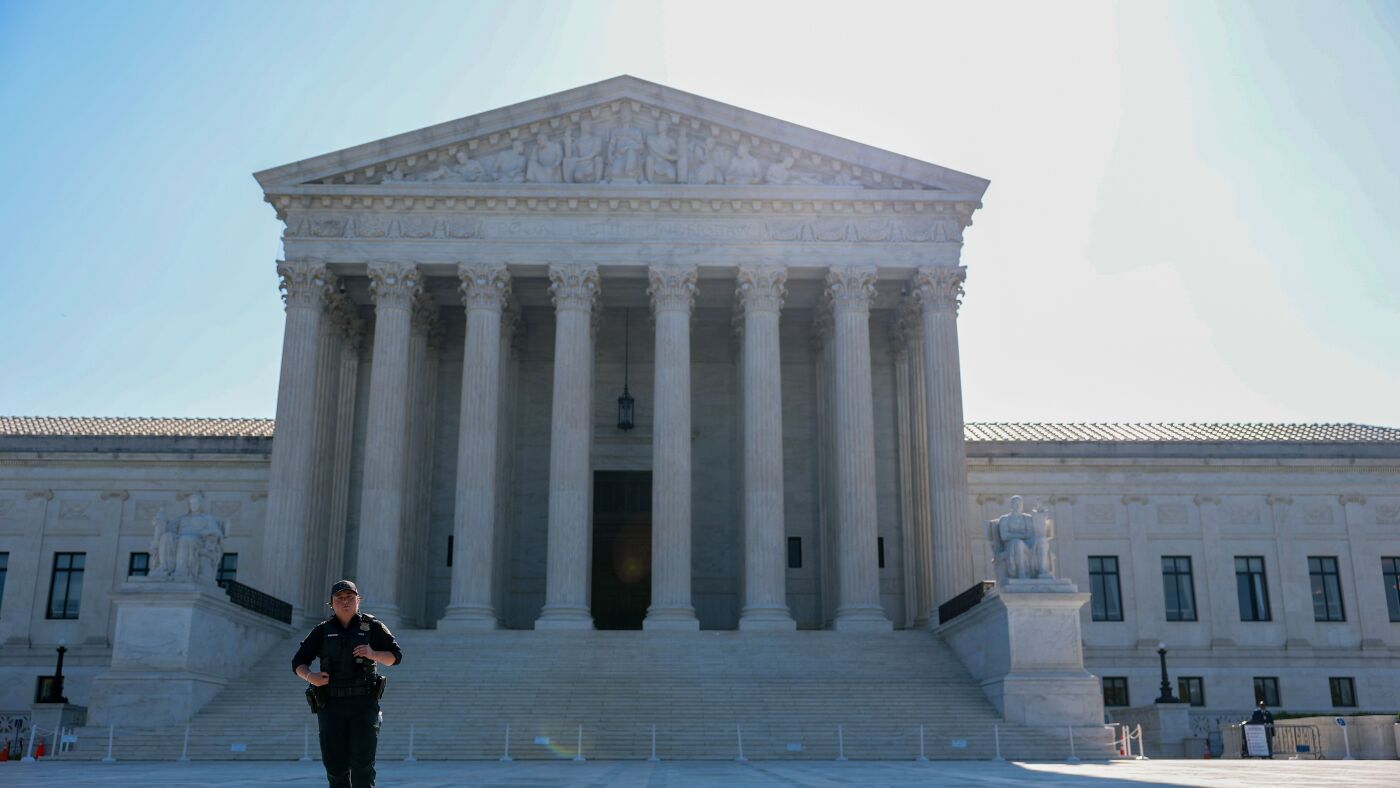
The U.S. Supreme Court

Tasos Katopodis/Getty Images


hide caption

toggle caption

Advertisement

Tasos Katopodis/Getty Images

The Supreme Court Tuesday upheld the long-established right of children born on U.S. soil to automatic American citizenship, regardless of their parents’ immigration status. In so doing, the court rejected President Trump’s most aggressive attempt to limit immigration in the United States.

Writing for the court majority, Chief Justice John Roberts traced birthright citizenship back to the founding of the nation. Just as the colonists demanded “the rights of Englishmen” more than 250 years ago, he said, Congress, after the Civil War, amended the Constitution to specify automatic citizenship for any child born on U.S. soil.

“Citizenship then and now was the right to have rights”—and the framers of the 14th amendment extended that promise to every free born person in this land. He concluded: “We keep that promise today.”

Advertisement

The vote was 6-to-3, depending on how you count it. Altogether, five justices signed on to the Roberts’ majority opinion. A sixth, Justice Brett Kavanaugh, agreed only that federal legislation enacted in the 1950s grants automatic citizenship for children born in the U.S.

Justice Clarence Thomas wrote the lead dissent, a 91-page opus that agreed with Trump’s assertion that the 14th amendment only applied to former slaves and their descendants. The Thomas dissent added ominously that he “was not sure that “today’s opinion will stand the test of time.” The dissent was joined by Justice Neil Gorsuch, with Justice Samuel Alito writing a separate dissent.

Justice Ketanji Brown Jackson, who, like Thomas is African American, responded to some of the themes in the Thomas dissent.

“Despite his longstanding endorsement of a colorblind society,” she wrote, “Justice Thomas now surprisingly suggests that the citizenship clause was a race-conscious remedial measure relating only to freed slaves.”

Cecillia Wang, legal director of the ACLU, who successfully argued the case at the Supreme Court, said President’s Trump failed attempt to limit birthright citizenship was transparent.

Advertisement
Continue Reading

News

Rep. Tom Kean returns to Congress, says depression is why he went missing for months

Published

on

Rep. Tom Kean returns to Congress, says depression is why he went missing for months

Rep. Thomas Kean Jr., R-N.J., arrives at the U.S. Capitol with his wife Rhonda Kean on June 30.

Anna Moneymaker/Getty Images


hide caption

toggle caption

Advertisement

Anna Moneymaker/Getty Images

New Jersey Republican Thomas Kean Jr. said it was struggles with depression that kept him away from Congress for nearly four months with no explanation to his constituents.

Kean last voted on March 5th, missing numerous votes and other appearances on Capitol Hill since. In April, House Speaker Mike Johnson told reporters he had spoken to Kean and that he was dealing with an undisclosed medical issue. Kean was not spotted until recently at his New Jersey home.

Speaking from the House floor on Tuesday, the second term lawmaker said he had checked into a hospital for testing several months ago after health concerns, and was subsequently diagnosed with depression.

Advertisement

“Talking about myself has never come naturally,” Kean said. “But I believe that I owe an explanation to the people of New Jersey’s seventh district, to my colleagues in this chamber and to the American people for my absence.”

Kean said he originally did not think his diagnosis would result in a long-term absence. Doctors recommended he remain in the hospital to address the illness, and it was his fastest route to recovery, he said.

“It is physical. It is emotional,” he said. “And until you experience it yourself, it is difficult to fully understand how powerful this illness could be.”

Kean said he miscalculated how long he would be away, estimating it would be a matter of weeks. However, he said like the roughly 48 million Americans who have battled the illness, he learned there is no timeline for recovery.

“I am grateful that I accepted help,” Kean said. “Today I stand before you healthier, stronger and excited to return to the work that I love.”

Advertisement

Kean’s absence proved a struggle for House Republicans, who contend with a razor thin majority to pass party priorities. For weeks, Kean and his office declined to share additional details on why he was away, feeding rumors and speculation and raising interest in a member known for his privacy.

Continue Reading

News

Michigan governor threatens to pull troops from D.C. if used for Trump task force

Published

on

Michigan governor threatens to pull troops from D.C. if used for Trump task force

Members of the National Guard stand in front of a large image of U.S. President Donald Trump that hangs from the the Robert F. Kennedy Department of Justice Building on May 18, 2026 in Washington, D.C.

Andrew Harnik/Getty Images North America


hide caption

toggle caption

Advertisement

Andrew Harnik/Getty Images North America

WASHINGTON, D.C. — In a strongly worded letter to the head of Michigan’s National Guard, Gov. Gretchen Whitmer reiterated troops from her state are only to be used for operations surrounding America 250 celebrations in Washington, D.C., and not for President Trump’s long-running — and controversial — joint task force to fight crime. She said that she would pull her troops from the city if that is not the case, in the letter obtained by NPR.

“Please take all necessary measures to ensure the Michigan National Guard is only supporting the narrow and limited America 250 Mission and is in no way supporting the D.C. Safe and Beautiful Mission,” wrote Gov. Whitmer, referencing the official name for the federal task force.

Trump deployed hundreds of troops to Washington, D.C., in August of 2025, in what experts said was a stunning departure from governing norms. He said he did so to address rampant crime, despite declining crime rates at the time. The number of troops in the city has increased over time to more than 4,800 from Washington, D.C. and almost two dozen states, which until recently were exclusively Republican-led.

Advertisement

Michigan — which has 161 guard members currently in the city — is one of four Democratic-led states that sent members of their National Guard to D.C. in recent weeks, ahead of an influx of tourists for America 250 celebrations. North Carolina and Kentucky each sent one member of their guard, while Minnesota sent more than a hundred last week.

Kentucky confirmed to NPR Monday that it had recalled its one guard member over the weekend, after that member was “diverted to the task force by the federal government without the knowledge or consent of Gov. Beshear of the Kentucky Guard,” Scottie Ellis, a spokesperson for Gov. Beshear, wrote to NPR in an email.

When contacted by NPR, spokespeople for each respective Democratic governor’s office made it clear that their guard members were sent to help specifically with America 250, not for law enforcement purposes as part of the larger ongoing federal joint task force operation. All four states have been clear about their opposition to the Trump administration’s ongoing deployment of National Guard troops to D.C., filing an amicus brief in support of litigation challenging it as recently as May.

Continue Reading
Advertisement

Trending