News
Many in Michigan don't know how — or whether — they'll vote in the general election


Left to right: Ka’Marr Coleman-Byrd, Shelly Zissler and Deasia Sampson, some of the undecided voters Morning Edition spoke to in the Detroit area.
Elaine Cromie for NPR
hide caption
toggle caption
Elaine Cromie for NPR

Left to right: Ka’Marr Coleman-Byrd, Shelly Zissler and Deasia Sampson, some of the undecided voters Morning Edition spoke to in the Detroit area.
Elaine Cromie for NPR
Kaja Braziel has historically voted Democrat. The 30-year-old Detroit native remembers casting her first-ever vote for Barack Obama, which eventually factored into her support for President Joe Biden.
Four years later, Braziel says she’s apprehensive about voting for Biden again. The Wayne State University senior, who also works full time, is upset that Biden hasn’t done more to address student loans. She acknowledges he’s not solely responsible for falling short of his promises, but says it’s an issue nonetheless.
“It doesn’t stop that from affecting my thought process of, when do I get to be a real adult?” said Braziel, who sacrificed an additional job in order to commit to her studies. “When do I get to buy a house? When do I get to feel stable enough to think about seriously having kids?”
Braziel has her doubts about continuing to support Biden, but says she doesn’t feel drawn to Republican candidates either. Eight months out from the general election, she told NPR’s Morning Edition she doesn’t know who to vote for, or whether she will even vote at all.
“It doesn’t seem like any choice is really a good choice at all,” said Braziel. “It feels more so like you’re caught between the devil you know and the devil you don’t. And at this point in time, it feels like both the devils that we know. And I’m not comfortable with either of them.”
Braziel is not alone.
Wayne State University senior Kaja Braziel, pictured on campus in Detroit on Friday, is apprehensive about voting for Biden again. Some of her top concerns are student loan forgiveness and the need for a livable wage.
Rachel Treisman/NPR
hide caption
toggle caption
Rachel Treisman/NPR
Wayne State University senior Kaja Braziel, pictured on campus in Detroit on Friday, is apprehensive about voting for Biden again. Some of her top concerns are student loan forgiveness and the need for a livable wage.
Rachel Treisman/NPR
NPR’s Morning Edition spoke with many metro Detroit residents ahead of Tuesday’s primary who didn’t plan to vote because they assumed Trump and Biden’s victories were a foregone conclusion — an assumption that proved correct within minutes of polls closing.
People of all ages and backgrounds — from college students to autoworkers — said they weren’t sure who, if anyone, to vote for in November either.
While their preferred parties, voting histories and policy concerns varied, many cited the economy, immigration, foreign military aid and societal divisions as their top issues, and said neither Trump nor Biden have done enough to solve them.
There was palpable disillusionment across the board, consistent with national polling that shows a majority of U.S. adults are pessimistic about the likely nominees and the state of politics in general.
That could spell trouble for both parties, since Michigan is one of a handful of swing states expected to help decide the presidency. Trump won it by just under 11,000 votes in 2016, while Biden won by over 154,000 votes in 2020, a year that saw record turnout of 5.5 million voters.
Conversations with eligible voters in the Detroit area help explain why enthusiasm is dimming — especially among key demographic groups like young voters and Black voters — and what the leading candidates would need to do to win them back.
A family of autoworkers worries about immigration, inflation and division
For Shelly and Matt Zissler, 47 and 50, working on cars is in their blood. The third- and second-generation autoworkers met on the job and got married in 2019. The following year, they both voted for Trump.
That was the first time Shelly, a lifelong Democrat, voted Republican. She says it’s because she felt Trump was “mentally better to run our country.” Matt, who identifies as a libertarian, had voted for Trump before but describes 2020 as a “very painful vote.”
Matt Zissler, Shelly Zissler and her son, Matt Vaughn, who all work for General Motors’ Flint Assembly plant, pose for a portrait outside their home in Flint, Mich., on Saturday.
Elaine Cromie for NPR
hide caption
toggle caption
Elaine Cromie for NPR
Matt Zissler, Shelly Zissler and her son, Matt Vaughn, who all work for General Motors’ Flint Assembly plant, pose for a portrait outside their home in Flint, Mich., on Saturday.
Elaine Cromie for NPR
Sitting at home in Flint, about an hour north of Detroit, the couple tells Morning Edition‘s Leila Fadel that they’re not sure how they’ll vote come November, but they wish they had different choices.
“I personally would like to see new people running,” Shelly said. “Because I feel like we’re just going to keep repeating this cycle of what we’ve already been through, if it’s the same two people.”
They could look to leadership of the United Auto Workers union — of which they are among more than 380,000 members in several states — for guidance on how to vote. UAW president Shawn Fain officially endorsed Biden last month, a coveted distinction in a state where support from blue-collar workers buoyed Trump in 2016.
It’s a major get for the candidate who bills himself as the most pro-worker president in U.S. history, and became the first sitting president to join a picket line in modern history when he showed his support for striking autoworkers last fall. But it doesn’t necessarily translate into votes from all UAW members.
“I will never let anyone tell me who to vote for,” said Matt. “I’ll take information from everyone. But in the end I’ll make up my own mind, whether it’s a union-endorsed candidate or not.”
The two say their top concerns include immigration and foreign aid. Shelly blames Biden for the record number of migrants crossing the southern border, and says she doesn’t understand “why it can’t be figured out.” Matt wants the government to stop sending money to wars overseas and do more to help people struggling at home.
“I still want to help people whenever we can,” he said. “But what if it comes at the cost of our own people, especially our veterans?”
Matt Zissler, who identifies as a libertarian, says the UAW leader’s endorsement alone won’t dictate his vote.
Elaine Cromie for NPR
hide caption
toggle caption
Elaine Cromie for NPR
Matt Zissler, who identifies as a libertarian, says the UAW leader’s endorsement alone won’t dictate his vote.
Elaine Cromie for NPR
Both are also concerned about the prices of things like gas and groceries. Shelly’s 28-year-old son, Matt Vaughan — a fourth-generation autoworker — says he still struggles at times, despite the generous pay raise he got in the most recent union contract.
Above all, the Zisslers take issue with how divided the country is. They say they have lost friends over politics. And they blame politicians in D.C., who they see as arguing with each other instead of listening to their constituents.
“I think we’re mirroring Washington more and more and more,” Matt said. “They’re supposed to be leading us and they’re acting like fools over there.”
They hope the candidates will do more to try to bring people together. They believe the right person could do it — but don’t think that’s either of the names poised to be on the ballot this fall.
Some Black churchgoers have lost faith in Biden
Black voters are credited with helping Biden win Michigan in 2020, thanks in large part to churches and other organizations who mobilized their members. That’s particularly true of Detroit, where Biden beat Trump by 94% to 5%.
And yet some Black voters in the city, especially younger Black voters, told NPR that they’ve lost faith in Biden. As they filed out of Sunday services at Greater New Mount Moriah Missionary Baptist Church, several shared that they had yet to decide who to vote for in the general election.
Ka’Marr Coleman-Byrd poses outside of Greater New Mt. Moriah Missionary Baptist Church in Detroit after service on Sunday.
Elaine Cromie for NPR
hide caption
toggle caption
Elaine Cromie for NPR
Ka’Marr Coleman-Byrd poses outside of Greater New Mt. Moriah Missionary Baptist Church in Detroit after service on Sunday.
Elaine Cromie for NPR
Ka’Marr Coleman-Byrd, a 27-year-old tax consultant who voted for Biden in 2020, says he’ll make up his mind closer to November based on where things stand with issues like foreign aid, race relations and student loans.
“Growing up, I feel like I voted Democrat just because it just seemed like the thing to do,” he said. “I’d say now … I’m sort of more into politics and seeing exactly what both parties present, so it’s not just like a blind vote in a sense.”
Just 50% of Black adults nationally approve of Biden, down from 86% in July 2021, according to a December AP-NORC poll. And there are signs that Black Michiganders’ support for Biden — which Democratic strategists see as key to his reelection — is waning.
A Howard University Initiative on Public Opinion poll released this month found that 91% of Black voters in Michigan plan to vote in the general election. When asked who they would vote for if that were today, 49% of respondents said Biden and 26% said Trump.
Deasia Sampson of Westland, Michigan, pictured outside Greater New Mt. Moriah Missionary Baptist Church on Sunday, voted for Biden in 2020 but isn’t sure how she’ll vote in November.
Elaine Cromie for NPR
hide caption
toggle caption
Elaine Cromie for NPR
Deasia Sampson of Westland, Michigan, pictured outside Greater New Mt. Moriah Missionary Baptist Church on Sunday, voted for Biden in 2020 but isn’t sure how she’ll vote in November.
Elaine Cromie for NPR
Deasia Sampson, 28, said she always makes it her duty to vote, even though she’s not sure who it will be for this time around. She points to student loan forgiveness, inflation and funding for schools as her top concerns, especially as a mom of a three-year-old.
Sampson works for the state Department of Health and Human Services, helping administer EBT and Medicaid programs. And she said she’s seen firsthand how many people are applying for benefits compared to before the COVID pandemic.
“Yeah they have this or have that, but they’re still struggling with food, still struggling with their utility bills, still struggling with medical coverage,” she added.
CJ Sampson says he’s lost confidence in Biden over his handling of issues like student loan forgiveness, inflation and foreign military aid.
Elaine Cromie for NPR
hide caption
toggle caption
Elaine Cromie for NPR
CJ Sampson says he’s lost confidence in Biden over his handling of issues like student loan forgiveness, inflation and foreign military aid.
Elaine Cromie for NPR
Her husband, CJ Sampson, agrees. While he considers himself a liberal, he’s lost confidence in Biden. The 31-year-old wishes he had seen more police reform since voting for Biden in 2020, is torn about whether his life was better under Trump or Biden.
“It’s kind of a mixture of both,” he said.
Several churchgoers in their 70s also gave Biden mixed reviews, docking points for things like high healthcare costs and the amount of money the U.S. is giving to Ukraine. Biden’s age — arguably his biggest political vulnerability — was a deterrent for some and a nonissue for others.
Velma Matthews, 76, left, and Lovie Hatcher, 74, pose for a portrait outside Greater New Mt. Moriah Missionary Baptist Church on Sunday.
Elaine Cromie for NPR
hide caption
toggle caption
Elaine Cromie for NPR
Velma Matthews, 76, left, and Lovie Hatcher, 74, pose for a portrait outside Greater New Mt. Moriah Missionary Baptist Church on Sunday.
Elaine Cromie for NPR
Velma Matthews, 76, voted for Biden in 2020 and plans to do so again. She thinks he’s a good person and believes in his politics. But she’s not necessarily pleased with how the government is functioning.
Her advice for politicians? “Get down to doing the business of government and stop all this craziness that’s going on.”
Dissatisfied college students wonder how to make their votes count
Wayne State University’s Detroit campus was mostly quiet last Friday at lunchtime, but not at the long, narrow table where six undergraduates gathered to share their election anxieties with Morning Edition.
The students range in age from 19 to 30 and hail from various parts of Michigan. Many of them are majoring in global studies. And all of them — not just Braziel — are unhappy with the choice likely awaiting them in November.
Addison Tracy was one of several Wayne State University students who told NPR they see voting for Biden as a harm reduction measure.
Rachel Treisman/NPR
hide caption
toggle caption
Rachel Treisman/NPR
Addison Tracy was one of several Wayne State University students who told NPR they see voting for Biden as a harm reduction measure.
Rachel Treisman/NPR
“In the last election, I remember feeling disappointed that I couldn’t vote, because it felt more meaningful then — it felt like a reaction against Trump,” said Addison Tracy, 21. “Rolling around to this election and being able to vote in it, with probably the same two candidates and two choices … I don’t feel hopeful or like I’m voting for something that will be that meaningful.”
Michigan saw a surge in young voters in 2020, to Biden’s advantage. And voters 18-29 turned out at a rate of 37% in Michigan in 2022, according to the Center for Information and Research on Civic Learning and Engagement at Tufts University — far higher than any other state it analyzed and the national average youth turnout rate itself.
But many students told NPR they’re not sure whether they’ll vote this year — at all, let alone for Biden. Their top concerns include the economy, human rights, the Israel-Hamas war and the state of politics in general.
Rania Umer, pictured at Wayne State University in Detroit, is eligible to vote for the first time in November but doesn’t plan to do so.
Rachel Treisman/NPR
hide caption
toggle caption
Rachel Treisman/NPR
Rania Umer, pictured at Wayne State University in Detroit, is eligible to vote for the first time in November but doesn’t plan to do so.
Rachel Treisman/NPR
Rania Umer, 19, does not think she’ll vote. She doesn’t support Trump, citing Jan. 6 and his human rights track record. But she also disagrees with Biden’s response to the war — specifically, the fact that the U.S. has not called for a permanent ceasefire or stopped sending military aid to Israel.
“If someone does not want either of these things, what are they supposed to do?” she asked. “It’s not like we have a choice. We are being pushed to vote undecided, third party, not vote at all.”
That sense of disappointment fueled a movement of Arab American, Muslim and other young voters, mostly in the Detroit metro area, to vote “uncommitted” on Tuesday as a warning to Biden: Change course on Gaza or risk losing our votes in November. The campaign had achieved more than ten times its goal of 10,000 votes by early Wednesday morning.
Some students around the table said they’ll ultimately vote for Biden in November, despite their reservations. Several specifically described it as a form of “harm reduction,” comparing Biden’s stance on abortion access and LGBTQ rights to that of Trump.
“There aren’t good options for any of us,” said Tracy. “We’re going to have to find other ways, whether it’s direct action or organizing and protesting … to show what we want, because voting clearly doesn’t seem to be a tool that’s working right now.”
Collectively, the students said they feel taken for granted by Democrats, turned off by Republicans and dismayed that each party seems to be campaigning on what to vote against, rather than for.
Wayne State University student Jovan Martin, who will either vote undecided or for Biden this fall, says he doesn’t feel like the U.S. is truly a democracy.
Rachel Treisman/NPR
hide caption
toggle caption
Rachel Treisman/NPR
Wayne State University student Jovan Martin, who will either vote undecided or for Biden this fall, says he doesn’t feel like the U.S. is truly a democracy.
Rachel Treisman/NPR
Jovan Martin, a junior, said there’s a clear need for a change in American politics, and that could start with people taking a stand in this election. He himself is torn between voting undecided or for Biden.
“Why is it that I have to vote in an election for two people that I hate, for two people that I feel like don’t represent me, for two people that are the oldest in American history?” Martin said. “And then it’s like, oh, maybe our democracy, maybe there’s a problem here. And then if we get enough people, it spreads like a virus. And then, that’s change.”
What then, do they say, to people who say they’re risking democracy — by throwing away their votes or potentially helping pave the way for another Trump term? Some acknowledged it’s not a decision they make lightly or even proudly. Others were quick to dismiss the idea that this is an especially consequential election.
Wayne State University student Sandeep Menon believes Democrats are risking young voters’ support because they have a messaging problem.
Rachel Treisman/NPR
hide caption
toggle caption
Rachel Treisman/NPR
Wayne State University student Sandeep Menon believes Democrats are risking young voters’ support because they have a messaging problem.
Rachel Treisman/NPR
“Are we not going to forget the decades’ worth of election that had the slavery debate, that actually rended our country and had a civil war?” said Sandeep Menon, 23, who is also a member of the Michigan Army National Guard.
“The issue that we have to worry about is not that, oh, our democracy is just going to suddenly end if Trump were to become president … Our institutions get eroded away when we fail to maintain them.”
Over an hour into the conversation, with a certain heaviness in the air, NPR asked the students whether there was anything giving them hope. The prevailing answer was the discussion itself.
“I know for a fact there are thousands upon thousands of people that agree with every single one of us,” Martin said. “And if we’re able to talk and convey these things, this is democracy, what we’re doing right here.”
The broadcast interviews for this story were produced by Ziad Buchh and edited by Reena Advani.


Top Senate Democrats are pushing for answers on whether a provision in a controversial settlement agreement between President Trump and his own administration applies to companies co-founded by or affiliated with the Trump family.
As part of a deal struck in May by the Justice Department to resolve a lawsuit brought by Mr. Trump, the Internal Revenue Service is permanently barred from pursuing claims against Mr. Trump, his oldest sons Don Jr. and Eric, and the Trump Organization based on prior tax returns.
In a one-page document signed by Acting Attorney General Todd Blanche and dated May 19, the Justice Department said the defendants in the president’s lawsuit — the IRS and the Treasury Department — are “FOREVER BARRED and PRECLUDED” from “prosecuting or pursuing, any and all claims” arising from tax returns filed before the settlement took effect. Blanche also wrote that the settlement applies to “parties including trusts, parent, sister, or related companies, affiliates, and subsidiaries.”
Now, Senators Elizabeth Warren of Massachusetts, Senate Minority Leader Chuck Schumer of New York, and Ranking Member of the Senate Finance Committee Ron Wyden of Oregon are pushing 11 businesses and organizations with ties to the Trump family to get answers for the “significant questions” the settlement raises relating to the tax audit provision, and whether the companies are included in the deal.
“Under the guise of a so-called legal settlement, the Trump administration has attempted to decree that the President, his family, and their entire business empire — potentially including entities with even the vaguest ‘affiliation’ to the family — are to face zero consequences if they have committed a range of financial crimes or misdeeds — regardless of the severity of the violation,” the senators wrote in letters transmitted to the companies Monday night.
The letters were sent to mining company Kaz Resources, defense firm Powerus, cryptocurrency companies World Liberty Financial and American Bitcoin, robotics startup Foundation Future Industries, investment firm 1789 Capital, private aviation company Tag Air, and prediction markets Polymarket and Kalshi.
All of the companies either were founded by Mr. Trump and his two adult sons, or list members of the Trump family as advisers, board members, or partial owners. Donald Trump Jr. sits on Polymarket’s advisory board and 1789 Capital, where he’s a partner, has invested in Polymarket. Days before Mr. Trump took office for his second term, Kalshi also announced Trump Jr. would be a strategic adviser.
The Democrats, who are in the minority, lack subpoena power, so Mr. Trump, his children and his companies can’t be forced to answer the questions posed by the senators.
According to recent financial disclosures, the president earned more than a billion dollars from cryptocurrency ventures alone last year, including from his meme coin business and World Liberty Financial, his family’s cryptocurrency firm.
Separately, the senators also asked the Trump Organization in a separate letter if it believes it has “immunity from all audits, civil penalties or federal prosecution” for any crimes that could have occurred before the settlement.
Trump Media and Technology Group, which is majority owned by a trust that lists Mr. Trump as the sole beneficiary and operates the Truth Social platform he uses daily, also received a letter from the Democratic senators.
“The public deserves transparency about the scope of this get-out-of-jail free card for Trump-aligned businesses, and about whether you intend to rely on this settlement as a free pass for any possible violations of the law,” the senators continued in their letter, which also seeks any communications that executives at the companies have had with the Justice Department and White House leading up to or after the settlement was signed.
The settlement was announced months after Mr. Trump and two of his sons and the Trump Organization accused the IRS and Treasury Department of unlawfully allowing a government contractor to leak tax returns to media outlets in 2020.
In a statement, a Justice Department spokesperson said “the IRS routinely provides releases as part of resolving taxpayer reviews and audits. This settlement follows that same standard practice.”
The spokesperson did not provide specific information about which companies are covered by the audit provision, or whether the Trump Organization and Trump family are the only entities covered by that addendum.

Charles De Ketelaere #17 of Belgium celebrates after scoring his team’s second goal during the World Cup Round of 16 match against the United States on Monday in Seattle.
Alex Grimm/Getty Images
hide caption
toggle caption
Alex Grimm/Getty Images
SEATTLE — This time was supposed to be different.
The U.S. men’s national team came into this FIFA World Cup with a lineup full of players with key roles in Europe’s top leagues. They had the name-brand coach — Mauricio Pochettino, of Tottenham, PSG and Chelsea fame. And they had homefield advantage, with every game on U.S. soil for the first time in three decades.

For weeks, the hype seemed like it might be real: The team’s three wins over Paraguay, Australia and Bosnia-Herzegovina were the most ever by a U.S. men’s squad in a World Cup. A new generation of American fans filled stadiums by the tens of thousands and tuned in on TV by the tens of millions.
But in the end, the Americans’ exit was the same as it ever was: Eliminated yet again in the Round of 16 at the hands of a European team — this time, Belgium, by a score of 4-1.
From the moment they stepped onto the Seattle field, the U.S. was outclassed by their opponent, No. 9-ranked Belgium. Countless turnovers and defensive lapses were seized on by the Belgians, who needed only nine minutes to take a 1-0 lead.

Then, once the Americans equalized on a free kick by midfielder Malik Tillman, Belgium scored yet again in barely a minute of play. Belgian forward Charles De Ketelaere scored both his team’s first-half goals.
After halftime, came an embarrassing nail in the coffin that silenced the Seattle sellout crowd for good — a 57th minute roll-in by Hans Vanaken after a slip-up by goalkeeper Matt Freese outside of the penalty area left the goal unguarded. Belgian forward Romelu Lukaku added a stoppage-time goal to seal the final score at 4-1.

Malik Tillman #17 of the United States celebrates scoring his team’s only goal during their World Cup match against Belgium. In what was one of the few bright spots of the game, the U.S. pulled even with Belgium at 1-1. The tie lasted less than two minutes before Belgium scored again.
Luke Hales/Getty Images
hide caption
toggle caption
Luke Hales/Getty Images
“It stinks,” said U.S. midfielder Tyler Adams. “Tonight was not a good performance overall. It’s not what we look to achieve. There [were] a lot of things that we could have done better.”
The U.S. had entered Monday’s game under a cloud of controversy around their striker Folarin Balogun, who was shown a red card in last week’s Round of 32 match against Bosnia-Herzegovina. An automatic one-game suspension was set to sideline Balogun, the Americans’ leading scorer at the World Cup, for Monday’s game.
Then, the day before the game, a FIFA disciplinary panel took the highly unusual step of delaying Balogun’s suspension by a year to allow him to participate. Then, news broke that President Trump had personally called FIFA president Gianni Infantino to encourage him to review the red card.
The Royal Belgian Football Association said it would protest Balogun’s inclusion in the lineup. But even at full strength, the U.S. were never real contenders in Monday’s game.
U.S. defender and team captain Tim Ream said the controversy swirling around the team had no impact. “We were fully focused on us as a group and as a team and fully focused on the game and not really worrying about what was being said or debated in the outside world.”
Belgium will advance to the quarterfinals for the third time in the past four World Cups, where it will face Spain on Friday in Los Angeles.

Mauricio Pochettino, Head Coach of the United States, walks down the touchline during the Round of 16 World Cup match between the USA and Belgium in Seattle on Monday.
Carl Recine/Getty Images
hide caption
toggle caption
Carl Recine/Getty Images
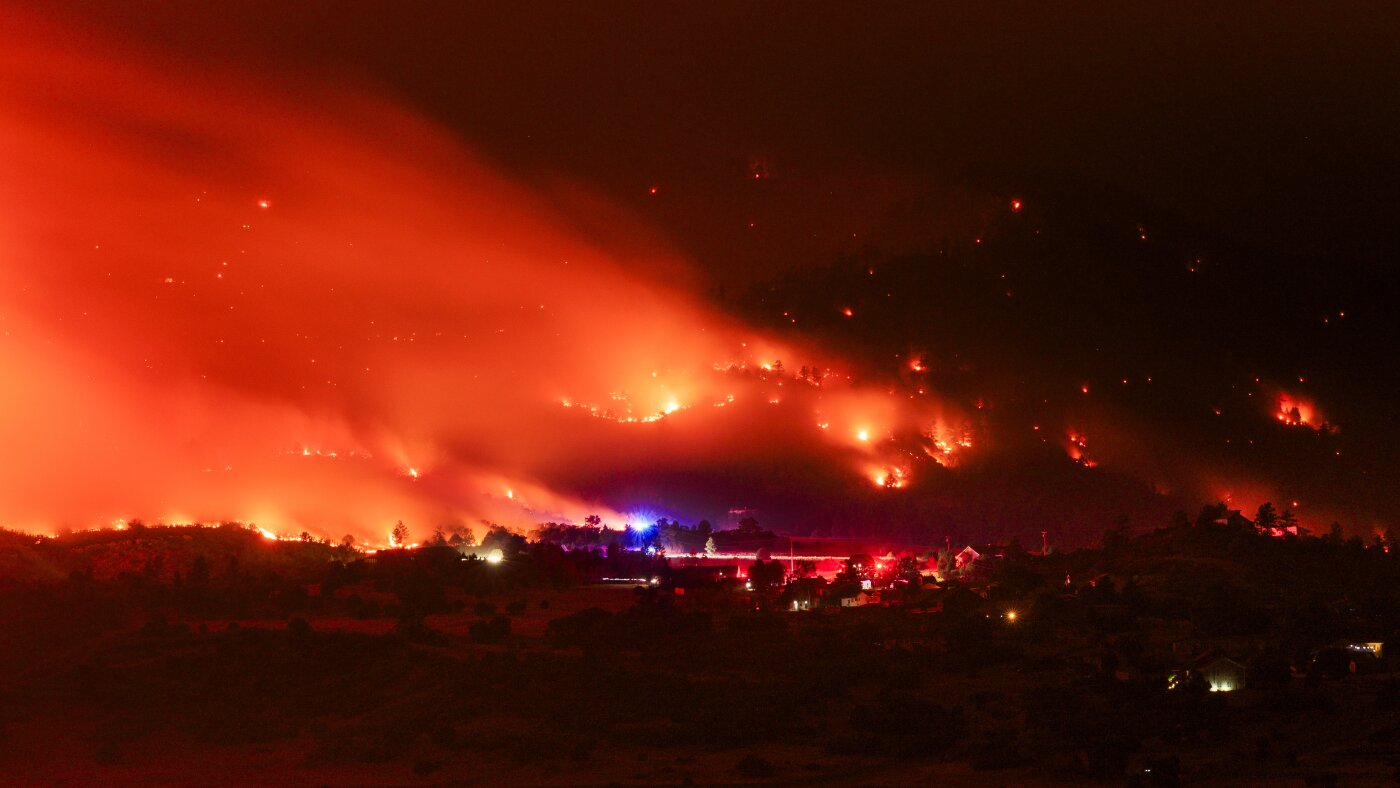
The Aspen Acres Fire burns on Friday in Rye, Colo.
Michael Ciaglo/Getty Images
hide caption
toggle caption
Michael Ciaglo/Getty Images
Thunderstorms with high winds on Sunday could hamper efforts to contain a massive wildfire that has scorched parts of southern Colorado.
The Aspen Acres Fire, which is burning south of Colorado Springs across Pueblo and Custer counties, has grown to more than 86,000 acres. It began nearly a week ago and is 13% contained, officials said on Sunday morning.

Authorities have ordered people to evacuate or to prepare to evacuate across counties including Custer, Pueblo, Huerfano and Fremont.
Scattered showers and thunderstorms could hit south central and southwest Colorado on Sunday, according to the National Weather Service.
Officials and forecasters say the rain could be beneficial for firefighting but are concerned it could lead to road damage in burned areas and cause flash flooding.
“The main threats from storms will be gusty outflow winds up to 50 mph and lightning,” the NWS office in Pueblo said.
Red flag warnings and air quality alerts have also been issued across the state, with the Colorado Department of Public Health and Environment on Sunday warning residents to limit time outdoors because of heavy smoke.
Other wildfires are burning in the state, including the Ferris Fire in southwest Colorado that has grown to more than 42,000 acres and is 7% contained as of Sunday afternoon. The Gold Mountain Fire, which is also in the southwest portion of the state, has grown to more than 25,000 acres and is 0% contained as of Sunday.
A memorial service was held on Sunday for three firefighters who were killed battling wildfires on the Colorado-Utah border on June 27: Emily Barker, Sydney Watson and Nick Hutcherson.
The firefighters, along with two others, were involved in a “burnover incident,” which happens when firefighters are overtaken and have to shelter as best they can while a fire passes directly over them, according to the Department of Interior. Two firefighters survived and were treated for burns.
Colorado Gov. Jared Polis ordered flags to fly half-staff in honor of the deceased firefighters.

“These three brave heroes ran towards the flames, put themselves in harm’s way, and gave the ultimate sacrifice to protect Coloradans, our communities and our families,” Polis said in a social media post on Sunday.
Another fire across the border in southern Utah, the Babylon Fire, has grown to more than 90,000 acres and is O% contained as of Sunday afternoon. It is expected to be hot and dry through Monday, with very little humidity, officials said, making conditions challenging for containment.
-

 Lifestyle2 minutes ago
Jessica McCormack: How a Challenger Is Seizing the Jewellery Opportunity
-
 Politics5 minutes ago
Commentary: Trump’s World Cup meddling only made matters worse for rattled U.S. squad
-
 Sports17 minutes ago
Looking back at the greatest high school basketball doubleheader in 2017
-

 World25 minutes ago
NATO must become more European, von der Leyen and Rutte say
-

 News50 minutes ago
Top Senate Democrats push Trump-affiliated companies for answers about IRS settlement
-

 Los Angeles, Ca2 hours ago
Missing 13-year-old with autism last seen at Los Angeles beach
-

 Videos2 hours ago
Charlie Kirk’s alleged killer appears in court
-
Detroit, MI3 hours ago
GET TO KNOW: Wide receiver Kendrick Law


