News
Judge orders pause on Biden program offering legal status to spouses of U.S. citizens

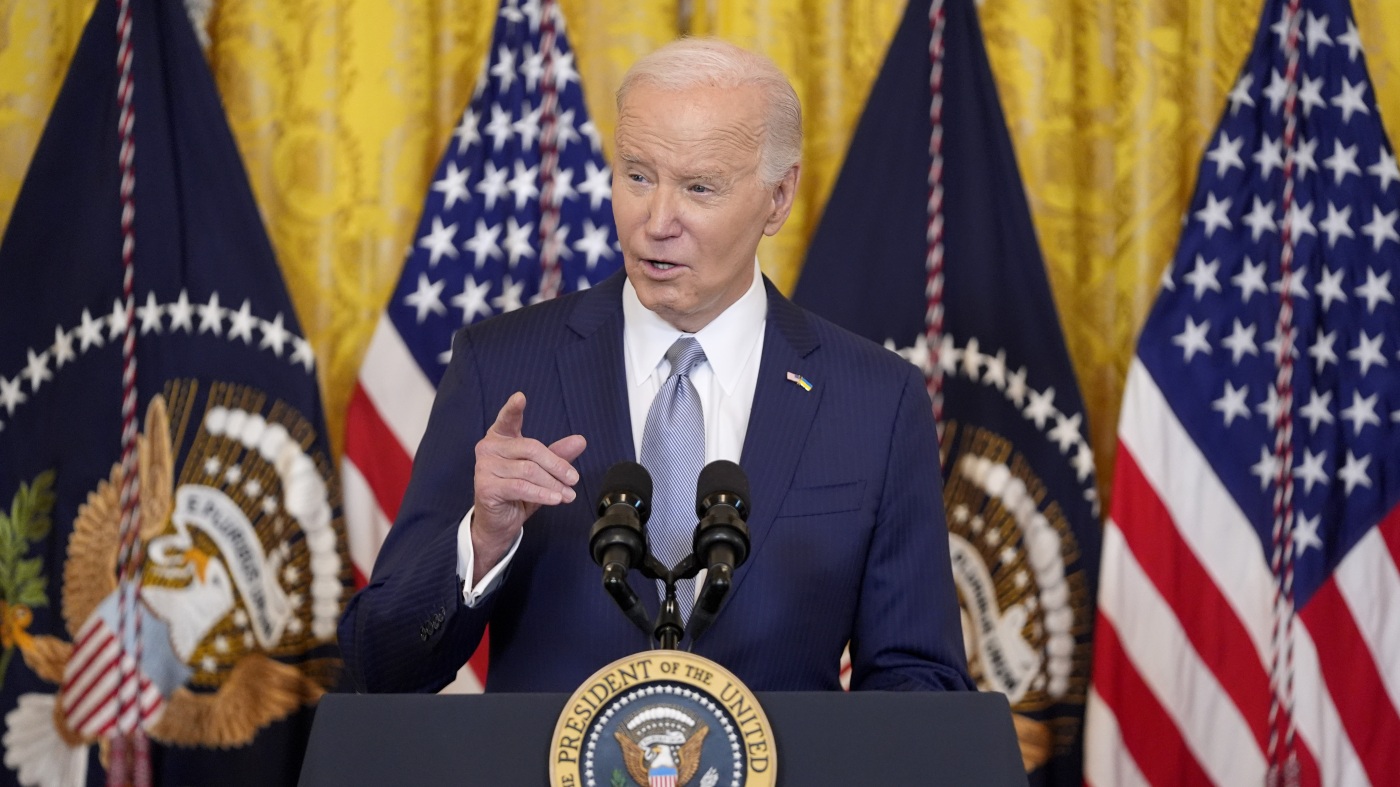
President Joe Biden speaks during an event with the National Governors Association in the East Room of the White House in February.
Evan Vucci/AP
hide caption
toggle caption
Evan Vucci/AP
McALLEN, Texas (AP) — A federal judge in Texas on Monday paused a Biden administration policy that would give spouses of U.S. citizens legal status without having to first leave the country, dealing at least a temporary setback to one of the biggest presidential actions to ease a path to citizenship in years.
The administrative stay issued by U.S. District Judge J. Campbell Barker comes just days after 16 states, led by Republican attorneys general, challenged the program that could benefit an estimated 500,000 immigrants in the country, plus about 50,000 of their children. The states accused the administration of bypassing Congress for “blatant political purposes.”
One of the states leading the challenge is Texas, which in the lawsuit claimed the state has had to pay tens of millions of dollars annually from health care to law enforcement because of immigrants living in the state without legal status.
President Joe Biden announced the program in June. The court order, which lasts for two weeks but could be extended, comes one week after the Department of Homeland Security began accepting applications.
“The claims are substantial and warrant closer consideration than the court has been able to afford to date,” Barker wrote.
Barker was appointed by former President Donald Trump in 2019 as a judge in Tyler, Texas, which lies in the 5th U.S. Circuit Court of Appeals, a favored venue for advocates pushing conservative arguments.
The judge laid out a timetable that could produce a decision shortly before the presidential election Nov. 5 or before a newly elected president takes office in January. Barker gave both sides until Oct. 10 to file briefs in the case.
The policy offers spouses of U.S. citizens without legal status, who meet certain criteria, a path to citizenship by applying for a green card and staying in the U.S. while undergoing the process. Traditionally, the process could include a years-long wait outside of the U.S., causing what advocates equate to “family separation.”
The Department of Homeland Security did not immediately return an email seeking comment on the order.
“The court’s decision tonight to halt the federal government from providing relief is devastating to the thousands of Texas families that could have benefited from this program,” Jessica Cisneros, an attorney for the advocacy organization the Texas Immigration Law Council, said Monday.

Several families were notified of the receipt of their applications, according to attorneys advocating for eligible families who filed a motion to intervene earlier Monday.
“Texas should not be able to decide the fate of hundreds of thousands of U.S. citizens and their immigrant spouses without confronting their reality,” Karen Tumlin, the founder and director of Justice Action Center, said during the press conference before the order was issued.
The program has been particularly contentious in an election year where immigration is one of the biggest issues, with many Republicans attacking the policy and contending it is essentially a form of amnesty for people who broke the law.
Republican Texas Attorney General Ken Paxton cheered the order.
“This is just the first step. We are going to keep fighting for Texas, our country, and the rule of law,” Paxton posted on the social media platform X.
To be eligible for the program, immigrants must have lived continuously in the U.S. for at least 10 years, not pose a security threat or have a disqualifying criminal history, and have been married to a citizen by June 17 — the day before the program was announced.
They must pay a $580 fee to apply and fill out a lengthy application, including an explanation of why they deserve humanitarian parole and a long list of supporting documents proving how long they have been in the country.
If approved, applicants have three years to seek permanent residency. During that period, they can get work authorization.
Before this program, it was complicated for people who were in the U.S. illegally to get a green card after marrying an American citizen. They can be required to return to their home country — often for years — and they always face the risk they may not be allowed back in.



Smoke rises over Konarak naval base in southern Iran on Sunday. The base was one of hundreds of targets of U.S. and Israeli forces throughout the country.
Planet Labs PBC
hide caption
toggle caption
Planet Labs PBC
Commercial satellite images are providing a unique look at the extent of damage being done to Iran’s military facilities across the country.
The U.S. and Israeli military campaign opened with a daytime attack that struck Iranian leadership in central Tehran. Smoke was still visible rising from Ayatollah Ali Khamenei’s compound following the attack that killed the supreme leader.

An image by the company Airbus taken on Saturday shows the aftermath of an Israeli strike on Iran’s Leadership House in central Tehran. Iran’s Supreme Leader Ayatollah Ali Khamenei was killed in the opening wave of attacks.
Pléiades Neo (c) Airbus DS 2026
hide caption
toggle caption
Pléiades Neo (c) Airbus DS 2026
Israel and the U.S. have gone on to strike targets across the country. Reports on social media indicate that there have been numerous military bases and compounds attacked all over Iran, and Iran has responded with attacks throughout the Middle East.
U.S. forces have also been striking at Iran’s navy. In a post on his social media platform, President Trump said that he had been briefed that U.S. forces had sunk nine Iranian naval vessels. U.S. Central Command did not immediately confirm that number but it did say it had struck an Iranian warship in port.

An image captured on Saturday shows a ship burning at Iran’s naval base at Konarak.
Satellite image ©2026 Vantor
hide caption
toggle caption
Satellite image ©2026 Vantor
Numerous satellite images show burning vessels at Konarak naval base in southern Iran. Images also show damage to a nearby airbase where hardened hangers were struck by precision munitions.

Hardened aircraft shelters at Konarak airbase were struck with precision munitions.
Satellite image ©2026 Vantor
hide caption
toggle caption
Satellite image ©2026 Vantor
And there was extensive damage at a drone base in the same area. Iran has launched numerous drones and missiles toward Israel and U.S. military installations in Bahrain, Kuwait and Qatar. Many drones have been intercepted but videos on social media show that some have evaded air defenses and caused damage in nearby Gulf countries. In Dubai, debris from an Iranian drone damaged the iconic Burj Al Arab, according to a statement from Dubai’s government.

Buildings at an Iranian drone base at Konarak were destroyed in the strikes.
Satellite image ©2026 Vantor
hide caption
toggle caption
Satellite image ©2026 Vantor
Iran’s most powerful weapons are its long-range missiles. The Iranian Revolutionary Guards have hidden the missiles deep inside mountain tunnels. Images taken Sunday in the mountains of northern Iran indicate that some of those tunnels were hit in a wave of strikes.
Following Khamenei’s death, Iran declared 40 days of mourning. Satellite images showed mourners gathering in Tehran’s Enghelab square on Sunday.
Iranian Foreign Ministry Spokesperson Esmail Baghaei told NPR on Sunday that Iran will continue to fight “foreign aggression, foreign domination.”
A White House official told NPR that Trump plans to talk to Iran’s interim leadership “eventually,” but that for now, U.S. operations continue in the region “unabated.”

A large crowd of mourners fill Enghelab Square in Tehran on Sunday, following the death of Iran’s Supreme Leader Ayatollah Ali Khamenei, who was killed in an Israeli airstrike.
Satellite image ©2026 Vantor
hide caption
toggle caption
Satellite image ©2026 Vantor

new video loaded: What the Texas Primary Battle Means for the Midterms
By J. David Goodman, Alexandra Ostasiewicz, June Kim and Luke Piotrowski
March 1, 2026

Gunfire rang out at a bar in Austin, Texas, early Sunday and at least three people were killed, the city’s police chief said.
Austin Police Chief Lisa Davis told reporters the shooter was killed by officers at the scene.
Fourteen others were hospitalized and three were in critical condition, Austin-Travis County EMS Chief Robert Luckritz said.
“We received a call at 1:39 a.m. and within 57 seconds, the first paramedics and officers were on scene actively treating the patients,” Luckritz said.
There was no initial word on the shooter’s identity or motive.
Davis noted how fortunate it was that there was a heavy police presence in Austin’s entertainment district at the time, enabling officers to respond quickly as bars were closing.
“Officers immediately transitioned … and were faced with the individual with a gun,” Davis said. “Three of our officers returned fire, killing the suspect.”
She called the shooting a “tragic, tragic” incident.

Austin Mayor Kirk Watson said his heart goes out to the victims, and he praised the swift response of first responders.
“They definitely saved lives,” he said.
Davis said federal law enforcement is aiding the investigation.

‘Wait Wait’ for February 28. 2026: Live in Bloomington with Lilly King!

This Windows gaming handheld has a screen that folds in half

Tel Aviv analyst shelters from 30 missile sirens in 48 hours, says Iran ‘won’t recover’

House Republicans push Johnson to go to war with Senate over SAVE Act

Diabetes surge among Americans could be driven by ‘healthy’ breakfasts, doctor warns

Florida High School Football Rankings: Top 25 teams – Oct. 21

Cleary's 21 help Le Moyne down Central Connecticut State 69-64 in OT

How old is Bo Nix? What to know about Oregon quarterback ahead of 2024 NFL Draft

99th annual Pony Swim held in Virginia

Indiana Members Credit Union announced as new anchor tenant at Bottleworks District
House Republicans push Johnson to go to war with Senate over SAVE Act

Israel FM says Europe too divided, slams Spanish PM
Satellite images provide view inside Iran at war

Video: What the Texas Primary Battle Means for the Midterms

Dems’ potential 2028 hopefuls come out against US strikes on Iran
-

 World4 days ago
Exclusive: DeepSeek withholds latest AI model from US chipmakers including Nvidia, sources say
-

 Massachusetts4 days ago
Mother and daughter injured in Taunton house explosion
-

 Montana1 week ago
2026 MHSA Montana Wrestling State Championship Brackets And Results – FloWrestling
-

 Denver, CO4 days ago
10 acres charred, 5 injured in Thornton grass fire, evacuation orders lifted
-

 Louisiana7 days ago
Wildfire near Gum Swamp Road in Livingston Parish now under control; more than 200 acres burned
-

 Technology1 week ago
YouTube TV billing scam emails are hitting inboxes
-

 Technology1 week ago
Stellantis is in a crisis of its own making
-

 Politics1 week ago
OpenAI didn’t contact police despite employees flagging mass shooter’s concerning chatbot interactions: REPORT