Connect with us

News

Iowa floodwaters breach levees as even more rain dumps onto parts of the Midwest

Published

on

Iowa floodwaters breach levees as even more rain dumps onto parts of the Midwest

A tornado is seen near Cedar Rapids, Iowa, on Tuesday. More severe weather was forecast to move into the region, potentially bringing large hail, damaging winds and tornadoes in parts of western Iowa and eastern Nebraska, according to the National Weather Service.

Nick Rohlman/The Gazette/AP


hide caption

toggle caption

Advertisement

Nick Rohlman/The Gazette/AP

DES MOINES, Iowa — Tornado warnings, flash flooding and large hail added insult to injury for people in the Midwest already contending with heat, humidity and intense flooding after days of rain.

The National Weather Service on Tuesday afternoon and evening issued multiple tornado warnings in parts of Iowa and Nebraska as local TV news meteorologists showed photos of large hail and spoke of very heavy rain.

Earlier on Tuesday, floodwaters breached levees in Iowa, creating dangerous conditions that prompted evacuations.

Advertisement

A vast swath of lands from eastern Nebraska and South Dakota to Iowa and Minnesota has been under siege from flooding from torrential rains since last week, while also being hit with a scorching heat wave. Up to 18 inches of rain have fallen in some areas, and some rivers rose to record levels. Hundreds of people were rescued, homes were damaged and at least two people died after driving in flooded areas.

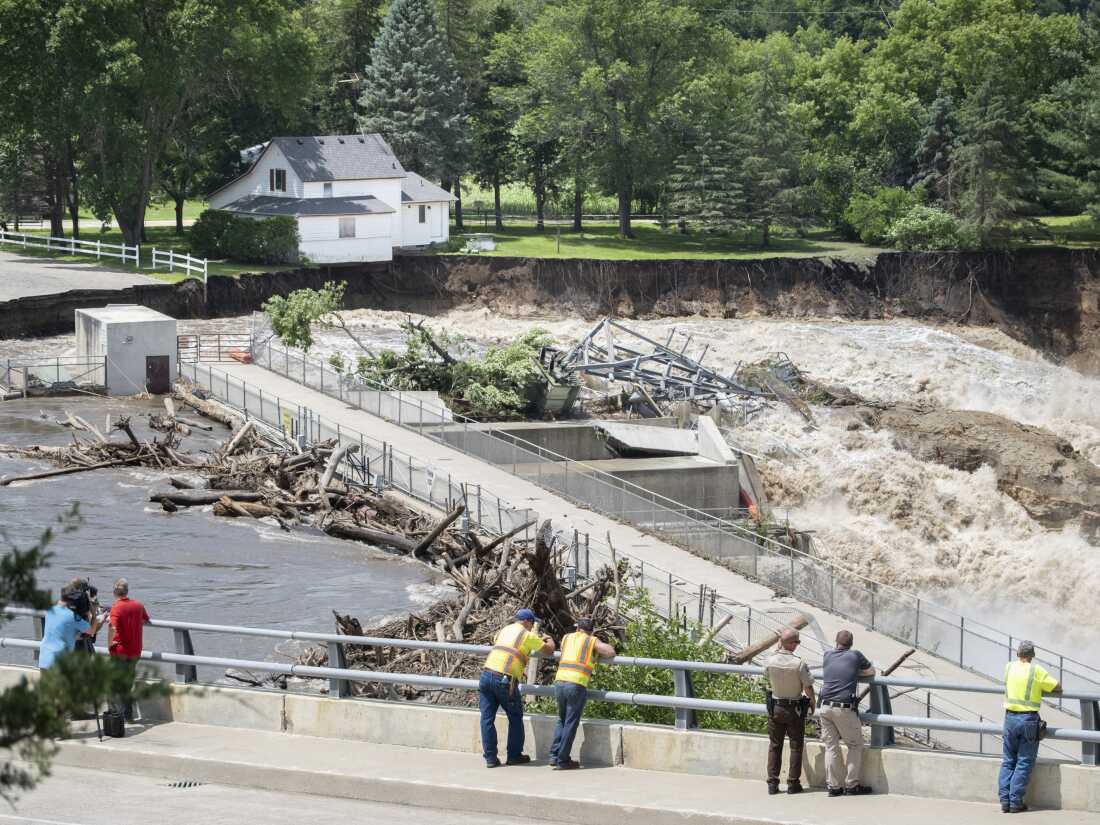
Onlookers take in the catastrophic damage to the Rapidan Dam site in Rapidan, Minn., on Monday. Debris blocked the dam, forcing the heavily backed up waters of the Blue Earth River to reroute along the bank nearest the Dam Store.

Onlookers take in the catastrophic damage to the Rapidan Dam site in Rapidan, Minn., on Monday. Debris blocked the dam, forcing the heavily backed up waters of the Blue Earth River to reroute along the bank nearest the Dam Store.

Casey Ek/The Free Press/AP


hide caption

toggle caption

Advertisement

Casey Ek/The Free Press/AP

The sheriff’s office in Monona County, near the Nebraska border, said the Little Sioux River breached levees in several areas. In neighboring Woodbury County, the sheriff’s office posted drone video on Facebook showing the river overflowing the levee and flooding land in rural Smithland. No injuries were immediately reported.

Patrick Prorok, emergency management coordinator in Monona County, described waking people at about 4 a.m. in Rodney, a town of about 45 people, to recommend evacuation. Later Tuesday morning, the water hadn’t yet washed into the community.

“People up the hill are saying it is coming our way,” Prorok said.

Advertisement
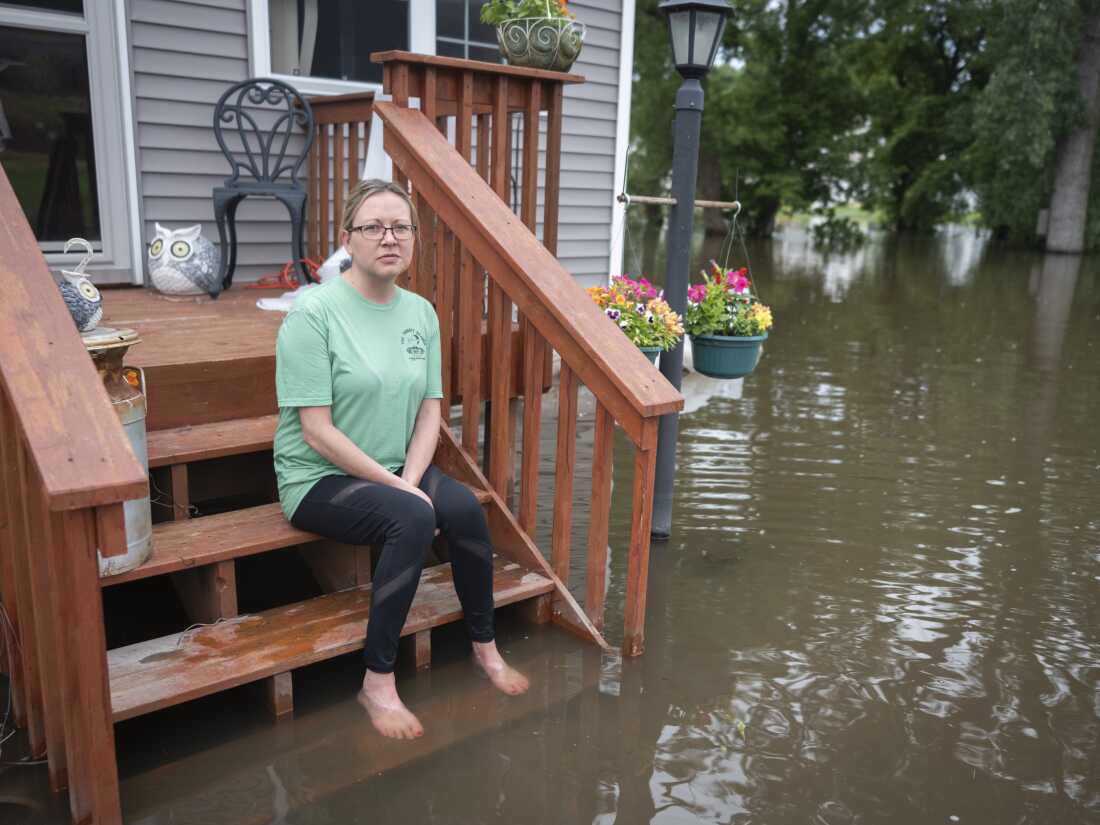
Rachel Morsching sits Tuesday on the flooded porch of her father Dean Roemhildt's home in Waterville., Minn. Waters from the nearby Tetonka and Sakatah lakes have encroached on the town amid recent heavy rains.

Rachel Morsching sits Tuesday on the flooded porch of her father Dean Roemhildt’s home in Waterville., Minn. Waters from the nearby Tetonka and Sakatah lakes have encroached on the town amid recent heavy rains.

Casey Ek/The Free Press/AP


hide caption

toggle caption

Casey Ek/The Free Press/AP

Advertisement

As new areas were flooding Tuesday, some cities and towns were cleaning up after the waters receded while others downstream were piling sandbags and taking other measures to protect against the oncoming swelled currents. Some normal, unassuming tributaries ballooned into rushing rivers, damaging homes, buildings and bridges.

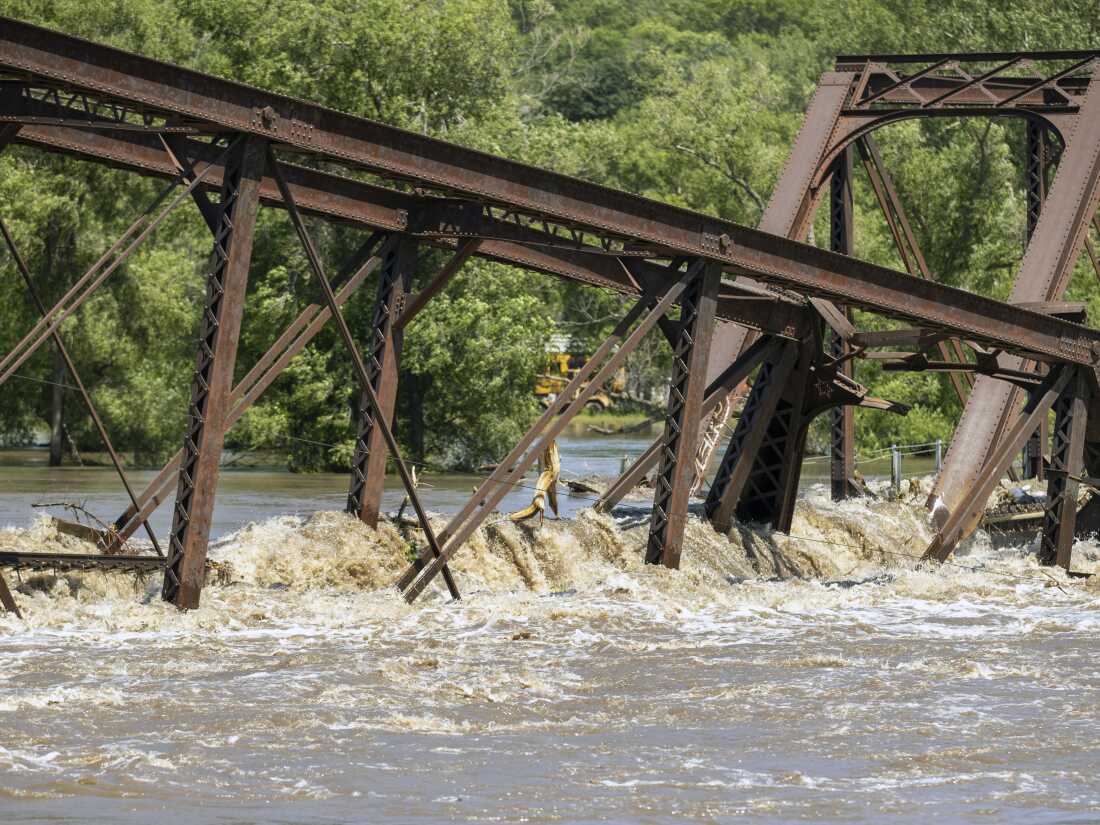
“Normally, this river is barely a trickle,” 71-year-old Hank Howley said as she watched the Big Sioux’s waters gush over a broken and partially sunken rail bridge in North Sioux City, South Dakota, on Monday. “Really, you could just walk across it most days.”

South Dakota state geologist Tim Cowman said that the five major rivers in the state’s southeastern corner have crested and are dropping, albeit slowly. The last of those rivers to crest, the James, did so early Tuesday.

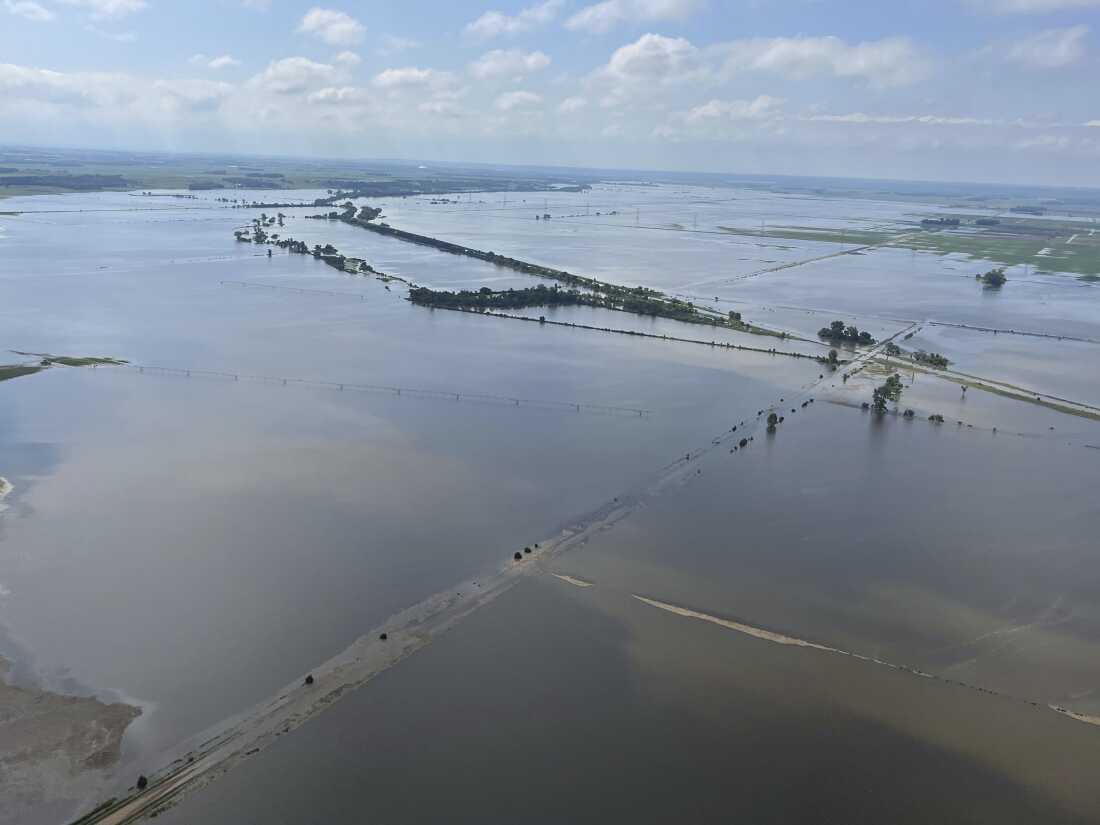
Heavy rains in recent days have submerged farmland near Vermillion, S.D., on Tuesday. Flooding has devastated communities in several states across the Midwest.

Heavy rains in recent days have submerged farmland near Vermillion, S.D., on Tuesday. Flooding has devastated communities in several states across the Midwest.

Jake Hoffner/AP

Advertisement


hide caption

toggle caption

Jake Hoffner/AP

Advertisement

In a residential development along McCook Lake in North Sioux City, the devastation became clear Tuesday as floodwaters began to recede from Monday, exposing collapsed streets, utility poles and trees. Some homes had been washed off their foundations.

“Currently, there is no water, sewer, gas or electrical service in this area,” Union County Emergency Management said in a Facebook post.

President Biden approved a major disaster declaration for affected counties in Iowa on Monday, a move that paves the way for federal aid to be granted.

To the south in Sioux City and Woodbury County, Iowa, officials responded to residents’ complaints that they had received little warning of the flooding and its severity. Sioux City Fire Marshal Mark Aesoph said at a news conference Tuesday that rivers crested higher than predicted.

“Even if we would have known about this two weeks ago, there was nothing we could do at this point. We cannot extend the entire length of our levee,” Aesoph said. “It’s impossible.”

Advertisement

Water had spilled over the Big Sioux River levee, and Aesoph estimated hundreds of homes likely have some internal water damage.

Homes on the south side of Spencer, Iowa, near the Little Sioux River are unlivable as water has reached the main floor, resident Ben Thomas said. A lot of people in town are facing a “double whammy,” with homes and businesses affected.

Officials in Woodbury County said around a dozen bridges over the Little Sioux River had been topped by flood water, and each would need to be inspected to see if they can reopen to traffic.

Forever Wildlife Lodge and Clinic, a nonprofit animal rescue, in northwest Iowa has answered over 200 calls since the flooding started, said licensed wildlife rehabilitator Amanda Hase.

Hase described the flooding as “catastrophic” for Iowa wildlife, which are getting washed out of dens, injured by debris and separated from each other. She and other rehabilitators are responding to calls about all kinds of species, from fawns and groundhogs to bunnies and eaglets.

Advertisement

“I’ve never seen it this bad before, ever,” she said.

Floodwaters rush over a collapsed railroad bridge over the Big Sioux River near North Sioux City, S.D., on Monday.

Floodwaters rush over a collapsed railroad bridge over the Big Sioux River near North Sioux City, S.D., on Monday.

Josh Jurgens/AP


hide caption

toggle caption

Advertisement

Josh Jurgens/AP

Further to the east in Humboldt, Iowa, a record crest of 16.5 feet was expected Wednesday at the west fork of the Des Moines River. Amid high temperatures and humidity, nearly 68,000 sandbags have been laid, according to county emergency manager Kyle Bissell.

Bissell told reporters Tuesday that there was no water on the streets yet, but flooding had begun in some backyards and was reaching up to foundations. Humboldt is home to nearly 5,000 residents.

More severe weather was forecast to move into the region Tuesday, potentially bringing large hail, damaging winds and even a brief tornado or two in parts of western Iowa and eastern Nebraska, according to the National Weather Service. Showers and storms were also possible in parts of South Dakota and Minnesota, the agency said.

Advertisement

In Michigan, more than 150,000 homes and businesses were without power Tuesday morning after severe thunderstorms barreled through, less than a week after storms left thousands in the dark for days in suburban Detroit.

The weather service also predicted more than two dozen points of major flooding in southern Minnesota, eastern South Dakota and northern Iowa, and flood warnings are expected to continue into the week.

Many streams, especially with additional rainfall, may not crest until later this week as the floodwaters slowly drain down a web of rivers to the Missouri and Mississippi. The Missouri will crest at Omaha on Thursday, said Kevin Low, a weather service hydrologist.

North of Des Moines, Iowa, the lake above the Saylorville Dam was absorbing river surge and expected to largely protect the metro area from flooding, according to the Polk County Emergency Management Agency. The U.S. Army Corps of Engineers projected Tuesday that water levels at Saylorville Lake will rise by more than 30 feet by the Fourth of July.

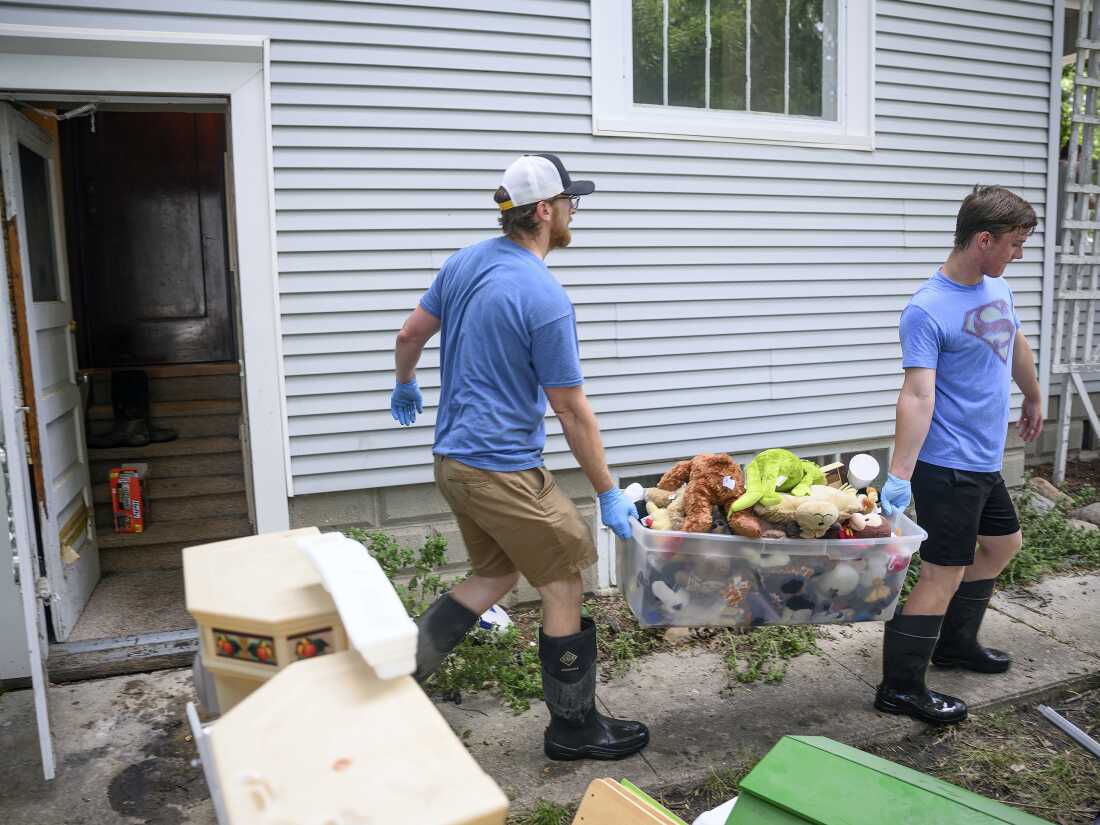
Jared Gerlock (left) and his son, Robbie, carry a bin of water-logged stuffed animals out of the flood-damaged basement of their home on East Second Street in Spencer, Iowa, on Tuesday. Officials said about 40% of properties in the city were affected after the Little Sioux River flooded.

Jared Gerlock (left) and his son, Robbie, carry a bin of water-logged stuffed animals out of the flood-damaged basement of their home on East Second Street in Spencer, Iowa, on Tuesday. Officials said about 40% of properties in the city were affected after the Little Sioux River flooded.

Tim Hynds/Sioux City Journal/AP

Advertisement


hide caption

toggle caption

Tim Hynds/Sioux City Journal/AP

Advertisement

Outside Mankato, Minnesota, the local sheriff’s office said Monday that there was a “partial failure” of the western support structure for the Rapidan Dam on the Blue Earth River after the dam became plugged with debris. Flowing water eroded the western bank, rushed around the dam and washed out an electrical substation, causing about 600 power outages.

Eric Weller, emergency management director for the Blue Earth County sheriff, said the bank would likely erode more, but he didn’t expect the concrete dam itself to fail. The two homes downstream were evacuated.

Minnesota Gov. Tim Walz on Tuesday cautioned against rebuilding too fast, instead emphasizing more sustainable repairs that could prevent or mitigate future flooding.

“Nature doesn’t care whether you believe in climate change or not,” Walz said. “The insurance companies sure believe in it. The actuarials sure believe in it, and we do.”

Advertisement

News

Former Olympian pleads not guilty in reflecting pool vandalism charges

Published

on

Former Olympian pleads not guilty in reflecting pool vandalism charges

Former U.S. Olympian David Hearn (left) walks with his attorney Norman Eisen to speak to reporters and protesters gathered after his arraignment at the Superior Court of the District of Columbia in Washington, D.C. on Thursday.

Finn Gomez/Getty Images


hide caption


toggle caption

Advertisement

Finn Gomez/Getty Images

Former U.S. Olympic canoeist David Hearn pleaded not guilty to damaging the Lincoln Memorial Reflecting Pool in D.C. Superior Court Thursday morning.

Federal prosecutors charged Hearn with a single count of destruction of property causing more than $1,000 in damage to the pool.

Hearn has previously claimed, which his attorneys repeated during a short press conference outside the court, that he simply touched the water in the pool out of curiosity.

Advertisement

The Trump administration had just completed a $14 million renovation of the pool.

But shortly after the work finished, peeling paint and algae gathered in the water. The remodel has been largely criticized as a massive failure and waste of taxpayer dollars.

Superior Court Judge Carmen McLean released Hearn on his own recognizance. His next hearing is scheduled for Aug. 5.

Norm Eisen, one of Hearn’s attorneys, spoke to reporters outside of court following the hearing. He said the administration is using Hearn as a “scapegoat … for their own failures.”

“It is not a crime to touch the reflecting pool, to touch water in the United States of America,” he said.

Advertisement

Prosecutors say there is a host of evidence against Hearn.

This is a developing story.

Continue Reading

News

Three more people charged with damaging Reflecting Pool after Trump’s multimillion-dollar restoration | CNN Politics

Published

on

Three more people charged with damaging Reflecting Pool after Trump’s multimillion-dollar restoration | CNN Politics

Three more people have been criminally charged with destruction of property at the Lincoln Memorial Reflecting Pool.

Officers say they detained Cameron Thiers, Sophie Dennison-Gibby and Justin Carreno one Saturday afternoon in June and described in court documents witnessing them peeling and removing pieces of blue paint from the Reflecting Pool.

One officer “witnessed Carreno reach down into the reflecting pool and pull up a piece of the blue paint,” according to the court documents.

The officer who detained Dennison-Gibby “found 1 additional piece of the reflecting pool liner” in her purse, the documents said.

All three incidents were recorded on the officers’ body worn cameras, they said in the court documents.

Advertisement

Several “partnering law enforcement agencies assigned to the Reflecting Pool” working with US Park Police were involved in detaining the two men and one woman — including officers from Texas, Oklahoma, Montana and California.

One of the officers said in court documents that Thiers “admitted to removing a piece of blue sealant from the Reflecting Pool and still had it in his hand when I made contact with him.”

The three defendants were arraigned in court Wednesday and pleaded not guilty to the misdemeanor charges of destruction of property with a value less than $1,000. The judge ordered them to stay away from the Reflecting Pool.

Lawyers for Thiers and Dennison-Gibby declined to comment. CNN has reached out to Carreno’s attorney.

If found guilty of destruction of property, the defendants could be fined up to $1,000 and face a maximum of 180 days behind bars.

Advertisement

The New York Times first reported that three additional people had been charged with damaging the Reflecting Pool.

President Donald Trump has repeatedly claimed that vandals caused major damage to the pool by gashing the lining after his administration spent more than $14 million on renovations, though he has not provided evidence to support that claim. The officers who charged Carreno, Thiers and Dennison-Gibby did not accuse them of gashing the lining.

Former Olympic canoeist David Hearn was indicted by a grand jury in Washington, DC, last week for allegedly damaging the Reflecting Pool. Hearn — unlike Carreno, Thiers and Dennison-Gibby – was charged with destruction of property with a value of more than $1,000 which carries a maximum penalty of 10 years in prison, if convicted. He is set to be arraigned in court Thursday.

Crews began draining the Reflecting Pool over the weekend to make repairs, according to Interior Secretary Doug Burgum, for the second time in three months.

The move comes after weeks of problems – algae blooms, green-hued water, a chipping bottom and the administration’s allegations of vandalism – that have plagued the iconic landmark, making its woes the subject of national interest.

Advertisement
Continue Reading

News

Supreme Court financial disclosures reveal how their books add to their income

Published

on

Supreme Court financial disclosures reveal how their books add to their income

Supreme Court Justice Amy Coney Barrett speaks at the Reagan Library on Sept. 9, 2025, in Simi Valley, Calif. Barrett discussed and signed copies of her new book, Listening to the Law: Reflections on the Court and Constitution.

Mario Tama/Getty Images


hide caption


toggle caption

Advertisement

Mario Tama/Getty Images

Even as the Supreme Court was handing down one legal thunderbolt after another last week, the justices were quietly releasing their annual financial reports. Justice Samuel Alito was the only sitting justice to request an extension, which he has done for 15 years. The disclosures do not give a complete account of the justices’ total income and wealth, but they give insights into their concertgoing, guest professorships and even their involvement in youth sports.

In addition to their salaries, much of the justices’ reported income came from their book deals. Justice Ketanji Brown Jackson led the pack earning more than $1.1 million last year for a total of roughly $4 million since her memoir, Lovely One, was published in 2024.

Justices Sonia Sotomayor, Neil Gorsuch, Amy Coney Barrett and retired Justice Anthony Kennedy also reported income from published books. Earnings from their books ranged from $849,000 for Barrett, to $300,000 for Gorsuch and $88,000 for Sotomayor, whose books include her 2013 autobiography and five children’s books. Justice Clarence Thomas, who previously earned $1.5 million for his 2007 memoir, listed no publisher payments last year, and Justice Brett Kavanaugh, one of 13 co-authors of a 2016 legal treatise, also received no payments last year. Kavanaugh is said to be working on a memoir but he listed no payments for the anticipated book. Alito does have a book coming out in the fall, but with his financial report still outstanding, there is no data on how much he was paid for the work in 2025.

Advertisement

The only two sitting justices who have not written books are Chief Justice John Roberts and Justice Elena Kagan.

Many justices also earned income from teaching at law schools. Roberts reported income from New England Law, located in Boston, and Gorsuch reported teaching income from George Mason University in Virginia. Thomas taught classes at Catholic University in Washington, D.C., and Barrett and Kavanaugh taught at Notre Dame Law School. Barrett graduated from the school and began teaching there 23 years ago; Kavanaugh has family connections to Notre Dame.

Continue Reading
Advertisement

Trending