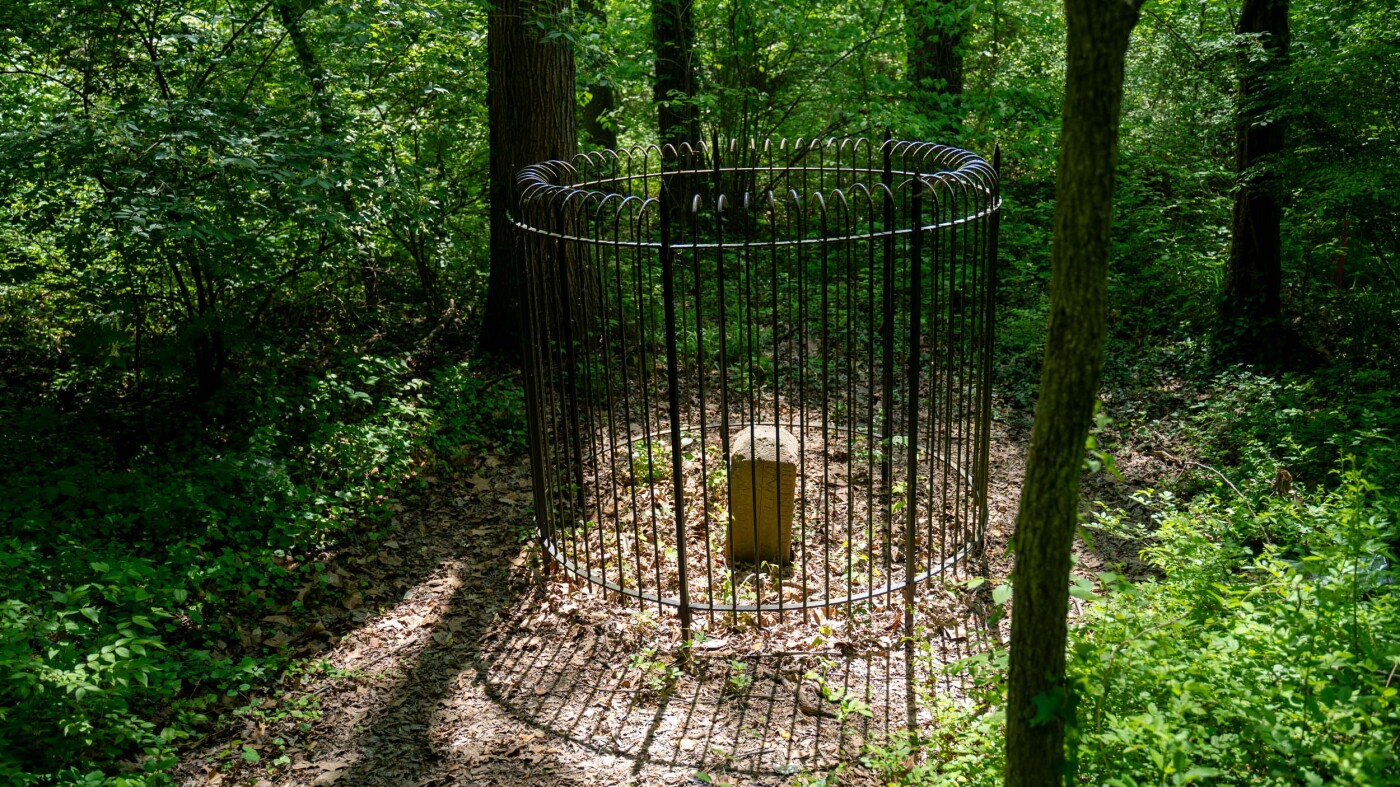
D.C.’s east cornerstone, located at the city’s easternmost point, is hidden in a small patch of woods in a residential neighborhood.
Jacob Fenston/For NPR
hide caption
toggle caption
Jacob Fenston/For NPR
If you’ve been to Washington, D.C., chances are you paid a visit to some of the city’s many monuments.
You probably didn’t see D.C.’s oldest monuments — even though they are thought to be the first federal monuments anywhere in the country, dating back to the 1790s. But they aren’t on any tourist map, and many are at risk of being destroyed.
The monuments in question are D.C.’s boundary stones. Placed by surveyors more than 200 years ago, they delineated the borders of what would become the young nation’s new capital city. Today, 36 of the original 40 sandstone markers remain, but they’re far outside the downtown areas most visitors see.
One face of each stone is carved with the year it was set in the ground, either 1791 or 1792.
Jacob Fenston for NPR
hide caption
toggle caption
Jacob Fenston for NPR
I recently toured all of D.C.’s boundary stones in one day. It took more than 9 hours, crammed in the back of a minivan traversing the wilds of Washington, from the tony mansions along the Potomac River, to a mucky swamp behind the city’s car impound lot.
“It is a long day, and you’ve really got to be into it,” says Stephen Powers, who leads the small tour.
Powers may be the foremost expert on D.C.’s boundary stones and he’s largely responsible for a resurgence of interest in them in recent years. He’s been making these treks each year since 2005. He checks on each stone, and he brings along as many people as he can fit in his vehicle.
A capitol carved out of field and forest
The U.S. Constitution itself authorized the creation of the new nation’s capital — a 10-mile by 10-mile square — and President George Washington selected the exact location. Before any construction could start, surveyors set out through old-growth forests and farmland, manually measuring and marking the official borders. Every mile along the way, they set a boundary stone.
Now, more than 200 years later, many are unmarked and tough to get to. For example, one is hidden in a bit of overgrown woods wedged between the eight-lane I-295 freeway and the Potomac River.
I’m riding next to Sharon Pitts, a local who lives nearby in Alexandria, Va. She’s having fun on this unusual tour, but it’s a little outside her comfort zone. She says she doesn’t usually spend her Sundays wearing khaki cargo pants and muddy boots.
“Oh, no, no! Church,” she says, laughing. “I’m all dressed up and all that.”
Sharon Pitts on the hunt for the southeast #9 boundary stone, located in a small forest between the Potomac River and I-295.
Jacob Fenston for NPR
hide caption
toggle caption
Jacob Fenston for NPR
Powers pulls his minivan over on the shoulder of I-295 , then guides the group over the guardrail as cars whiz by.
A short way into the vine-draped trees, we clamber over a broken section of chain-link fence, and then bushwhack through brambles.
Then, we find it: a little, pyramid-shaped stone, about 2 feet tall. It’s pitted, and dotted with lichen, but you can clearly make out the carved numbers: 1792.
The stone is engraved with the word “Maryland” on one side, and “Jurisdiction of the United States” on the other.
“This is one of the earliest representations of the words ‘United States’ carved into stone,” Powers says.
He waves his arms to show where the border runs, dividing Maryland and the District of Columbia.
For Powers, the boundary stones are a hobby. By day he’s a civil engineer at Metro, D.C.’s public transit agency. In 2005, he got interested in the stones when his second-grade daughter did a school project on them. At the time, before ubiquitous smartphones and GPS-powered maps, he had to spend countless hours tracking down the people who knew how to find each stone. Now, he runs a website with an interactive map and directions to each stone.
Over the centuries, Washington’s boundary stones have been threatened by the elements, in particular water, erosion, and falling trees. A few may have been damaged or gone missing during the Civil War. But in more recent years, there’s been an even bigger threat: the automobile.
On the tour, we pull into a gas station parking lot, and dash across a major intersection. At the spot where a boundary stone should be, there is instead wreckage from a car crash — twisted pieces of metal and yellow caution tape fluttering in the breeze.
Powers was one of the first people on the scene after the crash happened a few days earlier. He found the boundary stone intact, but covered with smashed car parts, including the Maryland license plate from the vehicle involved — a detail that may help police track down the culprit.
District officials later retrieved the stone. They’re still figuring out how to reinstall it to prevent further damage.
Powers heard about the crash from Janet McFarland with the D.C. chapter of the Daughters of the American Revolution. The group has been helping look after the boundary stones for more than a century, and McFarland was on her way to a cleanup of one of the boundary stones when she spotted the one that had been hit and alerted Powers.
“Cars right now are our biggest enemy,” says McFarland.
The boundary stones used to be in the middle of nowhere. In the 1700s, Washington, D.C. was just an idea — an imagined street grid of grand avenues and squares to be built over what was then a rural landscape at the confluence of two rivers.
As Washington’s population grew, the stones were swallowed up by the city. Now, one is on the unnaturally verdant lawn of a self-storage business, one is next to a strip mall parking lot, one is in a cemetery. Many are along busy roads.
On the tour, we see at least three that have been hit by cars over the years.
A bit of history in a suburban yard
Many boundary stones are in people’s yards. Rosa García has one in front of her bungalow. Her house is in Mt. Rainier, Md., but the sidewalk and street are in D.C.
When I call out to her, she’s not surprised to have a stranger at her front gate.
“Plenty of people come by,” she tells me in Spanish. They stop, takes pictures.
She doesn’t mind all the attention to the unusual lawn ornament. “Pues, es historia,” she says. It’s history.
Over the years there have been surges of interest in the boundary stones. They were almost completely forgotten for the first century of their existence, before being surveyed again in 1894.
Powers says there have been many people before him who’ve been fascinated by, even obsessed with, the boundary stones.
“I like to call them stoners,” Powers says. “I walk in their footprints.”
There have been efforts to elevate the status of the stones, and better preserve them. In the 1980s there was an unsuccessful push to turn all of them into National Historic Landmarks, a move that would open the door to federal funding.
There has been some government investment: in 2015, D.C. led a project to restore the stones, digging up, repairing, and resetting them. For the four stones that were missing, concrete replicas were made.
A few of the stones have informational signs, but most don’t. Powers says that’s not necessarily a bad thing.
“I have mixed emotions about that. There are some that I really feel should be more accessible,” he says.
Others, he says, are probably better off hidden — protected by their obscurity, and more fun to visit.
We finally come to the end of the tour, at the western corner stone. We’ve gone 57.8 miles, circumnavigating the city and getting a 360-degree view of life in modern-day Washington. We drove through neighborhoods that are home to Supreme Court justices and cabinet secretaries; we stopped for coffee in a vibrant community of Ethiopian immigrants; we wolfed down a packed lunch behind a dusty concrete plant.
“You get the diversity of it all,” Powers says.
As the minivan pulls to a stop, Sharon Pitts records the time — it’s 9 hours, 33 minutes after we started.
“This has been such a wonderful day,” Pitts says.