News
Here’s a partial list of U.S. elected officials opposing Trump’s invasion of Venezuela

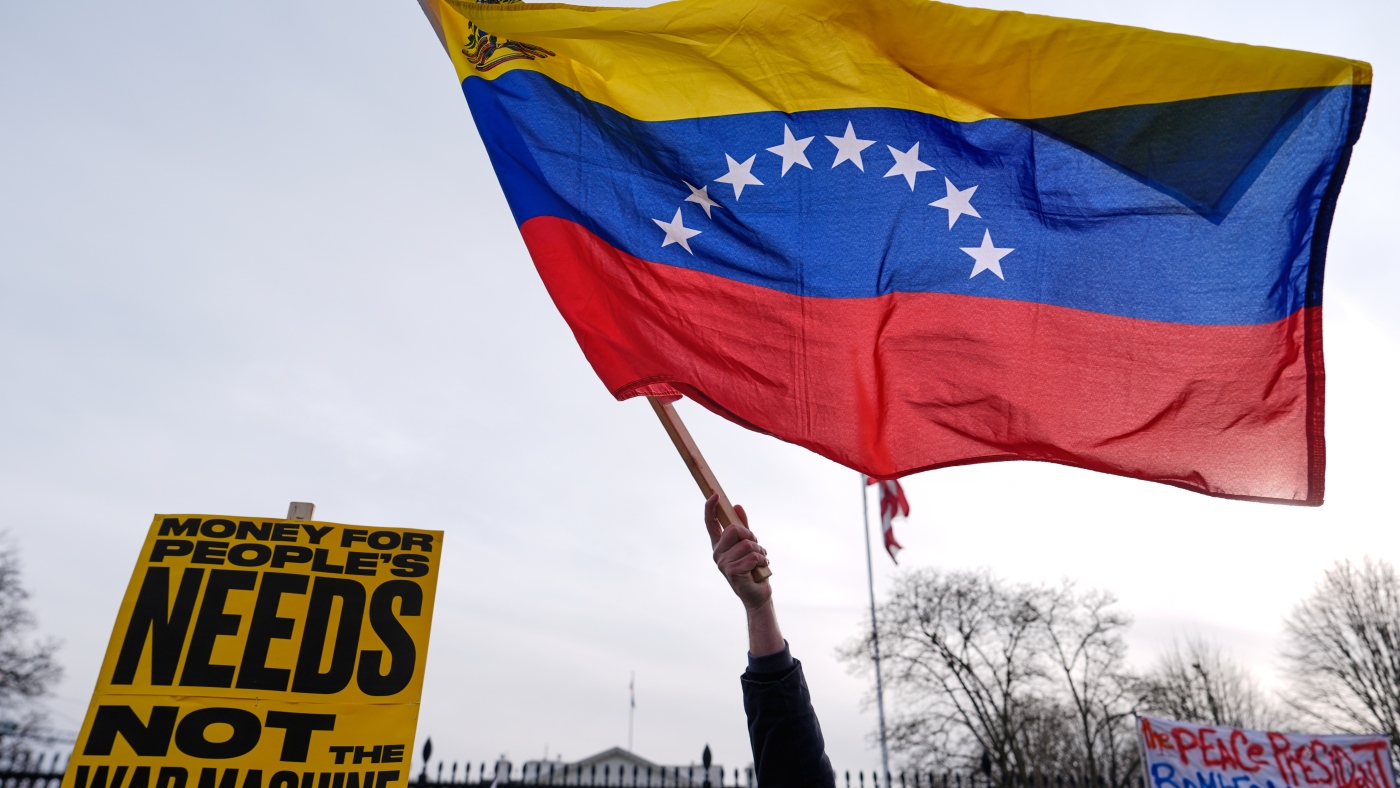
Protesters rally outside the White House Saturday, Jan. 3, 2026, in Washington, after the U.S. captured Venezuelan President Nicolás Maduro and his wife in a military operation.
Julia Demaree Nikhinson/AP
hide caption
toggle caption
Julia Demaree Nikhinson/AP
President Trump’s move to depose Venezuelan President Nicolás Maduro has drawn praise inside the United States, especially from Republican leaders. But the invasion also faces significant skepticism, questions about legality, and full-throated opposition from some elected officials across the political spectrum.
Here’s a survey.
Some Republicans condemn, or question, Trump’s invasion
While most conservative lawmakers voiced support for Trump’s action, a small group of Republican House members and GOP Senators described the move as unlawful or misguided.
“If the President believes military action against Venezuela is needed, he should make the case and Congress should vote before American lives and treasure are spent on regime change in South America,” said Rep. Thomas Massie, a Republican from Kentucky, speaking on the House floor. “Do we truly believe that Nicolás Maduro will be replaced by a modern-day George Washington? How did that work out in Cuba, Libya, Iraq or Syria?”
Rep. Marjorie Taylor Greene, R-Ga., posting on social media, voiced skepticism that the true goal of Trump’s invasion was to stop the flow of drugs into the United States. She also described the military action as a violation of conservative “America First” principles.
“Americans disgust with our own government’s never ending military aggression and support of foreign wars is justified because we are forced to pay for it and both parties, Republicans and Democrats, always keep the Washington military machine funded and going,” Greene posted on X. “This is what many in MAGA thought they voted to end. Boy were we wrong.”
Rep. Don Bacon, R-Neb., a retired U.S. Air Force Brigadier General, generally praised the military operation, but he also said the precedent of U.S. military intervention could embolden more aggressive action by authoritarian regimes in China and Russia.
“Freedom and rule of law were defended last night,” Bacon said on X, referring to the invasion of Venezuela, “but dictators will try to exploit this to rationalize their selfish objectives.”
At least three Republican Senators also voiced concern or skepticism about the invasion and its legal justification, while also celebrating the fall of Maduro.
“In this case, a leader who monopolized central power is removed in an action that monopolizes central power,” Kentucky Sen. Rand Paul wrote on the platform X. “Best though, not to forget, that our founders limited the executive’s power to go to war without Congressional authorization for a reason—to limit the horror of war and limit war to acts of defense.”
GOP Senators Lisa Murkowski and Dan Sullivan, both of Alaska, said Maduro’s ouster would make the United States and the world safer, but suggested the operation could turn into a quagmire for U.S. troops.
“Late last year, I voted to proceed to debate on two resolutions that would have terminated the escalation of U.S. military operations against Venezuela absent explicit authorization from Congress,” Murkowski wrote on the platform X. She added that she expects further briefings from Trump officials on the “legal basis for these operations.”
“The lessons learned from what took place after the United States deposed another Latin American indicted drug lord—Panama’s Manuel Noriega in 1989—could prove useful, as could the painful and difficult lessons learned after the U.S. invasion of Iraq in 2003,” Sullivan wrote on X.

Most Democrats condemn the invasion
Most Democratic lawmakers and elected officials also described Maduro as a dictator, but they generally condemned Trump’s action. At a press conference Saturday, New York City’s new Mayor Zohran Mamdani told reporters he phoned Trump and voiced opposition to the invasion.
“I called the President and spoke with him directly to register my opposition to this act and to make clear that it was an opposition based on being opposed to a pursuit of regime change, to the violation of federal and international law,” Mamdani said.
Democratic minority leader Sen. Chuck Schumer of New York accused Trump of acting in bad faith and violating the U.S. Constitution. “The idea that Trump plans to now run Venezuela should strike fear in the hearts of all Americans,” Schumer said in a post on X. “The American people have seen this before and paid the devastating price.”
According to Schumer, the Trump administration assured him “three separate times that it was not pursuing regime change or or military action without congressional authorization.”
California’s Democratic Sen. Adam Schiff, a frequent Trump critic, posted a series of comments on X describing Saturday’s military action and Trump’s proposed U.S. occupation of Venezuela as potentially disastrous.
“Acting without Congressional approval or the buy-in of the public, Trump risks plunging a hemisphere into chaos and has broken his promise to end wars instead of starting them,” Schiff wrote.
“Donald Trump has once again shown his contempt for the Constitution and the rule of law,” said Vermont’s Independent Sen. Bernie Sanders, in a video posted on social media, where he described the U.S. invasion as “imperialism.”
“This is the horrific logic of force that Putin used to justify his brutal attack on Ukraine,” Sanders said.
Trump campaigned on an “America First” platform. Now he wants to “run” Venezuela?
60% of Americans live paycheck to paycheck. Health care is collapsing. Housing is unaffordable.
Trump should address these major crises at home and end his illegal military adventurism abroad. pic.twitter.com/vyoNpEcn4a
— Sen. Bernie Sanders (@SenSanders) January 3, 2026
Rep. Alexandria Ocasio-Cortez, Democrat of New York, also spoke harshly of the military strike, describing it as an effort by Trump to distract attention from domestic troubles in the United States.
“It’s not about drugs. If it was, Trump wouldn’t have pardoned one of the largest narco traffickers in the world last month,” Ocasio-Cortez said, referring to Trump’s decision to free former Honduran President Orlando Hernandez, who had been convicted in the U.S. of helping smuggle more than 400 tons of cocaine into the U.S.
“It’s about oil and regime change. And they need a trial now to pretend that it isn’t. Especially to distract from Epstein + skyrocketing healthcare costs,” Ocasio-Cortez added on X.


The Justice Department sent letters warning election officials in all 50 states and the District of Columbia that they could face criminal prosecution over noncitizen voting, a spokesperson for the Justice Department confirmed Tuesday.
The letters, signed by Assistant Attorney General Harmeet Dhillon, who heads up the department’s Civil Rights Division, give states five days to explain how they will comply with federal voter eligibility laws and how they will maintain “clean voter lists.”
“The Department sent these letters to all 50 states and the District of Columbia, asking for voluntary compliance in a timely manner with their obligations under federal law to ensure only citizens vote in federal elections,” a Justice Department spokesperson said in a statement.
Noncitizen voting in federal elections is extremely rare, but Trump and his administration have falsely portrayed it as a widespread issue.
Michigan Secretary of State Jocelyn Benson, Nevada Secretary of State Francisco Aguilar and Utah Lt. Gov. Deidre Henderson are among those who said they received the letters from the Justice Department.
The letters say state election officers “could be criminally prosecuted for aiding and abetting” noncitizen voting. They further specify that any election officer who knowingly retains noncitizens on a statewide voting registration list or who facilitates noncitizens’ receiving and casting ballots could be subject to criminal liability.
“An intentional act that is aimed at diluting the votes of citizens could also constitute a violation” of federal law, the letters said.
Henderson wrote on social media that the threats constitute “truly bizarre behavior.”
“Got another love letter this morning from the DOJ sprinkled throughout with threats of criminal prosecution,” she wrote. “I’m sure I’m not the only chief election officer of a state who is being targeted for following state and federal laws by resisting DOJ’s demands for private voter data that have thus far been ruled illegal by at least a dozen courts.”
The letters are the latest move in the Justice Department’s campaign to assert more federal control over state elections.
While some states have complied with the administration’s demands that they hand over voter roll data, the Justice Department has sued 30 states and Washington, D.C., for resisting. So far, 11 different federal courts have dismissed the Justice Department’s efforts to seize voter rolls.

Lionel Messi #10 of Argentina celebrates scoring his team’s second goal during their World Cup match against Egypt in Atlanta on Tuesday.
Elsa/Getty Images
hide caption
toggle caption
Elsa/Getty Images
They looked beaten. And out. Argentina, the defending World Cup champion and No. 1-ranked team, was down 2-0 late against Egypt.

Then, in a span of 13 remarkable minutes, Argentina scored not once, not twice, but three times, capping a comeback for the ages and leaving Egypt stunned and shellshocked.
For much of the game in Atlanta, Egypt was in control, hobbling Argentina early. The Egyptian attack began almost immediately with a stunning header goal delivered by Yasser Ibrahim in the 15th minute. After that, Egypt’s defense closed ranks, making it practically impossible for Argentina to equalize.
It was downhill from there for the Argentines: team captain Lionel Messi failed to convert a penalty kick, and in the 67th minute, Egypt got a second goal from Mostafa Ziko (after an earlier Egyptian goal had been disallowed after a video review). It looked like Argentina was finished. On the brink of elimination.
But no one told the Argentine players that.
In the 79th minute, Lionel Messi began doing his thing. He fired a cross near the Egyptian goal, and Cristian Romero headed it in. Messi was not done. Four minutes later, he powered a shot past the Egyptian keeper. It was his eighth goal of this tournament, the most of any player. The score was 2-2.
Then, in stoppage time, yet another Argentina header and another goal, this time from Enzo Fernandez.
“This is the World Cup for you,” said Messi after the game. “It wasn’t easy to come back from two goals down. But as I always say, this group never gives up. We always try to fight until the end.”

French referee François Letexier speaks with Egypt forward Mohamed Salah during the World Cup Round of 16 match between Argentina and Egypt in Atlanta.
Roberto Schmidt/AFP via Getty Images
hide caption
toggle caption
Roberto Schmidt/AFP via Getty Images
Afterward, Egypt coach Hossam Hassan complained about the French referee and the officiating. “I am not convinced. I am not convinced with this outcome. I’m not convinced with the way things unfolded during this match,” said Hassan in a post-match news conference. “We have been treated unfairly today. We have suffered injustice.”
“We would have deserved to earn this win, but we are leaving with honor, with pride, regardless of this defeat,” said Hossan.
African soccer teams have been the stars of this World Cup. Morocco has yet to lose a game. Cape Verde qualified for the first time in its history and stymied Spain, Uruguay and Saudi Arabia. Argentina barely beat them in a nail-biter of a match.
For Egypt, getting this far in the tournament is historic in itself: it’s the first time the team has made it this far. For Argentina, it was a terrifying yet relieving victory: several players, including Messi himself, cried after the game.
Next, they move to the quarterfinals and will play the winner of today’s Switzerland-Colombia match.

Top Senate Democrats are pushing for answers on whether a provision in a controversial settlement agreement between President Trump and his own administration applies to companies co-founded by or affiliated with the Trump family.
As part of a deal struck in May by the Justice Department to resolve a lawsuit brought by Mr. Trump, the Internal Revenue Service is permanently barred from pursuing claims against Mr. Trump, his oldest sons Don Jr. and Eric, and the Trump Organization based on prior tax returns.
In a one-page document signed by Acting Attorney General Todd Blanche and dated May 19, the Justice Department said the defendants in the president’s lawsuit — the IRS and the Treasury Department — are “FOREVER BARRED and PRECLUDED” from “prosecuting or pursuing, any and all claims” arising from tax returns filed before the settlement took effect. Blanche also wrote that the settlement applies to “parties including trusts, parent, sister, or related companies, affiliates, and subsidiaries.”
Now, Senators Elizabeth Warren of Massachusetts, Senate Minority Leader Chuck Schumer of New York, and Ranking Member of the Senate Finance Committee Ron Wyden of Oregon are pushing 11 businesses and organizations with ties to the Trump family to get answers for the “significant questions” the settlement raises relating to the tax audit provision, and whether the companies are included in the deal.
“Under the guise of a so-called legal settlement, the Trump administration has attempted to decree that the President, his family, and their entire business empire — potentially including entities with even the vaguest ‘affiliation’ to the family — are to face zero consequences if they have committed a range of financial crimes or misdeeds — regardless of the severity of the violation,” the senators wrote in letters transmitted to the companies Monday night.
The letters were sent to mining company Kaz Resources, defense firm Powerus, cryptocurrency companies World Liberty Financial and American Bitcoin, robotics startup Foundation Future Industries, investment firm 1789 Capital, private aviation company Tag Air, and prediction markets Polymarket and Kalshi.
All of the companies either were founded by Mr. Trump and his two adult sons, or list members of the Trump family as advisers, board members, or partial owners. Donald Trump Jr. sits on Polymarket’s advisory board and 1789 Capital, where he’s a partner, has invested in Polymarket. Days before Mr. Trump took office for his second term, Kalshi also announced Trump Jr. would be a strategic adviser.
The Democrats, who are in the minority, lack subpoena power, so Mr. Trump, his children and his companies can’t be forced to answer the questions posed by the senators.
According to recent financial disclosures, the president earned more than a billion dollars from cryptocurrency ventures alone last year, including from his meme coin business and World Liberty Financial, his family’s cryptocurrency firm.
Separately, the senators also asked the Trump Organization in a separate letter if it believes it has “immunity from all audits, civil penalties or federal prosecution” for any crimes that could have occurred before the settlement.
Trump Media and Technology Group, which is majority owned by a trust that lists Mr. Trump as the sole beneficiary and operates the Truth Social platform he uses daily, also received a letter from the Democratic senators.
“The public deserves transparency about the scope of this get-out-of-jail free card for Trump-aligned businesses, and about whether you intend to rely on this settlement as a free pass for any possible violations of the law,” the senators continued in their letter, which also seeks any communications that executives at the companies have had with the Justice Department and White House leading up to or after the settlement was signed.
The settlement was announced months after Mr. Trump and two of his sons and the Trump Organization accused the IRS and Treasury Department of unlawfully allowing a government contractor to leak tax returns to media outlets in 2020.
In a statement, a Justice Department spokesperson said “the IRS routinely provides releases as part of resolving taxpayer reviews and audits. This settlement follows that same standard practice.”
The spokesperson did not provide specific information about which companies are covered by the audit provision, or whether the Trump Organization and Trump family are the only entities covered by that addendum.
-
 Entertainment11 seconds ago
Still a Nico and Devo fan, Wes Anderson looks back on 30 years of musical moments
-
 Lifestyle3 minutes ago
Is it safe to eat from your garden after the Boyle Heights warehouse fire?
-
 Politics8 minutes ago
Seth Doane and Jim Axelrod among contenders for ’60 Minutes’ roles
-
 Science15 minutes ago
Contributor: The crucial medical question that AI can’t ever answer
-
 Sports18 minutes ago
Commentary: Lionel Messi is the ultimate summer romance
-

 World30 minutes ago
Spain pitches €850bn per year in common EU borrowing
-

 News53 minutes ago
DOJ warns of criminal charges for state election officials if noncitizens vote
-

 Los Angeles, Ca2 hours ago
Bicyclist killed by hit-and-run driver in Long Beach

