News
Debby left thousands in the dark, and threats of more flooding
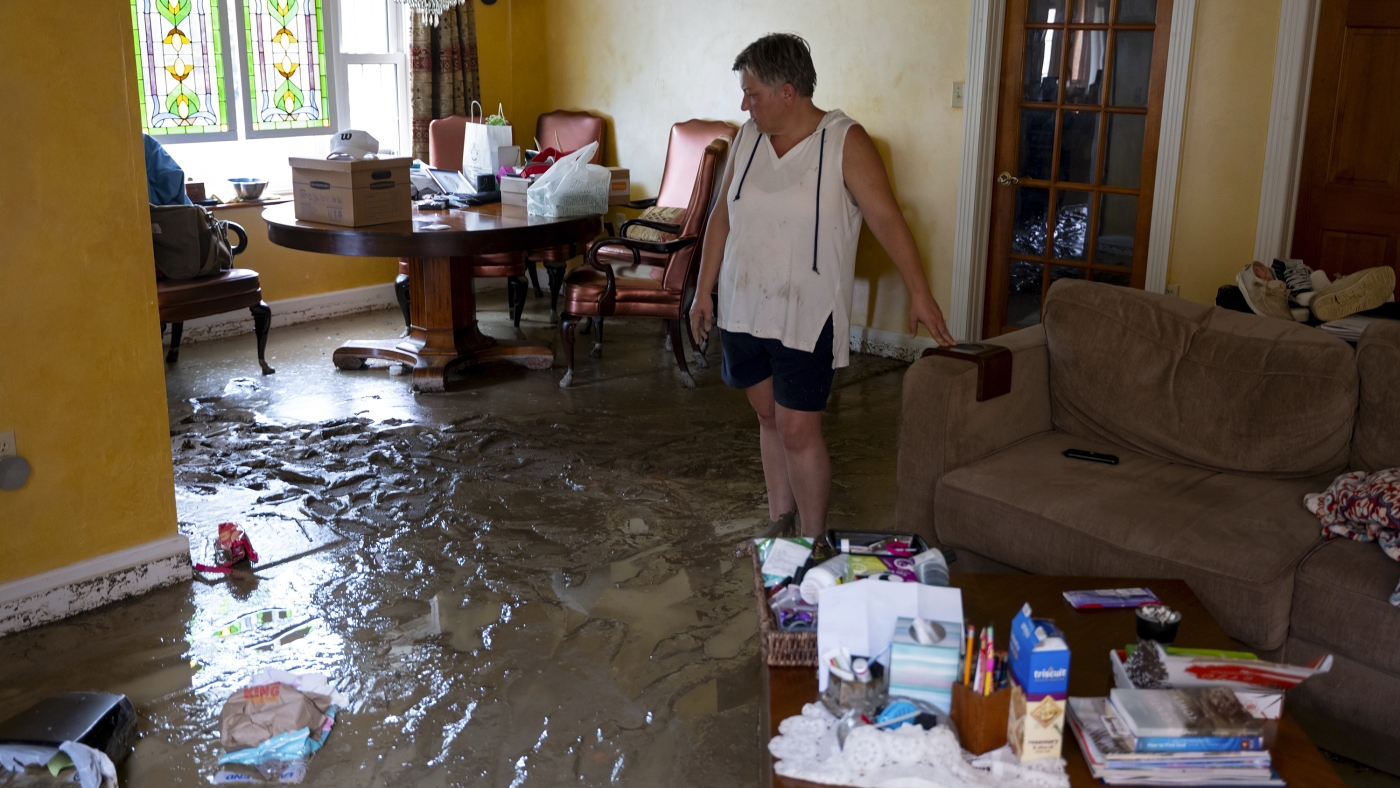
Ann Farkas walks in her flood-damaged home in Canisteo, N.Y., Friday, after remnants of Tropical Storm Debby swept through the area, creating flash flood conditions in some areas.
Craig Ruttle/AP
hide caption
toggle caption
Craig Ruttle/AP
PHILADELPHIA — The weather system previously known as Hurricane Debby was not quite done with parts of the U.S. Sunday as flood warnings remained in effect in North Carolina and thousands were without power in New York, Ohio and Pennsylvania.
After hitting Florida as a hurricane Aug. 5, the storm spent nearly a week unleashing tornadoes and flooding, damaging homes and taking lives along the East Coast before moving into Canada on Saturday.
While many rivers had receded by Sunday, flood warnings remained in effect across central and eastern North Carolina, where more thunderstorms were possible over the next few days. With the ground already saturated from Debby, the National Weather Service said localized downpours could result in additional flash flooding throughout the coastal Carolinas.
Authorities in Lumberton, N.C., said in a Facebook post Saturday that one person died after driving into floodwaters on a closed road and getting swept away. Officials didn’t identify the driver, but said that what they hoped would be a post-storm rescue, quickly turned into a recovery.
“It bears repeating,” the agency said in the post. “Never drive into flooded roadways and obey road closed signage.”
In New Bern, North Carolina, business was brisk at the Halftime Pub and Grub restaurant Sunday afternoon just after a flash flood warning was issued, said server Chastity Bettis.
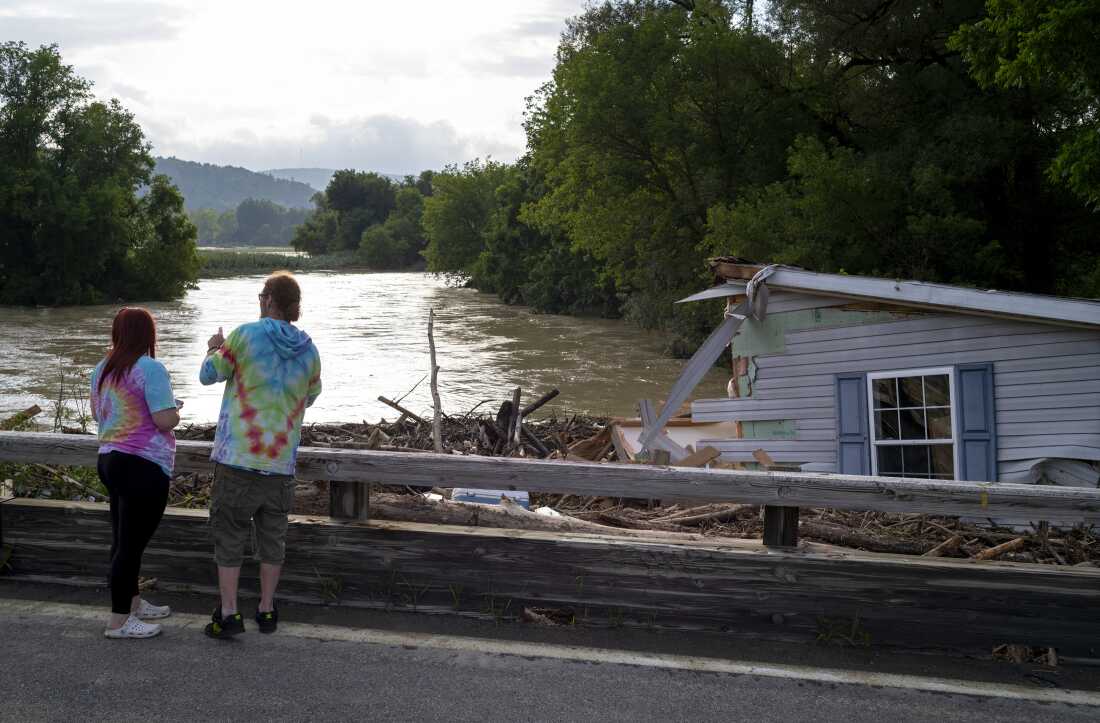
A mobile home swept from its foundation is seen lodged about 1,000 feet away from the property where it stood near a bridge on the Canisteo River, Friday, in Canisteo, N.Y., after remnants of Tropical Storm Debby swept through the area.
Craig Ruttle/AP
hide caption
toggle caption
Craig Ruttle/AP
“Right now, it’s thundering, sprinkling and pretty dark so I’d say it’s going to start raining hard here pretty soon,” she said. “If you live here, you’re pretty used to hurricane season and it being like this, but the last week or two we’ve been getting it pretty rough.”
In South Carolina, the National Weather Service’s Charleston office warned Sunday that as much as 3 to 4 inches of additional rainfall was possible in the afternoon and evening, and could lead to flash flooding. Showers and thunderstorms could develop across Charleston County down through Chatham County and inland, the office said.
Even in drier areas, more than 35,000 homes and businesses in Ohio, New York, Pennsylvania and Vermont still had no electricity as of Sunday afternoon, according to the tracking website PowerOutage.us. Some 23,000 outages lingered in hard-hit Ohio, where Debby-related storms including tornadoes blew through the northeastern part of the state on Wednesday.
Debby’s last day and night over the U.S. inundated parts of New York, Pennsylvania and New England with rain and flash flooding on Friday, prompting evacuations and rescues.
Stacey Urban, whose family owns the Moss Vanwie Farm in Canisteo, New York, said the floodwaters destroyed about three-fourths of the 1,200 acre farm, including about 400 acres of corn, 200 acres of soybeans and hundreds more acres of hay used to feed their cows and other animals.
“This is complete and total devastation,” she said by phone Sunday as fire department officials were bailing out the home’s flooded basement. “We never thought this would happen.”
Urban said the family, which has operated the farm about 37 years, hasn’t had a chance to take a full accounting of the damage but said all their 150 cows and 200 youngstock are safe and all farm equipment has been recovered.
“Whether it all works is another thing,” she said. “The water came in fast.”
Recovery efforts were ongoing in upstate New York’s Steuben County. Officials announced plans to distribute water bottles and clean-up kits to residents impacted by flash flooding on Sunday and Monday. The Red Cross also opened a shelter for flood victims at the Corning-Painted Post High School and planned to operate it until Monday.
The county, located along the Pennsylvania state line, declared a state of emergency Friday and ordered several towns evacuated as flood waters engulfed homes, farms and roadways. The area has been hit by devastating flash floods in prior storms, including in 2021.
“Twice in three years the Tuscarora Creek turned from a gentle stream into a raging beast,” county officials wrote in a post on the government’s Facebook page Sunday afternoon. “It’s just too much. The sun still rose Saturday. Volunteers fixed breakfast. People from all four towns rolled up their sleeves, took a deep breath.”
Officials in Tioga County in north-central Pennsylvania said Sunday morning that 10 teams of emergency service volunteers would be out surveying residents about damage as responders kept up the search for a person missing since the flooding.
“Please be kind to them, because these are volunteers … they work here in the 911 center, they’re fire, police, they’re EMS, these folks are dedicating their Sunday to help you out,” said County Commissioner Marc Rice.
Faith-based disaster relief organizations were also mobilizing to help assess damage and provide help, state Rep. Clint Owlett said. “That’s going to be a big deal.”
Meanwhile, the National Hurricane Center is tracking another potential tropical storm in the Atlantic. Officials said a tropical depression is likely to form within the next day or two and could approach portions of the Greater Antilles by the middle of the week.

News
Rubio’s Absence From Iran Talks Highlights Stay-at-Home Role
When President Barack Obama negotiated a nuclear deal with Iran more than a decade ago, his point man was Secretary of State John Kerry. Over 20 months of talks, Mr. Kerry met with his Iranian counterpart on at least 18 different days, often several times per day.
High-level nuclear diplomacy was a natural role for the top U.S. diplomat. Secretaries of state traditionally take the lead on the country’s biggest diplomatic tasks, from arms control treaties to Israeli-Palestinian agreements.
But as President Trump prepares to send a delegation to the latest round of U.S.-Iran talks in Pakistan this weekend, his secretary of state, Marco Rubio, will remain where he often does: at home.
Mr. Rubio did not attend the last U.S. meeting with Iran earlier this month. Nor did he join several meetings held over the past year in Geneva and Doha. Mr. Rubio has also been absent from U.S. delegations abroad working to settle the war in Ukraine and Israel’s war in Gaza. Despite a long period of crisis and war in the region, he has not visited the Middle East since a brief stop in Israel last October.
In recent months, Mr. Rubio — consumed with his second role, as Mr. Trump’s national security adviser — has not traveled much at all.
During the Biden administration, Secretary of State Antony J. Blinken made 11 foreign trips from January 2024 to late April 2024, stopping in roughly three dozen cities, according to the State Department. So far this year, Mr. Rubio has visited six foreign cities, including a stop in Milan for the 2026 Winter Olympics.
Mr. Trump has outsourced much of his diplomacy to others, including his friend Steve Witkoff, a wealthy associate from the world of Manhattan real estate, and his son-in-law, Jared Kushner. Mr. Witkoff and Mr. Kushner have spearheaded diplomacy with Israel, Ukraine and Russia, as well as Iran, whose delegation they will meet for the second time this month in Islamabad, Pakistan’s capital.
Mr. Rubio’s distance from the trenches of diplomacy reflects his dual role on Mr. Trump’s national security team. For the past year, he has served as the White House national security adviser even while leading the State Department — the first person to do so since Henry A. Kissinger in the mid-1970s.
The secretary of state runs the State Department, overseeing U.S. diplomats and embassies worldwide, as well as Washington-based policymakers. Working from the White House, the national security adviser coordinates departments and agencies, including the State Department, to develop policy advice for the president.
The twin roles reflect Mr. Rubio’s influence with Mr. Trump, and offer him a way to maintain it. For Mr. Rubio, less time abroad means more time at the side of an impulsive president prone to making critical national security decisions at any moment.
As Mr. Witkoff, Mr. Kushner and Vice President JD Vance met with Iranian officials in Pakistan earlier this month, Mr. Rubio was at Mr. Trump’s side at an Ultimate Fighting Championship event, noted Emma Ashford, an analyst of U.S. diplomacy at the nonpartisan Stimson Center in Washington. “Rubio clearly prefers to stay close to Trump,” Ms. Ashford said.
Mr. Rubio accepted the national security adviser job on an acting basis last May after Mr. Trump reassigned the job’s previous occupant, Michael Waltz. But officials say that Mr. Rubio is expected to keep it indefinitely.
That arrangement is not inherently bad, Ms. Ashford added. And she noted that previous presidents had entrusted major diplomatic tasks to people other than the secretary of state. President Joseph R. Biden Jr. delegated his C.I.A. director, William J. Burns, to handle diplomacy with Russia and cease-fire negotiations between Israel and Hamas, for instance.
But she echoed the complaints by many current and former diplomats that Mr. Rubio seems less like someone performing both jobs than a national security adviser who sometimes shows up at the State Department. “I do think it’s to the detriment of the whole department of State and to America’s ability to conduct diplomacy in general that we effectively have the secretary of state position sitting vacant,” she said.
Tommy Pigott, a State Department spokesman, contested such claims. “Anyone trying to paint Secretary Rubio’s close coordination with the White House and other agencies as a negative could not be more wrong,” he said. “We now have an N.S.C. and State Department that are totally in sync, a goal that has eluded past administrations for decades.”
Mr. Rubio divides his time between the State Department and the White House, often spending time at both in the same day. In an interview with Politico last June, Mr. Rubio said he visited the State Department “almost every day.”
While there, he often meets with visiting dignitaries before returning to the White House. Last week, Mr. Rubio presided over a meeting at the State Department between Lebanese and Israeli officials that set the stage for a cease-fire in Lebanon.
His twin jobs “really do overlap in many cases,” he said. “In many cases you end up being in the same meetings or in the same places; there’s just one less person in there, if you think about it,” Mr. Rubio added. “A lot of people would come to Washington, for example, for meetings, and they’d want to meet with the national security adviser and then meet with me as secretary of state. Now they can do both in one meeting.”
Asked about his travel schedule during a news conference last December, Mr. Rubio said he had less reason to travel abroad because “we have a lot of leaders constantly coming here” to visit Mr. Trump at the White House. Mr. Rubio also joins Mr. Trump’s foreign trips in his capacity as national security adviser.
Many national security veterans call the arrangement unwise, saying that both jobs are extremely demanding and incompatible with one another.
It was not easy even for Mr. Kissinger, who had firmly established himself over more than four years as national security adviser before convincing President Richard M. Nixon to let him take on an additional role as secretary of state in 1973. (In a reversal of Mr. Rubio’s approach, Mr. Kissinger was in constant motion, including a round of Middle East shuttle diplomacy that kept him on the road for 33 straight days.)
“In general, it’s a mistake to combine those roles,” said Matthew Waxman, who held senior roles at the National Security Council, State Department and the Pentagon during the George W. Bush administration.
“That said, it’s not necessarily a bad thing that a dual-hatted Rubio is so offscreen right now,” Mr. Waxman added. “Especially while so much attention is focused on high-wire diplomacy with Iran, someone needs to manage foreign policy around the rest of the world.”
News
Appeals court rules that Trump’s asylum ban at the border is illegal
President Trump speaks during an event on health care affordability in the Oval Office at the White House on Thursday in Washington.
Mark Schiefelbein/AP
hide caption
toggle caption
Mark Schiefelbein/AP
WASHINGTON — An appeals court on Friday blocked President Trump’s executive order suspending asylum access at the southern border of the U.S., a key pillar of the Republican president’s plan to crack down on migration.
A three-judge panel from the U.S. Court of Appeals for the District of Columbia Circuit found that immigration laws give people the right to apply for asylum at the border, and the president can’t circumvent that.

The court opinion stems from action taken by Trump on Inauguration Day 2025, when he declared that the situation at the southern border constituted an invasion of America and that he was “suspending the physical entry” of migrants and their ability to seek asylum until he decides it is over.
The panel concluded that the Immigration and Nationality Act doesn’t authorize the president to remove the plaintiffs under “procedures of his own making,” allow him to suspend plaintiffs’ right to apply for asylum or curtail procedures for adjudicating their anti-torture claims.

“The power by proclamation to temporarily suspend the entry of specified foreign individuals into the United States does not contain implicit authority to override the INA’s mandatory process to summarily remove foreign individuals,” wrote Judge J. Michelle Childs, who was nominated to the bench by Democratic President Joe Biden.
“We conclude that the INA’s text, structure, and history make clear that in supplying power to suspend entry by Presidential proclamation, Congress did not intend to grant the Executive the expansive removal authority it asserts,” the opinion said.
White House says asylum ban was within Trump’s powers
The administration can ask the full appeals court to reconsider the ruling or go to the Supreme Court.
The order doesn’t formally take effect until after the court considers any request to reconsider.
White House press secretary Karoline Leavitt, speaking on Fox News, said she had not seen the ruling but called it “unsurprising,” blaming politically-motivated judges.
“They are not acting as true litigators of the law. They are looking at these cases from a political lens,” she said.
Leavitt said Trump was taking actions that are “completely within his powers as commander in chief.”
White House spokeswoman Abigail Jackson said the Department of Justice would seek further review of the decision. “We are sure we will be vindicated,” she wrote in an emailed statement.
The Department of Homeland Security said it strongly disagreed with the ruling.
“President Trump’s top priority remains the screening and vetting of all aliens seeking to come, live, or work in the United States,” DHS said in a statement.
Advocates welcome the ruling
Aaron Reichlin-Melnick, senior fellow at the American Immigration Council, said that previous legal action had already paused the asylum ban, and the ruling won’t change much on the ground.

The ruling, however, represents another legal defeat for a centerpiece policy of the president.
“This confirms that President Trump cannot on his own bar people from seeking asylum, that it is Congress that has mandated that asylum seekers have a right to apply for asylum and the President cannot simply invoke his authority to sustain,” said Reichlin-Melnick.
Advocates say the right to request asylum is enshrined in the country’s immigration law and say denying migrants that right puts people fleeing war or persecution in grave danger.
Lee Gelernt, attorney with the American Civil Liberties Union, who argued the case, said in a statement that the appellate ruling is “essential for those fleeing danger who have been denied even a hearing to present asylum claims under the Trump administration’s unlawful and inhumane executive order.”
Las Americas Immigrant Advocacy Center, one of the plaintiffs in the lawsuit, welcomed the court decision as a victory for their clients.
“Today’s DC Circuit ruling affirms that capricious actions by the President cannot supplant the rule of law in the United States,” said Nicolas Palazzo, director of advocacy and legal Services at Las Americas.
Judge Justin Walker, a Trump nominee, wrote a partial dissent. He said the law gives immigrants protections against removal to countries where they would be persecuted, but the administration can issue broad denials of asylum applications.
Walker, however, agreed with the majority that the president cannot deport migrants to countries where they will be persecuted or strip them of mandatory procedures that protect against their removal.
Judge Cornelia Pillard, who was nominated by Democratic President Obama, also heard the case.
In the executive order, Trump argued that the Immigration and Nationality Act gives presidents the authority to suspend entry of any group that they find “detrimental to the interests of the United States.”
The executive order also suspended the ability of migrants to ask for asylum.
Trump’s order was another blow to asylum access in the U.S., which was severely curtailed under the Biden administration, although under Biden some pathways for protections for a limited number of asylum seekers at the southern border continued.
Migrant advocate in Mexico expresses cautious hope
For Josue Martinez, a psychologist who works at a small migrant shelter in southern Mexico, the ruling marked a potential “light at the end of the tunnel” for many migrants who once hoped to seek asylum in the U.S. but ended up stuck in vulnerable conditions in Mexico.
“I hope there’s something more concrete, because we’ve heard this kind of news before: A district judge files an appeal, there’s a temporary hold, but it’s only temporary and then it’s over,” he said.
Meanwhile, migrants from Haiti, Cuba, Venezuela and other countries have struggled to make ends meet as they try to seek refuge in Mexico’s asylum system that’s all but collapsed under the weight of new strains and slashed international funds.
This week hundreds of migrants, mostly stranded migrants from Haiti, left the southern Mexican city of Tapachula on foot to seek better living conditions elsewhere in Mexico.
News
A New Worry for Republicans: Latino Catholics Offended by Trump
When Stuart Sepulvida arrives at St. Francis de Sales Roman Catholic Parish in Tucson, Ariz., for Mass, which he attends most mornings, he passes a display honoring local soldiers and encouraging parishioners to pray for their safety. Hundreds of small cards record their names: Robles, Arenas, Grajeda. A portrait of Pope Leo XIV hangs across the lobby.
Mr. Sepulvida, 81, is a Vietnam veteran whose patriotism and Catholicism are deeply intertwined. He voted for President Trump three times but has never felt more betrayed by an American president than when Mr. Trump denounced Pope Leo as “weak on crime” and “terrible for foreign policy.”
“It was very disturbing to me to hear both of them clashing like they did,” Mr. Sepulvida said, standing outside the church one morning this week. Now, he is reconsidering whether he will vote Republican this year.
The Republican Party is struggling to hold onto the support from Hispanic voters who helped propel Mr. Trump back into the White House in 2024. Yet as many party leaders have acknowledged the urgent need to stop the backsliding among Latinos, the president has enraged many of even his strongest supporters by clashing with the pope.
On Easter Sunday, Pope Leo, the first U.S.-born pontiff, spoke of the need to “abandon every desire for conflict, domination and power, and implore the Lord to grant his peace to a world ravaged by wars.” Within days, Mr. Trump, who has led the United States into a war with Iran, said the pope was “catering to the radical left” and posted an AI-generated image portraying himself as a Jesus figure. Mr. Trump later deleted the image, saying he thought it depicted him as a doctor.
“It just isn’t what a president should do,” Mr. Sepulvida said. “The pope speaks for his people. He is beyond politics.”
Mr. Trump won 55 percent of Catholic voters in the 2024 election, compared to 43 percent who voted for former Vice President Kamala Harris, according to Pew Research Center. The most sizable gains came from Hispanic Catholics. While Joseph R. Biden Jr. won their votes by a 35-point margin in 2020, the Democratic advantage shrunk to 17 points in 2024. Now, just 18 percent of Hispanic Catholics said they support most or all of President Trump’s agenda, according to a poll from Pew released earlier this year.
If the president’s quarrel with the pope sours more Latinos on the Republican Party, it could affect midterm races across the country, including in South Florida and South Texas, where Republicans have notched important victories in predominantly Hispanic districts in recent years.
In Arizona’s Sixth Congressional District, which stretches from north of Tucson to the Mexican border, voters were still grappling with the fallout this week.
The district is roughly evenly divided among Republicans, Democrats and independent voters. Nearly a third of the district is Hispanic, and there is a significant population of members of the Church of Jesus Christ of Latter-day Saints, as well as a large Catholic community with deep history in the region. It also has one of largest numbers of military veterans of all congressional districts in the country.
“The president is looking for a lot of attention from everything,” said Maria Ramos, 60, who regularly attends weekday Mass at St. Francis. A registered independent, she usually votes for Democrats but often declines to cast a ballot if she views a candidate as too liberal. “He believes he can put God in his place. He’s meddling in countries that he’s not in control of — he wants to control the world.”
“It is not just a very serious lack of respect — it is a mortal sin,” she said, shaking her head. One word comes to her mind again and again, she said: disgust.
Like so many others in southern Arizona, Ms. Ramos has several relatives who serve in the military — a path they saw to both serve the country and as an entry into the stable middle class. Many of them, she said, voted for Mr. Trump for president.
The Tucson district is now widely seen as one of the most competitive in the country. Republican Juan Ciscomani narrowly won the district in 2022, in part by emphasizing his biography as a Mexican immigrant and a devoted father of six children. He is also an evangelical Christian, a group that has driven much of the growth among Hispanic Republican voters in recent years.
Mr. Ciscomani declined a request for an interview, but when a local radio host asked Mr. Ciscomani what he thought of Mr. Trump’s comments “as a man of faith,” the congressman declined to criticize the president but said, “You can trust that you won’t see any meme like that coming out of my account.”
JoAnna Mendoza, the Democrat challenging Mr. Ciscomani this fall, has made her 20-year career in the U.S. Navy and Marines a key aspect of her story on the campaign trail. While she rarely speaks about her religious background and no longer considers herself a practicing Catholic, she said she briefly considered becoming a nun as a teenager. She criticized Mr. Ciscomani for not condemning the president’s remarks.
“You can’t make faith a central part of your campaign and then allow this to stand,” she said in an interview.
Across Tucson, Latino Catholics, regardless of their past voting preferences, were similarly quick to condemn the president’s remarks.
When Cecilia Taisipic, 71, heard about it, she said, she winced with shame about her vote for him in 2024.
“I thought he would make the country better, but apparently it’s the opposite,” she said as she left Mass at St. Francis earlier this week. She is so fed up with politics, she said, that she is unlikely to vote at all this year. “When it comes to my faith, I don’t like anybody to challenge it. Now I don’t want to hear anything on the news. I just want to pray.”
Matilde Robinson Bours, 63, teaches a weekly Spanish Bible study class at St. Thomas the Apostle Parish, and like nearly all of the women in her class, she immigrated from Mexico decades ago. She has voted for Republicans in nearly every election since she became a citizen. Though she has never liked President Trump, she said, his comments about the pope enraged her more than anything else he has said or done in the past.
“This surpassed everything, every social and political norm — this is personal to all Catholics,” she said. “The arrogance and ego is disgusting. To think that he is God? The pope has every right and responsibility to talk about peace.”
Still, Ms. Robinson Bours said, nothing will stop her from supporting Republicans again this year. She has been delighted that her adult children have stopped supporting Democrats in recent elections.
“Almost everyone I know thinks the way I do,” she said.
Patricia Martinez, 86, who has attended the same Bible study as Ms. Robinson Bours for years, shook her head in disagreement. She said she cannot imagine voting for a Republican who supports Mr. Trump.
“This is different — this shows he is out of his mind,” said Ms. Martinez. “We have to have basic respect and teach that to people in this country.”
Patrick Robles, a 24-year-old native of Tucson, spent years alienated from the Roman Catholic Church, but returned to his faith more recently. “The craziness of the world sort of caused me to seek some sort of answers,” he said. Now, he attends Mass at the St. Augustine Cathedral in downtown Tucson, a few blocks from the office where he works as an aide to Representative Adelita Grijalva, a Democrat.
Mr. Robles said he saw Mr. Trump’s battle with the pope as both a personal affront and a political opportunity.
“The president is basically trying to draw a line between Catholics and what we perceive to be patriotism,” he said. “I believe we can be both.”
Last week, he texted one of his uncles who has supported Mr. Trump in every election asking him what he thought.
“I’m afraid we need divine intervention,” the uncle replied.
-
New York40 minutes agoDemocrats Weigh Whether a Lawmaker’s Ethnicity Counts More Than Ideology
-
Detroit, MI1 hour agoPotential Day 3 Detroit Lions targets: 10 players to consider
-
San Francisco, CA1 hour agoKaelon Black selected by 49ers in NFL draft: Grade, analysis
-
Dallas, TX1 hour agoDallas Cowboys remaining draft selections after second and third rounds
-
Miami, FL2 hours ago
How much and where to park in Miami during a hurricane or flood threat
-
Boston, MA2 hours agoBuffalo visits Boston with 2-1 series lead
-
Denver, CO2 hours agoDenver Broncos’ Day 3 pivotal to expanding title window after only 1 draft pick so far
-
Seattle, WA2 hours ago
Neal selected by Seattle in 3rd round of NFL Draft