News
Creating a throw-away culture: How companies ingrained plastics in modern life


A trash can overflows as people sit outside of the Martin Luther King Jr. Memorial in Washington, D.C.
Jacquelyn Martin/AP/AP
hide caption
toggle caption
Jacquelyn Martin/AP/AP
Just for a minute, think about how much of the plastic you use today will end up as trash. Drink bottles? Grocery bags? Food wrappers? If you live in the United States, it’ll probably add up to about a pound of stuff — just today.
Most plastic is dumped in landfills or becomes pollution in places like rivers and oceans, according to the Organisation for Economic Co-operation and Development. Along the way, it sheds microplastics that can make their way into animals and people. Just 4% of plastic in the U.S. is recycled.
It wasn’t always this way. But over the past 70 years, plastic has become embedded in nearly every aspect of human life. The world produces around 230 times more plastic now than it did in 1950, according to Our World in Data.
As production soared, so did pollution. Many scientists and activists say chemical and fossil fuel companies make too much plastic now for society to manage sustainably. The United Nations says the problem is also being fueled by a “worrying shift” toward single-use products and packaging, which are designed to be used once and thrown away.
Plastic became ingrained in modern life in large part because the plastics industry started working in the 1950s to convince people to embrace the material as cheap, abundant and disposable.
The marketing campaign worked so well that litter soon became a problem across the U.S., and there was a public backlash. The industry responded by pitching recycling. But almost from the outset, corporations knew that recycling probably wouldn’t work to rein in waste, multiple investigations have shown.
Now, faced with spiraling plastic pollution, the U.N has set out to write a legally-binding agreement to deal with the problem. But the negotiations are fraught.
And even if nations can broker a deal, it’ll be a daunting task to actually reduce the world’s consumption of plastic, which is in almost everything, from clothing and diapers to medical devices.
“We’ll continue to need plastic for specific uses,” Inger Andersen, executive director of the United Nations Environment Programme, said at the latest round of U.N. negotiations in Canada in April. “But there’s a growing agreement,” she said, that a lot of single-use plastic “can probably go.”

Vintage Bakelite and other plastic objects at a museum in England.
Matt Cardy/Getty Images/Getty Images Europe
hide caption
toggle caption
Matt Cardy/Getty Images/Getty Images Europe
The plastics industry pitched disposability to make more money
As part of the treaty talks, some countries want to cap production of new plastic, which is made from oil and gas. However, those efforts are opposed by big fossil fuel producers that are determined to keep plastic demand growing. State and local governments in the U.S. have tried to limit pollution by passing laws that ban plastic shopping bags or single-use plastic bottles.
The industry has responded by fighting regulations that could hurt demand for its products. It says the solution to environmental problems is better recycling, not using less plastic.
Matt Seaholm, chief executive of the Plastics Industry Association, says his group is advocating on behalf of plastic producers and consumers alike, since “it is an essential part of society at this point.”
Synthetic plastic was patented in the early 1900s. It was known as Bakelite, and it sparked a boom in durable and affordable consumer goods. Soon, companies started selling different kinds of plastic. At first, most of it was marketed as sturdy and reusable. One television ad from 1955 — about a made-up homemaker named Jane in a made-up place called Plasticstown, USA — touts how plastic containers are ideal for families because they won’t break if kids accidentally drop them.
But soon, the messaging started to change. In 1956, the industry learned about a new way to boost sales — and profits. At the plastics industry’s annual conference in New York, Lloyd Stouffer, the editor of an influential trade magazine, urged executives to stop emphasizing plastics’ durability. Stouffer told the companies to focus instead on making a lot of inexpensive, expendable material. Their future, he said, was in the trash can.
Companies got the message. They realized they could sell more plastic if people threw more of it away. “Those corporations were doing what they’re supposed to do, which is make a lot of money,” says Heather Davis, an assistant professor at The New School in New York who’s written about the plastics industry.
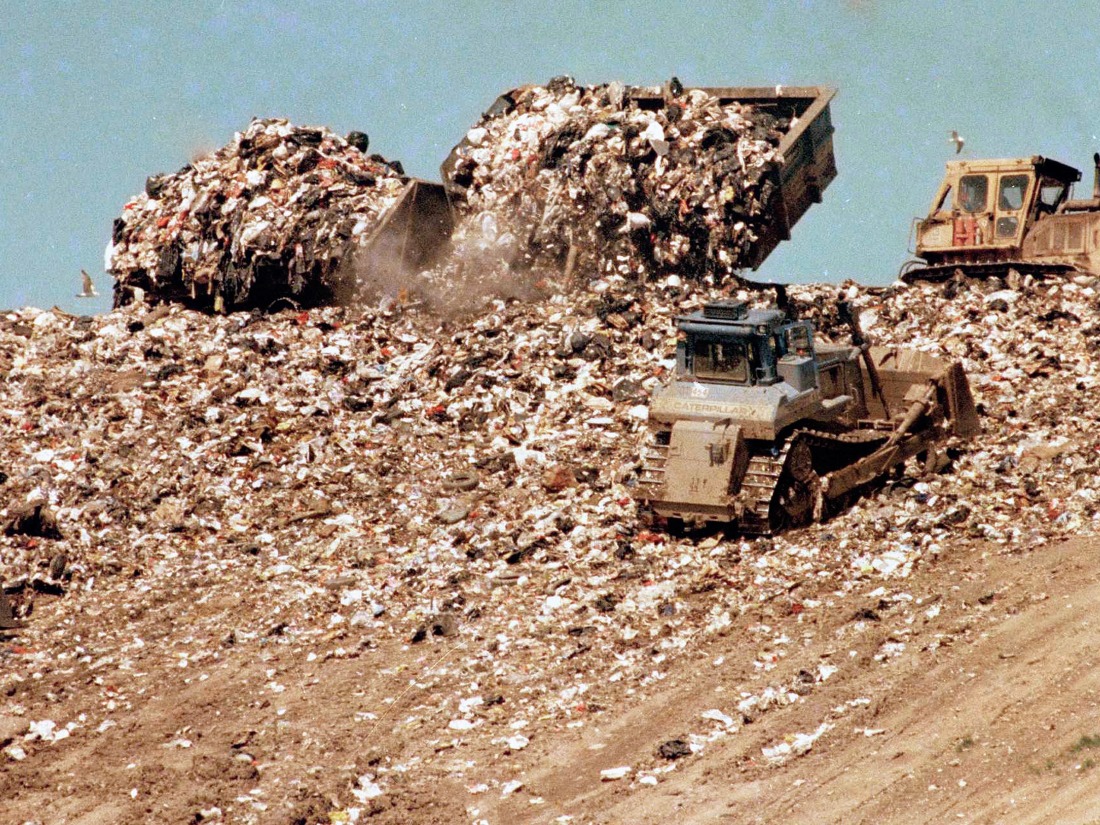
Garbage is dumped at the Fresh Kills Landfill in Staten Island, New York, in 1989.
David Cantor/AP/AP
hide caption
toggle caption
David Cantor/AP/AP
Throw-away living was a foreign concept in 1950s America
But getting people to throw away items after a single use took a lot of work.
Adults in the 1950s had lived through The Great Depression and World War II, and they were trained to save as much as possible, Davis says.
“It was a really difficult sell to the American public in the post-war period, to inculcate people into a throwaway living,” she says. “That is not what people were used to.”
A solution companies came up with was emphasizing that plastic was a low-cost, abundant material.
A 1960 marketing study for Scott Cup said the containers were “almost indestructible,” but that the manufacturer could still convince people to discard them after a few uses. To counter any “pangs of conscience” consumers might feel about throwing them away, the researchers suggested a “direct attack”: Tell people the cups are cheap, they said, and that “there are more where these came from.”
A few years later, Scott ran an advertisement saying its plastic cups were available at “‘toss-away prices.”
In a 1963 report for another plastics conference in Chicago, Stouffer congratulated the industry for filling dumps and garbage cans with plastic bottles and bags.
“The happy day has arrived,” Stouffer wrote, “when nobody any longer considers the [plastic] package too good to throw away.”
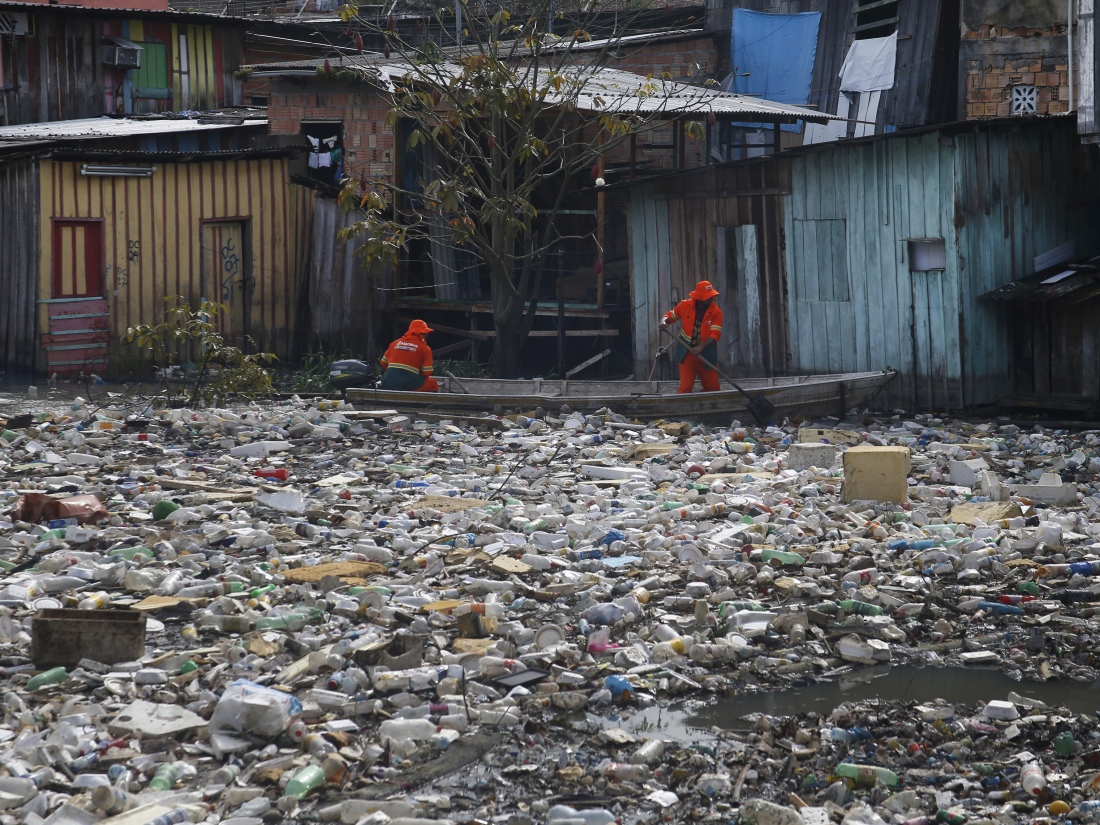
Workers remove garbage floating on the Negro River in Manaus, Brazil.
Edmar Barros/AP/AP
hide caption
toggle caption
Edmar Barros/AP/AP
A booming market hit a consumer backlash
By the early 1970s, plastics were booming. The market was expanding faster than the “rosiest of predictions,” and its growth prospects were “out of sight,” an executive at the chemical company DuPont told the Chamber of Commerce in Parkersburg, West Virginia, in 1973. Soon, big soft drink companies introduced plastic soda bottles.
But the industry faced a growing public-relations problem that was especially threatening to beverage companies, whose names were stamped on the packaging: Plastic litter was becoming an eyesore across the country.
“Even if you’ve convinced people that maybe the disposability of plastics isn’t such a bad thing, people are still seeing this waste out in public,” says Bart Elmore, a professor of environmental history at Ohio State University.
So drink makers went on offense. Elmore says they fought bans on throw-away bottles and joined the plastics industry in pushing recycling as an environmental solution.
However, multiple investigations, including by NPR, have shown that plastics industry representatives long knew that recycling would probably never be effective on a large scale. Officials have said they encouraged recycling to avoid regulations and ensure that demand for plastic kept growing.
Trade groups for plastic companies say those investigations don’t accurately reflect today’s industry.
There isn’t evidence that drink makers were part of those internal discussions about recycling’s viability. But Elmore says they should have had enough information at the time to know recycling was a risky bet.
In 1976 — two years before big soft-drink makers introduced plastic soda bottles — a study by the U.S. Food and Drug Administration concluded that “substantial recycling of plastics is unlikely in the near future.” That echoes the agency’s 1975 draft report that found “recycling of plastic bottles is unlikely to be commercially feasible.”
“To make a gamble like that, where public agencies and public documents are saying this at the time, I think raises real questions about culpability, accountability in an era when I think a lot of people are asking for that,” Elmore says.
Less than 10% of plastic waste is recycled globally. As countries try to negotiate a global waste agreement, activists and scientists are focusing a lot of their attention on chemical and fossil fuel companies that make plastic. But Elmore says consumer goods companies like beverage makers also deserve scrutiny, because they use a ton of plastic packaging and rank as some of the biggest plastic polluters globally.
“If they take a stand, one way or the other, it has a huge global impact,” Elmore says.
A business group called the American Beverage Association said in a statement to NPR that one of its highest priorities is creating a so-called circular economy where plastic is recycled and reused to prevent waste.
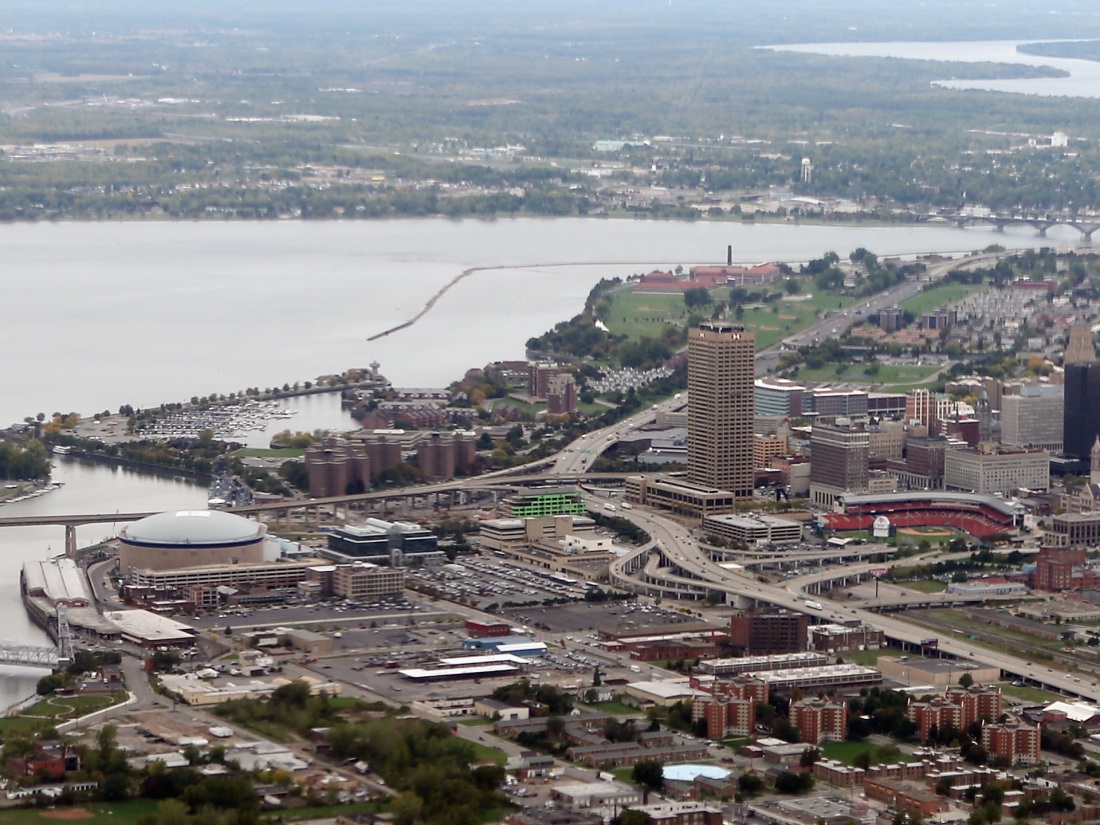
An aerial view of Buffalo, New York, facing Lake Erie.
Bruce Bennett/Getty Images/Getty Images North America
hide caption
toggle caption
Bruce Bennett/Getty Images/Getty Images North America
A lawsuit aims to hold a major plastic polluter accountable
The disposable culture that was fostered by the plastics industry is playing out in places like the Buffalo River, which empties into Lake Erie in western New York. Plastic debris litters the banks of the river, and it breaks down into fragments called microplastics that accumulate in the lake, contaminating drinking water for about 11 million people.
One morning this spring, volunteers met at the river to clean up some of the pollution. “We see plastic tops, bottles, we have single-use plastics from takeout food,” says Jill Jedlicka, who leads Buffalo Niagara Waterkeeper, a nonprofit that organized the event.
It’s constant work. The debris that volunteers collected will be replaced in weeks by more plastic trash. “It’s an onslaught,” Jedlicka says.
A lot of the plastic waste around the Buffalo River is packaging sold by the food and beverage giant PepsiCo, according to a lawsuit that New York State Attorney General Letitia James filed last year against the company. New York prosecutors say plastic pollution around the Buffalo River is a public nuisance, and that Pepsi contributes to the problem by selling tons of single-use packaging.
Activists say lawsuits like the one New York filed against Pepsi are a way to try to hold corporations accountable.
In a court filing, Pepsi said it isn’t responsible for the Buffalo River pollution, and that it shouldn’t have to warn people that plastic waste poses environmental and health risks.
“Consumers are more than capable of purchasing a beverage or snack product, consuming it, and placing the packaging in a recycling or waste bin,” the company said.
Researchers say companies often blame consumers when plastic waste gets into the environment.
Pepsi said in statements to NPR that “no single group or entity bears responsibility for plastic pollution,” and that it is trying to improve recycling and reduce how much new plastic it uses.
However, in its latest sustainability report, Pepsi said its use of new plastic increased slightly in 2022, partly because recycled material was expensive and hard to find. Pepsi isn’t alone: Despite growing public pressure, companies increased their use of new plastic by 11% between 2018 and 2022, according to data compiled by the Ellen MacArthur Foundation.
“There is so much that the plastics industry needs to do to improve the sustainability of plastics,” says Shelie Miller, a professor at the School for Environmental Sustainability at the University of Michigan. But she says consumer culture is also part of the problem.
“If our stance is, consumers should be able to consume whatever they want in whatever quantity they want and it’s someone else’s job to deal with it,” Miller says, “that’s not a path toward sustainability.”



Smoke rises over Konarak naval base in southern Iran on Sunday. The base was one of hundreds of targets of U.S. and Israeli forces throughout the country.
Planet Labs PBC
hide caption
toggle caption
Planet Labs PBC
Commercial satellite images are providing a unique look at the extent of damage being done to Iran’s military facilities across the country.
The U.S. and Israeli military campaign opened with a daytime attack that struck Iranian leadership in central Tehran. Smoke was still visible rising from Ayatollah Ali Khamenei’s compound following the attack that killed the supreme leader.

An image by the company Airbus taken on Saturday shows the aftermath of an Israeli strike on Iran’s Leadership House in central Tehran. Iran’s Supreme Leader Ayatollah Ali Khamenei was killed in the opening wave of attacks.
Pléiades Neo (c) Airbus DS 2026
hide caption
toggle caption
Pléiades Neo (c) Airbus DS 2026
Israel and the U.S. have gone on to strike targets across the country. Reports on social media indicate that there have been numerous military bases and compounds attacked all over Iran, and Iran has responded with attacks throughout the Middle East.
U.S. forces have also been striking at Iran’s navy. In a post on his social media platform, President Trump said that he had been briefed that U.S. forces had sunk nine Iranian naval vessels. U.S. Central Command did not immediately confirm that number but it did say it had struck an Iranian warship in port.

An image captured on Saturday shows a ship burning at Iran’s naval base at Konarak.
Satellite image ©2026 Vantor
hide caption
toggle caption
Satellite image ©2026 Vantor
Numerous satellite images show burning vessels at Konarak naval base in southern Iran. Images also show damage to a nearby airbase where hardened hangers were struck by precision munitions.

Hardened aircraft shelters at Konarak airbase were struck with precision munitions.
Satellite image ©2026 Vantor
hide caption
toggle caption
Satellite image ©2026 Vantor
And there was extensive damage at a drone base in the same area. Iran has launched numerous drones and missiles toward Israel and U.S. military installations in Bahrain, Kuwait and Qatar. Many drones have been intercepted but videos on social media show that some have evaded air defenses and caused damage in nearby Gulf countries. In Dubai, debris from an Iranian drone damaged the iconic Burj Al Arab, according to a statement from Dubai’s government.

Buildings at an Iranian drone base at Konarak were destroyed in the strikes.
Satellite image ©2026 Vantor
hide caption
toggle caption
Satellite image ©2026 Vantor
Iran’s most powerful weapons are its long-range missiles. The Iranian Revolutionary Guards have hidden the missiles deep inside mountain tunnels. Images taken Sunday in the mountains of northern Iran indicate that some of those tunnels were hit in a wave of strikes.
Following Khamenei’s death, Iran declared 40 days of mourning. Satellite images showed mourners gathering in Tehran’s Enghelab square on Sunday.
Iranian Foreign Ministry Spokesperson Esmail Baghaei told NPR on Sunday that Iran will continue to fight “foreign aggression, foreign domination.”
A White House official told NPR that Trump plans to talk to Iran’s interim leadership “eventually,” but that for now, U.S. operations continue in the region “unabated.”

A large crowd of mourners fill Enghelab Square in Tehran on Sunday, following the death of Iran’s Supreme Leader Ayatollah Ali Khamenei, who was killed in an Israeli airstrike.
Satellite image ©2026 Vantor
hide caption
toggle caption
Satellite image ©2026 Vantor

new video loaded: What the Texas Primary Battle Means for the Midterms
By J. David Goodman, Alexandra Ostasiewicz, June Kim and Luke Piotrowski
March 1, 2026

Gunfire rang out at a bar in Austin, Texas, early Sunday and at least three people were killed, the city’s police chief said.
Austin Police Chief Lisa Davis told reporters the shooter was killed by officers at the scene.
Fourteen others were hospitalized and three were in critical condition, Austin-Travis County EMS Chief Robert Luckritz said.
“We received a call at 1:39 a.m. and within 57 seconds, the first paramedics and officers were on scene actively treating the patients,” Luckritz said.
There was no initial word on the shooter’s identity or motive.
Davis noted how fortunate it was that there was a heavy police presence in Austin’s entertainment district at the time, enabling officers to respond quickly as bars were closing.
“Officers immediately transitioned … and were faced with the individual with a gun,” Davis said. “Three of our officers returned fire, killing the suspect.”
She called the shooting a “tragic, tragic” incident.

Austin Mayor Kirk Watson said his heart goes out to the victims, and he praised the swift response of first responders.
“They definitely saved lives,” he said.
Davis said federal law enforcement is aiding the investigation.

Setting sail on iceboats across a frozen lake in Wisconsin

West Virginia Surrenders Six-Run Lead, Falls in Series Finale to Kennesaw State

Meyer’s Late Score Lifts Wyoming past Air Force – SweetwaterNOW

Crypto Sector Suffers Exodus of Reliable Retail Investors | PYMNTS.com

Canton High School students find success in personal finance

Florida High School Football Rankings: Top 25 teams – Oct. 21

Cleary's 21 help Le Moyne down Central Connecticut State 69-64 in OT

How old is Bo Nix? What to know about Oregon quarterback ahead of 2024 NFL Draft

99th annual Pony Swim held in Virginia

Indiana Members Credit Union announced as new anchor tenant at Bottleworks District

House Republicans push Johnson to go to war with Senate over SAVE Act

Israel FM says Europe too divided, slams Spanish PM
Satellite images provide view inside Iran at war

Video: What the Texas Primary Battle Means for the Midterms

Dems’ potential 2028 hopefuls come out against US strikes on Iran
-

 World4 days ago
Exclusive: DeepSeek withholds latest AI model from US chipmakers including Nvidia, sources say
-

 Massachusetts4 days ago
Mother and daughter injured in Taunton house explosion
-

 Montana1 week ago
2026 MHSA Montana Wrestling State Championship Brackets And Results – FloWrestling
-

 Denver, CO4 days ago
10 acres charred, 5 injured in Thornton grass fire, evacuation orders lifted
-

 Louisiana7 days ago
Wildfire near Gum Swamp Road in Livingston Parish now under control; more than 200 acres burned
-

 Technology1 week ago
YouTube TV billing scam emails are hitting inboxes
-

 Politics1 week ago
OpenAI didn’t contact police despite employees flagging mass shooter’s concerning chatbot interactions: REPORT
-

 Technology1 week ago
Stellantis is in a crisis of its own making