News
Claudine Gay's resignation highlights the trouble with regulating academic writing


Claudine Gay speaks during commencement ceremonies at Harvard University in May. Gay resigned as Harvard’s president Tuesday amid plagiarism accusations.
Steven Senne/AP
hide caption
toggle caption
Steven Senne/AP

Claudine Gay speaks during commencement ceremonies at Harvard University in May. Gay resigned as Harvard’s president Tuesday amid plagiarism accusations.
Steven Senne/AP
Harvard University President Claudine Gay resigned her post on Tuesday, following controversial congressional testimony over campus antisemitism and amid mounting allegations of plagiarism that have plagued the once-rising star of academia in recent weeks.
Gay’s resignation underscores the intense scrutiny confronting university presidents who are the public faces of the institutions they lead.
Gay is not the first head of an academic institution unseated by allegations of plagiarism: Marc Tessier-Lavigne resigned last year as Stanford’s president after an investigation found several academic reports he authored contained manipulated data. And in 2021, Robert Caslen resigned as president of the University of South Carolina after plagiarizing part of a speech.
Gay, who took office in July, made the leap from professor to president in about 16 years, a trajectory that the Harvard Crimson described as “meteoric.” But her downfall raises questions about how people in such high-profile positions can find themselves facing such charges in an age where advanced technology so easily enables detecting alleged cases of plagiarism.
Experts additionally say improved technology could bring forth more alleged transgressions from past works yet to be unearthed.
So how does a sought-after academic star end up here?
Dave Tomar, a self-described “professional cheat” who spent about a decade ghost-writing academic papers for undergrads and post-doctoral students, said it’s easy to understand how Gay’s writing went undetected for so long.
“I think 20 years ago, the alarm bells weren’t really raised as much,” Tomar, author of The Complete Guide To Contract Cheating In Higher Education, told NPR. “It’s a no-brainer to me that she was just sort of right ahead of the curve of detection at the time.”
That was largely due to the absence of plagiarism detection technology, he said, noting that the 1990s and even early 2000s were the nascent days of the internet. Research was still conducted in physical libraries using card catalogs. It wasn’t unusual for papers to be written out by hand, then typed into a computer or word processor. And the few software tools that eventually became available back then, were nowhere near as sophisticated as what exists today.
Without the plagiarism detection software programs that are now in use, professors were encouraged to use their intuition if something felt off with an assignment. They were urged to hold one-on-one meetings to help them assess a student’s grasp of the material.
Tomar began his career as a professional cheater during this pre-internet time. “It was really, really easy to get away with Googling and cutting and pasting before educators were really hip to it,” he recalled.
Still, Dr. Sarah Elaine Eaton, author of Plagiarism in Higher Education: Tackling Tough Topics in Academic Integrity, says allegations of plagiarism are still largely handled manually.
“The software is not foolproof; it still requires human intervention,” she said.
Additionally, Ph.D. dissertations go through several steps of verification, including being reviewed by a supervisor, an examination committee and peers.
“Supervisors should bear some responsibility for mentoring and shepherding the student to ensure that the quality of the work that they produce is high,” Eaton said.
“And the fact that none of this was found until now, the timing is pretty curious,” she added.
The irony, Tomar said, is that Gay’s alleged failings are likely only now coming to light because of the endless amounts of data that gets fed into artificial intelligence programs, such as Chat GPT.
He predicts a slew of academic leaders will likely be outed in similar fashion. And while he feels little sympathy for those who are caught having violated an institution’s policies, he says that’s the wrong thing on which to focus.
“We may be able to retroactively discover what somebody did in the 1990s. But ought we not to be slightly more concerned about what the person who was going to graduate next year is doing?” he asked.
Harvard has not called it plagiarism in Gay’s case
It has been a tumultuous episode for Harvard, whose highest governing board, known as the Harvard Corporation, has since noted that Gay had acknowledged “missteps.” In a Dec. 12 statement in which officials addressed the plagiarism charges, the university said an initial review of Gay’s published writings “revealed a few instances of inadequate citation.”
The corporation added: “While the analysis found no violation of Harvard’s standards for research misconduct, President Gay is proactively requesting four corrections in two articles to insert citations and quotation marks that were omitted from the original publications.” The articles date back to 2001 and 2017.
Gay will remain at Harvard as a professor.
On Monday, right-wing website the Washington Free Beacon reported that it found problems in four of Gay’s published papers, including her 1997 dissertation.
Gay, who was the first person of color and the second woman to hold the post at Harvard, has had a spectacular rise throughout her career and in her field of political science. Even in the early days of her career, she was repeatedly courted by the nation’s most prestigious institutions.
In her resignation letter, Gay defended her academic record.
“Amidst all of this, it has been distressing to have doubt cast on my commitments to confronting hate and to upholding scholarly rigor — two bedrock values that are fundamental to who I am,” she wrote, “and frightening to be subjected to personal attacks and threats fueled by racial animus.”
Gay moved to Harvard after being lured away from a tenured position at Stanford University. In her 16-year journey from professor to president, Gay, who is Black and the daughter of Haitian immigrants, has been praised by colleagues, bosses, and students for her originality of thought, rigor, and devotion to data.



Note: Map shows the area with a shake intensity of 3 or greater, which U.S.G.S. defines as “weak,” though the earthquake may be felt outside the areas shown. The New York Times
A minor earthquake with a preliminary magnitude of 3.5 struck in Southern California on Monday, according to the United States Geological Survey.
The temblor happened at 2:06 p.m. Pacific time about 9 miles north of Tecate, Mexico, data from the agency shows.
As seismologists review available data, they may revise the earthquake’s reported magnitude. Additional information collected about the earthquake may also prompt U.S.G.S. scientists to update the shake-severity map.
Source: United States Geological Survey | Notes: Shaking categories are based on the Modified Mercalli Intensity scale. When aftershock data is available, the corresponding maps and charts include earthquakes within 100 miles and seven days of the initial quake. All times above are Pacific time. Shake data is as of Monday, April 6 at 5:08 p.m. Eastern. Aftershocks data is as of Monday, April 6 at 7:05 p.m. Eastern.
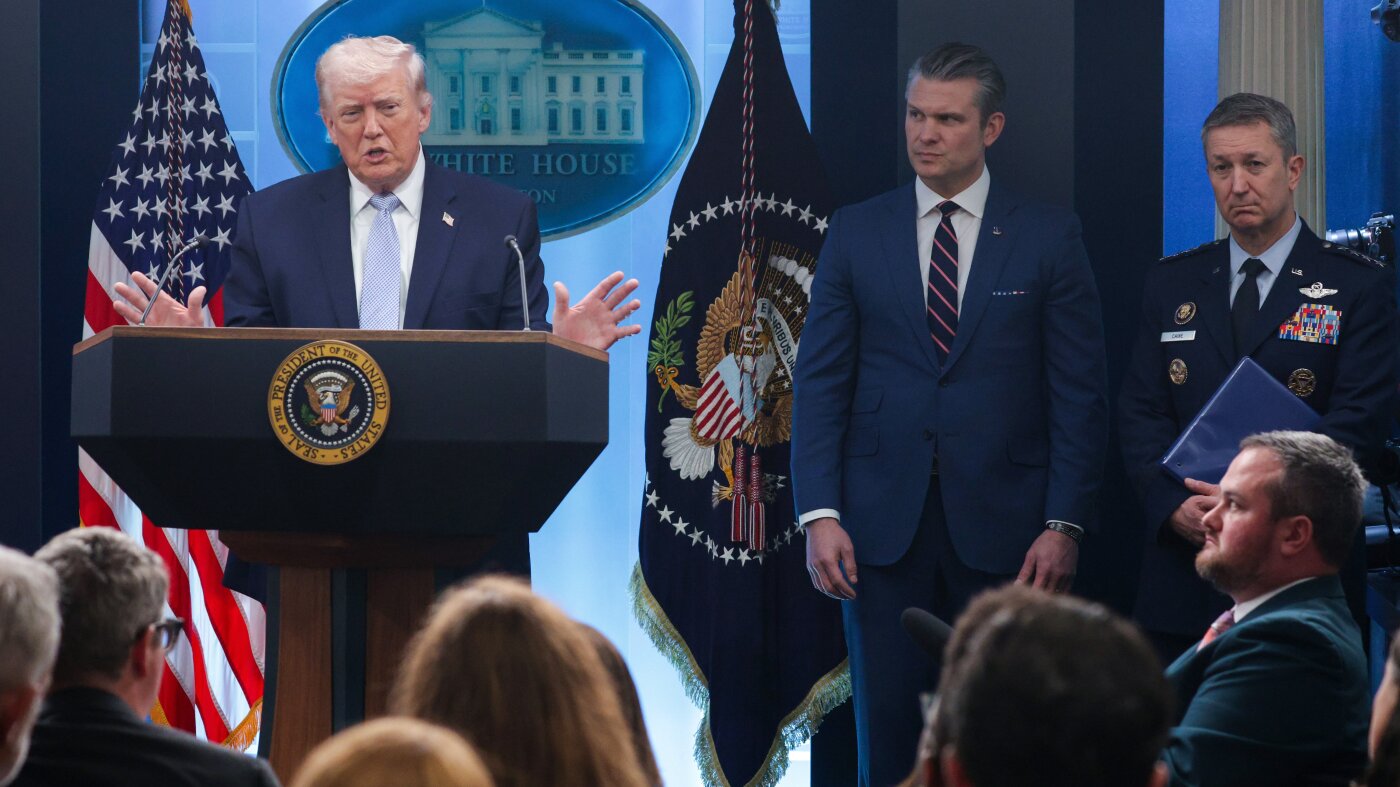
President Trump speaks as Secretary of Defense Pete Hegseth (center) and Chairman of the Joint Chiefs of Staff General Dan Caine look on during a news conference at the White House on April 6.
Alex Wong/Getty Images
hide caption
toggle caption
Alex Wong/Getty Images
Stay up to date with our Politics newsletter, sent weekly.
President Trump repeated threats to Iran during during his Monday press conference, including against Iran’s civilian infrastructure if a deal to end the war is not reached by Tuesday night at 8 p.m. ET. Negotiations, he said, must include an open Strait of Hormuz.
“Every bridge in Iran will be decimated by 12 o’clock tomorrow night, where every power plant in Iran will be out of business, burning, exploding and never to be used again. I mean complete demolition by 12 o’clock, and it will happen over a period of four hours if we wanted to, we don’t want that to happen,” Trump told reporters.
He added: “We may even get involved with helping them rebuild their nation.”
After days of flip-flopping messaging, vacillating from demanding Iran open the Strait of Hormuz to telling U.S. allies it’s up to them to open it to an Easter Sunday profanity-laced social media post demanding Iran open it, Trump said a successful negotiation would have to include “free traffic of oil.”
“We have to have a deal that’s acceptable to me and part of that deal is going to be, we want free traffic of oil and everything,” he said.
Asked about his mixed messages about the status of the war, and whether it was winding down or ramping up amid his latest threats, he said: “I don’t know. I can’t tell. It depends what they do. This is a critical period. They have a period of, well, till tomorrow, at eight o’clock.”
Trump said he can’t discuss a potential ceasefire, but the U.S. has “an active, willing participant on the other side” of negotiations.
Asked if he’s concerned that bombing of power plants and bridges would amount to war crimes, Trump said, “No. I hope I don’t have to do it.”

He opened the press conference by describing the successful rescue mission for the downed airman over the weekend.
Trump spent several minutes describing the rescue mission, calling his decision to authorize the rescue as “risky” and “hard.”
“But in the U.S. military. We leave no American behind,” he said. The president claimed Iran “got lucky” when they took out the U.S. fighter jet.
CIA Director John Radcliffe, Defense Secretary Pete Hegseth and Joint Chiefs of Staff Chairman Gen. Dan Caine all recounted the rescue operation at the press conference — Trump’s first since the U.S. and Israel launched a war with Iran more than a month ago.
The news conference comes days after Trump formally addressed the nation from the White House last week and said the conflict would end “shortly.” At that address, he criticized other countries, though didn’t name any specifically, and said it was up to others to reopen the Strait of Hormuz, the route through which 20% of the world’s oil is transported.
Iran’s closure of the strait during the war has led to a jump in gas prices globally, hitting around $4 per gallon last week in the U.S.
The president has also been threatening a surge in strikes on Iran Tuesday, unless the strait is reopened by tomorrow evening.
“Tuesday will be Power Plant Day, and Bridge Day, all wrapped up in one, in Iran,” Trump said on social media over the weekend, “Open the F***in’ Strait, you crazy bastards, or you’ll be living in Hell – JUST WATCH!”
The post comes as negotiations between the U.S. and Iran have made some progress. A 45-day ceasefire proposal was submitted to the U.S. and Iran on Sunday. On Monday, Trump called the proposal “a significant step.”
The president has repeatedly said the war would last roughly six weeks. But now, in its sixth week, the timeline on when the war would end and how achievable Trump’s objectives are remain unclear.
For weeks, Trump has been moving the goal posts on the administration’s goals with Iran, including whether the U.S. will remove Iran’s uranium stockpiles. Trump has also suggested that the U.S. could end the war but strike Iran again later if they aim to build up nuclear defenses.
Polling shows that Americans oppose the war in Iran. Even among Republican supporters of the president, his approval rating has dipped. A CNN poll released last week showed that Republicans who strongly approve of Trump’s job performance dropped to 43%, compared to 52% in January.
High costs, including gas prices, remain a top of mind concern for voters heading into the midterm elections in roughly six months. On Monday, Trump said the high prices might last into the summer.
“We’re never going to let them have a nuclear weapon,” Trump said of Iran. “And if we have to pay a little extra for fuel for a couple of months, and we’ll do that, but we’re never going to allow Iran to have a nuclear weapon.”
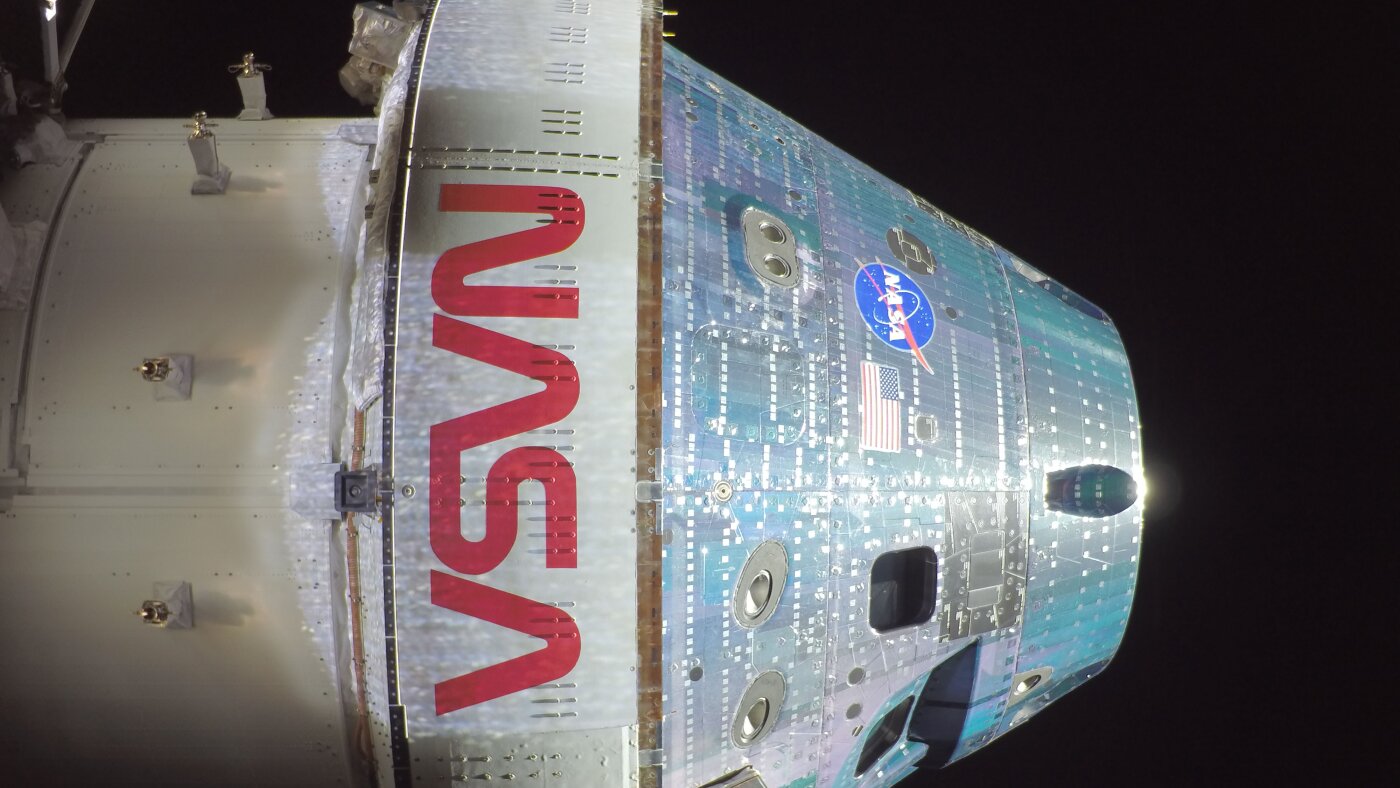
A photo of NASA’s Orion space capsule taken by a remote camera mounted on one of its solar arrays as it sped towards the moon. The four astronauts will loop around the moon on Monday and also venture farther into space than any humans before.
NASA via Getty Images
hide caption
toggle caption
NASA via Getty Images
The crew of NASA’s Artemis II will make its closest approach to the moon Monday afternoon after launching from Kennedy Space Center last week.

It marks a critical milestone of the agency’s Orion space capsule, sending humans on a mission to the moon for the first time in more than 50 years. As the capsule loops around the moon, the astronauts will reach farther into space than humans have ever ventured.
The Orion spacecraft is now in the lunar sphere of influence, meaning the moon’s gravity has more pull on the vehicle than the Earth. At 1:46 p.m. ET, the crew will surpass the record for the farthest distance traveled from Earth by humans, which was set by the Apollo 13 mission at 248,655 statute miles from Earth. At 2:45 p.m., the crew will begin making observations of the surface of the moon during the flyby.
As the vehicle circles the far side of the moon, communication back to Earth is expected to be blocked for about 40 minutes. At 7:02 p.m., the crew is expected to have reached the mission’s maximum distance from Earth at 252,760 statute miles.
The flyby is scheduled to conclude at 9:20 p.m. and then the crew will be on its way home, with a planned splashdown in the Pacific Ocean off San Diego, Calif. on Friday at 8:07 p.m.
During the Artemis II flyby, the crew will pass over two previous human lunar landing sites — Apollo 12 and 14.
Lunar science observations
During the lunar flyby, the closest Orion will come to the surface of the moon is 4,070 miles. From that distance the crew will have a unique vantage point of the moon as a full disc — and the ability to take observations never before seen by human eyes.
NASA scientists have identified about 35 geological features for the crew to observe. Working in pairs, they will take photos of the sites and describe them in real time to scientists at Mission Control at the Johnson Space Center in Houston.
“They’re going to be absolutely buzzing,” said Artemis II lunar science lead Kelsey Young on Sunday. The team will be monitoring the observations and providing guidance to the crew.
“The science team will get to work right away, kind of synthesizing those [observations], and then we’ll actually downlink the rest of the descriptions overnight, in advance of a crew conference we’ll have the following morning to continue the science discussion.”
Artemis II has ten science objectives for the flyby. One is to observe color variations on the lunar surface. Changes in color can indicate the composition of the minerals on the surface. These changes are hard to detect with satellite images.
“This is something that human eyes are just incredibly good at teasing out nuances about,” said Young.
Satellites like the Lunar Reconnaissance Orbiter, which launched in 2009, have given scientists a better understanding of the lunar surface. The Artemis II crew’s observations will build on that knowledge.
“We understand, you know, what it’s made out of. We understand the topography, but we don’t know what the crew are going to see in these specific illumination conditions from a scientific perspective,” said Young. “And that’s exciting.”
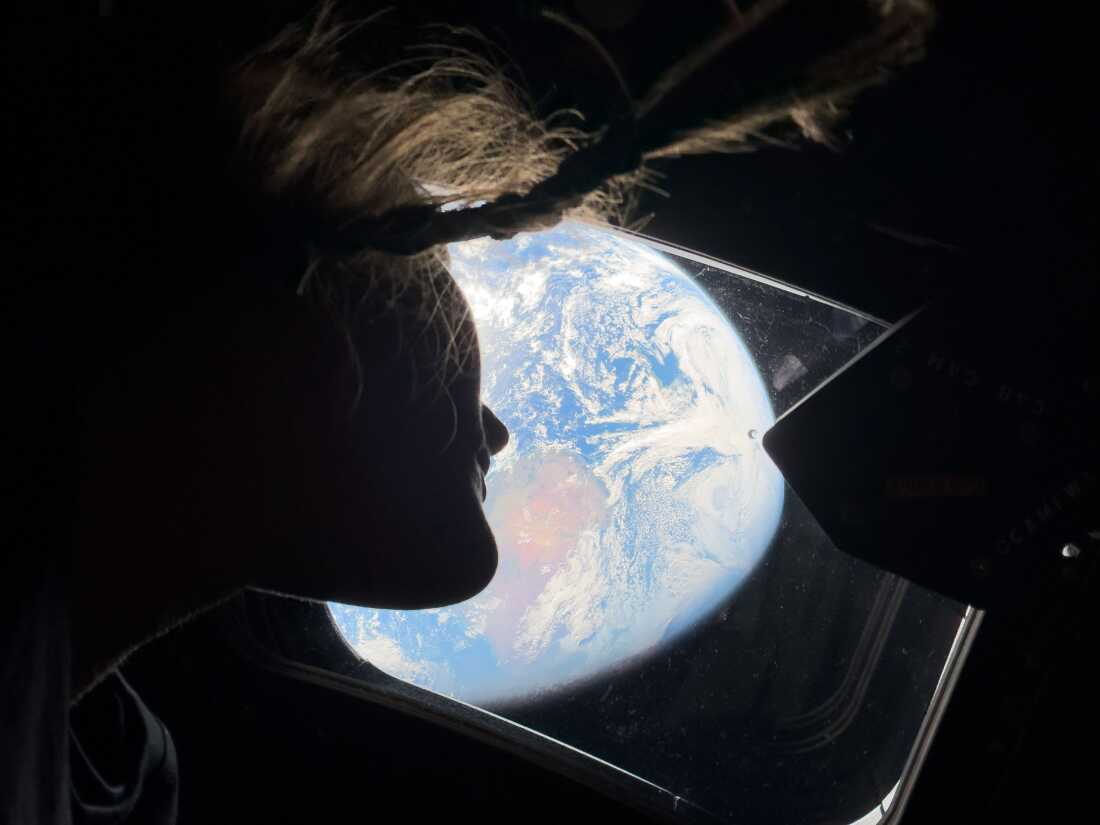
NASA astronaut and Artemis II mission specialist Christina Koch peers out of one of the Orion spacecraft’s main cabin windows, looking back at Earth on Saturday, as the crew traveled towards the Moon.
NASA via Getty Images/Getty Images North America
hide caption
toggle caption
NASA via Getty Images/Getty Images North America
The observations will help future landing missions. One target site is a potential future landing area for an uncrewed payload mission. The crew will also get a small glimpse of the lunar south pole — where humans might land as early as 2028.
The mission so far
Artemis II is more than halfway through its slingshot mission around the moon and back. This is a test flight of the Orion space capsule, carrying a human crew for the first time.
“Our mission continues to go incredibly well,” said Lori Glaze, who leads NASA’s Artemis program.
Tests include manual control of the Orion spacecraft. Mission pilot Victor Glover practiced the maneuverability of the capsule for future rendezvous with lunar landing vehicles.

The crew tested the spacecraft’s life support systems, like the carbon dioxide scrubbers, and donned their space suits midflight — which future astronauts might have to do in an emergency.
The Artemis II mission is also testing the first deep-space toilet. NASA’s Universal Waste Management System is stowed in the floor of Orion and allows the crew to use the bathroom in private. So far, the hardware has had a few hiccups (not having enough water in the bowl and, at a different point, not being able to dump the waste overboard due to a frozen line), but those seem to be resolved.
“We’re continuing to proceed with the mission and the use of the toilet nominally,” said Artemis II flight director Rick Henfling, meaning the crew is allowed to use the onboard lavatory.

NHL roundup: Zach Werenski says slumping Blue Jackets ‘still in it’

How to watch San Francisco Giants vs. Philadelphia Phillies

After deadly crash, loved one questions suspect’s actions at scene

Unlicensed contractor arrested after allegedly scamming Miami Catholic school out of $220,000

Boston University OT Program Ranks Top in Its Class for Fifth Straight Year by U.S. News & World Report

Florida High School Football Rankings: Top 25 teams – Oct. 21

How old is Bo Nix? What to know about Oregon quarterback ahead of 2024 NFL Draft

Cleary's 21 help Le Moyne down Central Connecticut State 69-64 in OT

99th annual Pony Swim held in Virginia

Indiana Members Credit Union announced as new anchor tenant at Bottleworks District

Map: Minor Earthquake Strikes Near San Diego

Trump claims he’d win as the president of Venezuela — just needs to ‘quickly’ learn Spanish

US Supreme Court clears path for Steve Bannon criminal case dismissal
Trump reiterates threats to bomb Iran’s power plants and bridges

Trump threatens Iranian infrastructure over Strait of Hormuz | BBC News
-

 Atlanta, GA2 days ago
1 teenage girl killed, another injured in shooting at Piedmont Park, police say
-

 South-Carolina1 week ago
South Carolina vs TCU predictions for Elite Eight game in March Madness
-

 Movie Reviews5 days ago
Vaazha 2 first half review: Hashir anchors a lively, chaos-filled teen tale
-

 Vermont1 week ago
Skier dies after fall at Sugarbush Resort
-

 Politics1 week ago
Trump’s Ballroom Design Has Barely Been Scrutinized
-

 Politics1 week ago
JD Vance says he was ‘obsessed’ with UFOs, believes aliens are actually ‘demons’
-
 Entertainment5 days ago
Inside Ye’s first comeback show at SoFi Stadium
-

 Atlanta, GA1 week ago
Fetishist ‘No Kings’ protester in mask drags ‘Trump’ and ‘JD Vance’ behind her wheelchair