Connect with us

News

A US tariff pathology is unleashed upon the world

Published

on

A US tariff pathology is unleashed upon the world

Unlock the White House Watch newsletter for free

Well, at least we now know what Donald Trump will do with tariffs, until he is seized by another whim. Perhaps it was better when we didn’t. The “reciprocal” tariffs announced on so-called liberation day were farcical, set by an arithmetic formula based on trade deficits in the apparent belief that current account imbalances can be fixed by trade policy. 

The US will apparently charge tariffs on exports from Heard Island and the McDonald Islands, a volcanic archipelago near the Antarctic inhabited only by penguins, and from Diego Garcia, a US military base. In theory tariffs trigger a currency appreciation to offset their effects but the dollar has weakened in response to this shambolic policymaking.

But this isn’t some general crisis of credibility in trade and globalisation. It’s largely a localised pathology, and particularly one of the Republican Party. The Democrats under Joe Biden accepted far too much of Trump’s first term tariff legacy, but at least with a vaguely coherent industrial policy rationale. The Republicans haven’t necessarily turned into a seething nest of protectionists, but their increasingly extreme bent ever since Richard Nixon took the party to the right in the 1960s has allowed a mindlessly destructive trade warrior to take over and they are too terrified to stop him.

Advertisement

Accident, prejudice and unintended consequence play a bigger role in dysfunctional US tariff policy than the grand sweep of economic history might suggest. The “Tariff of Abominations” in 1828, which massively raised taxes on industrial imports, almost causing South Carolina to secede from the union because of the effect on agricultural trade, became law by accident. Lawmakers from southern farming states inserted destructive spoilers to prevent it being agreed and watched with horror as it passed nonetheless.

The notorious Smoot-Hawley tariff of 1930 similarly reflected politicking gone wrong. This time, Republicans proposed big industrial tariffs, which US manufacturers didn’t need, as a quid pro quo for introducing protection for farmers. They did not imagine that other countries would retaliate and set off a global spiral of protection that worsened the Great Depression.

This current case is not just a tactical mistake: it’s what happens when an ideological extremist becomes president. If there are any grown-ups among Trump’s economic team, they are locked in a cupboard when decisions are taken. Among them is Kevin Hassett, an orthodox free-trade economist who advised George W Bush and Mitt Romney but who is unable or unwilling to stop the chaos. Treasury secretary Scott Bessent was supposed to be the voice of the financial markets: he’s evidently silent or ignored. The animating drive is from Trump himself, who since the 1980s has had a wrong-headed view of tariffs based on an analogy with a corporate profit-and-loss account, and the trade warrior Peter Navarro, who appears closest to the president’s ear.

Under a president of the Bush mould, many of today’s congressional Republicans might well be willing to preserve a relatively open trading system. John Thune of South Dakota, elected as majority leader of the Senate in November, holds orthodox views on the need for more trade deals to open up markets abroad. But along with almost all his caucus, he has utterly failed to reassert Congress’s constitutional role in trade policy.

The consolation is that the rest of the world is much less likely to follow the US than it did in the 1930s, during which time the international gold standard was also inflicting profound damage and inducing extreme reactions from policymakers. Only the EU is likely to retaliate with tariffs and other import restrictions anywhere near dollar for dollar, and Brussels emphatically does not want to raise high and permanent trade barriers with the rest of the world.

Advertisement

The US is a smaller share of the global economy than during the 1930s, and the risks of protectionism are far better understood. In the same way that Trump has kindled Canadian public patriotism and a geopolitical awakening among European leaders, his tariffs are more likely to act as a cautionary tale for other governments than an incentive to join the US in some fantastical “Mar-a-Lago Accord” to realign currencies.

There can be no logic-washing of Donald Trump’s tariffs. This isn’t part of a carefully-designed industrial policy or a cunning strategy to induce compliance among trading partners or a choreographed appearance of chaos to scare other governments into obedience. It’s wildly destructive stupidity, and the generations of American, and particularly Republican politicians, who allowed things to slide to this point are collectively to blame.

alan.beattie@ft.com

News

Video: F.A.A. Ignored Safety Concerns Prior to Collision Over Potomac, N.T.S.B. Says

Published

on

Video: F.A.A. Ignored Safety Concerns Prior to Collision Over Potomac, N.T.S.B. Says

new video loaded: F.A.A. Ignored Safety Concerns Prior to Collision Over Potomac, N.T.S.B. Says

transcript

transcript

F.A.A. Ignored Safety Concerns Prior to Collision Over Potomac, N.T.S.B. Says

The National Transportation Safety Board said that a “multitude of errors” led to the collision between a military helicopter and a commercial jet, killing 67 people last January.

“I imagine there will be some difficult moments today for all of us as we try to provide answers to how a multitude of errors led to this tragedy.” “We have an entire tower who took it upon themselves to try to raise concerns over and over and over and over again, only to get squashed by management and everybody above them within F.A.A. Were they set up for failure?” “They were not adequately prepared to do the jobs they were assigned to do.”

Advertisement
The National Transportation Safety Board said that a “multitude of errors” led to the collision between a military helicopter and a commercial jet, killing 67 people last January.

By Meg Felling

January 27, 2026

Continue Reading

News

Families of killed men file first U.S. federal lawsuit over drug boat strikes

Published

on

Families of killed men file first U.S. federal lawsuit over drug boat strikes

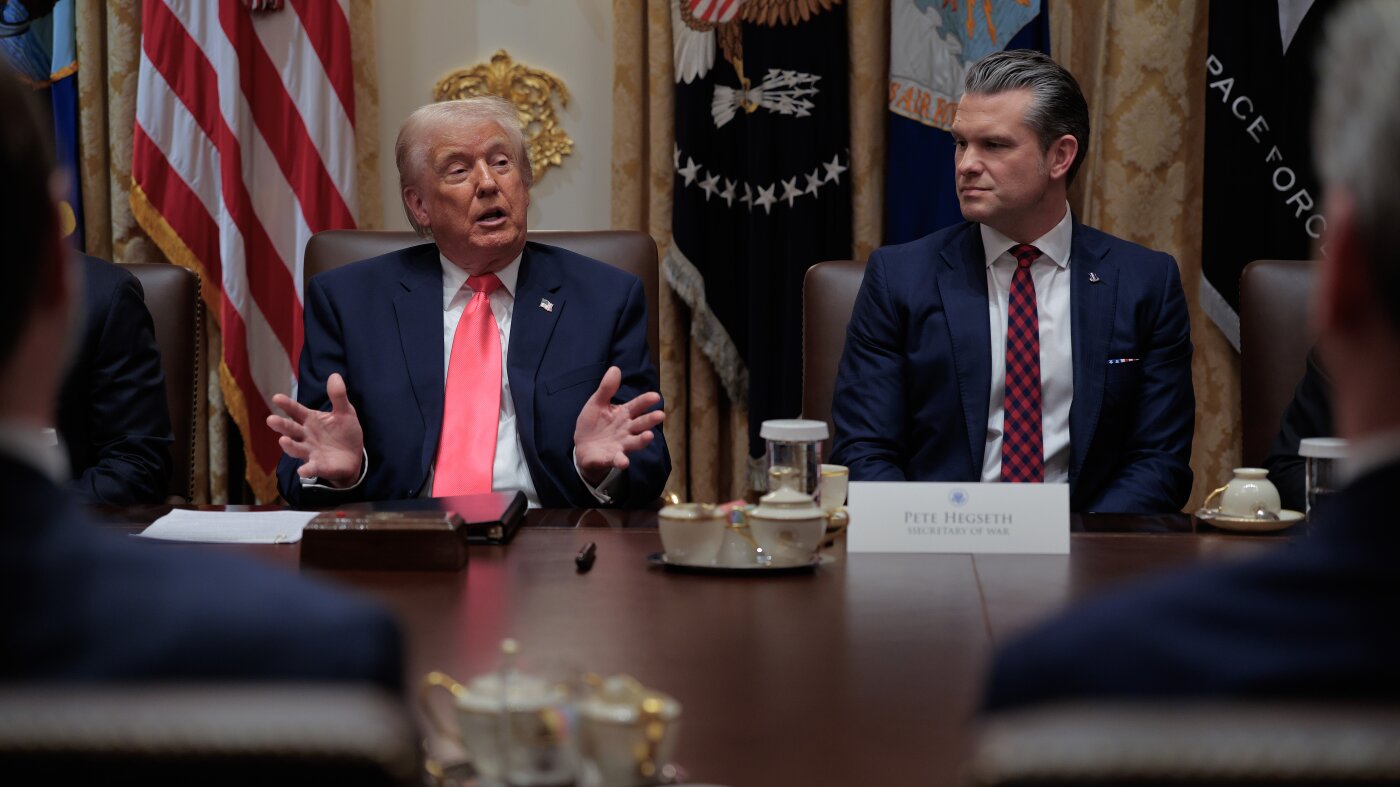
President Trump speaks as U.S. Secretary of Defense Pete Hegseth looks on during a meeting of his Cabinet at the White House in December 2025.

Chip Somodevilla/Getty Images


hide caption

toggle caption

Advertisement

Chip Somodevilla/Getty Images

Relatives of two Trinidadian men killed in an airstrike last October are suing the U.S. government for wrongful death and for carrying out extrajudicial killings.

The case, filed in Massachusetts, is the first lawsuit over the strikes to land in a U.S. federal court since the Trump administration launched a campaign to target vessels off the coast of Venezuela. The American government has carried out three dozen such strikes since September, killing more than 100 people.

Among them are Chad Joseph, 26, and Rishi Samaroo, 41, who relatives say died in what President Trump described as “a lethal kinetic strike” on Oct. 14, 2025. The president posted a short video that day on social media that shows a missile targeting a ship, which erupts in flame.

Advertisement

“This is killing for sport, it’s killing for theater and it’s utterly lawless,” said Baher Azmy, legal director of the Center for Constitutional Rights. “We need a court of law to rein in this administration and provide some accountability to the families.”

The White House and Pentagon justify the strikes as part of a broader push to stop the flow of illegal drugs into the U.S. The Pentagon declined to comment on the lawsuit, saying it doesn’t comment on ongoing litigation.

But the new lawsuit described Joseph and Samaroo as fishermen doing farm work in Venezuela, with no ties to the drug trade. Court papers said they were headed home to family members when the strike occurred and now are presumed dead.

Neither man “presented a concrete, specific, and imminent threat of death or serious physical injury to the United States or anyone at all, and means other than lethal force could have reasonably been employed to neutralize any lesser threat,” according to the lawsuit.

Advertisement

Lenore Burnley, the mother of Chad Joseph, and Sallycar Korasingh, the sister of Rishi Samaroo, are the plaintiffs in the case.

Their court papers allege violations of the Death on the High Seas Act, a 1920 law that makes the U.S. government liable if its agents engage in negligence that results in wrongful death more than 3 miles off American shores. A second claim alleges violations of the Alien Tort Statute, which allows foreign citizens to sue over human rights violations such as deaths that occurred outside an armed conflict, with no judicial process.

The American Civil Liberties Union, the Center for Constitutional Rights, and Jonathan Hafetz at Seton Hall University School of Law are representing the plaintiffs.

“In seeking justice for the senseless killing of their loved ones, our clients are bravely demanding accountability for their devastating losses and standing up against the administration’s assault on the rule of law,” said Brett Max Kaufman, senior counsel at the ACLU.

U.S. lawmakers have raised questions about the legal basis for the strikes for months but the administration has persisted.

Advertisement

—NPR’s Quil Lawrence contributed to this report.

Continue Reading

News

Video: New Video Analysis Reveals Flawed and Fatal Decisions in Shooting of Pretti

Published

on

Video: New Video Analysis Reveals Flawed and Fatal Decisions in Shooting of Pretti

new video loaded: New Video Analysis Reveals Flawed and Fatal Decisions in Shooting of Pretti

A frame-by-frame assessment of actions by Alex Pretti and the two officers who fired 10 times shows how lethal force came to be used against a target who didn’t pose a threat.

By Devon Lum, Haley Willis, Alexander Cardia, Dmitriy Khavin and Ainara Tiefenthäler

January 26, 2026

Continue Reading

Trending