Midwest
Tutu-wearing monkey picked up near highway in 'bananas situation'

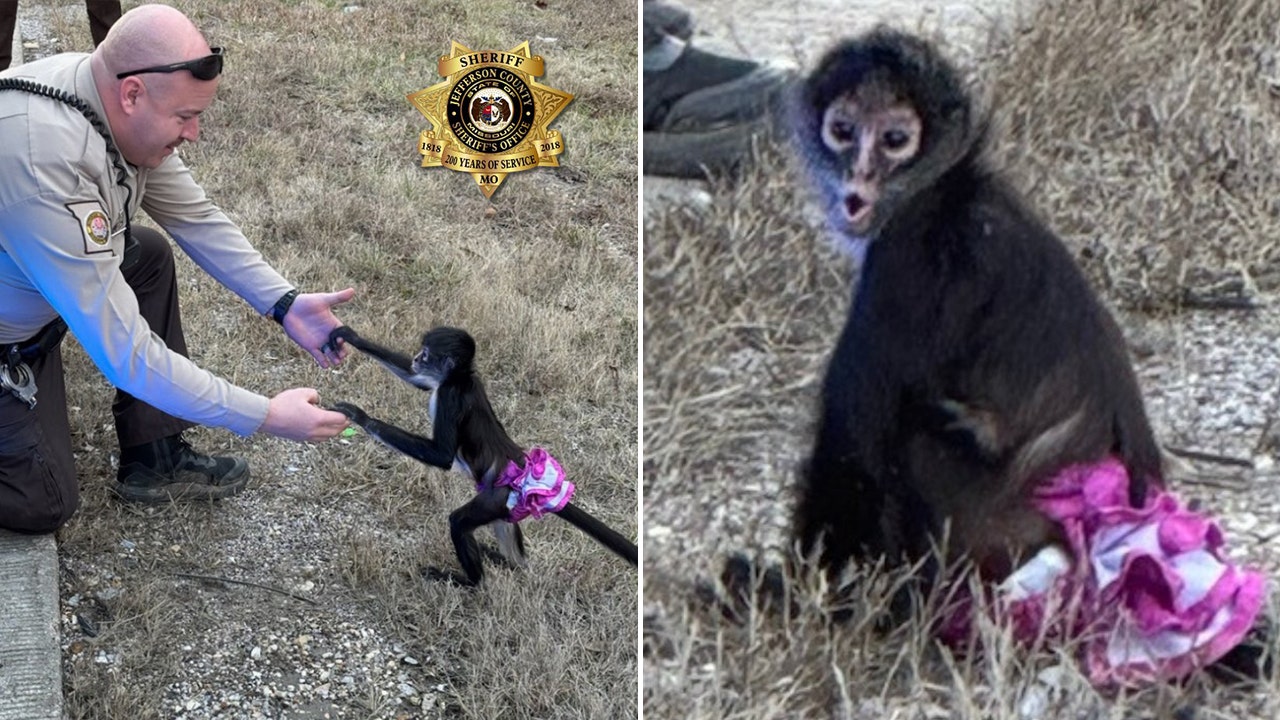
Sheriff’s deputies in Missouri say they responded to a “bananas situation” on Monday when they responded to a report of a subject “monkeying around.”
In an unusual police stop, the Jefferson County Sheriff’s Office said they discovered a spider monkey wearing a pink-colored tutu near Route 21 and Highway M in eastern Missouri. Spider monkeys are typically found in tropical forests of Central and South America.
In a light-hearted post on X, the Jefferson County Sheriff’s Office said that first-responding units found the subject “naked except for what appeared to be a tutu.”
“After careful negotiations, deputies were able to get close enough to go ‘hands-on’ with the subject and bring this bananas situation under control without incident,” the law enforcement agency wrote.
Sheriff’s deputies in Missouri discovered a spider monkey wearing a tutu near Route 21 on Monday. (Jefferson County Sheriff’s Office)
CALIFORNIA HIGHWAY PATROL GETS IN SOME MONKEY BUSINESS DURING ROUTINE STOP
Officials said the exotic primate was staying at a nearby home when it managed to open a door and get outside.
The Jefferson County Sheriff’s Office posted several pictures of its deputies with the black-colored monkey. In one heart-warming image, a deputy is holding hands with the animal.
The Jefferson County Sheriff’s Office posted several pictures of its deputies with the black-colored monkey. In one heart-warming image, a deputy is holding hands with the primate. (Jefferson County Sheriff’s Office)
MONKEY MAYHEM AS DOZENS OF PRIMATES ESCAPE SOUTH CAROLINA RESEARCH CENTER
“In all seriousness, this is a great example of law enforcement officers never knowing what they’ll face on any given call and having to be prepared to handle whatever the job throws at them,” the post continues.
“Deputies surrounded the animal and eventually got it back to its caretaker. Nice work by everyone involved. What a day in #JeffCo.”
A permit is required to own a spider monkey in Missouri.
The spider monkey was discovered wearing a punk tutu. (Jefferson County Sheriff’s Office)
The news comes days after a spider monkey dressed in a onesie was discovered by police in California.
A California Highway Patrol official stopped a 2022 Rolls-Royce Ghost in Madera County last week for excessive speeding on Highway 99 and found the monkey in the car.
Meanwhile, in November, 43 rhesus macaque monkeys escaped a testing facility in South Carolina. A majority of them were recaptured.
Read the full article from Here

Detroit, MI
Trailblaze Detroit: Blazing New Trails while Backpacking Metro Detroit | Visit Detroit | Visit Detroit

Kensington Metropark is a Detroit region outdoor destination that hardly requires an introduction. With over 4,500 acres of protected recreational prowess, the Metropark receives nearly 3 million visitors each year that enjoy the following amenities:
- Hiking, biking, and equestrian trails weaving through over 700 acres of forests, fields, fens, and swamps
- Boating, paddling, and fishing along the Huron River and massive Kent Lake
- Tee times at its 18 hole golf course
- Family-friendly exhibits and events at its Nature Center and Farm Center
- Playgrounds and beaches
- Ultimate summer fun at “Splash ‘n’ Blast” water park
With its abundance of amenities – and impressive visitation figures – readers of this article might be surprised to have only just learned that the Chief Pontiac Trail crosses through the beloved metropark. If you fall into that camp, then know that you’re far from being alone. In fact, that sentiment is representative of one of the best aspects of the Chief Pontiac Trail experience: leading backpackers through the least-visited segments of an extremely popular metropark.
As you complete the Chief Pontiac Trail, you’ll enjoy stunning natural vistas that remain hidden from the majority of visitors to Kensington. From rolling grasslands to stunning explosions of wildflowers and dramatic ridge lines, the dramatic approach to the Huron River provides a gorgeous finale to your long morning on the trail.

A final descent to Kensington’s “Group Campground” illuminates the finish line of the Chief Pontiac trail: the Group Camp Road Bridge over the Huron River. In true Detroit fashion, there’s no glitzy sign or over-hyped fanfare waiting for you at the end of the trail. Instead, nearly 20 miles of backpacking through the heart of Metro Detroit provides you with the following rewards:
- A lifetime of memories gathered in two days
- Unmatched sense of accomplishment and adventure
- Lasting awe and affinity towards the beauty of Metro Detroit’s outdoors
- Shattered expectations regarding “Pure Michigan” trail experiences
- Stunning views of the shining Huron River
Congratulations on walking in Chief Pontiac’s steps, Detroit.
We can’t wait to see you at another trailhead soon.
____________________________________________________________________
Trailblaze Detroit is a multimedia series co-produced by Visit Detroit and Expedition Detroit. The core purpose of the series is to promote outdoor adventure tourism and discovery throughout Wayne, Oakland, and Macomb Counties, as well as highlight the Detroit region’s natural spaces, seasonal activities, hidden outdoor gems, and the individuals that support them.
Are you interested in using adventure marketing to promote your organization or business? Awesome – we’re here to help! Contact us at info@expeditiondetroit.com or 734.821.6416 to learn more.


Employees at a south Minneapolis child care center said they are increasingly concerned about drug use and safety issues, as a homeless encampment grows nearby under the Cedar Avenue and Highway 55 overpass.
Staff at Baby’s Space child care, which has served the neighborhood for more than 25 years, said things have gotten especially bad over the past month.
Yolanda Reyes is an administrative assistant at Baby’s Space, which is just blocks away from the encampment.
“The encampment was moving and then the cops would clear it out, and they’d wait a few hours and they were right back,” said Reyes.
Staff said a fence installed to discourage people from gathering at the encampment has been ineffective. A WCCO camera captured an opening in the fence that allowed people to continue gathering on the sidewalk.
Drug use has become more visible and has moved right outside the child care center’s front door, Reyes said.
“Open use, just freely using their drugs. I had to go out the front door and say, ‘Hey, this is a child care center,’” she said.
The concerns have affected daily activities at the facility. Debbie Lund, executive director for Baby’s Space, said staff worry about what children could encounter while playing outside. She said Minneapolis police now stand watch by their playground.
“It’s hard for us to play outside because we’re not sure what the kids are going to be exposed to,” said Lund.
The concerns have drawn the attention of city leaders. On Tuesday, Minneapolis City Council Member Jason Chavez sent an email to city officials, including Mayor Jacob Frey and Public Safety Commissioner Todd Barnette, requesting immediate support for unhoused residents in the area.
A city spokesperson said the fencing is temporary to allow time for a better long-term solution, in collaboration with the county, Metro Transit, and the Minnesota Department of Transportation, who all have facilities in the area.
In the meantime, the city said they are working to help people move from unsheltered homelessness into stable housing.
Reyes and Lund emphasized that they sympathize with people living in the encampment who are struggling with addiction.
“It’s so hard because our hearts go out to everybody, and yet we really need to keep our children safe,” said Lund.
-

 Crypto1 minute ago
Enlivex token gets Gate listing, widening access to its $1.14B treasury asset
-

 Finance6 minutes ago
Protecting Bolivia’s forest watersheds with sustainable finance
-

 Fitness13 minutes ago
Alexandra Daddario, 40, relies on this underrated crunch upgrade for strong abs – here’s how to do it properly
-

 Movie Reviews28 minutes ago
Movie Review – In the Hand of Dante (2025)
-

 World31 minutes ago
Brazil's Flavio Bolsonaro Plans to Testify Against Proposed US Tariffs
-

 News43 minutes ago
Video: Mamdani Allies Sweep New York Primaries
-
 Lifestyle1 hour ago
4 ways to design a dreamy summer, according to a happiness expert
-

 Education1 hour ago
Video: School Year Cut Short and Aid Delivery Slowed Amid Fuel Crisis in Cuba

