North Dakota
Abortion is illegal again in North Dakota after court reverses a judge’s earlier decision

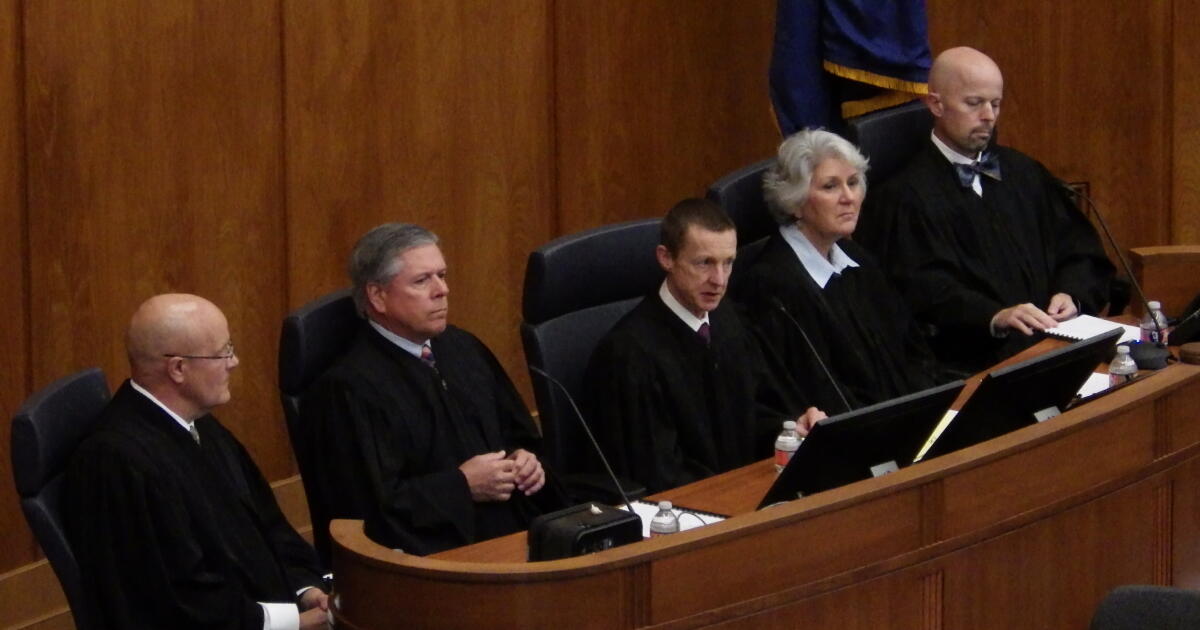
BISMARCK, N.D. — Abortion is again illegal in North Dakota after the state’s Supreme Court on Friday couldn’t muster the required majority to uphold a judge’s ruling that struck down the state’s ban last year.
The law makes it a felony crime for anyone to perform an abortion, though it specifically protects patients from prosecution. Doctors could be prosecuted and penalized by as much as five years in prison and a $10,000 fine.
Three justices agreed that the ban is unconstitutionally vague. The other two justices said the law is not unconstitutional.
The North Dakota Constitution requires at least four of the five justices to agree for a law to be found unconstitutional, a high bar. Not enough members of the court joined together to affirm the lower court ruling.
In his opinion, Justice Jerod Tufte said the natural rights guaranteed by the state constitution in 1889 do not extend to abortion rights. He also said the law “provides adequate and fair warning to those attempting to comply.”
North Dakota Republican Atty. Gen. Drew Wrigley welcomed the ruling, saying, “The Supreme Court has upheld this important pro-life legislation, enacted by the people’s Legislature. The attorney general’s office has the solemn responsibility of defending the laws of North Dakota, and today those laws have been upheld.”
Republican state Sen. Janne Myrdal, who introduced the 2023 legislation that became the law banning abortion, said she was “thrilled and grateful that two justices that are highly respected saw the truth of the matter, that this is fully constitutional for the mother and for the unborn child and thereafter for that sake.”
The challengers called the decision “a devastating loss for pregnant North Dakotans.”
“As a majority of the Court found, this cruel and confusing ban is incomprehensible to physicians. The ban forces doctors to choose between providing care and going to prison,” Center for Reproductive Rights senior staff attorney Meetra Mehdizadeh said. “Abortion is healthcare, and North Dakotans deserve to be able to access this care without delay caused by confusion about what the law allows.”
The ruling means access to abortion in North Dakota will be outlawed. Even after a judge had struck down the ban last year, the only scenarios for a patient to obtain an abortion in North Dakota had been for life- or health-preserving reasons in a hospital.
The state’s only abortion provider relocated in 2022 from Fargo to nearby Moorhead, Minn.
Justice Daniel Crothers, one of the three judges to vote against the ban, wrote that the district court decision wasn’t wrong.
“The vagueness in the law relates to when an abortion can be performed to preserve the life and health of the mother,” Crothers wrote. “After striking this invalid provision, the remaining portions of the law would be inoperable.”
North Dakota’s newly confirmed ban prohibits the performance of an abortion and declares it a felony. The only exceptions are for rape or incest for an abortion in the first six weeks of pregnancy — before many women know they are pregnant — and to prevent the woman’s death or a “serious health risk” to her.
North Dakota joins 12 other states enforcing bans on abortion at all stages of pregnancy. Four others bar it at or around six weeks of gestational age.
Judge Bruce Romanick had struck down the ban the GOP-led Legislature passed in 2023, less than a year after the U.S. Supreme Court overturned Roe vs. Wade and opened the door to the state-level bans, largely turning the abortion battle to state courts and legislatures.
The Red River Women’s Clinic — the formerly sole abortion clinic in North Dakota — and several physicians challenged the law. The state appealed the 2024 ruling that overturned the ban.
The judge and the Supreme Court each denied requests by the state to keep the abortion ban in effect during the appeal. Those decisions allowed patients with pregnancy complications to seek care without fear of delay because of the law, Mehdizadeh previously said.
Dura writes for the Associated Press.



North Dakota
Gov. Armstrong seeks federal disaster declaration after storms cause $4.6M in damage across North Dakota

BISMARCK, N.D. (Valley News Live) – Gov. Kelly Armstrong on Tuesday requested a presidential major disaster declaration following a pair of severe storms that caused more than $4.6 million in damage across seven North Dakota counties.
Armstrong submitted the request through the Federal Emergency Management Agency, seeking federal public assistance funding to help cover the cost of repairing and replacing damaged public infrastructure.
The storms struck June 7-9.
The first round, on June 7, produced a derecho-like wind event with straight-line winds estimated between 80 and 100 mph. Two days later, supercell thunderstorms brought tornadoes, baseball-sized hail, and additional damaging winds.
“Just as communities were starting to clean up from the first round of storms on June 7, another round hit two days later, compounding the damage and complicating response and recovery for our citizens,” Armstrong said. “We appreciate the administration considering this request to help cover the cost of significant damage to public infrastructure from this one-two punch.”
The storms knocked out power to more than 25,000 people, toppled trees, and caused widespread damage to homes, businesses, and public utilities. Preliminary damage estimates to public facilities, including debris removal, exceed $4.6 million.
Armstrong declared a state disaster on June 30 in response to the storms.
The federal request covers seven counties: Bottineau, Burke, Divide, McLean, Mercer, Oliver, and Williams. A presidential major disaster declaration would make FEMA public assistance available to eligible applicants in those counties.
Copyright 2026 KVLY. All rights reserved.
North Dakota
Crime in North Dakota down; attorney general pushes for sentencing reform as violent crime remains high

BISMARCK — Crime in North Dakota is at a low not seen in more than a decade, but the state’s top law enforcement official continues to
push for a law requiring violent criminals to serve larger portions of their sentences,
noting violent crime remains high.
North Dakota recorded 42,594 offenses last year, according to a report released Tuesday, July 7, by the North Dakota Attorney General’s Office. That’s about 7% down from 2024 and an 18% decline from 2021, which had an all-time high of 51,784 crimes, according to the state office.
Last year’s total crime number is the state’s lowest since 2014, when state officials reported 42,968 offenses. Crime per 100,000 residents was 5,323 in 2025, down from 6,682 in 2021 and 6,348 in 2016, according to the office.
“We have some modest declines, but they are declines,” North Dakota Attorney General Drew Wrigley said during a press conference in Bismarck.
Wrigley’s office collects crime data from all law enforcement agencies across the state. Some statistics in the 2025 report are “less alarming,” Wrigley said. He focused on violent crime, which declined 3% from 2024 to 11,913 offenses last year, the report said.
The report defined violent crime as murder, manslaughter, assault, intimidation, stalking, kidnapping, abduction, sex offenses, commercial sex acts, involuntary servitude and robbery.
The 2025 numbers are at a five-year low; law enforcement agencies reported 12,246 violent crimes in 2021. Last year’s numbers are 22% higher than 2016’s report of 9,787.
Violent crime hit a high in 2023 with 12,601 offenses, according to Wrigley’s office. He described the last five years as a “plateau.”
Overall, the increase is a “dramatic failure” that is not being addressed, he said.
“We have to ask ourselves: Is this an acceptable new norm?” Wrigley asked.
Crimes against persons uses a federal definition that only includes murder, manslaughter, rape and assault. North Dakota had 11,765 offenses last year, down 3% from 2024 and 2% from 2021. Last year’s numbers are up 23% from 2016.
The state reported 1,472 crimes against persons offenses per 100,000 residents last year, down from 1,556 in 2021 but up from 1,267 in 2016, according to the Attorney General’s Office.
Wrigley used the press conference to argue for “truth-in-sentencing” reforms in North Dakota. The attorney general has twice proposed legislation that would require certain offenders to serve a portion of their sentence in a prison, instead of being released to minimum custody or transitional facilities.
During the 2025 legislative session, the North Dakota House killed Senate Bill 2128. The legislation
would have required
violent criminals, drug traffickers and sex offenders to serve at least 50% of their sentences before qualifying for early release. The bill in its original form also would have set minimum sentences for simple assault against law enforcement, fleeing and preventing arrest.
The bill attracted lengthy debate through the session, with opponents saying it would clog prisons and cost the state more money. Transitional facilities help inmates develop skills that allow them to return to life outside prison, ultimately reducing recidivism, according to North Dakota Department of Corrections and Rehabilitation Director Colby Braun.
Wrigley promised to push for “truth-in-sentencing” and more transparency surrounding decisions to release inmates and recidivism rates, calling current policy a “fundamentally flawed system” that needs to be corrected.
Wrigley noted Minnesota requires certain offenders to serve two-thirds of sentence before they are released. Other states have eliminated parole boards, he said, though he added he wasn’t suggesting North Dakota dissolve its own.
Releasing repeat offenders early, Wrigley said, is not acceptable to victims and law enforcement.
“It has to be corrected on behalf of the victims in the state, the ones who have already been victimized and the victims who are to come,” he said. “There needs to be integrity in sentencing.”
Property crimes have dropped dramatically over the last decade, from 26,082 in 2016 to 19,135 last year (27%), according to the Attorney General’s Office. Crimes against society — prostitution, drug and weapons violations, and child sex abuse material cases — also have trended down about 6%, from 12,427 in 2016 to 11,649 last year
Wrigley noted a “troubling” trend in driving under the influence numbers. Last year, law enforcement arrested 4,618 motorists on suspicion of drunken driving, up 14% from 2021, according to Wrigley’s report.
That’s still down 15% from 2015, when the state had 5,406 DUIs. The increase over the last five years is disappointing since North Dakota has spent time educating the public about the dangers of drinking and driving, Wrigley said.
“It can’t be ignored at this point,” he said.

Today in History revisits the Sunday, July 7, 1940, edition of the Grand Forks Herald and highlights a story of five children being sent to Grand Forks who were fleeing the Blitzkrieg-threatened British Isles.
Five children, fleeing the blitzkrieg-threatened British Isles, will arrive in Grand Forks soon.
The five—two boys and three girls—are from Edinburgh, Scotland, and are second cousins of Rev. W. Murray Allan, minister of the Plymouth Congregational church. They will live at the Allan home.
Mr. Allan said the boys were from one family and the girls from another. Ten days ago Mr. Allan received a cable from the parents, whom he has not seen in 25 years, asking if he would care for them.
Although he has not had definite word, Mr. Allan said he presumed the children are en route to the United States now. He also has been in touch with the American Committee for European Children.
The children coming here are believed to be the first war refugees who will reach North Dakota. Several other Grand Forks families are reported considering offering their homes to British children.

Our newsroom occasionally reports stories under a byline of “staff.” Often, the “staff” byline is used when rewriting basic news briefs that originate from official sources, such as a city press release about a road closure, and which require little or no reporting. At times, this byline is used when a news story includes numerous authors or when the story is formed by aggregating previously reported news from various sources. If outside sources are used, it is noted within the story.
-

 Augusta, GA2 minutes ago
Textron plans split that could spin off Augusta’s E‑Z‑GO | Exclusive
-

 Washington, D.C5 minutes ago
DC is second riskiest city for driving, Allstate says
-
Cleveland, OH10 minutes ago
Rachelle M. Hale Obituary Jul 3, 2026 – Slone and Co. Funeral Directors
-

 Austin, TX17 minutes ago
Texas Stock Exchange launches in Dallas, big implications for Austin start-ups
-

 Alabama20 minutes ago
Alabama adds commitment from in-state linebacker to 2028 class
-

 Alaska25 minutes ago
Opinion: Alaska’s whale-strike risk is growing while regulators keep studying the obvious
-

 Arizona32 minutes ago
Arizona Lottery Mega Millions, Pick 3 Evening results for July 7, 2026
-
Arkansas35 minutes ago
Arkansas Lottery Mega Millions, Cash 3 winning numbers for July 7, 2026

