Missouri
Different needs but similar fears arise in communities on both ends of Missouri’s redistricting


KANSAS CITY, Mo. — To grasp the effects of the rush to redraw America’s congressional districts before the 2026 elections, consider one historically Black neighborhood in downtown Kansas City, Missouri, and the small town of Boonville, population 7,800.
The 18th and Vine community is known for a museum telling the story of segregated professional baseball in the decades before Jackie Robinson broke Major League Baseball’s color barrier. Its leaders are talking about expanding the city’s streetcar line to lure more visitors to its cultural and historical attractions.
About 100 miles (161 kilometers) east, Boonville leaders want federal help restoring an old railroad bridge to give cyclists a more direct route on a popular cross-state bike trail near the mostly white farming community.
The two areas are thrust together under a new map Missouri Republicans passed in September in response to President Donald Trump’s push to give the GOP another winnable seat ahead of next year’s elections. Texas answered Trump’s call first, tilting five seats toward Republicans, but lawmakers in both major political parties are fighting a mid-decade, state-by-state battle to squeeze extra territory out of states they control. In California, voters approved a new House map to boost Democrats.
Missouri Republicans targeted Democratic U.S. Rep. Emanuel Cleaver, shaving off portions of his Kansas City district and stretching it into Republican-heavy rural areas.
Congressional districts often mix rural and urban areas, but redoing boundaries can alter priorities and change which federal projects representatives pursue and how they pursue things like health care, housing and education funding. When Congress debates a farm bill, is protecting food assistance benefits more important than preserving crop insurance? It often depends on who’s being represented.
That might explain why Robert Sylvan, an 81-year-old Kansas City resident who attends Cleaver’s church, worries “the whole set of dynamics that impact us” could be upended.
People walk between downtown shops Wednesday, Nov. 5, 2025, in Boonville, Mo. Credit: AP/Charlie Riedel
Voters fear being forgotten
Even with U.S. politics deeply polarized, there’s bipartisan agreement on Sylvan’s point.
Republican state Rep. Tim Taylor, who represents the Boonville area in the Legislature, said farmers Cleaver previously represented didn’t feel he understood them or came around much.
“Where he lives, things are different than they are here,” said Taylor, who voted for the redistricting plan despite misgivings about it.
It’s unclear how any Republican challenging Cleaver in the redrawn district would balance the needs of the two communities. So far, no likely contender is from Kansas City.
Troost Avenue, the city’s traditional racial dividing line, now marks a boundry for redrawn congressional districts in an attempt to flip a seat from Democrat to Republican, Thursday, Nov. 6, 2025, in Kansas City, Mo. Credit: AP/Charlie Riedel

Some Kansas City residents don’t expect people around 18th and Vine to get much attention if Cleaver loses. Cleaver was raised in public housing in Texas and preached about social justice as a Methodist pastor in a predominantly African American congregation.
“Naturally, 18th and Vine is kind of his baby,” said Bob Kendrick, president of the Negro Leagues Baseball Museum. “I don’t want it to be forgotten.”
Not just urban vs. rural
Fewer than 11% of Boonville’s residents are Black, while more than 64% are in 18th and Vine. The new Missouri map could have the state going from having people of color hold two of its eight House seats to one. Non-Hispanic white people are 62% of Missouri’s population but would hold 88% of its seats.
“We could potentially have folk representing us who have no interaction and have never had any interaction with people of color and have no idea of what goes on in the urban context,” said Cleaver’s son, Emanuel Cleaver III.
The areas often see common needs differently. Is the pressing problem with health care cuts that they cause rural hospitals to struggle or that millions of Americans don’t have insurance? An 18th and Vine resident is nearly twice as likely as a Boonville resident to have no health insurance. Boonville has been without a hospital since 2020.
Other differences: Buses stop every 15 minutes in 18th and Vine but must be prescheduled in Boonville. Kansas City leaders want more gun laws to combat violence while Republicans like Taylor have fought to expand gun rights. Trump won 67% of Boonville’s vote, compared with 14% of 18th and Vine’s.
The Kansas City neighborhood, celebrated for barbecue and jazz joints, hosted a 1920 meeting that founded the Negro National League, where Robinson got his start. Later, the area fell into disrepair.
Cleaver helped change that, seeking taxpayer dollars for 18th and Vine since 1989, first as a city councilman and then mayor before his two decades in Congress. The city’s spending has exceeded $100 million, helped by federal grants. Most recently, Cleaver helped obtain $15.5 million in federal money to renovate the nation’s oldest Black-owned housing cooperative, which he called “one of the citadels for the African American community.”
That project followed Cleaver’s efforts to bring money to neighborhoods on the historically Black side of Troost Avenue, long known as the city’s unofficial racial dividing line. It’s now one of his new district’s borders, which he finds outrageous.
“I feel more skeptical about the society’s direction than I did when I was a kid growing up in public housing,” Cleaver lamented during an interview at the church his son now leads.
Now, 18th and Vine also is home to all-night jazz jam sessions, a dance company, an arts center and an MLB Urban Youth Academy. Kendrick’s museum hopes to raise $35 million to triple exhibit space.
If there’s unease among locals, it’s that they might be priced out as taxpayer money helps transform the area. The city is working on a pedestrian plaza and a parking garage. Local officials are studying a streetcar line extension. There’s no cost estimate yet, but the latest streetcar extension got $174 million in federal funds.
Carmaletta Williams, executive director of the Black Archives of Mid-America in Kansas City, an area museum, wonders about a new representative: “Will they see the value in what’s going on?”
A bike trail lures tourists to Boonville
Boonville is surrounded by row crops and cattle ranches. One local school district graduates fewer than 10 students a year.
Yet it lures tourists with the Katy Trail. At 240 miles (386 kilometers), it’s the longest trail built on former rail lines in the U.S., and work on it began at nearly the same time as the rebuilding in 18th and Vine.
Taylor said after the trail’s first section opened in 1990 it was instrumental in reviving a town that was “pretty much dying” when he was a teenager in the 1980s. His wife runs Taylor’s Bake Shop & Espresso downtown.
Heading into Boonville, bikers detour off the railroad’s original path, crossing the Missouri River on a highway bridge that includes a designated bike path. The path leads them away from a 1932 railroad bridge, which trail riders would love to see refurbished. The city applied unsuccessfully last year for a $236,000 federal planning grant.
“The Katy Bridge is like the Eiffel Tower of Missouri if it would only be fixed,” said Annie Harmon, who runs a store in downtown Boonville called Celestial Body that sells essential oils, herbs, tie-dyed clothing and crystals.
Missouri has received $30 million in federal funds over the years for the Katy Trail and a related trail-building effort that cycling enthusiasts hope will loop almost 450 miles (724 kilometers), said Brandi Horton, a spokeswoman for the Rails to Trails Conservancy, a Washington-based nonprofit.
“You can’t do trail development at this scale,” Horton said, “without the dollars and the investment that the federal government can uniquely provide.”



Missouri
Missouri bill that would split Jackson County and Kansas City gets little support from lawmakers

A Missouri House committee had its first hearing this week on a proposed constitutional amendment that would split Kansas City and Jackson County upon approval by voters.
The legislation is nicknamed “Jackxit,” a nod to Brexit, the withdrawal of the United Kingdom from the European Union in 2020.
Republican state Rep. Mike Steinmeyer is sponsoring the bill. He said eastern Jackson County voters feel underrepresented in the county government, and this legislation would give them the power to change that.
At the hearing, committee members listened to Steinmeyer’s presentation of the bill before asking questions and sharing their thoughts.
Democratic state Rep. Bridget Walsh Moore compared what the bill proposes to “The Great Divorce” that saw the legal separation of the city of St. Louis from St. Louis County in 1876.
Several committee members criticized a part of the bill that says if it’s signed into law, the question of whether to split the county in two would appear on the Missouri ballot every 10 years.
Moore called it a “never-ending clause.”
“There’s a provision that says every 10 years this has to go back on the ballot, whether you like it or not,” Moore said. “And we’re going to keep voting on it, until you vote the way we think you should.”
Democratic state Rep. Jeff Hales said the bill’s language suggests the question would reappear on the ballot every 10 years until it’s approved by voters.
“Why does it end when it’s approved if the importance and the value here is giving the voters of Jackson County a right to weigh in on their charter and their government?” Hales said.
Steinmeyer said that clause exists to give Jackson County voters the opportunity to weigh in on their form of government.
“It gives them the right to speak and say we want change, or we want to abolish and start over,” Steinmeyer said. “That’s all we’re asking for.”
Democratic state Rep. Ashley Aune questioned how the ballot question would protect the right of voters. Steinmeyer said it protects their right to vote and be heard, specifically on their governance.
Lobbyist Shannon Cooper testified on behalf of the city of Kansas City, the Greater Kansas City Chamber of Commerce and the Civic Council of Greater Kansas City. He said during a public comment period that the bill was “the most befuddling piece of legislation” that he’s had to testify for or against.
Cooper brought up the historic recall election of County Executive Frank White Jr. and said the recall showed the system Steinmeyer is trying to fix with this bill can work.
“If the voters are not happy, they can deal with their problems,” Cooper said. “They’ve proven that in the last year.”
No action was taken on the bill, and it is not yet scheduled for a future hearing.
Missouri
Kansas City, Missouri, City Council voted Thursday to approve the city’s $2.6 billion budget for 2026-27
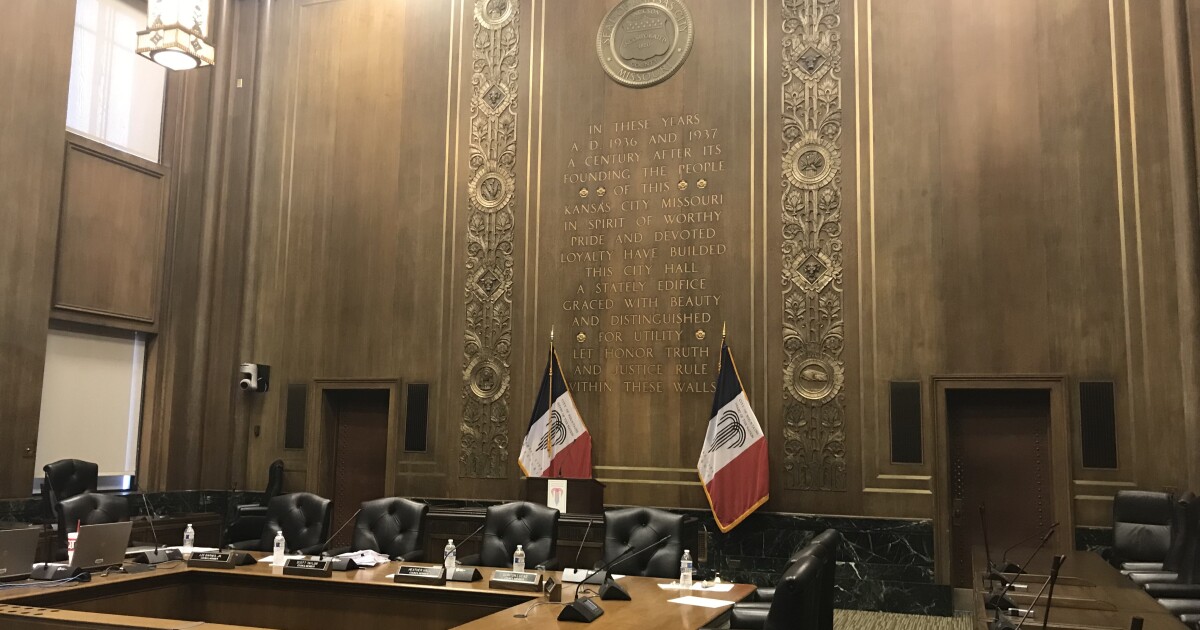
KANSAS CITY, Mo. — The Kansas City, Missouri, City Council voted Thursday to approve a $2.6 billion budget for the city’s fiscal year of 2026-27.
The budget includes $744 million in spending for public safety, including $26.3 million for a new Department of Community Safety and $4.2 million to hire 50 new KCMO Police Department officers, along with 10 call takers and 10 dispatchers.
“Our budget respects the strong fiscal foundation the taxpayers have helped Kansas City build, maintaining a rainy-day fund of over $200 million, increasing road resurfacing, hiring more public safety and city workers, and investing in all Kansas City neighborhoods,” Mayor Quinton Lucas said in a news release from the city. “In a city that can walk and chew gum, we are proud to welcome the world while delivering strong basic services for Kansas City’s families.”
The council voted to spend $83.8 million for the Kansas City Area Transportation Authority to provide bus services, but the KCATA may have to make cuts in bus services even with a $6 million boost in funding from the city.
In addition, the council approved spending $39.4 million for citywide street resurfacing and $1.5 million for tearing down dangerous buildings.
“This budget reflects a collaborative effort across the city, and provides a clear path for Kansas City to keep moving forward with discipline, accountability and a focus on service,” City Manager Mario Vasquez said in the news release. “Thank you to the council for its thoughtful deliberation and input in crafting this budget.”
More information on the fiscal year 2026-27 budget can be found on the city’s website.
—
The Missouri Lottery offers several draw games for those aiming to win big.
Here’s a look at March 25, 2026, results for each game:
Winning Powerball numbers from March 25 drawing
07-21-55-56-64, Powerball: 26, Power Play: 4
Check Powerball payouts and previous drawings here.
Winning Pick 3 numbers from March 25 drawing
Midday: 3-2-0
Midday Wild: 7
Evening: 0-0-5
Evening Wild: 5
Check Pick 3 payouts and previous drawings here.
Winning Pick 4 numbers from March 25 drawing
Midday: 2-6-3-9
Midday Wild: 4
Evening: 9-5-6-8
Evening Wild: 1
Check Pick 4 payouts and previous drawings here.
Winning Cash Pop numbers from March 25 drawing
Early Bird: 07
Morning: 09
Matinee: 04
Prime Time: 14
Night Owl: 07
Check Cash Pop payouts and previous drawings here.
Winning Show Me Cash numbers from March 25 drawing
12-14-22-26-28
Check Show Me Cash payouts and previous drawings here.
Winning Powerball Double Play numbers from March 25 drawing
35-38-41-43-62, Powerball: 08
Check Powerball Double Play payouts and previous drawings here.
Feeling lucky? Explore the latest lottery news & results
Are you a winner? Here’s how to claim your lottery prize
All Missouri Lottery retailers can redeem prizes up to $600. For prizes over $600, winners have the option to submit their claim by mail or in person at one of Missouri Lottery’s regional offices, by appointment only.
To claim by mail, complete a Missouri Lottery winner claim form, sign your winning ticket, and include a copy of your government-issued photo ID along with a completed IRS Form W-9. Ensure your name, address, telephone number and signature are on the back of your ticket. Claims should be mailed to:
Ticket Redemption
Missouri Lottery
P.O. Box 7777
Jefferson City, MO 65102-7777
For in-person claims, visit the Missouri Lottery Headquarters in Jefferson City or one of the regional offices in Kansas City, Springfield or St. Louis. Be sure to call ahead to verify hours and check if an appointment is required.
For additional instructions or to download the claim form, visit the Missouri Lottery prize claim page.
When are the Missouri Lottery drawings held?
- Powerball: 9:59 p.m. Monday, Wednesday and Saturday.
- Mega Millions: 10 p.m. Tuesday and Friday.
- Pick 3: 12:45 p.m. (Midday) and 8:59 p.m. (Evening) daily.
- Pick 4: 12:45 p.m. (Midday) and 8:59 p.m. (Evening) daily.
- Cash4Life: 8 p.m. daily.
- Cash Pop: 8 a.m. (Early Bird), 11 a.m. (Late Morning), 3 p.m. (Matinee), 7 p.m. (Prime Time) and 11 p.m. (Night Owl) daily.
- Show Me Cash: 8:59 p.m. daily.
- Lotto: 8:59 p.m. Wednesday and Saturday.
- Powerball Double Play: 9:59 p.m. Monday, Wednesday and Saturday.
This results page was generated automatically using information from TinBu and a template written and reviewed by a Missouri editor. You can send feedback using this form.

L.A. Affairs: Our night together reminded me of what I’d been missing this entire time

Trump jokes, rants, talks price of pens as Iran war enters fifth week

High school softball top 20 rankings for the Southland
Access Error

US diplomat Marco Rubio denounces settler violence, tolls in Hormuz strait

Florida High School Football Rankings: Top 25 teams – Oct. 21

How old is Bo Nix? What to know about Oregon quarterback ahead of 2024 NFL Draft

Cleary's 21 help Le Moyne down Central Connecticut State 69-64 in OT

99th annual Pony Swim held in Virginia

Indiana Members Credit Union announced as new anchor tenant at Bottleworks District
US diplomat Marco Rubio denounces settler violence, tolls in Hormuz strait

Iran-linked hackers have breached FBI Director Kash Patel’s personal emails | CNN Politics

Live: CPAC 2026 Day 2

Video: Will ICE Change Under Its New Leader?

DHS shutdown breakthrough comes at cost for Republicans as funding fights nears end
-

 Detroit, MI1 week ago
Drummer Brian Pastoria, longtime Detroit music advocate, dies at 68
-

 Movie Reviews1 week ago
‘Youth’ Twitter review: Ken Karunaas impresses audiences; Suraj Venjaramoodu adds charm; music wins praise | – The Times of India
-

 Sports6 days ago
IOC addresses execution of 19-year-old Iranian wrestler Saleh Mohammadi
-

 New Mexico5 days ago
Clovis shooting leaves one dead, four injured
-
 Business1 week ago
Disney’s new CEO says his focus is on storytelling and creativity
-

 Technology5 days ago
YouTube job scam text: How to spot it fast
-

 Tennessee4 days ago
Tennessee Police Investigating Alleged Assault Involving ‘Reacher’ Star Alan Ritchson
-

 Texas1 week ago
How to buy Houston vs. Texas A&M 2026 March Madness tickets