Minnesota
What defines a heat wave?


Minnesota is in the midst of a sizzling stretch of summer-like weather. Something unique for this time of year.
A packed Nokomis Beach, soaked in sunshine and steaming close to 90 degrees, would make you think it’s a mid-summer day. But it’s just mid-May.
Several beachgoers WCCO talked with described the day as hot but bearable thanks to a lake breeze.
Still, temperatures that feel like late July for a four-day stretch had them calling it a heat wave.
What defines a heat wave?
“I think it’s in the eye of the beholder,” said Ken Blumenfeld, a senior climatologist with the Minnesota Department of Natural Resources.
According to the National Weather Service (NWS), a heat wave is a “period of abnormally hot weather generally lasting more than two days. Heat waves can occur with or without high humidity.”
There was no specific temperature listed, but the NWS added that a heat wave often involves dangerously hot weather that could harm people.
Blumenfeld looks at heat waves from a statistical perspective. “In climatology it’s just extreme warmth relative to the time of year,” he said.
May 11 to May 14, the daily high temperature hit or was forecasted to land around 90 degrees. The average high for this time of year is around 67 to 68 degrees according to the National Oceanic and Atmospheric Administration (NOAA). That means the Twin Cities is running least 20 degrees warmer than usual.
“If it’s supposed to be like 60 right now but right now, we’re having all this heat, it’s gotta be a heat wave,” said Ambuskah Little Voice while at the beach with friends.
Blumenfeld also understands that public health workers have their own definition.
“[They] might consider a heat wave to be something that could cause human bodies to have problems keeping itself cool naturally,” said Blumenfeld.
That’s usually in peak summer when high humidity combines with high temperatures, creating dangerous conditions leading to heat stroke and exhaustion.
“Heat during late May and even late September and October tends to be really dry compared to the kind of heat you get in July and August,” said Blumenfeld.
If nights are comfortably cool, is it still a heat wave?
“That’s where it gets a little iffy,” Blumenfeld said.
A heat wave in mid-summer could have nights in the 70s while the air remains thick. In May, the daily low temperatures have settled in the 60s and even 50s, creating a difference of 25 to 30 degrees, even larger during this current heat wave. The air also pleasantly dry.
Could you have a heat wave in the winter?
Beachgoers said both yes and no. Heat isn’t a word typically associated with the coldest time of year, but there’s no denying that it still arrives in surprising fashion.
“We can have heat waves in winter if you’re looking at it statistically,” Blumenfeld said.
Consider late December 2023, the Twin Cities hit 55 degrees on Christmas Eve, then 54 degrees on Christmas day along with relatively high humidity. That’s extreme warmth for the holiday season, heating up the debate on how to label these steamy stretches.
“Defining a heat wave really kind of depends on who’s asking,” Blumenfeld said.
The most recent extreme heat for the month of May came in 2018. That’s when much of Minnesota hit 100 degrees on Memorial Day.



Minnesota
Where to watch Cleveland Guardians vs Minnesota Twins: TV channel, start time, streaming for July 9


What to know about MLB’s ABS robot umpire strike zone system
MLB launches ABS challenge system as players test robot umpire calls in a groundbreaking season.
The 2026 MLB season has surpassed the quarter mark, and after each team’s first 40 games, there’s plenty of reasons to tune in all summer long.
Chicago White Sox slugger Munetaka Murakami has already proven doubters wrong by launching 17 home runs, Pittsburgh’s Paul Skenes consistently looks like the best version of himself on the mound and Milwaukee ace Jacob Misiorowski is throwing harder than any starter in the majors.
The MLB action continues on Thursday as the Cleveland Guardians visit the Minnesota Twins.
Here’s everything you need to know to tune in for the first pitch.
See USA TODAY’s sortable MLB schedule to filter by team or division.
What time is Cleveland Guardians vs Minnesota Twins?
First pitch between the Minnesota Twins and Cleveland Guardians is scheduled for 1:40 p.m. (ET) on Thursday, July 9.
How to watch Cleveland Guardians vs Minnesota Twins on Thursday
All times Eastern and accurate as of Thursday, July 9, 2026, at 6:33 a.m.
- Matchup: CLE at MIN
- Date: Thursday, July 9
- Time: 1:40 p.m. (ET)
- Venue: Target Field
- Location: Minneapolis, Minnesota
- TV: Guardians.TV and Twins.TV
- Streaming: MLB.TV on Fubo
Watch MLB all season long with Fubo
MLB regional blackout restrictions apply
MLB scores, results
MLB scores for July 9 games are available on usatoday.com . Here’s how to access today’s results:
See scores, results for all of today’s games.

Minneapolis police are investigating a shooting that seriously injured a man on the city’s north side Wednesday afternoon.
The shooting happened just before 2 p.m. on the 1200 block of 36th Avenue North, according to the Minneapolis Police Department.
Upon arrival, officers found a man inside the living room of a residence suffering from a life-threatening gunshot wound. Police provided medical aid to the victim before he was transported by ambulance to an area hospital.
Officers are working to determine what led up the shooting, including if it was accidental, according to officials.
No arrest have been made so far.

The National Weather Service (NWS) has confirmed that the tornado that struck the Detroit Lakes area of northwestern Minnesota on July 6 was rated EF2, with estimated peak winds of 185 km/h (115 mph).
The tornado touched down at 19:47 local time (LT), approximately 3 km (2 miles) south-southwest of Westbury, according to the NWS.
It remained on the ground for about 10 minutes. The tornado had a path length of 10.93 km (6.79 miles) and reached a maximum width of more than 730 m (2 400 feet). It dissipated approximately 6 km (4 miles) northeast of Detroit Lakes at 19:57 LT.
The Becker County Sheriff’s Office (BCSO) said deputies and other emergency responders began monitoring the severe weather around 19:30 LT after receiving reports of a possible funnel cloud north of Lake Park.
At approximately 20:14 LT, the Sheriff’s Office received a report of a tornado near the Oakland Beach area, where it caused extensive damage to homes, buildings, and trees.
The NWS confirmed two injuries associated with the event, one of which was directly caused by the tornado.
“1 injury can be directly attributed to the tornado, as a homeowner was injured in their home when their roof was removed by the tornado. The second injury was after the tornado during the cleanup stage and could be due to shock or trauma, according to the county emergency manager,” the NWS reported.
“Responders went from home to home looking for residents and checking for the injured. Two individuals were transported to Essentia St. Mary’s Hospital with non-life-threatening injuries. One other patient went to the hospital by private vehicle,” the BCSO said.
-

Tornado damage in Detroit Lakes, Minnesota on July 6, 2026. Credit: Becker County Sheriff’s Office
-
Tornado damage in Detroit Lakes, Minnesota on July 6, 2026. Credit: Becker County Sheriff’s Office
-
Tornado damage in Detroit Lakes, Minnesota on July 6, 2026. Credit: Becker County Sheriff’s Office
-
Tornado damage in Detroit Lakes, Minnesota on July 6, 2026. Credit: Becker County Sheriff’s Office
-
Tornado damage in Detroit Lakes, Minnesota on July 6, 2026. Credit: Becker County Sheriff’s Office
-
Tornado damage in Detroit Lakes, Minnesota on July 6, 2026. Credit: Becker County Sheriff’s Office
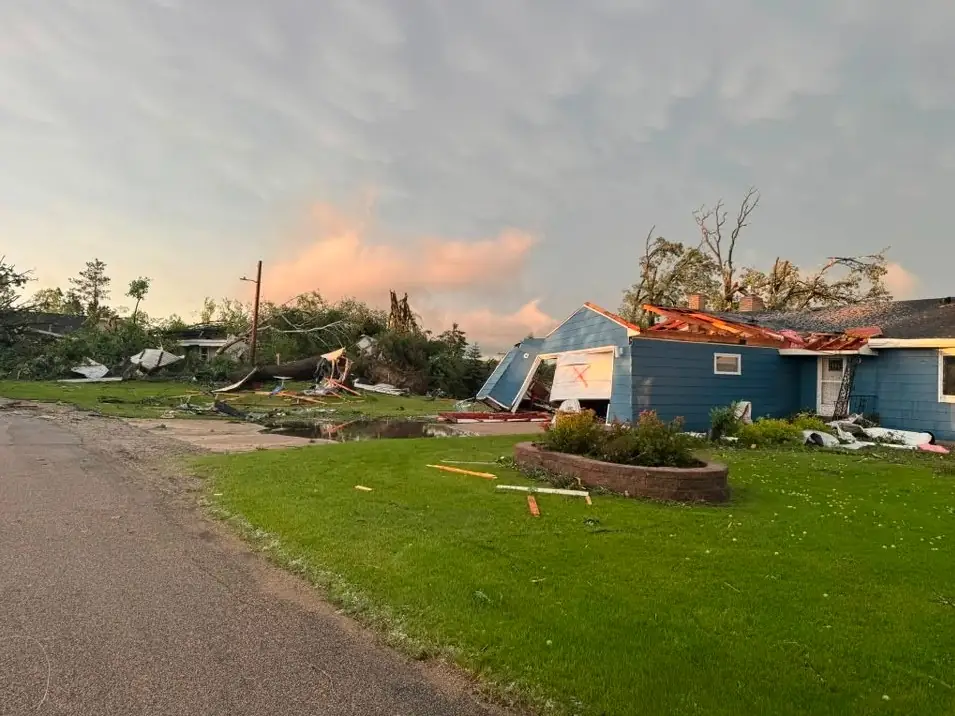
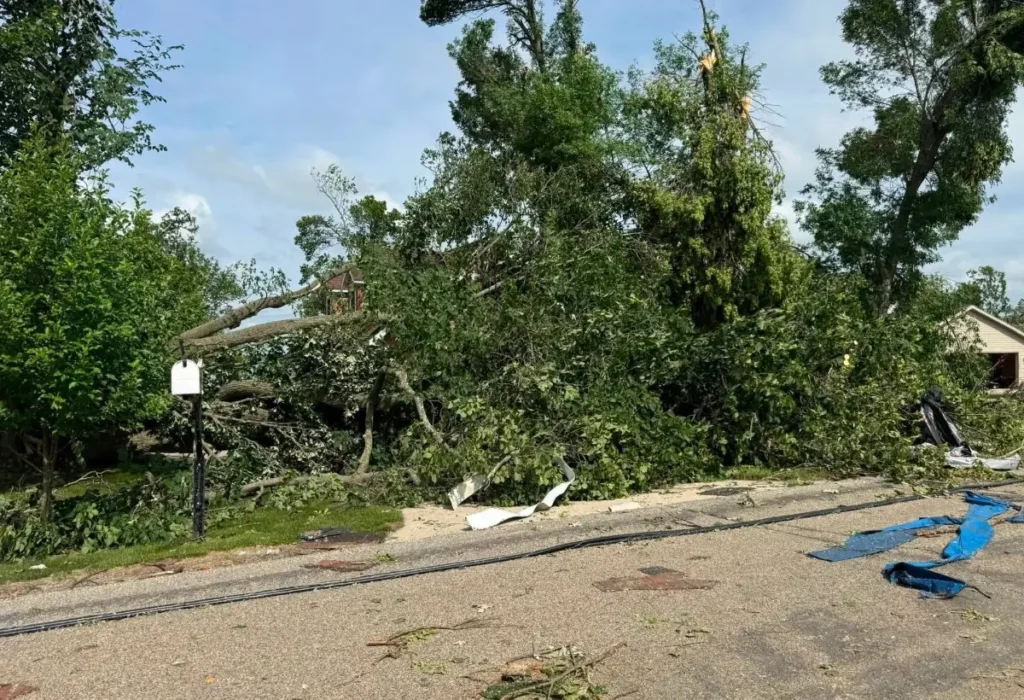
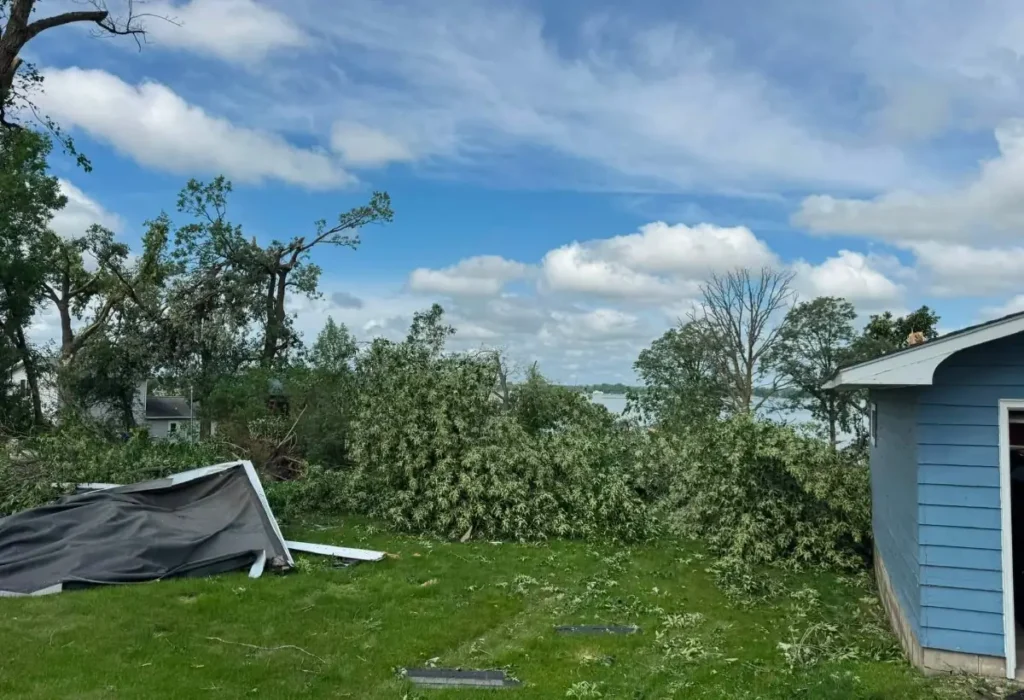
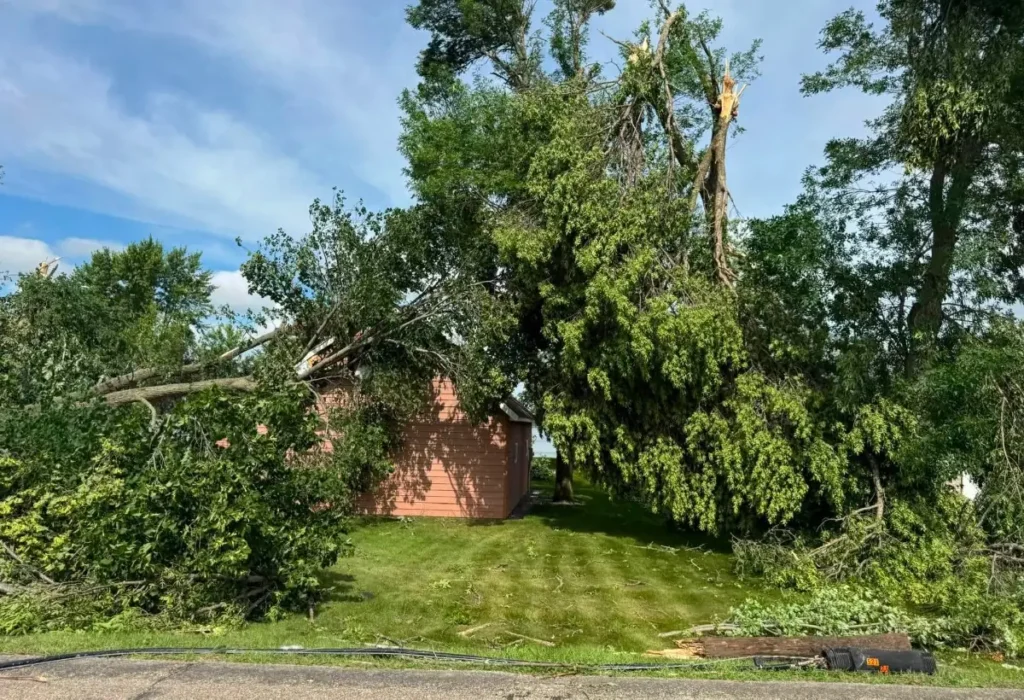
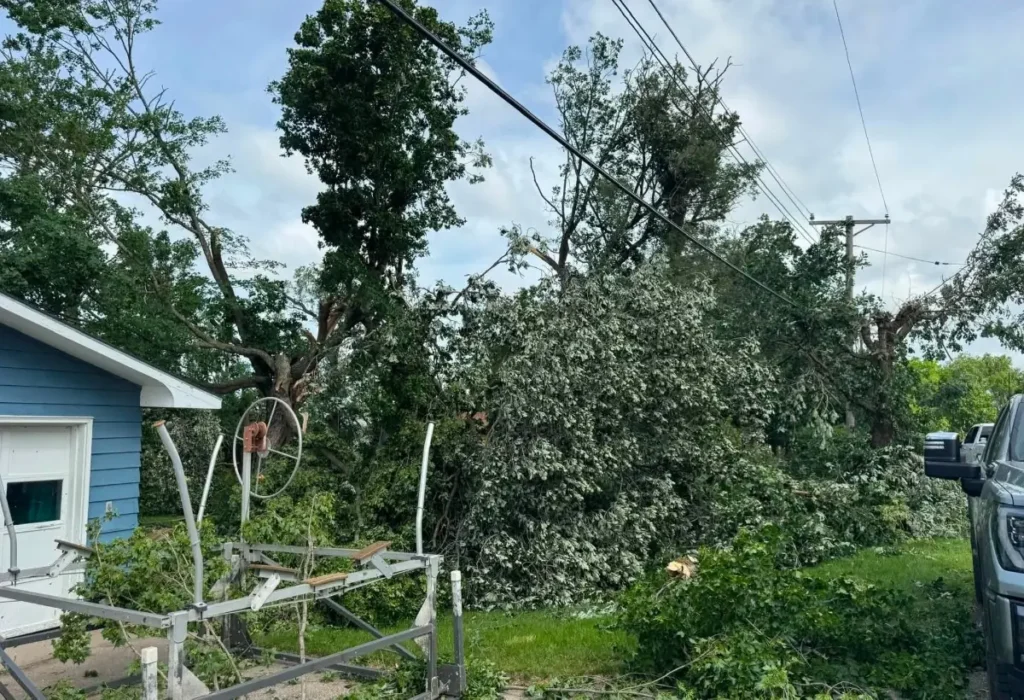
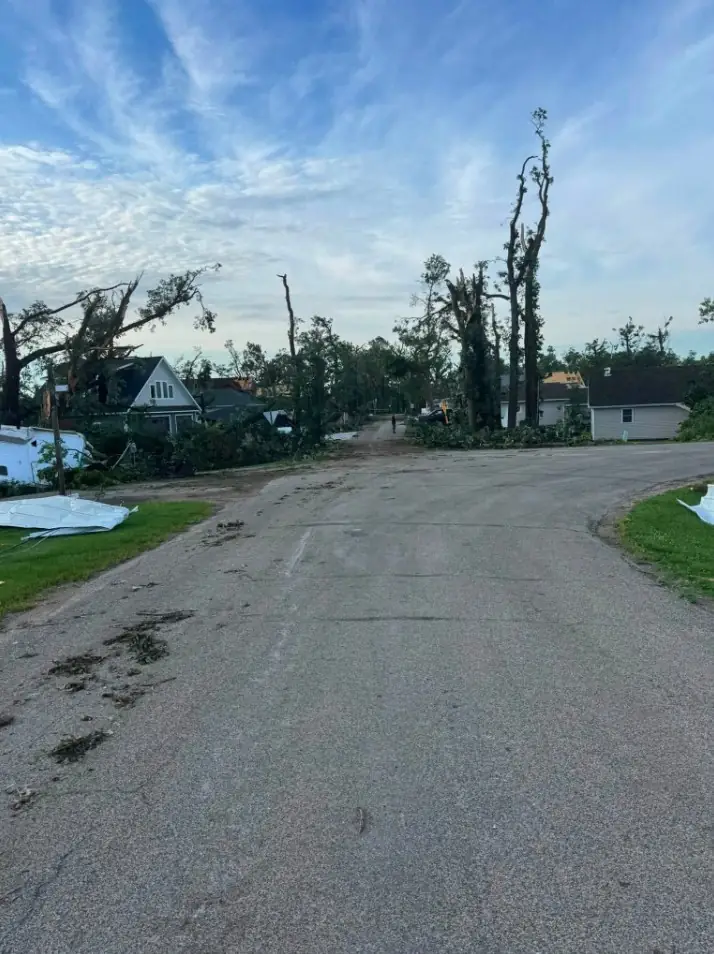
The tornado began about 2 km (1 mile) northwest of Wheeler Lake before crossing the lake, where it damaged the roofs of several homes and snapped the trunks of large oak and poplar trees.
It reached its maximum width near the western shore of Big Floyd Lake, with the Oakland Beach neighborhood sustaining the most severe damage.
Multiple garages and lighter outbuildings were swept away, while widespread roof and tree damage was reported. A 2 x 4 m (6 x 12-foot) horse trailer was lofted and carried about 200 m (656 feet) before the tornado crossed Big Floyd Lake and continued east. The last visible damage was identified near the intersection of County Highway 25 and Anchor Road.
More than 500 customers lost power as a result of the storms, according to Detroit Lakes Public Utility.
As the storm tracked east-southeast, strong winds, hail, and heavy rain affected areas north of Audubon before a tornado warning was issued for the Callaway and Rochert areas. Reports of downed trees, power lines, and debris soon followed from Detroit Township between U.S. Highway 59 and County Highway 21.
References:
1 Public Information Statement – NWS – July 7, 2026
-

 Los Angeles, Ca59 minutes ago
Heat advisory, beach hazards in effect as Southern California sizzles
-

 Detroit, MI1 hour ago
Teen on moped hit by car after cruising through stop sign in Detroit
-

 San Francisco, CA1 hour ago
Flight of fancy: San Francisco moves to build private luxury airport terminal
-

 Dallas, TX2 hours ago
Dallas’ digital creator economy is booming. Burnout is too.
-
Miami, FL2 hours ago
I went to 2 famous Miami restaurants, a flashy steakhouse and a Cuban hot spot. Here’s how they compared.
-

 Boston, MA2 hours ago
Pedestrian struck and killed in Roxbury – Boston News, Weather, Sports | WHDH 7News
-

 Denver, CO2 hours ago
Santa Fe Drive in Denver closed this weekend for pedestrian bridge construction
-

 Seattle, WA2 hours ago
Police video shows West Seattle Bridge copper wire theft suspect’s arrest


