Minnesota
Centreville man indicted on federal child exploitation charges in Minnesota – WTOP News


According to court documents, Raymond Jung Woo Choi began messaging the 13/14-year-old girl on social media apps between November of 2023 and February of 2024.
A man from Centreville, Virginia, is under arrest after police say he coerced a teenager in Minnesota to send sexually explicit photographs of herself to him and then tried to meet her in person.
Raymond Jung Woo Choi, 41, was arrested in Fairfax City on Monday after a grand jury indicted him on one count of production of child pornography, one count of receipt of child pornography and one count of coercion and enticement of a minor.
According to court documents, Choi began messaging the 13/14-year-old girl on social media apps between November of 2023 and February of 2024 using an alias of “Jason Lee.”
Prosecutors said Choi knew the victim was a minor and in middle school when he messaged her. They claim Choi would convince the girl to send him the photos and in return provide gifts, which he either sent via Amazon or mailed through the U.S. Postal Service to her home.
In January, while waiting for more photos of the victim, Choi is accused of sending her a message about meeting in person.
The message Choi is accused of sending to the victim reads: “Ugh I wish I could just visit u. And record our own. Problem solved.”
Choi, according to prosecutors, boarded a plane in February and flew to Minnesota with the intention of meeting the victim — but that meeting never happened because of “family and law enforcement intervention,” court documents stated.
Choi then flew back to Virginia, where he was arrested this month. He remains behind bars in the Commonwealth as he awaits transportation to Minnesota to face the charges there.
The U.S. Attorney’s Office in Minnesota said the case was part of what it called part of “Project Safe Childhood” — an initiative aimed at identifying and rescuing victims of exploitation and prosecuting those responsible.
Get breaking news and daily headlines delivered to your email inbox by signing up here.
© 2024 WTOP. All Rights Reserved. This website is not intended for users located within the European Economic Area.



Minnesota
Where to watch Cleveland Guardians vs Minnesota Twins: TV channel, start time, streaming for July 9


What to know about MLB’s ABS robot umpire strike zone system
MLB launches ABS challenge system as players test robot umpire calls in a groundbreaking season.
The 2026 MLB season has surpassed the quarter mark, and after each team’s first 40 games, there’s plenty of reasons to tune in all summer long.
Chicago White Sox slugger Munetaka Murakami has already proven doubters wrong by launching 17 home runs, Pittsburgh’s Paul Skenes consistently looks like the best version of himself on the mound and Milwaukee ace Jacob Misiorowski is throwing harder than any starter in the majors.
The MLB action continues on Thursday as the Cleveland Guardians visit the Minnesota Twins.
Here’s everything you need to know to tune in for the first pitch.
See USA TODAY’s sortable MLB schedule to filter by team or division.
What time is Cleveland Guardians vs Minnesota Twins?
First pitch between the Minnesota Twins and Cleveland Guardians is scheduled for 1:40 p.m. (ET) on Thursday, July 9.
How to watch Cleveland Guardians vs Minnesota Twins on Thursday
All times Eastern and accurate as of Thursday, July 9, 2026, at 6:33 a.m.
- Matchup: CLE at MIN
- Date: Thursday, July 9
- Time: 1:40 p.m. (ET)
- Venue: Target Field
- Location: Minneapolis, Minnesota
- TV: Guardians.TV and Twins.TV
- Streaming: MLB.TV on Fubo
Watch MLB all season long with Fubo
MLB regional blackout restrictions apply
MLB scores, results
MLB scores for July 9 games are available on usatoday.com . Here’s how to access today’s results:
See scores, results for all of today’s games.

Minneapolis police are investigating a shooting that seriously injured a man on the city’s north side Wednesday afternoon.
The shooting happened just before 2 p.m. on the 1200 block of 36th Avenue North, according to the Minneapolis Police Department.
Upon arrival, officers found a man inside the living room of a residence suffering from a life-threatening gunshot wound. Police provided medical aid to the victim before he was transported by ambulance to an area hospital.
Officers are working to determine what led up the shooting, including if it was accidental, according to officials.
No arrest have been made so far.

The National Weather Service (NWS) has confirmed that the tornado that struck the Detroit Lakes area of northwestern Minnesota on July 6 was rated EF2, with estimated peak winds of 185 km/h (115 mph).
The tornado touched down at 19:47 local time (LT), approximately 3 km (2 miles) south-southwest of Westbury, according to the NWS.
It remained on the ground for about 10 minutes. The tornado had a path length of 10.93 km (6.79 miles) and reached a maximum width of more than 730 m (2 400 feet). It dissipated approximately 6 km (4 miles) northeast of Detroit Lakes at 19:57 LT.
The Becker County Sheriff’s Office (BCSO) said deputies and other emergency responders began monitoring the severe weather around 19:30 LT after receiving reports of a possible funnel cloud north of Lake Park.
At approximately 20:14 LT, the Sheriff’s Office received a report of a tornado near the Oakland Beach area, where it caused extensive damage to homes, buildings, and trees.
The NWS confirmed two injuries associated with the event, one of which was directly caused by the tornado.
“1 injury can be directly attributed to the tornado, as a homeowner was injured in their home when their roof was removed by the tornado. The second injury was after the tornado during the cleanup stage and could be due to shock or trauma, according to the county emergency manager,” the NWS reported.
“Responders went from home to home looking for residents and checking for the injured. Two individuals were transported to Essentia St. Mary’s Hospital with non-life-threatening injuries. One other patient went to the hospital by private vehicle,” the BCSO said.
-

Tornado damage in Detroit Lakes, Minnesota on July 6, 2026. Credit: Becker County Sheriff’s Office
-
Tornado damage in Detroit Lakes, Minnesota on July 6, 2026. Credit: Becker County Sheriff’s Office
-
Tornado damage in Detroit Lakes, Minnesota on July 6, 2026. Credit: Becker County Sheriff’s Office
-
Tornado damage in Detroit Lakes, Minnesota on July 6, 2026. Credit: Becker County Sheriff’s Office
-
Tornado damage in Detroit Lakes, Minnesota on July 6, 2026. Credit: Becker County Sheriff’s Office
-
Tornado damage in Detroit Lakes, Minnesota on July 6, 2026. Credit: Becker County Sheriff’s Office
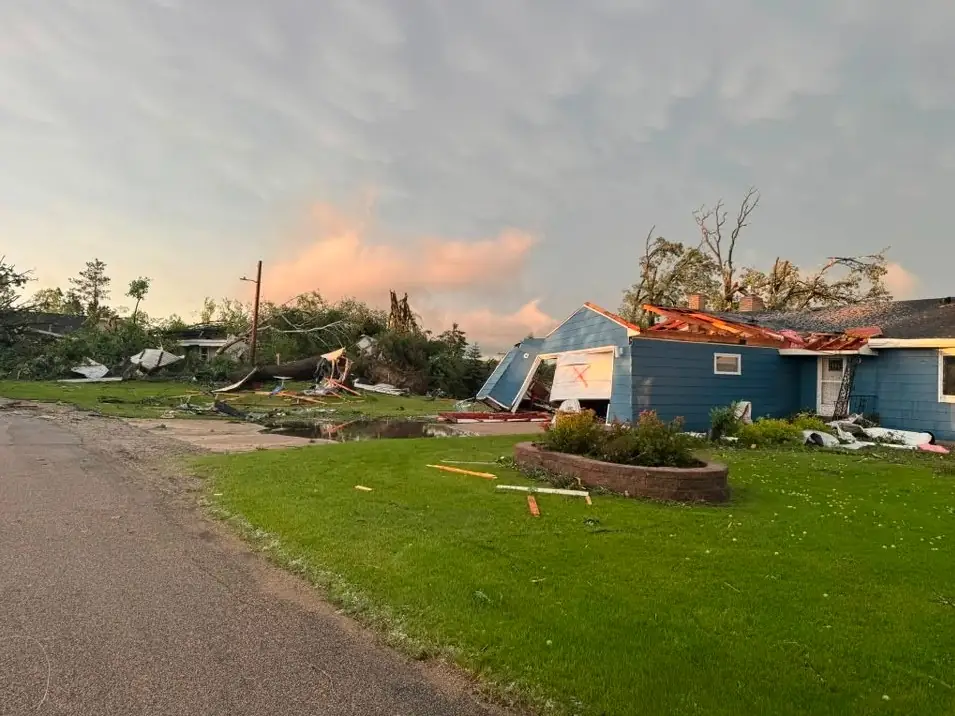
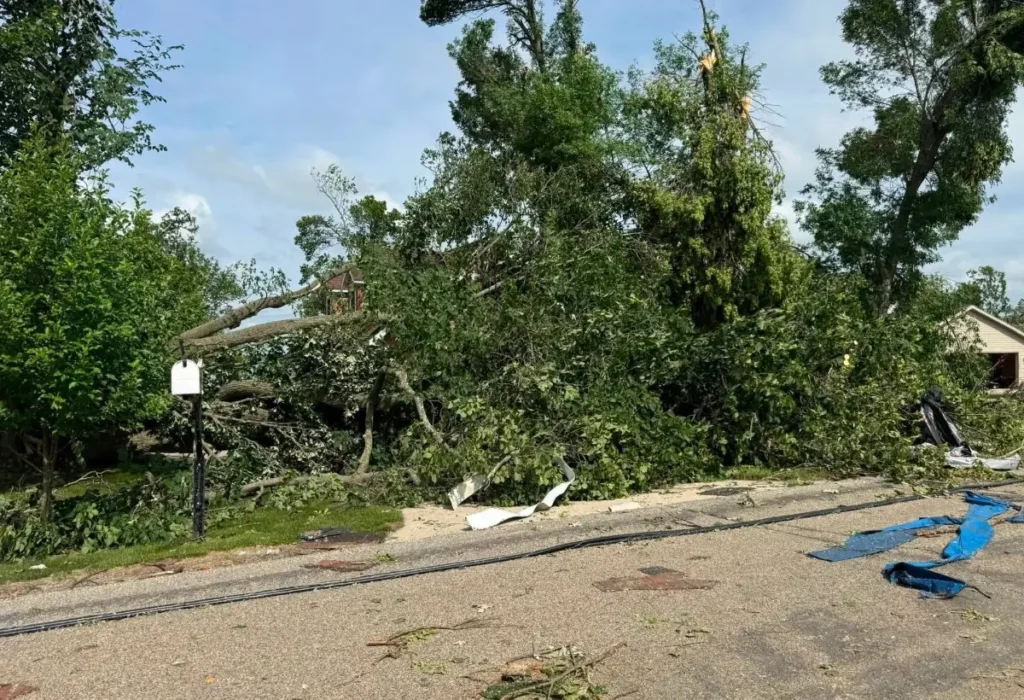
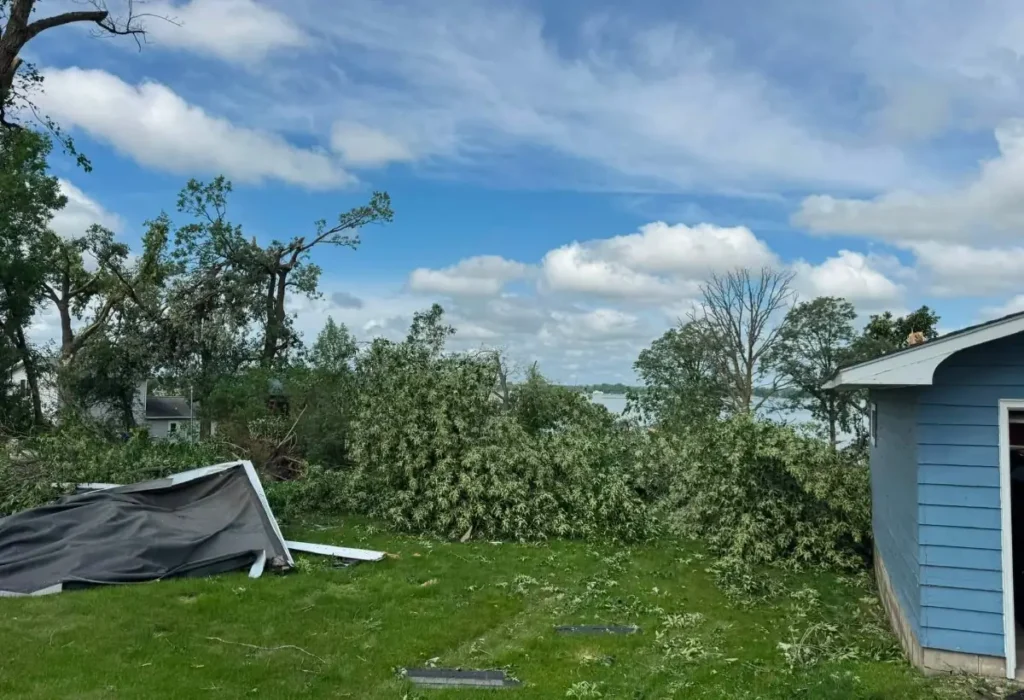
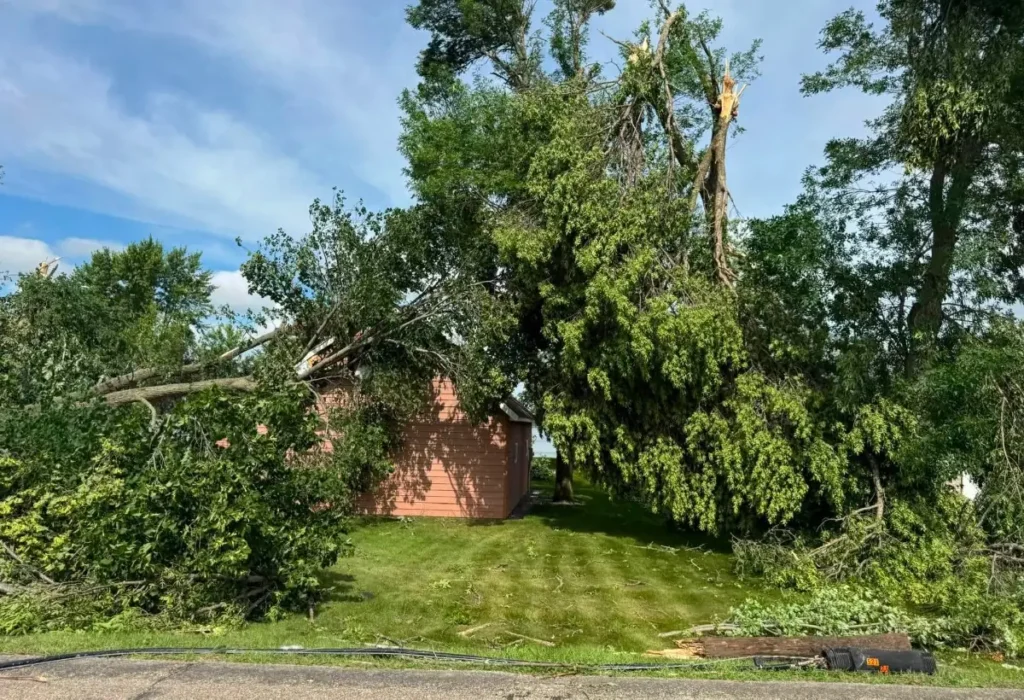
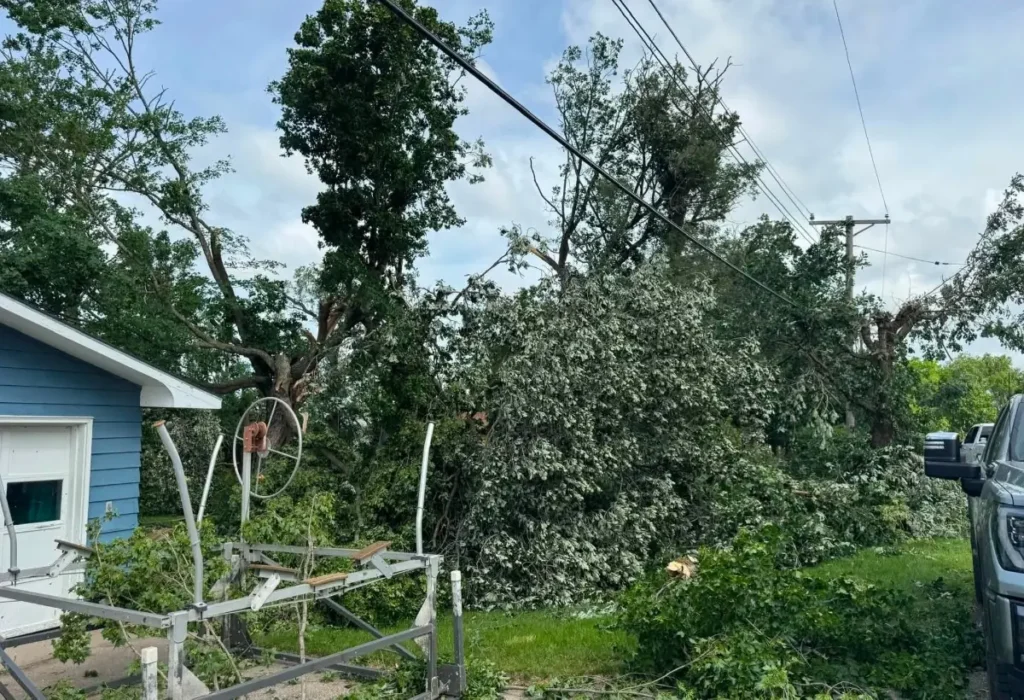
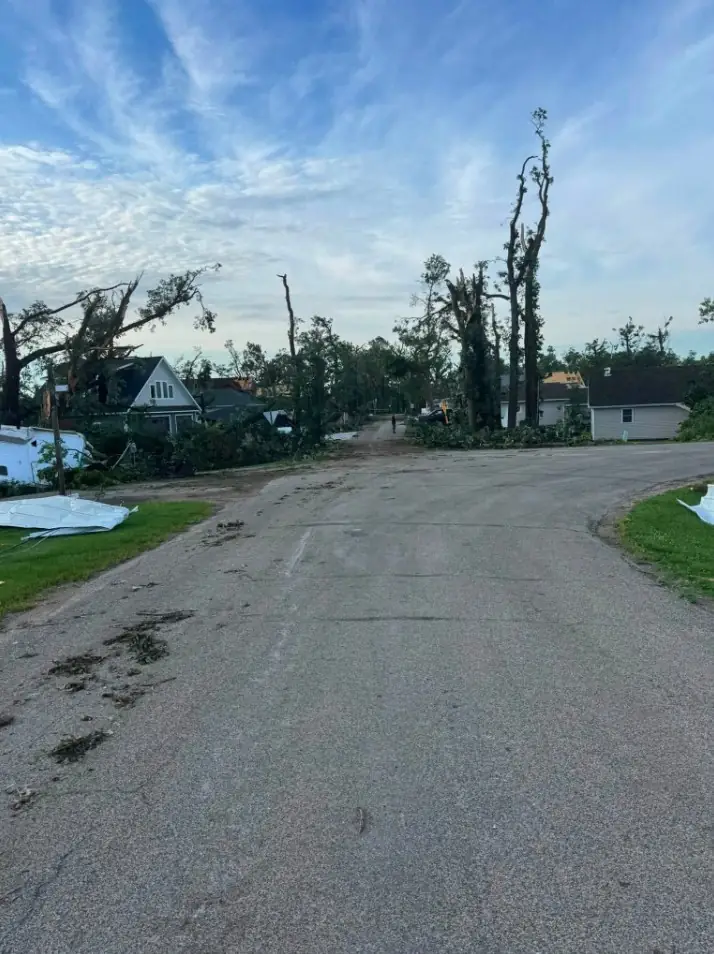
The tornado began about 2 km (1 mile) northwest of Wheeler Lake before crossing the lake, where it damaged the roofs of several homes and snapped the trunks of large oak and poplar trees.
It reached its maximum width near the western shore of Big Floyd Lake, with the Oakland Beach neighborhood sustaining the most severe damage.
Multiple garages and lighter outbuildings were swept away, while widespread roof and tree damage was reported. A 2 x 4 m (6 x 12-foot) horse trailer was lofted and carried about 200 m (656 feet) before the tornado crossed Big Floyd Lake and continued east. The last visible damage was identified near the intersection of County Highway 25 and Anchor Road.
More than 500 customers lost power as a result of the storms, according to Detroit Lakes Public Utility.
As the storm tracked east-southeast, strong winds, hail, and heavy rain affected areas north of Audubon before a tornado warning was issued for the Callaway and Rochert areas. Reports of downed trees, power lines, and debris soon followed from Detroit Township between U.S. Highway 59 and County Highway 21.
References:
1 Public Information Statement – NWS – July 7, 2026
-

 Hawaii3 minutes ago
Three West Hawaii sex offenders arrested – West Hawaii Today
-

 Idaho6 minutes ago
Idaho Power crews respond to outage affecting 2,163 customers in Canyon County
-
 Illinois18 minutes ago
As Illinois enters 10th year under Evidence-Based Funding model, equity remains an elusive goal
-

 Indiana21 minutes ago
FAIRFIELD NATIVE AND HIS WIFE FOUND DEAD IN THEIR NEWBURGH, INDIANA HOME
-

 Iowa26 minutes ago
From caviar nuggets to bison, 10 new Iowa State Fair food trends
-

 Kentucky36 minutes ago
Kentucky lawmakers hold town hall on AI data centers in Louisville
-

 Louisiana41 minutes ago
Norman C. Francis library naming honors Lafayette education legacy
-

 Maine48 minutes ago
Live updates: U.S. and Iran escalate attacks; jockeying starts in Maine after Graham Platner drops Senate bid

