Indiana
High school baseball matchups for semi-state weekend


INDIANAPOLIS (WISH) — The IHSAA baseball state tournament has reached the semi-state round, with the games taking place on Saturday.
Here are the matchups in the semi-state round in each class:
Class 4A
North (Griffith, at Gary Steel Yard)
Game 1 (10:30 a.m. CT): Zionsville vs. Lake Central
Game 2 (12:30 p.m. CT): No. 7 Penn vs. Fort Wayne Snider
The winners will play at 7 p.m. CT. Lake Central is the last team of the group to win the state title, doing so in 2024.
South (Castle; at Braun Stadium, University of Evansville)
Game 1 (10 a.m. CT): No. 3 Evansville North vs. No. 1 Center Grove
Game 2 (1 p.m. CT): No. 10 Bloomington South vs. North Central
The winners will play at 7 p.m. CT. Evansville North made it to state last season, losing to Valparaiso. Center Grove made it to state in 2023, losing to Penn.
Class 3A
North (LaPorte, at Schreiber Field)
Game 1 (10:30 a.m. CT): NorthWood vs. Norwell
Game 2 (12:30 p.m. CT): No. 1 Andrean vs. No. 5 DeKalb
The winners will play at 7 p.m. CT. Andrean won the 3A state title last season, and has won nine state championships.
South (Jasper, at Ruxer Field)
Game 1 (11 a.m. ET): Providence vs. No. 2 Guerin Catholic
Game 2 (2 p.m. ET): No. 4 Gibson Southern vs. No. 8 Cathedral
The winners will play at 8 p.m. ET. Providence is the last team of the group to make the state championship, winning the 2A state title in 2024.
Class 2A
North (Oak Hill)
Game 1 (11 a.m. ET): Lafayette Central Catholic vs. Bluffton
Game 2 (2 p.m. ET): No. 2 Eastbrook vs. Lakeland
The winners will play at 8 p.m. ET. Lafayette Central Catholic made the 1A state championship in 2024, losing to Barr-Reeve.
South (Lawrence Central)
Game 1 (11 a.m. ET): No. 9 University vs. No. 1 Evansville Mater Dei
Game 2 (2 p.m. ET): Heritage Christian vs. Sullivan
The winners will play at 8 p.m. Evansville Mater Dei made it to state last year, losing to Boone Grove.
Class 1A
North (Lafayette Jefferson, at Loeb Stadium)
Game 1 (11 a.m. ET): Fort Wayne Blackhawk Christian vs. North Miami
Game 2 (2 p.m. ET): No. 10 Rossville vs. No. 1 Kouts
The winners will play at 7:30 p.m. ET. Kouts made it to state last year, losing to Lutheran.
South (Mitchell)
Game 1 (11 a.m. ET): Hauser vs. North Daviess
Game 2 (1 p.m. ET): Greenwood Christian vs. No. 4 Northeast Dubois
The winners will play at 7 p.m. ET. Hauser is the last team of the group to make it to state, back in 2005, when it lost to Fort Wayne Blackhawk Christian.


One sport has long been considered synonymous with Indiana.
It brings families and communities together. It sparks bonds that shine in small towns where it is the centerpiece and everything else revolves around it.
In 49 states, call it basketball. But this is Indiana. So, what better way to kickstart the 250th anniversary of the United States of America than to understand the origins of a sport that holds great significance in the Hoosier State.
As the country industrialized from its agricultural roots, spectator sports grew in popularity. The opportunity was there to introduce basketball as a competitive sport. A sport not in need of many players to occupy the winter months? That was perfect for Indiana.
By 1911, the Indiana High School Athletic Association introduced basketball in a regulated form.
The rest, as they say, was history.
The origin story of Indiana high school basketball
Basketball is a sport that has long brought unity to communities across the state. And perhaps nothing depicts that relationship better than the 1986 movie Hoosiers.
Some of the biggest high school gyms, a few holding over 8,000 people, reside in Indiana. Ron Newlin, author of Legacy and Legend: The History and Mythology of Basketball in Indiana and former director of the Indiana Basketball Hall of Fame, said the reason the large gyms were built was to accommodate for the growing public interest surrounding the IHSAA state tournament.
“For years, kids were playing basketball against each other during the regular season and there was no state tournament,” Newlin said. “After a couple years of resistance, (the IHSAA) decided to embrace the idea of having a state tournament. Having a gym big enough to host was what really kicked it in.”
Initially, most of the state champions were all within close proximity of each other in small towns near Central Indiana. And schools that had bigger gyms were given the advantage of having byes in the postseason because they were tournament hosts.
The rest of Indiana found it difficult to compete with this. But over time, schools caught up.
In 1943, Bosse became the first Evansville team to win a state title, led by Indiana Basketball Hall of Fame coach Herm Keller.
And while the goal at the end of the season is to be the last team standing, perhaps even more invaluable is the forming of relationships that come with this great game. Ones that will last far beyond a kid’s four years of high school basketball.
No medal can beat it. This game is bigger than what happens on the court.
Bosse’s mark in history
Much of Indiana’s basketball history revolves around the action up north, but allow Evansville to enter the conversation — and Bosse to be the program to lead it.
Current Bulldogs coach Shane Burkhart is approaching his 19th season leading the group. He has experienced triumphs at sectionals, regionals and semi-state.
Inside Bosse Gym, you get a sense of what the program has been about, even on a quiet offseason day in May. It becomes clear the program has winning history when you assess the names who have put on a Bulldogs jersey.
Bryna Jerrel, Jalen Pendleton, JaQuan Lyle, Kiyron Powell, Mekhi Lairy. High-level talent, multiple Trester Award winners and a plethora of names beyond those five.
At nearly 300 career wins, Burkhart is the all-time winningest coach in Bosse history. It is quite the resume.
At least in the Evansville area, this is the bar that has been set.
“I’ve been blessed with a lot of really good players and coaches,” Burkhart said. “I had four assistant coaches (this year) who were former players. Wanting to come back just means that the culture that we’ve built together really means something to them as well. It’s not just words that we say during their four years.”
Bosse’s success extends beyond Burkhart’s tenure. The program won two state championships in the 1940s and its third in 1962. Pair that with a successful stretch in the 1980s, and the Bulldogs have a history of winning.
But being from Marion, winners of an IHSAA record eight state championships, there was a cultural difference for Burkhart to realize at Bosse. He wanted the program to be diverse in a meaningful way for the area.
“That’s not taking away from anything Bosse has done in the past, it’s about trying to update it to where we are now,” Burkhart said.
The Marion Giants
Marion’s basketball history is as rich as any other in the state. The small town north of Indianapolis thrived during the single-class era of Indiana high school basketball. Burkhart, who grew up during the Purple Reign era where Marion won three-straight state titles in the 1980s, calls it the mecca.
“I was at the game, sitting at the top of the rafters with 9,000 people in the stands,” Burkhart said. “You don’t hear anything about anyone else because it’s Marion, this is supposed to be the top.”
Burkhart’s earliest memories of Marion basketball came when he was 10 watching Nikkie Mallory and Jay Teagle star for the 1985 state championship winning team.
He remembers the emotions each game brought to the community, how loud the energy inside the arena was. Marion’s gym remains one of the biggest in the country with a capacity over 7,500.
Indiana is home to 10 of the 12 largest high school gyms in the country. Marion’s Bill Green Arena, named after the Giants’ legendary coach, is among those.
“It’d be 35 degrees outside, but you could not wear heavy clothes inside the gym because you did nothing but sweat,” Burkhart said. “It was so hot because there were so many people.”
Marion’s eight state championships are tied for the most all time. The Giants have had eras of dominance that go as far back as the 1920s.
Burkhart described the urge he had to want to run around with the other kids while he was at the gym, Instead, his dad kept him by his side watching Marion go to work. Maybe not as fun for a kid, but still an element of excitement given the product on the court.
“When (Marion) would get to semi-state, you would make your reservation a year in advance because you knew you were coming back,” Burkhart said. “It was a cockiness, but we were also that good.”
Burkhart was a three-sport athlete in high school (baseball, football and soccer). His involvement with competitive basketball began in coaching. His career eventually found its way to Evansville in 2008 – pushing the limits with Bosse ever since.
The cultural difference
In the city of Marion, basketball was everything. Marion was the only thing.
It is just like Hickory in Hoosiers. That is not the case in Evansville.
Burkhart knew he could not bring all of his Marion experiences along; this was a different opportunity requiring a different approach. But he certainly wanted to maximize the opportunity, establishing a foundation to be proud of for years to come.
Burkhart wanted more than good scorers, rebounders and playmakers. He wanted more than title wins at sectionals, regionals and semi-state.
Above all else, Burkhart wanted to make sure his kids left Bosse in position to be successful men. That was always the goal. Basketball came second.
“I wanted to make sure our kids were ready for college, ready to be successful,” Burkhart said. “A lot of high school athletes don’t realize how hard (adulthood) is.”
Growth of the game
Across the history of Indiana high school basketball, there has been conversation about balancing its tradition with its evolution. The sport has undoubtedly taken a step forward since 1910.
Following the 1996-97 season, the IHSAA transitioned from its single-class state tournament format to a multi-class system where multiple winners would be crowned at season’s end. It was a decision met with backlash.
Newlin said it has caused high school basketball to not hold the same significance it once did — an opinion shared by several people.
And In May, the IHSAA Board of Directors voted against a proposal for a 35-second shot clock. Among other factors, the board analyzed the number of possessions that exceeded 35 seconds and the possible limitations it would place on coaches.
In an interview with WISH-TV, IHSAA commissioner Paul Neidig shared what led to the decision, leaning on tradition in his response.
The balance of tradition and evolution will surely be a continued conversation, as it has for years. Burkhart has his dissatisfaction with the decision making.
He wants Indiana to live up to its allure.
“In some ways, it’s becoming better basketball in other places because we refuse to get caught up to where we need to be,” Burkhart said. “If it’s going to be ‘just basketball in 49 other states,’ then we better get caught up with the times.”
Still, Burkhart is more than happy with where he is at. While he continues his aim of winning his first state title with Bosse, Burkhart remains proud of his experience.
And amid the cultural differences, in terms of status, he sees Marion in the same vein as Bosse in Evansville.
“Selfishly, I don’t want anyone else to win state in the area,” Burkhart said. “We are the mecca of Evansville basketball. I’m sure there’ll be a lot of people that say that’s a crazy statement, but I believe it to be true.”
NOTE: This story is part of a special “America 250” project on the history of Indiana high school basketball by journalists within USA Today Co. at the South Bend Tribune, Journal & Courier (Lafayette), The Star Press (Muncie), The Herald-Times (Bloomington) and The Courier & Press (Evansville). All stories will run on those respective sites between July 6-17, with select stories in printed copies of the paper as well.
Markos Tsegaye is a sports reporter for the Courier & Press. He can be reached at mtsegaye@usatodayco.com. Follow him on X @10_Markos_

INDIANAPOLIS (WISH) — The Indiana Black Expo will present its Carolyn Brown Mosby Above and Beyond Award to Mathew Knowles on July 17 for his health advocacy work.
Knowles will receive the award during the Pacers Sports & Entertainment Corporate Luncheon. The Indiana Black Expo (IBE) website says the luncheon will be at 11 a.m. July 17 in the Sagamore Ballroom at the Indiana Convention Center in downtown Indianapolis. Knowles will be recognized for his work in health awareness and early detection.
Knowles will lead a fireside chat titled Beyond Pink: The Untold Story of Breast Cancer in Men at 10 a.m. July 18 on the Education Stage at the Summer Celebration.
An IBE news release issued Monday said Knowles has achieved global leadership in sales and marketing, brand development, entrepreneurship, and leadership. He has generated over $5 billion across multiple industries and managed over $100 million in sales and acquisitions. Knowles also developed, recorded, and distributed the careers of notable artists, including Beyoncé; Destiny’s Child; Earth, Wind & Fire; and Solange. The release also said he is a passionate advocate for health awareness and the importance of early detection.
Health Fair
In 2026, the nonprofit is celebrating 40 years of providing access-free health care through its Summer Celebration Health Fair, which will be July 16-19. IBE said it’s expanding its programming for the event on July 18, said a news release issued Monday.
IBE touts the fair as one of the Midwest’s premier community health events, bringing together more than 65 health-focused exhibitors, health care providers, and community organizations dedicated to improving health outcomes across Indiana.
Community Health Network, a platinum partner, will offer over $4,000 in free health screenings, resources, and education for each person at the Summer Celebration.
The Health Fair’s Education Stage will host discussions and activations on pressing health issues. These include digital health care access for older people through “Telehealth, Portals & Online Pharmacies: What Seniors Need to Know,” “Unfiltered: Real Conversations About Women’s Health,” and “Beyond Aesthetics: The Science of Beauty & Wellness.”
Cooking demonstrations focused on heart and kidney health will also happen.
The release also said A Mental Health Symposium, part of IBE’s educational series “Cherish Your Mind,” was scheduled for noon Saturday in rooms 130–132 of the Indiana Convention Center. The symposium will feature Sheryl Swoopes, a former WNBA player; Leon, an American actor, producer and singer who’s real name is Leon Preston Robinson; Dr. Russell J. Ledet, a physician, U.S. Navy veteran and triple-board resident; Amp Harris, a promoter and athlete consultant; and Executive Director Barbara Thompson of NAMI Indiana.
Dr. Lauren Dungy-Poythress and Dr. Ruemu Birhiray are co-chairs of the Health Fair.
This story was formatted for WISHTV.com using AI-assisted tools. Our editorial team reviews and edits all content published to ensure it meets our journalistic standards for accuracy and fairness.
Indiana
Indiana gov to Porter County: If you want to miss out on fun of giving $250m in tax money to Bears, your loss
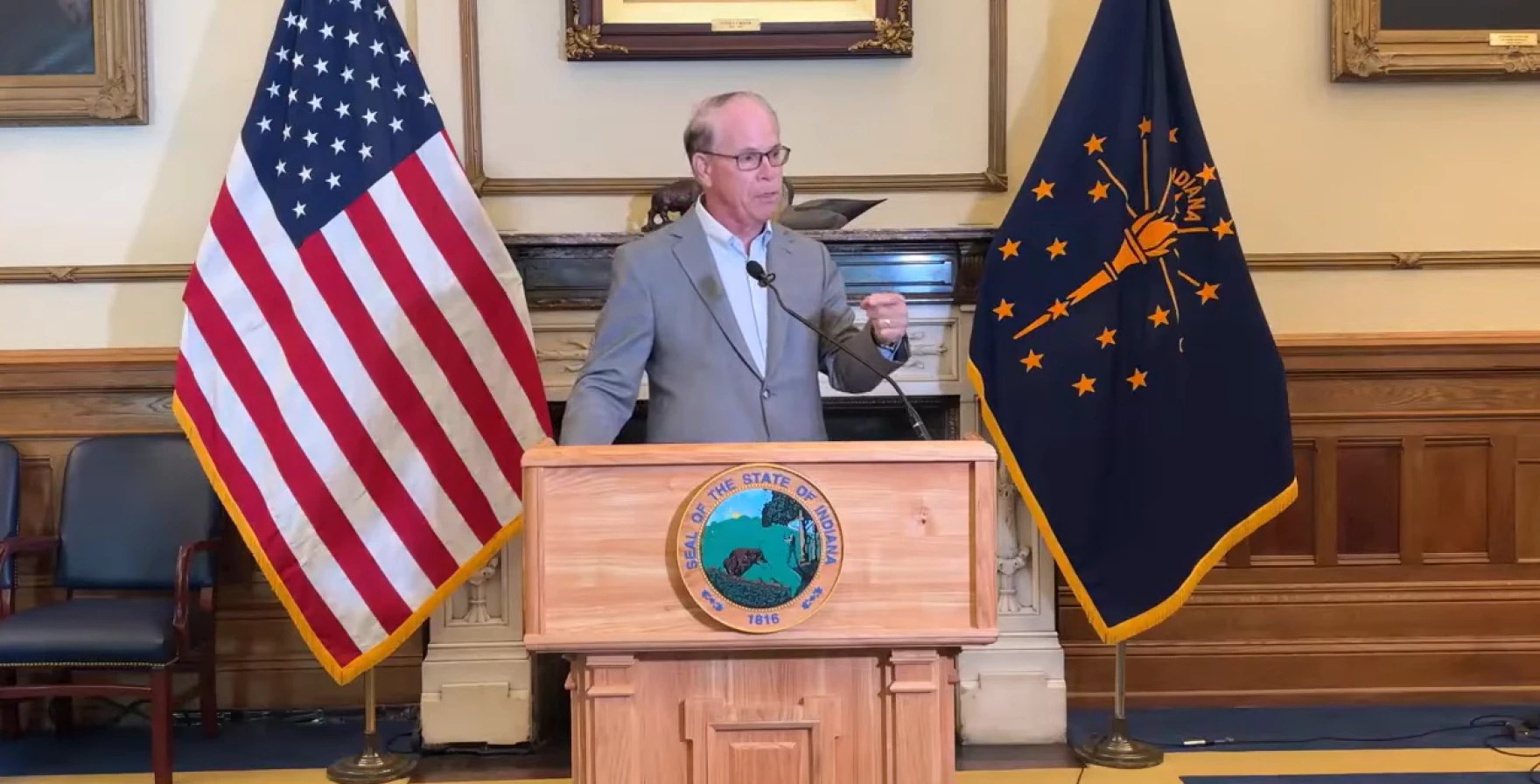
Indiana Gov. Mike Braun says he isn’t sweating Porter County leaders’ opposition to raising food and beverage taxes for a new Chicago Bears stadium the next county over, because really it’s Porter County that would be missing out on all the fun of taking part in shoveling money at the Bears owners:
Under the law, Porter County would have to approve a one-percent food and beverage tax to have representation on the stadium authority. The governor said if it doesn’t get approved, the biggest impact would be on Porter County itself.
“If they choose not to put any skin in the game, they’re not going to have any say-so for what happens from all the economic benefits we’re going to get from it,” Braun said.
Maybe you’re the one up a stump, Porter County! Does a county get a chance to fund a stadium deal every day?
The whole Porter County kerfuffle points up one of the weirder things about the Indiana Bears stadium deal: Though it was passed by the legislature back in February, it didn’t precisely spell out who would be spending what on a stadium, or even where exactly it would be. A newly created sports authority will be able to offer the Bears owners money from a whole bunch of taxes, only some of which actually exist yet:
- All new property tax, income tax, and sales tax for the next 35 years from an omni-TIF district encompassing the stadium and an undetermined number of square miles around it. This could certainly amount to billions of dollars, much of it potentially cannibalized from spending that has nothing to do with the Bears, but just as we saw in Kansas, it’s impossible to say exactly how much without knowing the size of the district.
- A doubling of the Lake County hotel tax from 5% to 10%, which would provide at least $90 million.
- Those 1% food and beverage tax surcharges in Lake and Porter counties, which would be worth about $250 million each, if approved.
- A 12% ticket tax, which would be worth about another $200 million, though as established ticket taxes are unlike other taxes in that they tend to come out of team owners’ revenues.
The best guess at the total public cost is “easily past $4 billion,” but that could go up or down depending on what gets approved in terms of that tax diversion district plus the new taxes. And a quarter-billion dollars from Porter County seems like a significant amount of money, though I suppose Braun is right in that if county leaders balk at that, the state could always compensate by running the omni-TIF district all the way to the Ohio border.
All this makes Indiana’s bid for the Bears a bit of a moving target in the state’s bidding war with Illinois, which is no doubt very much to Bears owner George McCaskey’s liking. (“You’re willing to give us $1.5 billion in property tax breaks and infrastructure money, you say? Well, what if I told you Indiana was offering a TIF district the size of the entire Local Group?”) Right now you have a three-way — or more, given the various Illinois factions — game of chicken going on, and nobody’s showing each other their cards, and … okay, maybe it’s too early in the day for me to be writing extended metaphors. If anyone says they know how much money Bears execs could get out of either Indiana or Illinois, they’re lying, that’s the upshot here.
-

 Lifestyle53 seconds ago
Jessica McCormack: How a Challenger Is Seizing the Jewellery Opportunity
-
 Politics4 minutes ago
Commentary: Trump’s World Cup meddling only made matters worse for rattled U.S. squad
-
 Sports16 minutes ago
Looking back at the greatest high school basketball doubleheader in 2017
-

 World24 minutes ago
NATO must become more European, von der Leyen and Rutte say
-

 News49 minutes ago
Top Senate Democrats push Trump-affiliated companies for answers about IRS settlement
-

 Los Angeles, Ca2 hours ago
Missing 13-year-old with autism last seen at Los Angeles beach
-

 Videos2 hours ago
Charlie Kirk’s alleged killer appears in court
-
Detroit, MI3 hours ago
GET TO KNOW: Wide receiver Kendrick Law


