Illinois
Illinois judge who reversed rape conviction removed from bench after panel finds he circumvented law

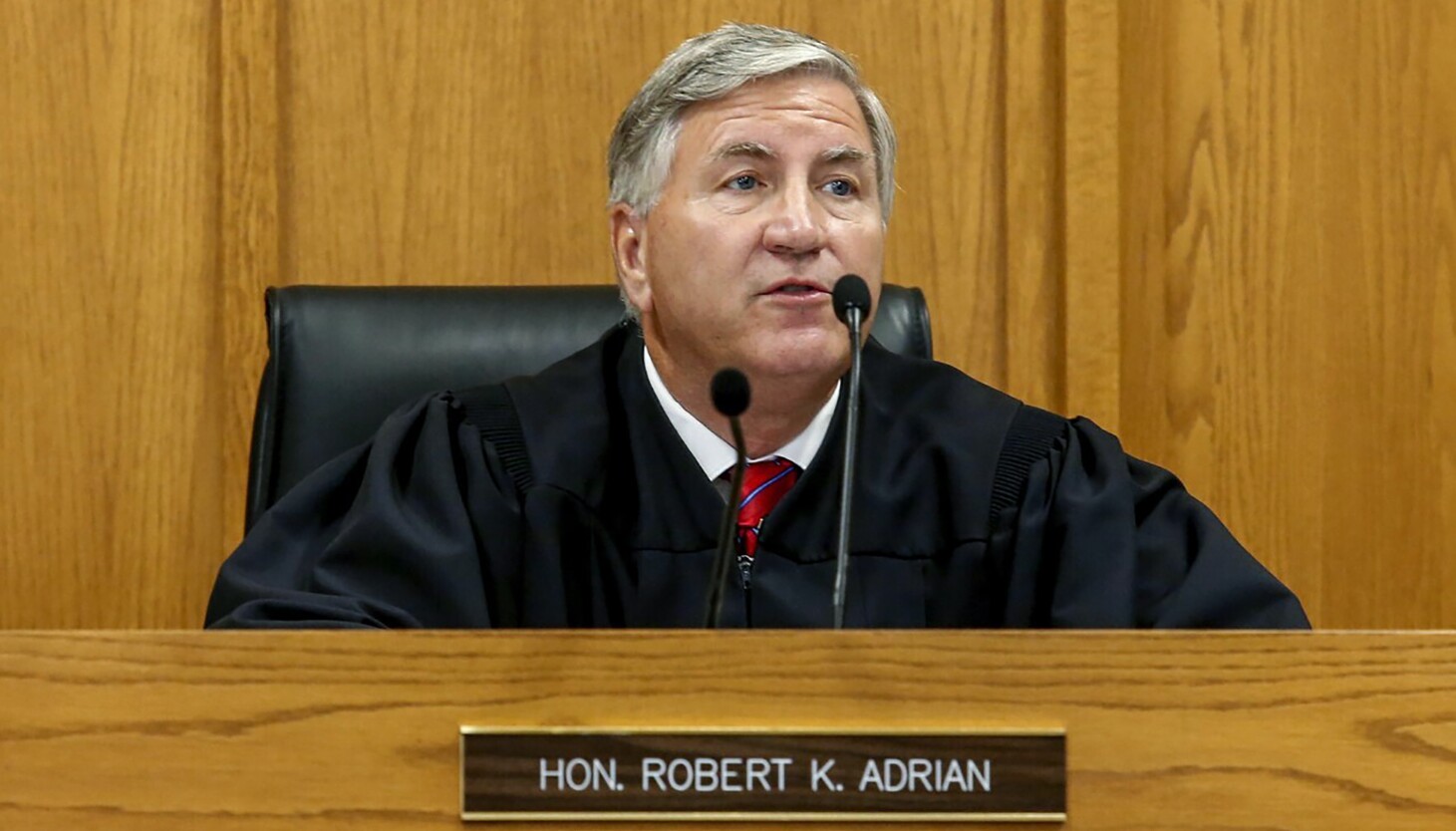
CHICAGO — An Illinois judge who sparked outrage by reversing a man’s rape conviction involving a 16-year-old girl has been removed from the bench after a judicial oversight body found he circumvented the law and engaged in misconduct.
The Illinois Courts Commission removed Adams County Judge Robert Adrian from the bench Friday after it held a three-day hearing in Chicago in November on a compliant filed against Adrian.
Its decision says Adrian “engaged in multiple instances of misconduct” and “abused his position of power to indulge his own sense of justice while circumventing the law.”
The commission could have issued a reprimand, censure or suspension without pay, but its decision said it had “ample grounds” for immediately removing Adrian from the bench in Adams County in western Illinois.
In October 2021, Adrian had found then 18-year-old Drew Clinton of Taylor, Michigan, guilty of sexual assaulting a 16-year-old girl during a May 2021 graduation party.
The state Judicial Inquiry Board filed a complaint against Adrian after the judge threw out Clinton’s conviction in January 2022, with the judge saying that the 148 days Clinton had spent in jail was punishment enough.
The complaint said Adrian had acknowledged he was supposed to impose the mandatory four-year sentence against Clinton, but that he would not send him to prison. “That is not just,” Adrian said at the sentencing hearing, according to court transcripts. “I will not do that.”
Clinton was accused of sexually assaulting Cameron Vaughan. The Associated Press does not typically name people who say they were sexually assaulted unless they come forward publicly.
Vaughan told The Associated Press in November, when she was 18, that Adrian’s reversal of Clinton’s verdict left her “completely shocked” but determined to oust the judge. She attended the November commission proceedings with family, friends and supporters.
After Adrian threw out Clinton’s conviction, Vaughan said that the judge told the court “this is what happens whenever parents allow teenagers to drink alcohol, to swim in pools with their undergarments on,” she recounted in an account supported by a court transcript of the January 2022 hearing.
Adrian’s move sparked outrage in Vaughan’s hometown of Quincy, Illinois, and beyond, with the prosecutor in the case saying that her “heart is bleeding for the victim.”
Vaughan told the Chicago Tribune following Friday’s decision removing Adrian that she was “very happy that the commission could see all the wrong and all the lies that he told the entire time. I’m so unbelievably happy right now. He can’t hurt anybody else. He can’t ruin anyone else’s life.”
When reached by phone Friday, Adrian told the Chicago Tribune that the commission’s decision to remove him is “totally a miscarriage of justice. I did what was right. I’ve always told the truth about it.”
Adams County court records show that Clinton’s guilty verdict was overturned because prosecutors had failed to meet the burden of proof to prove Clinton guilty.
But in Friday’s decision, the commission wrote that it found Adrian’s claim that “he reversed his guilty finding based on his reconsideration of the evidence and his conclusion that the State had failed to prove its case to be a subterfuge — respondent’s attempt to justify the reversal post hoc.”
Clinton cannot be tried again for the same crime under the Fifth Amendment. A motion to expunge Clinton’s record was denied in February 2023.

Illinois
Illinois Democrats face backlash after blaming Trump in Chicago cross-burning case | Fox News Video

‘Outnumbered’ reacts to Illinois Gov. JB Pritzker and Chicago Mayor Brandon Johnson blaming President Donald Trump for a cross-burning incident in Grant Park.
Illinois Democratic leaders Governor JB Pritzker and Chicago Mayor Brandon Johnson are slammed for weaponizing a Chicago cross burning incident by blaming former President Trump. Despite the suspect, Murlin Lue, admitting his motive was to protest Trump, not racism, Pritzker and Johnson doubled down. Critics, including Illinois GOP State Rep. Chris Miller, accuse them of playing politics and fostering division rather than seeking truth.

ROCKFORD, Ill. (WIFR) – November ballots will feature a repeat of top billing in the race for governor. Illinoisans can once again choose between Governor JB Pritzker or Darren Bailey to lead the Land of Lincoln.
But beside their spots, new names will appear for voters.
The Democratic and Republican candidates for governor picked new running mates for their rematch. With Lieutenant Governor Julianna Stratton running for U.S. Senate, Pritzker picked Christian Mitchell to join his ticket. On the Republican side, Aaron Del Mar joins Bailey, who previously ran with Stephanie Trussell in 2022.
Mitchell and Del Mar spoke Thursday with WIFR on what inspires them to run, their campaign priorities and ideas to improve the Rockford region.
Backgrounds
Starting with the Democratic ticket, Mitchell joins the race as a former state representative from Chicago as well as a deputy governor with the Pritzker administration.
“Before anything else, I’m Debbie’s son, and I’m James’s grandson,” Mitchell introduced. “They’re the ones who really instilled in me the value of hard work and made sure that I was going to have a very bright future.”
Mitchell sees the role of lieutenant governor as a partner to the state’s executive.
“I’m really lucky to be running with somebody who I respect, and who I think is the best governor in the nation… Governor JB Pritzker,” he said.. “My first thing is going to be supporting his agenda, which right now is all about lowering costs and raising wages.”
On the Republican side, Del Mar hails from suburban Chicago and considers his first priority to be raising his family.
“I wanted nothing to do with politics, did not want to be involved — wanted just to raise my kids and work my job,“ said Del Mar. He described his start in public service as something he ”kind of got pulled into.”
The Republican worked his way from a city council member in Palatine, at 29-years-old, to co-chair of the Illinois GOP. Although he says he “wanted nothing to do with being on” Bailey’s campaign, Del Mar sees strength in unity — offering a Chicago area perspective alongside Bailey’s southern Illinois roots.
“How about everybody in the state of Illinois, regardless of where you come from, has a seat at the table. If you’re from a southeast farming community, or you’re from the city of Chicago, where I grew up, everybody has a stake in the game.”
Priorities
Mitchell points to economic development as his focus for the gubernatorial campaign.
“I see vacancies on State Street in Chicago. I see vacancies on Main Street in Belleville and Alton and in Carbondale,” he recounted. “I want to make sure that we’ve got the kind of amenities and economic development, that kind of affordability, that allow us to make sure that folks want to stay in the towns that they’re born in if they want to.”
The Democratic candidate also eyes long-term planning for the state, including an “Illinois 2050 Plan.”
“How do we have the kind of educational undergirding that means that no matter where you’re from, you have a chance to have one of those jobs, whether it’s in new agriculture technology and new farming techniques or biotech, quantum.”
When asked how to achieve these priorities, Mitchell turned to investing in public education, retaining residents with better wages and improving health care.
“Making sure that we are able to protect our health care system, so that folks aren’t going broke when they get sick, that’s another big way that we can make an impact.”
Del Mar outlined a cost-of-living focus as central to his campaign.
“You wanna succeed, you do the basics really well, and the basics are affordability,” he contended.
The Republican repeatedly highlighted the state’s property taxes — reportedly the highest in the nation — as an issue to tackle. He suggested redirecting Illinois’s budget as one measure to ease the burden on homeowners.
“Number one is fully funding the state’s portion of local taxes, because that will offer people property tax relief.” Del Mar clarified this wouldn’t mean redirecting funds for public education.
“We’re looking at how we fund schools, how we make sure to empower teachers to have the best educational outcomes that we can have here in Illinois, regardless of what your zip code is, regardless of what your parents do for a living or how much money they make,” added Del Mar.
Reflecting on Rockford
Each candidate provided their vision for boosting the Rockford region.
For Mitchell, improvements continue with infrastructure funding, building on the state’s roughly $500 million investment in the area.
“The things that we have already worked on, through the capital plan that I helped lead as deputy governor, that the governor signed and is implementing, are already having benefits that the people of Rockford can see.”
The Democrat also pointed to the Chicago Rockford International Airport as an opportunity.
“Investing in that regional airport where we’ve already helped with a matching grant to get additional funds, that helps build out the economy,” said Mitchell. “There’s so much that’s happening there that it is really good for the economy and bringing more people back to Rockford.”
Del Mar shared his local priority as supporting unionization in the area.
“Union families deserve to be able to have a livable wage, and that’s something that’s important to Darren and I,” said Del Mar. He mentioned pensions were another item that a Republican executive wouldn’t touch for the public and private sector unions.
“I know that area up there has strong union backbone,” described Del Mar. “We want to make sure they know that they’re not going to have a bigger supporter in the governor’s mansion than Darren and I.”
Election Day
When asked for thoughts on their opponent, Mitchell criticized the Bailey campaign as a “repacking” of his 2022 run.
“The only record that they have to run on is extremism,” he exclaimed.
The Republican candidate also reflected on records, pointing to Pritzker’s years in office.
“Why are we underfunding education? Why are property taxes at all-time high? Why are businesses leaving?” asked Del Mar.
Voters can decide on who will lead Illinois November 3. Early voting starts September 24, with applications for voting by mail opening August 5.
Extended Interviews
Copyright 2026 WIFR. All rights reserved.

ROCHESTER, Minn. (FOX 9) – A man from Illinois is facing felony charges after police say he took part in a scheme that convinced a Rochester resident to hand over thousands of dollars in cash and nearly fell for a gold bar handoff.
Rochester phone scam
What we know:
According to a criminal complaint filed in Olmsted County District Court, police say the victim was contacted by phone and told he was under investigation for a crime. The caller convinced him to deliver $30,000 in cash to a man he met in person on June 17, 2026.
The victim was then pressured to arrange a second delivery — this time, 10 one-ounce gold bars — on June 23, 2026. Detectives worked with the victim to set up a controlled delivery using fake gold bars and a GPS tracker.
Charges state that the plan was for the victim to meet whoever arrived to pick up the package, while officers watched nearby. Surveillance officers saw a white SUV with Illinois plates circling the parking lot at 2711 Commerce Drive NW in Rochester.
The complaint states a man, later identified as Kiranbhai Kanubhai Vasava, got out, met the victim, gave the password and took the package. Officers followed the car as it left the scene. Detectives stop suspects and recover cash
Why you should care:
Police stopped the SUV near Eyota and searched it, finding $50,000 in cash, several cell phones, bank checks with Vasava’s name, and packaging materials similar to those used for the fake gold bars. The package with the GPS tracker and fake gold was missing, but officers later found the GPS device torn apart on the side of the highway.
The second man in the car, Hemendrasinh Pravinsinh Dabhi, told police he got a call from India about a package but claimed he knew nothing about it, saying, “he just drives.” Vasava also denied knowing what was happening.
Kiranbhai Vasava linked to Wisconsin case
The backstory:
The complaint states detectives linked Vasava to another similar case in Stevens Point, Wisconsin, where a bank customer was convinced to hand over $50,000 in cash to a driver in a white Honda SUV. Video from that incident showed Vasava receiving the package.
Police say this type of swindle involves convincing victims they are under investigation and must pay money or hand over valuables to clear their name. Detectives say the investigation involved coordination between local police and law enforcement in Wisconsin.
The Source: Criminal charges filed in Olmsted County Court.
-

 World9 minutes ago
Burkina Faso cuts diplomatic ties with former colonial ruler France
-
 News36 minutes ago
A day after Alito’s testy response to Sotomayor’s dissent, court says it was a ‘misunderstanding’
-

 Los Angeles, Ca2 hours ago
Watch Project Angel Food's 'Lead with Love' telethon on KTLA
-

 Detroit, MI2 hours ago
Metro Detroit weather forecast, June 26, 2026 — 4 p.m. Update
-

 San Francisco, CA2 hours ago
Newlyweds celebrate Pride-themed weddings inside SF City Hall as parade preparations underway
-

 Dallas, TX2 hours ago
All Dallas restaurants firing up specials for July 4th and America’s 250th
-

 Miami, FL3 hours ago
Helping Venezuela: State Department deploys Miami-Dade search-and-rescue team
-

 Boston, MA3 hours ago
Photos: Norway takes on France in high-powered World Cup matchup in Foxborough – The Boston Globe

