Illinois
Gov. JB Pritzker mulling bill passed by lawmakers to make Illinois a ‘right-to-die’ state


Gov. JB Pritzker on Monday wouldn’t commit to signing legislation narrowly approved by the Illinois General Assembly that would allow terminally ill people to end their own lives with a doctor’s prescription, but he said he’s “deeply” affected by the plight of residents seeking end-of-life options.
The Illinois Senate passed the polarizing bill with a bare-minimum 30-27 majority last week during the waning overnight hours of the Legislature’s fall veto session, leaving Pritzker’s signature as the final hurdle toward granting patients access to life-ending medicine if they have six months or less to live.
Like many other Springfield observers, the Democratic governor said he was surprised to see the bill taken up five months after it passed the Illinois House with just three votes to spare.
“It was something that I didn’t expect and didn’t know was going to be voted on, so we’re examining it even now,” Pritzker said after an unrelated press conference Monday in Glen Ellyn.
“I know how terrible it is that someone who’s in the last six months of their life could be experiencing terrible pain and anguish, and I know people who’ve gone through that. I know people whose family members have gone through that, and so it hits me deeply and makes me wonder about how we can alleviate the pain that they’re going through,” Pritzker said.
Lawmakers in 11 other states and Washington D.C. have passed so-called “right-to-die” legislation, which is opposed by religious leaders including Chicago Cardinal Blase Cupich.
Illinois’ bill, championed by Democratic Aurora state Sen. Linda Holmes, would open the door for people 18 or older with a terminal diagnosis to be prescribed a fatal dose of medicine.
They would have to be assessed by a physician and a mental health professional as being “of sound mind,” and make a series of oral and written requests for the drug, with witnesses attesting.
Doctors would be required to explain other end-of-life care options such as hospice. If prescribed a life-ending drug, patients would administer it themselves. Health care providers wouldn’t be required to participate.
“This is a choice,” Holmes said during Senate floor debate. “If you are opposed to it, whether the reason is moral, religious, you just don’t like the idea — fine. I would never tell you you should choose this option. What I’m saying is, why? Why, if I am facing an illness where I am going to die in pain, do you think you should tell me I don’t have the option to alleviate that pain?”
Holmes, whose parents died of terminal cancer, urged colleagues to “let people make the decision on how their lives are going to end.”
State Sen. Chris Balkema, R-Channahon, denounced the effort “to introduce a culture of death into Illinois.”
“Assisted suicide forces doctors into a role that contradicts their professional ethics. Illinois’ values overall are at stake,” Balkema said. “Whether the Lord chooses to take somebody today or 50 years from now, it shouldn’t be our choice to walk down that slippery slope, only to come back later, to have a future general assembly, open the guardrails and allow more of this.”
Archdiocese leaders of the Catholic Conference of Illinois urged Pritzker “not only to veto this bill in totality, but also to address humanely the reasons why some view assisted suicide as their only option.”
“It defies common sense for our state to enact a 9-8-8 suicide hotline, increase funding for suicide prevention programs and then pass a law that, based on the experience of other jurisdictions, results in more suicide,” Catholic Conference leaders said in a statement.
Bill proponents from the ACLU of Illinois and the nonprofit Compassion & Choices hailed the legislation to ensure “everyone in Illinois has the ability to access all options at the end of life.”
“Our hearts are with the families and individuals who have courageously shared their stories in the effort to advance this legislation. Their honesty and openness will make life better for Illinoisans once the law is implemented,” supporters said in a statement.
Pritzker has two months to consider the bill.


A number of Taco Bell locations have posted signs announcing they are “currently unable to sell Lettuce, Cilantro Onion, Pico de Gallo, and Guacamole due to a nationwide recall,” according to Detroit-area news radio outlet WWJ.
Taco Bell told the Post it would keep monitoring the situation and follow authorities’ guidance.
Taco Bell Lettuce Linked To Growing MI Parasite Outbreak: FDA
“Public health officials have not confirmed a link to Taco Bell or any specific ingredient, supplier, restaurant or retailer,” the company told the Post. “While authorities continue their broader review, Taco Bell has voluntarily and temporarily removed limited ingredients at select restaurants as a precautionary measure.”
In Michigan, where cases have been concentrated, media reports said notices were posted at some Detroit-area Taco Bell restaurants last week telling customers the chain was “currently unable to sell Lettuce, Cilantro-Onion, Pico de Gallo, and Guacamole due to a nationwide recall.”

The Illinois Republican Party filed its quarterly campaign finance report on the July 15 deadline. The party reported having just $223K in the bank. The next day, the party sent a letter to the Illinois State Board of Elections saying they were “reconciling” their records after a leadership change, and then noted that their actual end balance was $101K higher than it had reported the day before.
But that bit of found money was basically the end of the “good news” for the GOP last week.
Republicans no longer have a pet billionaire. Bruce Rauner and Ken Griffin have fled the state. The legions of wealthy business titans who once contributed and raised money have either retired to sunnier climes or passed away. Several prominent party members have publicly shunned labor unions and their hefty political war chests, although the state GOP legislative leaders have at least tried to rebuild ties to trade unions and even the Illinois Education Association. But the heavily gerrymandered legislative map combined with the current political climate means they’ll mostly receive scraps.
And, yes, the House Democrats are struggling this month with scandals, including a state representative who resigned under pressure and another who was indicted. I’m not trying to downplay that at all. But Democrats have the national political environment, the local infrastructure and tons of cash behind them. The Republicans have little to none of that.
The GOP’s gubernatorial candidate, Darren Bailey, raised $1.3 million in the second quarter, which ended June 30. That sounds like a lot, but he spent almost all of that on direct mail fundraising costs. The huge expenditures do give him a prospect list for future fundraising, but he ended the quarter with a mere $128K in the bank. That was still a whole lot more than the rest of the statewide ticket.
Attorney General nominee Bob Fioretti, a perennial candidate, raised $31K, spent $39K and had $28K on hand at the end of the quarter along with almost $15K in recent debt. Secretary of State candidate Diane Harris raised $6K, spent a bit over $4K and had a paltry $1,816.42 in the bank. Treasurer candidate Max Solomon, who ran as a write-in during the primary because the party failed to recruit anyone, raised less than $3K, reported no spending and ended the quarter with less than $8K. Comptroller candidate Bryan Drew raised $30K and received $47K in in-kind contributions from a company owned, ironically, by independent gubernatorial candidate Collin Corbett, spent less than $3K, ended with $54K and had $25K in debt from earlier this year.
Man, that’s just downright pathetic.
But I suppose it doesn’t really matter anyway unless we see a massive sea-change in national opinion in the coming months or the federal government finds a way to not certify certain election results. Regardless of where individual candidates are at this moment, they’ll have the money to compete. Unlike the Republicans, the Dems do have a pet billionaire (JB Pritzker) and, I assume eventually for most of them, organized labor.
The Republican legislative leaders have tried to scrape and claw as much as they can, but they’re vastly outgunned. Senate Republican Leader John Curran raised just $75K in the second quarter. He spent $71K and reported having a bit more than $3 million in the bank. His caucus committee reported having $160K in the bank.
Leader Curran has three Republican-held districts to defend in the Chicago media market that have all trended Democratic in the last three cycles. Depending how bad things get, he could be defending a couple, two or three more.
The Senate Democrats have a ton of money to do whatever they want. Senate President Don Harmon has about $20 million in his personal campaign account and $1.7 million in his caucus account.
Over in the House, Republican Leader Tony McCombie has at least four Democratic-trending or swingy districts to defend and just $1.3 million in her personal campaign account and another $363K in her caucus account so far.
In contrast, House Speaker Chris Welch had $11.4 million in his personal account and $1.2 million in his caucus account. Like Senate President Harmon, he has more than enough money already, but more is never enough when there’s so much out there, so those numbers will likely rise by November.
Rich Miller also publishes Capitol Fax, a daily political newsletter, and CapitolFax.com.

BLOOMINGTON — Springfield’s Alex Eickhoff nearly had a magical Thursday as he tied for second place in the 95th annual Illinois State Amateur Championship at Crestwicke Country Club.
Eickhoff, a 2020 Hillsboro High School graduate and former standout on the Southern Illinois University Edwardsville’s men’s golf team, shot a 4-under-par 68 in Thursday’s third round and followed that with an even-par 71 to finish the three-day, four-round event 1-over 285. He tied for second with Bloomington’s Logan Stauffer.
Eickhoff briefly took the lead through nine holes of his fourth round when he sat at 1-under par. Chicago’s Charlie Kulwin finished both of Thursday’s rounds under par and finished 2-under 282. He was the lone golfer to finish under par for the tournament.
Eickhoff was The State Journal-Register’s Small School Boys Golfer of the year twice in his high school career: once as a freshman in 2016-17 and again as a senior in 2019-20. After high school, he golfed for the University of Minnesota for two years before transferring to SIUE.
He began the tournament with a 3-over 74 on Tuesday and shaved off a stroke Wednesday with a 2-over 73. He closed out the event with an even-par 71 in Thursday’s final round.
Other area golfers who made the cut were Springfield’s Charles Hoogland (7-over 291, tied for 20th) and Jacksonville’s Brady Kaufmann (8-over 292, 25th).
The last golfer from The State Journal-Register’s coverage area to win the Illinois State Amateur was Jay Davis. Davis, a Jacksonville Routt graduate, won the 1991 and ‘92 tournaments.
Contact Ryan Mahan: 788-1546, ryan.mahan@sj-r.com, Twitter.com/RyanMahanSJR.
-
 Lifestyle2 minutes ago
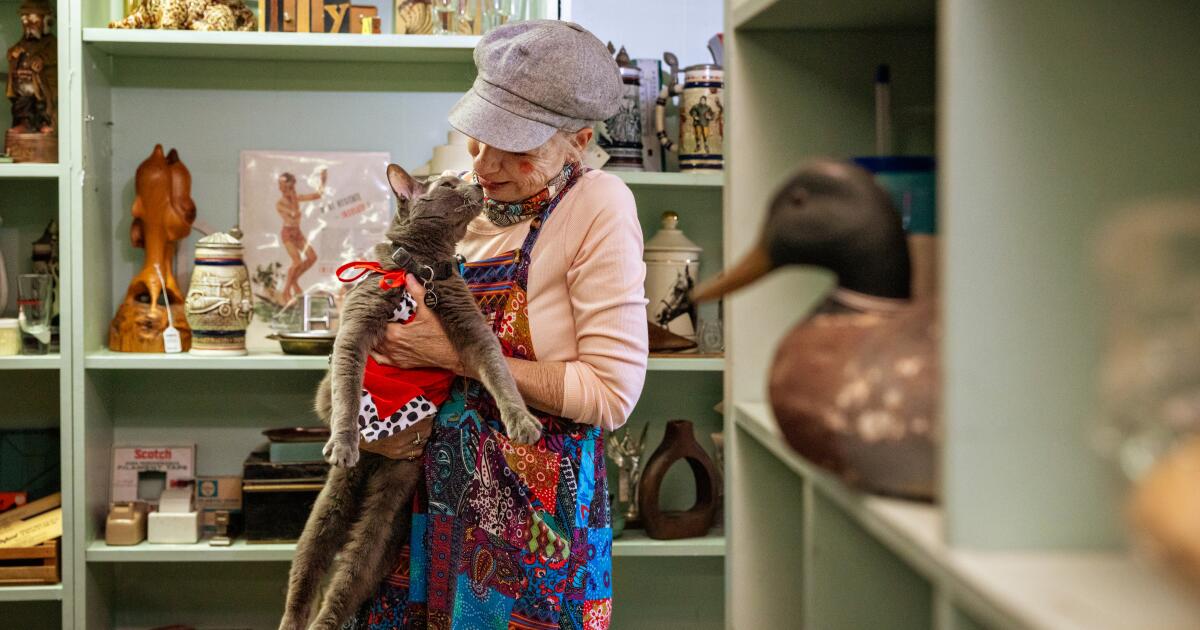
One-eyed rescue cat with Long Beach cult following celebrates 15th birthday in style
-
 Politics8 minutes ago
Commentary: Trump’s voter fraud speech was bait. Stop biting
-
 Science14 minutes ago
Commentary: The doctor who helped save her is in another state, and telemedicine follow-up is prohibited
-
 Sports20 minutes ago
Commentary: LAFC star Son Heung-Min proves life after the World Cup can offer hope and redemption
-

 World32 minutes ago
Death toll from the two earthquakes that hit Venezuela hits 5,069
-

 News1 hour ago
Where Wildfire Smoke Remains—And What To Do About It
-

 Los Angeles, Ca3 hours ago
Cybertruck driver arrested for DUI after Los Angeles pursuit crash
-

 Detroit, MI3 hours ago
DER Weekends: Pathways for first-gen students at the University of Detroit Mercy – WDET 101.9 FM

