Illinois
Capitol Briefs: Federal agency opposes new state law; Pritzker to lead trade mission to Japan | Capitol News Illinois


The Biden administration is asking a federal judge to halt Illinois’ first-in-the-nation law curtailing credit card “interchange fees” before it goes into effect next summer.
When fully implemented in July 2025, the law will curtail banks’ ability to charge those fees on the tax and tip portion of debit and credit card transactions.
After a coalition of financial institutions sued over the law in federal court this summer, federal officials this week sided with the banks. The Office of the Comptroller of the Currency – an independent bureau within the U.S. Department of Treasury – wrote in a legal brief that Illinois’ law is both “bad policy” and in conflict with federal law.
The filing, published Wednesday, frames interchange fees as a “core feature of an intricately designed nationwide payments system.”
“The Illinois Interchange Fee Prohibition Act is an ill-conceived, highly unusual, and largely unworkable state law that threatens to fragment and disrupt this efficient and effective system,” the brief said. “Although the IFPA’s requirements are vague and ambiguous in many respects, this much is clear: the IFPA prevents or significantly interferes with federally-authorized banking powers that are fundamental to safe and sound banking and disrupts core functionalities that drive the Nation’s economy.”
The law, which Gov. JB Pritzker and Democrats in the General Assembly approved as part of the state’s budget process earlier this year, was a concession to the Illinois Retail Merchants Association. Retailers had been opposed to the governor’s proposed cap on a tax deduction historically granted to them for collecting the state sales tax.
IRMA leaders defended the law last week, while Pritzker on Thursday said the Biden administration’s filing was “not something that I’m deeply concerned about.”
“When things get brought to court, you never know how they’ll turn out,” he said at an unrelated event. “I think this one is one that can be defended well and we’ll end up with the law we have on the books being affirmed.”
Pritzker’s Japan trade mission
Pritzker is also set to join state legislative and business leaders on a trade mission to Japan next week to explore clean energy, manufacturing, life sciences, quantum, and other “key growth industries,” according to the governor’s office.
Members of the delegation will meet with their counterparts in Tokyo to discuss strengthening economic ties between the state and the island nation.
The delegation represents what the governor’s office calls “Team Illinois” – a group of government and business officials that work to secure business and economic development partnerships. While it started informally, it’s now a key element of the Pritzker administration’s five-year plan for attracting businesses to the state.
In total, about four dozen lawmakers, economic development officials, academics and businesspeople will join the governor on the trip. Among them are House Speaker Emanuel “Chris” Welch, D-Hillside, and Senate President Don Harmon, D-Oak Park.
Christy George, the CEO of Intersect Illinois, is also joining the delegation. Intersect Illinois is the private economic development organization started by then-Gov. Bruce Rauner that has since become a go-between for businesses looking to relocate to Illinois and state government. It works on marketing and site selection in partnership with the state’s Department of Commerce and Economic Opportunity.
George stepped into the role in mid-September after working as the executive director of the Democratic National Convention’s 2024 Host Committee. Prior to that, George worked in Pritzker’s administration as an assistant deputy governor and as the executive director of the Illinois Commerce Commission.
Others heading to Japan include representatives of PsiQuantum and TCCI, both of which have received multimillion-dollar tax incentives from DCEO since last summer. The heads of the state’s major utilities, representatives from the University of Illinois and University of Chicago, and heads of several business-related lobbying organizations are also set to join the delegation.
The Pritzker administration has led similar trade missions to the United Kingdom and Canada in recent years. The governor’s first trade mission, in 2019, was also in Japan.
Since then, Illinois exports to Japan have increased 31.7% while imports from Japan have fallen 22.4%, according to the governor’s office.
Capitol News Illinois is a nonprofit, nonpartisan news service that distributes state government coverage to hundreds of news outlets statewide. It is funded primarily by the Illinois Press Foundation and the Robert R. McCormick Foundation.



Tuesday, July 7, 2026 1:19AM

MUNDELEIN, Ill. (WLS) — A motorcyclist was killed in a north suburban crash on Monday evening, police said.
Mundelein police said officers and members of the fire department responded to a crash involving a Suzuki motorcycle and a Honda SUV near Route 45 and Route 83 around 5:25 p.m.
ABC7 Chicago is now streaming 24/7. Click here to watch
The motorcyclist, a 34-year-old man, was ejected, police said. He was pronounced dead on the scene, and his name was not immediately released.
Police said the intersection was shut down but is expected to reopen around 8:30 p.m.
The Mundelein Police Department, the Lake County Major Crash Assistance Team, and the Lake County Coroner’s Office are investigating.
Authorities did not immediately provide further information.
Copyright © 2026 WLS-TV. All Rights Reserved.
Illinois
Severed arm in Illinois lake: Court records say body parts found in freezer, half-brother claimed self-defense

ILLINOIS – Editor’s note: This story contains graphic details that may be disturbing to some readers. Viewer discretion is advised.
New details have emerged in the case of a severed arm bearing a distinctive Chicago Bears and Green Bay Packers tattoo that was recovered from an Illinois lake, leading investigators to identify the victim.
James Adams, 26, and Robin Turner, 62, have been charged in connection with the death of 38-year-old Dalewayne Turner. Both face charges of concealment of a homicidal death, a Class 3 felony, and dismembering a human body, a Class X felony.
The backstory:
Two charged after severed arm with Packers tattoo found in Illinois lake, police say
Will County court documents released Monday identify Adams as Dalewayne Turner’s half-brother and Robin Turner as his wife.
According to the documents, Adams admitted to fatally stabbing Dalewayne Turner, while Robin Turner did not contact law enforcement after the killing.
Investigators allege the two took extensive steps to conceal the crime, including using bleach to clean the home and mask odors, repainting portions of the house, removing and burning wood paneling in a fire pit, and disposing of rugs.
Court records describe a large amount of blood at the scene and state that Dalewayne Turner’s body was dismembered. Some of his remains were placed in a freezer that investigators say was purchased specifically for that purpose.
Authorities allege the remains were placed in trash bags, weighted down, sealed with duct tape and transported to Lake Mattoon, where they were dumped in an effort to prevent the victim from being found and identified.
Prosecutors said one weighted bag came apart, allowing Dalewayne Turner’s tattooed arm to surface. Boaters discovered the arm on the evening of June 28.

Pictured is an arm tattoo of a skeleton holding a Green Bay Packers helmet. (Illinois State Police)
A dive team later recovered additional weighted bags containing human remains from the lake.
What they’re saying:
After Adams was taken into custody June 30, court documents say he confessed to the killing but claimed he acted in self-defense.
“The one thing I will say is that I did it, but I did it out of self-defense. I will tell you guys that,” James said.
During an interview with investigators June 30, Robin Turner said Adams and Dalewayne Turner argued in the living room before Adams stabbed him multiple times.
According to court documents, Adams later told Robin Turner that Dalewayne Turner either fell or was pushed down a staircase after the stabbing and that he placed the body in a freezer.
Robin Turner told investigators she believed the body was still in the freezer, which she said she purchased from Best Buy on June 19 after her previous freezer broke.
She also told investigators that the repainting and remodeling inside the home were part of renovation work completed between June 21 and June 30.
On July 1, Illinois State Police agents searched the home and found a downstairs freezer with what appeared to be a bloodstain dripping from a drain hole, according to court records.
Investigators opened the freezer and found a partial body consisting of a torso, neck and head, but no limbs, court documents state.
What’s next:
Both Robin Turner and Adams are scheduled to appear in court at 9 a.m. Thursday for a detention hearing.
The Source: The information in this article was provided by Will County court documents and previous FOX Chicago reporting.

Catholic Charities Fort Worth developed the Padua program, which is an anti-poverty program that ‘meets clients where they are.’
In the heart of one of Chicago’s most challenged neighborhoods, a proven, dignity-centered approach to breaking the cycle of poverty is about to take root.
Goodwill Greater Milwaukee & Chicago recently announced a major partnership with Catholic Charities Fort Worth (CCFW) to bring the innovative Padua program to the greater Englewood community in south Chicago.
Named after St. Anthony of Padua, patron saint of the poor, the program pairs participants with a team of two dedicated caseworkers for long-term, client-led support, with no arbitrary time limits. The only eligibility requirements for the program are that the client be 18 years old and willing to work.
The collaboration marks a significant expansion of the model, which was developed in 2015 by CCFW and validated through a randomized controlled trial by the University of Notre Dame’s Lab for Economic Opportunities (LEO).
Participants in the study were 25% more likely to achieve full-time employment, earned 46% higher incomes, and were 64% more likely to secure stable housing.
Brendan Perry, director of Padua National at Catholic Charities Fort Worth, told EWTN News that the program was in response to the nonprofit “seeing a lot of repeat customers,” which, “in the nonprofit world is not a good thing.”
“We weren’t truly creating economic mobility,” Perry recalled of the organization’s earlier efforts. “Padua was our answer to that challenge.”
Perry said the program was born from a simple but powerful question: What if?
“What if the way we’ve always addressed poverty isn’t the way it has to be?” he explained. “What if we created a program where clients set their own goals, timelines were built around people instead of funders, and we holistically addressed a client’s root issues instead of just the symptoms of their poverty? And what if we could prove it through research and create a model that was replicable?”
Unlike many short-term workforce programs, Padua’s two-person case management teams (a case manager and caseworker) provide holistic support in employment, housing, education, and emotional resilience. Clients define their own goals and remain in the program for as long as needed.
Perry said that people begin their journey with Padua from many different places and often come from a place of crisis. While Padua “is not a crisis program,” Perry said the program helps clients get to a place of stability.
“Once theyʼre there, weʼre gonna be sticking with you for the long haul to get to a point of strength and of prosperity.”
One client who has benefited from the Padua program is Lisa, a divorced mother of three who faced single parenthood, housing instability, unemployment, and mental health issues among her children.
“When I was in my marriage, there was a lot of breaking up and getting back together,” Lisa said. “There was a lot of moving around, and I believe thatʼs how my son developed separation anxiety, which led to depression, and [he] became highly suicidal.”
Lisa’s caseworker helped her find counseling for her son as well as for Lisa, who learned coping skills that helped her better care for her son.
“I pour into his life daily by reminding him that you are handsome, you are smart, you are capable, you have a mum and a family that loves you. You are loved, you deserve to be alive. This world needs you,” she said.
The Padua program helped her attend culinary school and taught her financial skills like budgeting and saving.
Lisa is now employed, has a stable home for her children, and has attended a culinary arts program with dreams of becoming a catering and private chef.
She gives credit to her caseworker, Taelor: “I call her my guardian angel because … sheʼs just been so loving and supportive.”
Perry added that the partnership with Goodwill reflects a shared commitment to human dignity.
“We’re not just expanding the program — we’re ensuring more families have access to the tools they need to build bigger, brighter futures.”
Clayton Pryor, chief mission officer for Goodwill Greater Milwaukee & Chicago, emphasized how naturally the program aligns with their existing work.
“At Goodwill, we believe lasting change starts with meeting people where they are,” Pryor told EWTN News. “Padua allows us to go deeper with individuals who need more intensive, long-term support. It’s client-led, research-backed, and focused on real stability — not just a job, but a foundation for life.”
The Illinois program is scheduled to launch in October out of Goodwill’s new Neighborhood Opportunity Center in Englewood. Pryor said the organization aims to serve 50 clients in the first year, scaling to more than 200 over five years.
-

 Politics3 minutes ago
Trump could hand prized stealth jets to NATO ally once seen as alliance headache
-

 Health5 minutes ago
Common gym supplement could help fight depression, new research suggests
-

 Sports11 minutes ago
SJSU was told of decades-old allegations against volleyball coach during controversial 2024 season
-
 Business20 minutes ago
Commentary: How right-wing anti-transgender attacks led to a Supreme Court ruling upholding sex discrimination
-
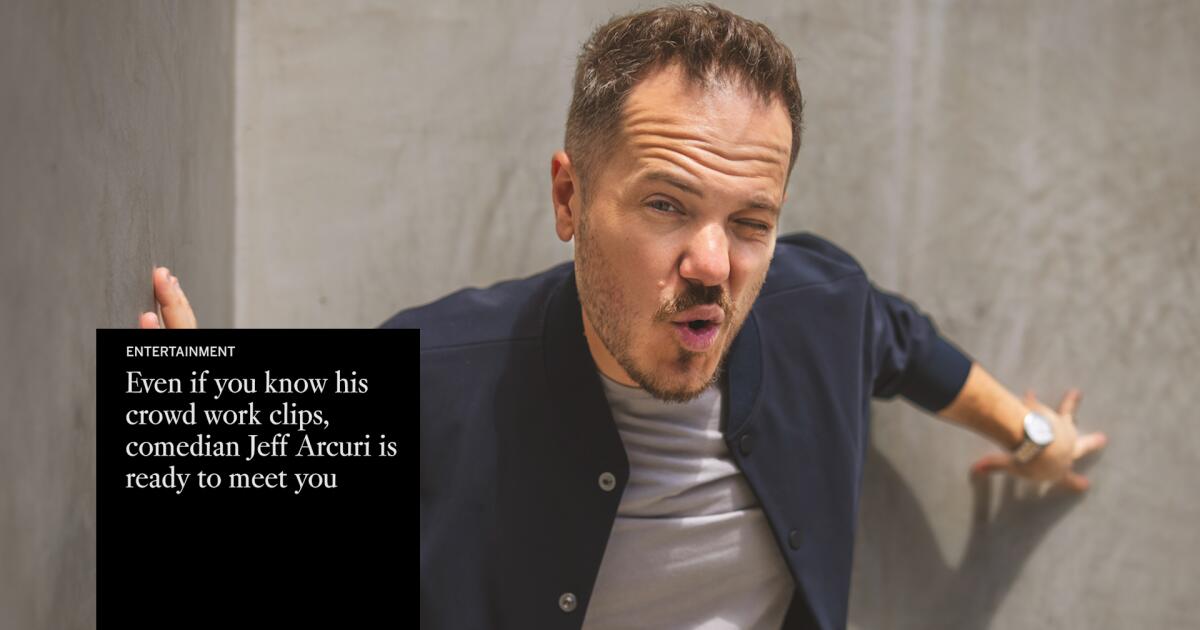 Entertainment26 minutes ago
Even if you know his crowd work clips and not his name, comedian Jeff Arcuri is ready to meet you
-

 Lifestyle33 minutes ago
Jessica McCormack: How a Challenger Is Seizing the Jewellery Opportunity
-
 Politics35 minutes ago
Commentary: Trump’s World Cup meddling only made matters worse for rattled U.S. squad
-
 Sports48 minutes ago
Looking back at the greatest high school basketball doubleheader in 2017

