Midwest
Classes resume in Michigan State building where deadly shooting transpired

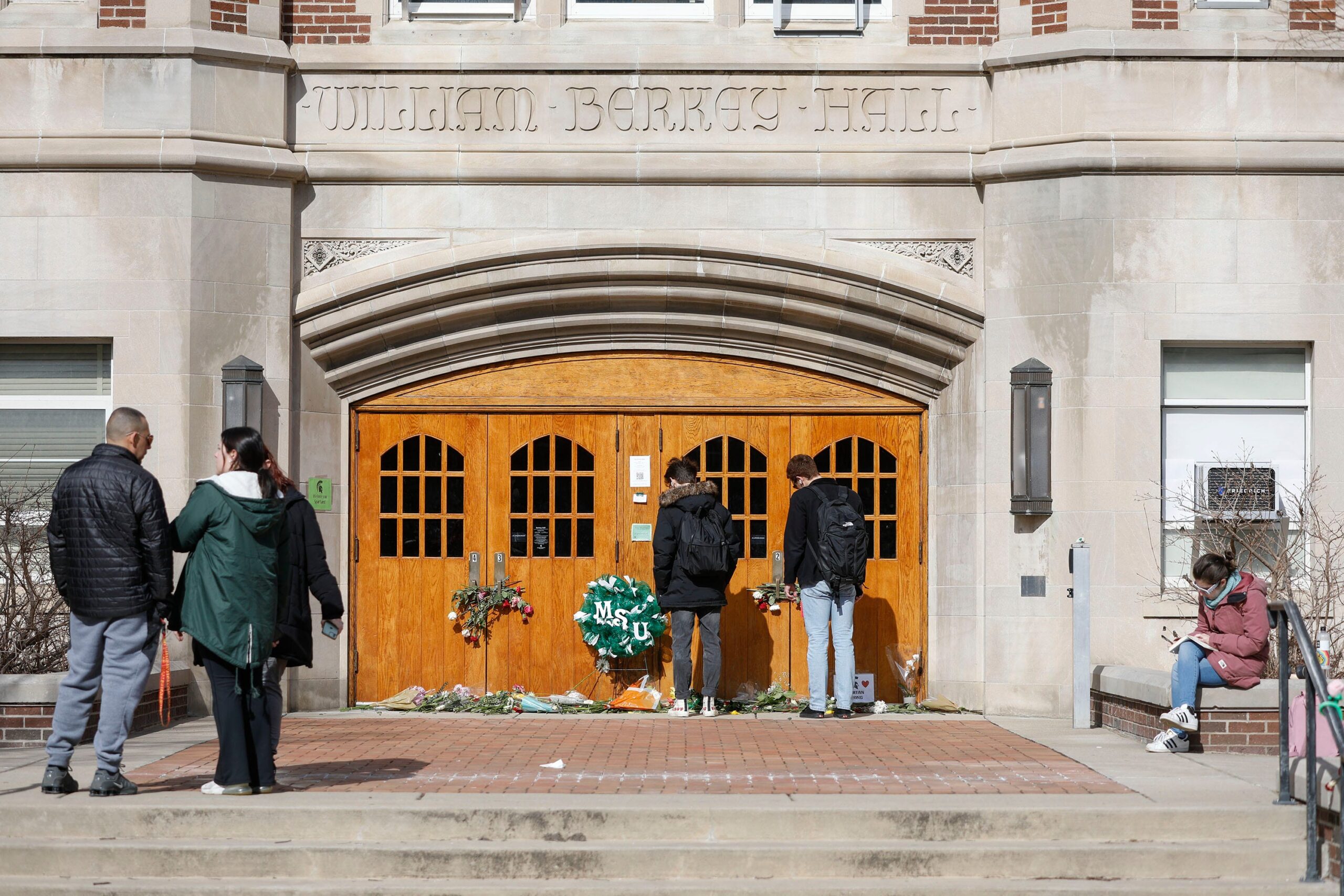
Michigan State University reopened a campus building for classes Monday for the first time since two students were fatally shot inside nearly a year ago.
Muffins and hot chocolate were offered at the front door of Berkey Hall. A therapy dog and counselors were also available for students or staff members who wanted to talk.
MICHIGAN STATE SET TO CANCEL CLASSES ON MASS SHOOTING ANNIVERSARY
“I think it’s nice they have everything here for us, and obviously they’ve made it a bit nicer,” sophomore Evan Koleski told the Lansing State Journal. “I had a class that semester so it was weird being back, but I think it should be good.”
People visit a memorial at Berkey Hall on the day that Michigan State University students return to classes for the first time since the February 13, 2023 mass shooting there in East Lansing, Michigan, February 20, 2023. The gunman shot 8 students on the campus of MSU, killing 3 of them, two of them at Berkey Hall. (Photo by Bill Pugliano/Getty Images)
Arielle Anderson and Alexandria Verner were killed during evening classes at Berkey Hall last Feb. 13. Another student, Brian Fraser, was fatally shot at a different building. Five more students were wounded by the gunman, who killed himself miles away after an hours-long manhunt.
While classes resumed at Berkey Hall, the rooms where violence occurred have been sealed. Staff offices reopened during the fall term.
“Personally, I think it’s a bit inappropriate to open up Berkey Hall not even a year after the incident happened,” junior Andrew Nguyen told The Detroit News as he approached the building.
Berkey Hall is home for the College of Social Science, the Institute for Public Policy and Social Research and the Department of Sociology.
Read the full article from Here


JEFFERSON CITY — New World Screwworms are back in the United States, with the insect being detected in Texas on June 3rd.
There are currently nine confirmed animal cases in the United States, in Texas and New Mexico.
Because insects are known to affect wildlife, the Missouri Department of Agriculture is working with local producers to mitigate the potential spread.
“We’ve known it’s been moving up through Mexico for quite a while. So, I think most cattle producers, most people knew that it was a matter of time,” said Callaway County cattle producer Doug Frank of Frank/Hazelrigg Cattle Co.
The CDC defines a screwworm as a “parasitic fly that completes its lifecycle by feeding on the tissue or flesh of warm-blooded animals.” The larvae are also referred to as maggots and have been known to be a larger issue for livestock.
“Right now, we’re talking about it a lot in the context of cattle because it’s a huge pest for the livestock industry, obviously…It’ll cause those wounds to be much deeper and much more intense. And especially if they have multiple wounds, that can be really concerning,” said MU Extension assistant professor and entomologist Emily Althoff.
Althoff says the strategy has been to mass-produce sterile males and release them into the wild.
This method controlled their spread in the past, but she believes budget cuts for those programs, and increasingly, illegal cattle trafficking, allow for the invasive spread of screwworms.
“I think the last time that we had them here in the States was in the 1980s. So, we’ve had quite a long period of time for success with this program…in 2022-2023, that time range, we started to see that buffer zone gets breached,” said Althoff.
Althoff added that past migration patterns led screwworms to Missouri.
This is why the Missouri Department of Agriculture is strengthening protocol and being diligent when it comes to transferring livestock in and out of the state.
“Now there are a lot of movement restrictions that have to be followed and monitored to prevent it from moving about,” said Steve Strubberg, State Veterinarian and Director of Animal Health at the Missouri Department of Agriculture.
The most important thing for ranchers and producers to do is to keep a keen eye out for unusual behaviors or signs of illness in their livestock.
“Just signs of an injured or sick animal. So those animals are feverish, not eating well, maybe acting noticeably different, and so forth,” said Strubberg.
The USDA wants people to know this is not a food safety issue.
The screwworm does not pose a risk to beef consumers.
However, the fly’s larvae can cause infestations in humans and all mammals, including pets, such as dogs and cats.
On June 12, the FDA issued an emergency use authorization for a drug to treat domestic animals with confirmed cases of screwworm.
The drug is generic nitenpyram.

SCOTTSBLUFF, Neb. (KOLN) – A Nebraska woman faces 41 charges after dozens of dogs were rescued June 5 from her home in Scotts Bluff County.
The Scotts Bluff County Sheriff’s Office was called to a home east of Scottsbluff around 2 p.m. for a report of possible animal abuse. According to court records, a dog from the home had been seen on Highway 26.
When deputies arrived, they contacted the owner of the dogs, 75-year-old Jody Staman. While speaking with Staman outside the home, a deputy saw numerous small dogs in wire cages. Further investigation found some of the dogs did not have food or water, and several were breathing heavily and appeared stressed. Dogs that did have water had bowls filled with algae, vegetation and mud. The dirt floors were covered in dog feces.
Staman told deputies she used to sell the dogs but stopped around 2020. She said she originally had 30 dogs and one puppy.
Deputies later returned with assistance from Nebraska Game and Parks and members of the Panhandle Humane Society. Court records state 40 live dogs and one dead puppy were collected from the property. Another puppy, which was in poor health, was taken to the Wildflower Animal Cottage.
Deputies and PHS staff described the conditions as “deplorable,” with the residence covered in dog and rodent feces. In some areas, animal feces were more than one foot deep. In most areas, it was impossible to take a step without stepping in feces.
Staman was charged with 40 counts of cruel neglect of an animal and one count of cruel neglect of an animal resulting in death.
Click here to subscribe to our 10/11 NOW daily digest and breaking news alerts delivered straight to your email inbox.
Copyright 2026 KOLN. All rights reserved.

North Dakota might be the country’s most underrated summer state, and that is exactly the point. While the crowds pile into busier places, its towns stay quiet under wide prairie skies. You can boat and fish and catch outdoor theater without ever fighting for a parking spot. Some towns sit in the Badlands, others along the Missouri River or up near the Canadian border. These eight prove a crowd-free summer is still easy to find.
Medora
Medora has fewer than 200 full-time residents and still feels like the liveliest stop for miles. The Marquis de Mores, a French nobleman, founded the town in 1883 and left behind buildings you can still walk through, while his wife funded St. Mary’s Catholic Church, the oldest Catholic church still in use in the state. The big summer event is the Medora Musical, entering its 61st season this June at the open-air Burning Hills Amphitheater, with live music and history nightly except Mondays. Right next door, Theodore Roosevelt National Park’s South Unit reopened its full 36-mile Scenic Loop Drive in late 2025 after a six-year closure, so the bison, wild horses, and painted buttes of the Badlands are all back in reach. Golfers can take on Bully Pulpit, named USA Today’s number-one public course in 2025, where the back nine climbs straight into the buttes. And come July 4, 2026, Medora gains the brand-new Theodore Roosevelt Presidential Library, a 100,000-square-foot attraction minutes from the park.
Valley City

Valley City calls itself the City of Bridges, and the drive in on the Sheyenne River Valley National Scenic Byway shows you why, rolling past wooded river bends and historic spans. Most road-trippers blow right by it on I-94 between Fargo and Jamestown, which is their loss. The Hi-Line Railroad Bridge runs nearly 3,900 feet long and sits about 162 feet above the river, ranking among the longest and highest single-track rail bridges in the country. In summer, Lake Ashtabula is the place to fish, boat, ski, or swim, while downtown hosts Summer Nights on Central every second Thursday from June through September. Just outside town, the 213-foot Medicine Wheel at Medicine Wheel Park lines up with the solstices, a quietly remarkable thing to find on the prairie.
Dunseith
Dunseith sits right on the Canadian border, where Turtle Mountain’s wooded slopes meet a string of quiet lakes. Its claim to fame is the International Peace Garden, a 3.65-square-mile spread straddling the US and Canada where you can wander flower beds and cross between two countries almost without noticing. Summer is the sweet spot to visit, since the grounds stay uncrowded outside the early-July national holidays, and the garden rents kayaks by the half-day. Lake Storman anchors the recreation here, and just up the road stands the W’eel Turtle, a sculpture built from more than 2,000 painted wheels. Cap the day with prime rib at Dale’s Cafe, then mark your calendar, because the first International Indigenous Peace Powwow lands here in early July 2026.
Mandan
Most people treat Mandan as the road to Bismarck, which keeps Fort Abraham Lincoln and the Missouri River bottomlands refreshingly quiet all summer. Fort Abraham Lincoln State Park is the oldest state park in North Dakota, complete with a reconstructed military fort, and it is where George Custer rode out on his doomed 1876 march to the Little Bighorn. The Mandan Rodeo, one of the world’s oldest continuously running rodeos, fills early July with denim, boots, and wide-brimmed hats, a tradition that predates North Dakota’s statehood by about a decade. If the kids need a break from history, the Raging Rivers Waterpark has tube slides, speed slides, and a lazy river to burn off the afternoon.
Garrison
Garrison bills itself as the Walleye Capital of the World, and the title is earned out on Lake Sakakawea, the reservoir the Garrison Dam created on the Missouri River back in 1953. Anglers in the know come for some of the best walleye water in the upper Midwest, while everyone else drives past toward flashier spots. Fort Stevenson State Park spreads over 500-plus acres of camping, biking, hiking, and boating under wooded bluffs, on the site of a frontier outpost now partly beneath the lake. Grab a shake at the Four Seasons Restaurant and Ice Cream Parlor, then poke around the North Dakota Firefighters Museum to see antique trucks and old firefighting gear.
Jamestown
Fargo, 100 miles east, hogs the eastern North Dakota spotlight, but Jamestown quietly offers just as much history and a lot more roadside character. Out front of the North American Bison Discovery Center stands the World’s Largest Buffalo, a 26-foot, 60-ton concrete bull built in 1959 by sculptor Elmer Petersen. Inside, exhibits trace the bison’s history and survival, and a live buffalo herd grazes nearby. For open-air time, Jamestown Reservoir and Pipestem Dam offer swimming, fishing, boating, and miles of trails. Jamestown is also the birthplace of Louis L’Amour, the best-selling Western novelist, and you can trace his early life on the self-guided Trail of Louis L’Amour, centered on a kiosk at the Alfred Dickey Public Library.
Walhalla
In the state’s far northeastern corner near the Canadian border, Walhalla flies under almost everyone’s radar. The Pembina Gorge nearby holds one of the largest unbroken blocks of forest in North Dakota, and this summer it gets a major upgrade, as Pembina Gorge State Park opens in June 2026 as the state’s 14th state park and its first new one since 1989. The Pembina River threads the gorge for seasonal kayaking, and Frost Fire Summer Theatre stages Broadway-style musicals on an outdoor stage right above it through July. History buffs should not skip the Gingras Trading Post State Historic Site, where fur trader Antoine Blanc Gingras built a hand-hewn log store and home that rank among the oldest buildings still standing in the state.
Washburn
Forty miles north of Bismarck, where most day-trippers turn around, Washburn keeps one of the richest Lewis and Clark stories almost to itself. The Lewis and Clark Interpretive Center walks you through the brutal winter of 1804 and 1805, and just west, Fort Mandan State Historic Site holds a full-size replica of the fort where the expedition waited it out. Nearby, Cross Ranch State Park runs wild along the Missouri River, with prairie-and-cottonwood trails for hiking, fishing, and paddling under the watch of bald eagles. When lunchtime hits, the Cabin Bar and Grill turns out one of the best burgers in the region.
Summer In North Dakota
North Dakota is one of America’s best-kept summer secrets, not just a box to tick on the way to visiting all fifty states. Between the Badlands, the Missouri River, and a string of welcoming towns, you get real outdoor adventure without the crowds that turn a trip into a chore.
-

 Mississippi4 minutes ago
Residents still have questions after Jackson data center forum
-

 Missouri11 minutes ago
Missouri agriculture officials tighten livestock protocols amid screwworm threat
-

 Montana14 minutes ago
Montana athletes prepare for 2026 Special Olympics USA Games
-

 Nebraska19 minutes ago
Nebraska woman faces 41 charges after numerous dogs rescued from home
-

 Nevada26 minutes ago
HopeLink of Southern Nevada hosts Pickleball Fundraiser ‘Dink for HopeLink’
-

 New Hampshire29 minutes ago
Ayotte Vetoes Three Bills, Signs 18 Others
-

 New Jersey34 minutes ago
Severe thunderstorm watch declared for much of North Jersey
-

 New Mexico41 minutes ago
Taos husband seeks restraining order against private investigator after wife’s remains found

