Lifestyle
What Musk's Twitter takeover could tell us about a possible government appointment

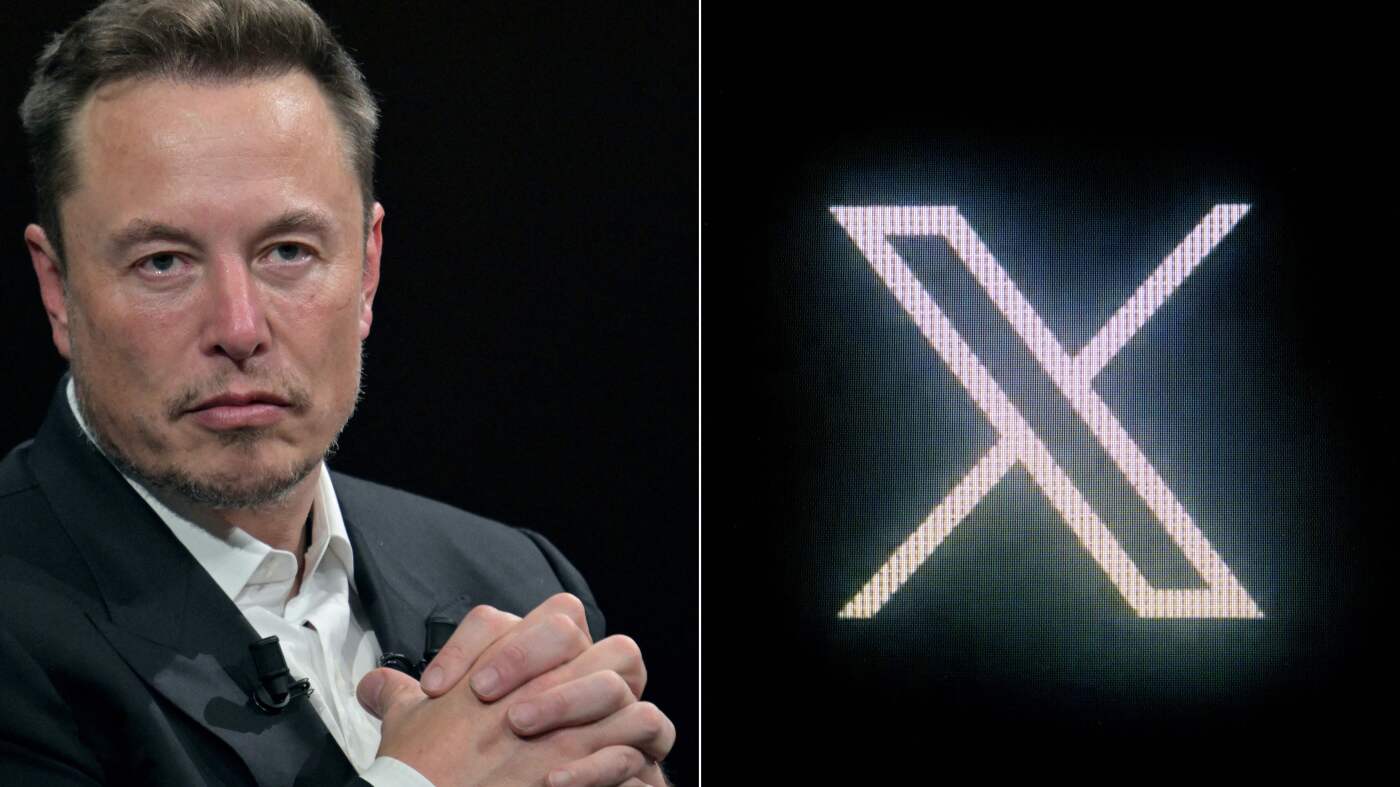
After buying Twitter in 2022, Elon Musk changed the company’s name to X.
Alain Jocard/AFP via Getty Images
hide caption
toggle caption
Alain Jocard/AFP via Getty Images
Former President Donald Trump has said that if reelected, he will appoint Elon Musk to head up a new efficiency commission with the mission of conducting an audit of the entire federal government and making recommendations for drastic reforms.
But New York Times tech reporter Ryan Mac points out that the appointment would raise a host of potential conflicts of interest: “I mean, [Musk] is a man who runs multiple companies who are under investigation from various government agencies,” Mac says.
Musk’s SpaceX, for instance, is facing off with the National Labor Relations Board over allegations of sexual harassment. And the Department of Justice is investigating Tesla for comments Musk has made about the company’s self-driving technology.

In their new book, Character Limit: How Elon Musk Destroyed Twitter, Mac and fellow reporter Kate Conger take a closer look at Musk’s takeover of the social media platform now known as X. Since buying the platform in 2022, Musk has laid off or fired about 75% of the staff; eliminated rules banning hate speech and disinformation; alienated many advertisers and users and lost money.
“There’s almost no part of the company that was left untouched,” Conger says the Twitter takeover. “We saw Musk make serious cuts to management, to engineering teams, to teams that worked on content moderation, advertising salespeople, security, janitorial services. Every part of the company was reduced in some way.”
Mac says the cuts were so deep that some employees in the New York office were left without toilet paper — they had to bring their own from home. At one point, Conger says, Musk got so frustrated that Twitter was not saving more money that he called the staff into weekend conference call. During the course of the hours-long call, he went through the company’s budget, line item by line item, asking employees to explain why they were spending money.

“It’s a scene that I keep coming back to, thinking about this efficiency platform,” Conger says. “And if [Musk] will try to hold a conference call with all of the Office of Management and Budget and run through the government spending with them or how that’s going to work.”

Character Limit
Penguin Random House
hide caption
toggle caption
Penguin Random House
Interview highlights
On the debt Musk carries because of Twitter
Ryan Mac: I think he would be the first person to admit that he overspent on Twitter. It became a central point for him to try and get out of the deal. And, you know, there were attempts to renegotiate the price. This price of $44 billion, or $54.20 a share, that he committed to long before buying the company, he tried to get out. In that acquisition itself, you know, he did have investors, but he also raised a lot of debt. And that debt came with pretty onerous terms. He’s paying, I think, more than $1 billion on interest alone a year. And that didn’t exist on Twitter’s books before. And so he’s not only having to operate a business that was sometimes in the red, sometimes in the black, but now he’s layered this debt on top of it. And he’s also depressed the revenue from advertising by scaring a lot of the advertisers away.
So it made this kind of maelstrom of issues for him that the only kind of reasonable tactic was to cut and to cut severely, to kind of head off some of these costs. And it’s still not going very well for him. The company has lost more than half its valuation. I think internally it’s worth, I think $19 billion now. And some investors have even marked that down further. So it’s been a bit of a disaster from that standpoint.
On the impact Musk’s takeover had on advertisers
Kate Conger: Elon made a lot of changes to the kinds of content that was and was not allowed on Twitter. He brought back accounts that had been banned by the previous management for spreading misinformation, for inciting harassment, for spreading lies about the outcome of the election in the United States and elections abroad. And so there is this whole swath of new content that came on to the platform as a result of his takeover that was within the bounds of the law, certainly, but the kinds of content that advertisers did not want to see their brands standing next to. And so that resulted in a lot of advertisers pulling back their spending or pausing their spending altogether so that they could wait and see how Elon would address those issues. And instead of addressing them, he sort of turned on advertisers and it became a very contentious relationship where now he has sort of told some advertisers not to spend on the platform at all and sued major advertising groups that have questioned these policies that he’s put into place.
On a chaotic tactic Musk used to fire staff
Mac: He sends out this email, which includes a Google form that asks people to opt-in to staying at the company and being “hardcore.” Like, you have to dedicate yourself to this company. You have to work long hours. And I think folks had less than 48 hours to opt into this choice. It could have even been shorter than that. … This is not a quick decision. Some people said the email went to spam as well, so they never saw it. And this is like literally an opt-in email to keep your job and so people that didn’t click were essentially let go.

It was so chaotic that on the day of the decision that it’s supposed to happen, Elon Musk and some of his executives are holding these meetings to convince people to stay. They’re pitching them on why they should stay: “You’re going to make a lot of money. You’re going to make a huge impact. [Musk] is a generational entrepreneur.” … I think thousands of people left at that point.
Conger: You can tell that it’s something that he just decided to do sort of on a whim, as he does so many things in this story. But the option for employees who wanted to stay was to click “Yes, I consent to the new hardcore version of Twitter.”
Mac: It was totally a loyalty oath. You have to bear in mind, someone like Musk, he sells people on missions, right? SpaceX: You’re trying to get humans to Mars. At Tesla, you’re saving the environment and you are electrifying fleets of cars. But at Twitter, people didn’t have a mission to be sold on. Like, they weren’t sold on this idea of free speech. They had seen him go back and forth on the actual acquisition, not want it and want it again and really jerked them around. And now he’s asking for their full and total commitment, their loyalty pledge. And I think by that point, people had just kind of had it with him. …
Conger: He asked people to say, “Yes, I want to stay,” but he didn’t ask for people to click another option if they wanted to leave. And so it set off this real scramble within the remaining people employed on Twitter’s human resources team to figure out who had actually resigned from the company and whose access they needed to cut off from internal systems.
On the changing the platform so that users can pay to be verified

Mac: It was a major change to the app. There are a lot of criticisms of these verification badges, but they also had a lot of utility. Think of an emergency service announcing a tornado warning, for example, or an election official talking about voting results. And he wanted this change to the service to happen before the midterm elections in 2022, [at] this very crucial voting period. And that struck a lot of people in the company as irresponsible, rolling out this significant change to the platform. And it worried folks like the FBI, who reached out to Twitter at the time and asked him what was going on and what their plans were heading into the midterms. …

To his credit, he did delay it to the day after the election. But even so, the rollout was immensely chaotic. I mean, those impersonations that people thought would happen very much did happen. And there were parody accounts or, you know, imitations of things like Eli Lilly, for example, the drug company, saying things like insulin is now free. There were kind of mocking tweets about Nintendo and the famous Mario character flipping the bird from what looked like a verified Nintendo account. So Twitter employees’ worst fears were playing out in real time as this thing was being launched.
On how COVID-19 changed Musk’s politics
Mac: I would say 2020 is a shift for him. He gets very upset with how California is handling COVID. And a large part of that is because Tesla, which is largely based in California and has manufacturing operations, can’t manufacture its cars. And so he lashes out at the state of California at its policies during the time as we’re trying to stop the spread. And he downplays the seriousness of COVID. He makes some pretty awful projections about the virus itself. And he just seems to go more and more to the right on that issue. …
He has a trans daughter who seems to change his view on liberals and the progressive left. And this hatred of “wokeness” essentially, which is kind of an indefinable term. But he makes this this kind of boogeyman that he believes Democrats are supporting and that the Republican Party is the party for him, that this is the party that’s going to push back on those things. And it creates this kind of cocktail for him to kind of link up with Trump in 2024.
On the leadership styles of Musk and Trump

Conger: I think that there are a lot of similarities between these two men. I mean, the demand for loyalty above all else. Wanting people around them who are deeply, deeply loyal and committed to the mission. There’s also, I think, parallels in the impulsivity and recklessness with which they conduct business. We’ve seen similarities as well in the way that they run their businesses and some of the legal challenges that they’ve run into. …
Mac: I think going through lawyers is a common trait for both of them. As well as their addiction to social media. They are very online individuals.
On the disconnect between Tesla and SpaceX and X (formerly Twitter)
Conger: Musk’s achievements in engineering are pretty undeniable. The things that he’s been able to build at Tesla and SpaceX really bolster that reputation as a best-in-class engineer. What we’ve seen with Twitter is that Twitter is not really a technical problem. It’s a people problem, right? It’s a communication problem. You have to figure out how to bring the world together into the same place and allow constructive conversation. And it’s not something that Musk has a lot of experience with, nor has he excelled at in his own personal life. He’s often talked about his struggles to communicate and to find common ground with people. And so I think in Twitter, he’s really come up against a unique challenge that he was not equipped to take on.
One of the ways he has been able to succeed at Tesla and SpaceX is to just really bang his head against the wall, force himself to work these really long hours and kind of just force his way through these technical issues. And he’s tried the same approach with Twitter with less positive effect, trying to just kind of force the platform along, force these sort of rogue policy decisions where he’s deciding to ban people he doesn’t like. And it hasn’t worked out as well. And it has been quite damaging to his reputation.
Sam Briger and Joel Wolfram produced and edited this interview for broadcast. Bridget Bentz, Molly Seavy-Nesper, Julia Redpath and Bobby Allyn adapted it for the web.




An underwater view shows US’ Lilly King competing in a heat of the women’s 200m breaststroke swimming event during the Paris 2024 Olympic Games at the Paris La Defense Arena in Nanterre, west of Paris, on July 31, 2024. (Photo by François-Xavier MARIT / AFP) (Photo by FRANCOIS-XAVIER MARIT/AFP via Getty Images)
François-Xavier Marit/Getty Images
hide caption
toggle caption
François-Xavier Marit/Getty Images
This week’s show was recorded in Bloomington, Indiana with host Peter Sagal, judge and scorekeeper Bill Kurtis, Not My Job guest Lilly King and panelists Alonzo Bodden, Josh Gondelman, and Faith Salie. Click the audio link above to hear the whole show.
Who’s Bill This Time
State of the Union is Hot; The Tribal Council Convenes Again; A Glow Up In the Doll Aisle
Panel Questions
The Toot Tracker
Bluff The Listener
Our panelists tell three stories about a travel hack in the news, only one of which is true.
Not My Job: Olympic Swimmer Lilly King answers our questions about Lil’ Kings
Olympic Swimmer Lilly King plays our game called, “Lilly King meet these Lil’ Kings” Three questions about short kings.
Panel Questions
Cleaning Out The Cabinet; Bedtime Stacking
Limericks
Bill Kurtis reads three news-related limericks: Getting Cozy With Cross Country Skiing; Pickleball’s New Competition; Bees Get Freaky
Lightning Fill In The Blank
All the news we couldn’t fit anywhere else
Predictions
Our panelists predict, after American Girls, what’ll be the next toy to get an update.

Law Roach
Zendaya and Tom’s Wedding Already Happened …
Y’all Missed It!!!
Published
Zendaya and Tom Holland are married … so claims her longtime stylist, Law Roach.
Here’s the deal … the celebrity stylist — who started styling Zendaya way back in 2011 — spoke to Access Hollywood on the Actors Awards red carpet where he sang out “The wedding has already happened, you missed it.”
Waiting for your permission to load the Instagram Media.
The AH reporter asks in shock if that’s true … and, Law responds by saying it’s “very true” before walking off.
This isn’t the first time Tom and Zendaya’s relationship status has made headlines on a red carpet … remember at the Golden Globes in 2025, Zendaya had a ring on that finger — and, the next day, we found out the two were engaged.

TMZ.com
Zendaya and Tom met on the set of “Spider-Man: Homecoming” in 2016, started dating a couple years later and went public with their relationship in 2021.
We’ve reached out to Tom and Zendaya’s teams … so far, no word back.

Online prediction market platforms allow people to place bets on wide-ranging subjects such as sports, finance, politics and currents events.
Photo Illustration by Scott Olson/Getty Images
hide caption
toggle caption
Photo Illustration by Scott Olson/Getty Images
The rise of prediction markets means you can now bet on just about anything, right from your phone. Apps like Kalshi and Polymarket have grown exponentially in President Trump’s second term, as his administration has rolled back regulations designed to keep the industry in check. Billions of dollars have flooded in, and users are placing bets on everything from whether it will rain in Seattle today to whether the US will take over control of Greenland. Who’s winning big on these apps? And who is losing? NPR correspondent Bobby Allyn joins The Sunday Story to explain how these markets came to be and where they are going.
This episode was produced by Andrew Mambo. It was edited by Liana Simstrom and Brett Neely. Fact-checking by Barclay Walsh and Susie Cummings. It was engineered by Robert Rodriguez.
We’d love to hear from you. Send us an email at TheSundayStory@npr.org.
Listen to Up First on Apple Podcasts and Spotify.

Oklahoma Ford Sports Blitz: Mar. 1, 2026
Oregon Lottery Pick 4 results for March 1

Iran vows revenge after the killing of its top leader

Man allegedly kills man in R.I. before causing car crash that killed 2 in Mass.

Rev. Jesse Jackson returns home to South Carolina to lie in state

Florida High School Football Rankings: Top 25 teams – Oct. 21

Cleary's 21 help Le Moyne down Central Connecticut State 69-64 in OT

How old is Bo Nix? What to know about Oregon quarterback ahead of 2024 NFL Draft

99th annual Pony Swim held in Virginia

Indiana Members Credit Union announced as new anchor tenant at Bottleworks District

House Republicans push Johnson to go to war with Senate over SAVE Act

Israel FM says Europe too divided, slams Spanish PM

Satellite images provide view inside Iran at war

Video: What the Texas Primary Battle Means for the Midterms

Dems’ potential 2028 hopefuls come out against US strikes on Iran
-

 World4 days ago
Exclusive: DeepSeek withholds latest AI model from US chipmakers including Nvidia, sources say
-

 Massachusetts4 days ago
Mother and daughter injured in Taunton house explosion
-

 Denver, CO4 days ago
10 acres charred, 5 injured in Thornton grass fire, evacuation orders lifted
-

 Louisiana7 days ago
Wildfire near Gum Swamp Road in Livingston Parish now under control; more than 200 acres burned
-

 Technology1 week ago
YouTube TV billing scam emails are hitting inboxes
-

 Politics1 week ago
OpenAI didn’t contact police despite employees flagging mass shooter’s concerning chatbot interactions: REPORT
-

 Technology1 week ago
Stellantis is in a crisis of its own making
-

 News1 week ago
World reacts as US top court limits Trump’s tariff powers