Lifestyle
We’re transitioning into Gemini, and Rick Owens won’t let us lose our house keys

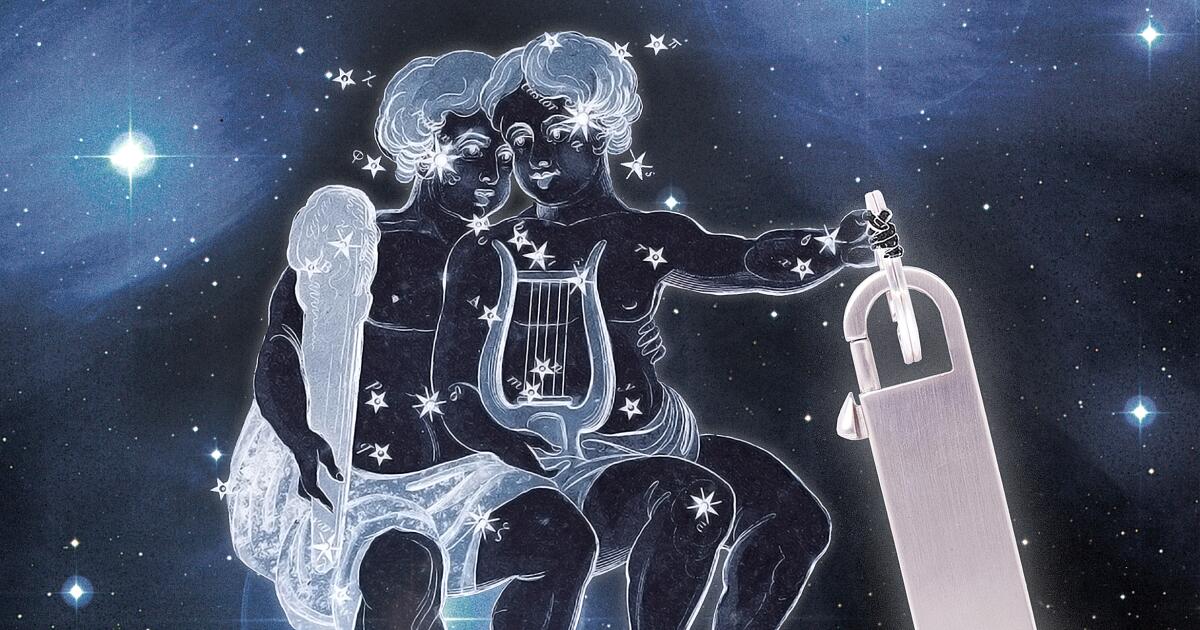
(Beth Hoeckel, featuring “Silver Gemini keychain” by Rick Owens)
This story is part of Image’s May issue, Homemaking, about home and the many ways we choose to make it.
In this sunny, gloomy town, it’s not just that things are often not as they seem — they are more than. Excess competes with restraint for the same parking spot, and they keep promising each other they’ll get lunch (neither can decide if they want to follow through). Youth and experience attend the same cocktail hour, and both leave early — one, to not miss the last bus to the Eastside; the other, to be well rested for 7 a.m. hot Pilates. To make a home of this metropolitan desert oasis requires a certain cognitive dissonance, a willingness to accept that multiple worlds will nest into each other simultaneously forever and there’s nothing you can do about it (nor would you want to). After all, the dapple of sunlit pool water reflected on the underside of a patio umbrella on a 75-degree day in June is just the mirror image of a grimy, chilly May fog crystallized on the palm trees lining cracked asphalt streets. Thanks to the ever-providential mercurial gods, we have been granted permission to leave either/or in Taurus season. Everybody knows Gemini season is for both/and.
Anyone who has ever tried to make a home of a Gemini (another kind of desert oasis) understands, for better or worse, that their beloved is an enigma of contradictions that somehow make all too much sense when looked at as the sum of a kaleidoscopic whole. It is in the spirit of this supple duality that we encounter the Rick Owens Silver Gemini key chain, aptly and concisely named as such because, well, isn’t it obvious?
Homemaking is an art, a craft, a practice, a burden, a necessity, a privilege.
A smooth brass circle meets a confident silver-tone rectangle in a holy geometric union that could inspire a passive allegory of the masculine-feminine from a less inventive mind (sorry, Virgo). But for our intents and purposes, we consider the tool (the apparatus?) of the key chain more intently, more deeply. It is a vessel intended to be secure, assumed to be trustworthy, the bearer of the most treasured of quotidian possessions that simply cannot be misplaced, at the risk of inconvenience at best, a catastrophe at worst. It’s funny how we just trust these pieces of metal to guard other pieces of metal, our access to our dwellings, our most intimate and vulnerable places.
Homemaking is an art, a craft, a practice, a burden, a necessity, a privilege. It’s in the talismans that we arrange within our homes, from the haphazardly purchased necessities to the carefully considered luxuries. It’s the memory of a past lover washing a wine glass stolen from the dive bar down the street after Sunday night supper, a dusty paw print left by a familiar venturing into a forgotten crevice. Homemaking can be taken care of, obsessively attended to or ignored altogether — it is Gemini season, after all, and that means we can do what we want. But the making of a home is something we are all compelled to consider at one point or another. And, amazingly, it all starts with a key, a tiny piece of carved metal, which, like all of us, needs something to keep it safe — even if that something contains as many multitudes as the city herself.
Goth Shakira is a digital conjurer based in Los Angeles.




An underwater view shows US’ Lilly King competing in a heat of the women’s 200m breaststroke swimming event during the Paris 2024 Olympic Games at the Paris La Defense Arena in Nanterre, west of Paris, on July 31, 2024. (Photo by François-Xavier MARIT / AFP) (Photo by FRANCOIS-XAVIER MARIT/AFP via Getty Images)
François-Xavier Marit/Getty Images
hide caption
toggle caption
François-Xavier Marit/Getty Images
This week’s show was recorded in Bloomington, Indiana with host Peter Sagal, judge and scorekeeper Bill Kurtis, Not My Job guest Lilly King and panelists Alonzo Bodden, Josh Gondelman, and Faith Salie. Click the audio link above to hear the whole show.
Who’s Bill This Time
State of the Union is Hot; The Tribal Council Convenes Again; A Glow Up In the Doll Aisle
Panel Questions
The Toot Tracker
Bluff The Listener
Our panelists tell three stories about a travel hack in the news, only one of which is true.
Not My Job: Olympic Swimmer Lilly King answers our questions about Lil’ Kings
Olympic Swimmer Lilly King plays our game called, “Lilly King meet these Lil’ Kings” Three questions about short kings.
Panel Questions
Cleaning Out The Cabinet; Bedtime Stacking
Limericks
Bill Kurtis reads three news-related limericks: Getting Cozy With Cross Country Skiing; Pickleball’s New Competition; Bees Get Freaky
Lightning Fill In The Blank
All the news we couldn’t fit anywhere else
Predictions
Our panelists predict, after American Girls, what’ll be the next toy to get an update.

Law Roach
Zendaya and Tom’s Wedding Already Happened …
Y’all Missed It!!!
Published
Zendaya and Tom Holland are married … so claims her longtime stylist, Law Roach.
Here’s the deal … the celebrity stylist — who started styling Zendaya way back in 2011 — spoke to Access Hollywood on the Actors Awards red carpet where he sang out “The wedding has already happened, you missed it.”
Waiting for your permission to load the Instagram Media.
The AH reporter asks in shock if that’s true … and, Law responds by saying it’s “very true” before walking off.
This isn’t the first time Tom and Zendaya’s relationship status has made headlines on a red carpet … remember at the Golden Globes in 2025, Zendaya had a ring on that finger — and, the next day, we found out the two were engaged.

TMZ.com
Zendaya and Tom met on the set of “Spider-Man: Homecoming” in 2016, started dating a couple years later and went public with their relationship in 2021.
We’ve reached out to Tom and Zendaya’s teams … so far, no word back.

Online prediction market platforms allow people to place bets on wide-ranging subjects such as sports, finance, politics and currents events.
Photo Illustration by Scott Olson/Getty Images
hide caption
toggle caption
Photo Illustration by Scott Olson/Getty Images
The rise of prediction markets means you can now bet on just about anything, right from your phone. Apps like Kalshi and Polymarket have grown exponentially in President Trump’s second term, as his administration has rolled back regulations designed to keep the industry in check. Billions of dollars have flooded in, and users are placing bets on everything from whether it will rain in Seattle today to whether the US will take over control of Greenland. Who’s winning big on these apps? And who is losing? NPR correspondent Bobby Allyn joins The Sunday Story to explain how these markets came to be and where they are going.
This episode was produced by Andrew Mambo. It was edited by Liana Simstrom and Brett Neely. Fact-checking by Barclay Walsh and Susie Cummings. It was engineered by Robert Rodriguez.
We’d love to hear from you. Send us an email at TheSundayStory@npr.org.
Listen to Up First on Apple Podcasts and Spotify.
‘Wait Wait’ for February 28. 2026: Live in Bloomington with Lilly King!

This Windows gaming handheld has a screen that folds in half

Tel Aviv analyst shelters from 30 missile sirens in 48 hours, says Iran ‘won’t recover’

House Republicans push Johnson to go to war with Senate over SAVE Act

Diabetes surge among Americans could be driven by ‘healthy’ breakfasts, doctor warns

Florida High School Football Rankings: Top 25 teams – Oct. 21

Cleary's 21 help Le Moyne down Central Connecticut State 69-64 in OT

How old is Bo Nix? What to know about Oregon quarterback ahead of 2024 NFL Draft

99th annual Pony Swim held in Virginia

Indiana Members Credit Union announced as new anchor tenant at Bottleworks District
House Republicans push Johnson to go to war with Senate over SAVE Act

Israel FM says Europe too divided, slams Spanish PM

Satellite images provide view inside Iran at war

Video: What the Texas Primary Battle Means for the Midterms

Dems’ potential 2028 hopefuls come out against US strikes on Iran
-

 World4 days ago
Exclusive: DeepSeek withholds latest AI model from US chipmakers including Nvidia, sources say
-

 Massachusetts4 days ago
Mother and daughter injured in Taunton house explosion
-

 Montana1 week ago
2026 MHSA Montana Wrestling State Championship Brackets And Results – FloWrestling
-

 Denver, CO4 days ago
10 acres charred, 5 injured in Thornton grass fire, evacuation orders lifted
-

 Louisiana7 days ago
Wildfire near Gum Swamp Road in Livingston Parish now under control; more than 200 acres burned
-

 Technology1 week ago
YouTube TV billing scam emails are hitting inboxes
-

 Technology1 week ago
Stellantis is in a crisis of its own making
-

 Politics1 week ago
OpenAI didn’t contact police despite employees flagging mass shooter’s concerning chatbot interactions: REPORT