Lifestyle
The designer who turned her pain into a colorful crochet brand (spotted on Kendrick Lamar)


Krysta Grasso, 27, is the owner of the crochet brand Unlikely Fox.
Surrounded by a sea of colorful yarn, 27-year-old Krysta Grasso lounged on her bed in her West Adams apartment as she crocheted a custom order.
With the yarn in one hand and a crochet hook in the other, she intricately worked in more of the neon pink, highlighter yellow and tortoise blue that she’d hand-dyed in her kitchen. When she was finished, she held up her creation: a fox-ear hat, one of her signature pieces.
Grasso’s crochet brand, Unlikely Fox, is having a shining moment — her designs have been spotted on several musicians, including Grammy award-winning rapper Kendrick Lamar, Malaya (who wore a hat during an NPR Tiny Desk performance) and Amindi.
Still, despite the recent fanfare, Grasso’s days haven’t changed much. This peaceful afternoon looks a lot like the ones she used to spend with her mother, Dunia, who taught her how to crochet when she was about 5. Together, they’d sit on the couch, watching cartoons and romantic comedies for hours as they crocheted everything from scarves to granny squares, which they sometimes turned into blankets.
Grasso enjoyed crocheting simply because “my mom did it,” she said of Dunia, whose signature is tattooed in red on her left forearm. “I just always wanted to be like her. Most of the things she did, I just wanted to do naturally.”
For many years, crocheting was just a hobby for Grasso, who goes by the nickname Fox. She comes from three generations of seamstresses in her Caribbean family — her grandmother owned a sewing boutique in the Chicago area, where Grasso grew up. As a teen, she would sell DIY clothes on Etsy. But it wasn’t until her mother suddenly died in June 2018 from cardiac arrest, just days after having a stroke, that Grasso started crocheting with a new vigor.
At first, it was her way of grieving, an attempt to find bits of joy within each day. And then it became something even more.
A photograph of Krysta Grasso and her late mother, Dunia, is displayed in Grasso’s bedroom and crochet studio.
Krysta Grasso, who is owner of Unlikely Fox, likes to keep the strings loose on her crochet products to showcase the amount of colors and textures she uses.
“After she passed, I realized how deeply connected my crocheting was to her,” Grasso said of her mom, who raised three kids on her own. “I was really motivated to start doing it for a living.”
As she crocheted, Grasso would listen to the Spotify playlists her mom made, which were filled with reggaeton, R&B and soul tracks, and watch their favorite Christmas films. Grasso made vibrant colored hats, swimwear and sweaters. She also started designing crochet sleeves and front hoodie pockets, which she added to vintage T-shirts. “When I’m sad, I tend to gravitate to bright colors,” she said.
While Grasso looked for a job in L.A., she began selling her products at the popular Melrose Trading Post. At the time, she was one of a few crochet artists there. She didn’t make much money in the beginning, but she always received the same compliment from patrons. “People would say, ‘I’ve never seen anything like this before,’” she said, adding that they were intrigued by her use of color.
She eventually found a job as a server at a restaurant but was laid off when the pandemic hit. With more free time, she began experimenting with color and hand-dying her own yarn for her crochet work. The hours-long process goes like this: She soaks yarn in citric acid, then places it in a pan on the stove that’s filled with a mix of hot water and dye and lets it sit for a set amount of time to absorb the color. This can take anywhere from 30 minutes to two hours. Afterward, she takes the pan off the heat to let the yarn cool off, then washes it and lets it dry.
“Color is the thing that I love most about the entire craft,” she said, adding that she’s also intrigued by various textures. In one piece, for example, the fox-ear hat, Grasso may use up to 25 combinations of different colors. She likes to keep the strings loose on her pieces — a distinct style choice — to show how many colors and fibers she uses in her products. No two items are ever the same.
Grasso may use up to 25 combinations of colors for her most vibrant crochet projects.
A tattoo of Grasso’s mother’s name, Dunia. Grasso uses a mix of fibers — mohair, merino wool, cotton, silk, recycled fibers and dead stock acrylic. (Zay Monae/For The Times)
Grasso typically uses a mixture of fibers — mohair, merino wool, cotton, silk, recycled fibers and dead stock acrylic — to avoid buying too much acrylic yarn, which often ends up in landfills because it is produced in abundance and isn’t used quickly enough, she said. The higher-priced fibers are the reason her hats sell for $190 and clothing pieces cost $300 to $1,500.
In early 2021, Grasso started selling skeins of her hand-dyed yarn online, which were a hit. When she released a collection called the “Steven Universe” Yarn Club, based on the Cartoon Network animated series, she made nearly $10,000 in two days off the yarn, which was about $25 to $30 per skein.
“I was incredibly surprised. I’d never had a drop that big. Things definitely changed,” she said. She was working at a bookstore at the time, but this made her realize that she could potentially make Unlikely Fox her main source of income.
Soon after, she quit her job and continued doing monthly yarn drops, which were all inspired by animated shows, video games and movies she liked, including “Chowder,” “Animal Crossing,” “Rick and Morty” and “The Princess and the Frog.”
By that fall, Grasso was selling at the Black Market Flea, a monthly flea market that is brimming with clothing brands and handmade goods, all designed and crafted by Black artisans. Before long, her Unlikely Fox products were selling out, and she was able to make half her income from the market and the other half from her monthly yarn drops.
“I think the Black Market Flea was my target audience,” she said. “Those are my peers, and I think it was much easier to communicate what I was doing to people who looked like me, rather than being a small group of people of color and Black people in such a huge white space.”
Krysta Grasso said each item she crochets is personal and feels like “a piece of me.”
There aren’t many times that you’ll see Grasso without a crochet hook and yarn in her hands.
Stephanie Smith first met Grasso when she was crocheting outside a coffee shop in Leimert Park a couple years ago.
“She was so zoned in and just doing it with ease, and I just thought that was so cool,” said Smith, a photographer, returning customer and now close friend of Grasso. “It was refreshing to see a younger woman crocheting.”
Smith owns about 10 of Grasso’s pieces, including a matching set — a wrap skirt and a bustier-style top with removable sleeves — that she customized for her 26th birthday. “I’ve bought other crochet items [from other designers], but her’s are woven way tighter, and her colors really stand out to me.” Each time Smith wears an Unlikely Fox piece, people flag her down to ask where she got it, she said.
Smith said she appreciates Grasso’s pieces even more because of how personal they are to her.
“I won’t ever get rid of these pieces ever because I feel like it’s a part of my friend and it’s also a part of her mother,” she said.
If you follow Grasso on social media, you know who her mother is. Dunia’s face, which is almost identical to Grasso‘s, is plastered across Grasso’s Instagram feed, and Grasso’s bio says simply “Dunia’s daughter.” Grasso has locs similar to those worn by her mom; she got hers shortly after her mom died. She is also candid online about days when her grief strikes even harder, and she shares the activities she does to help boost her mood, like crocheting and running.
Krysta Grasso with a picture of her late mother, Dunia, who taught her how to crochet when she was 5.
For Grasso, talking about her mom and her grieving process is a necessity. “I think I just have to,” she said. “When I don’t, I feel awful.”
Grasso opens up about her experience online not only because it helps her “but I also want to encourage people to grieve more outwardly. I think just the act of speaking about something, whether it’s painful or not, is really powerful.”
At times, it can feel conflicting for Grasso to sell her crochet work because it’s “a piece of me,” she said. For this reason, she recently shifted from doing flea markets regularly to focusing more on making commission-based pieces and selling limited drops online. That way, she doesn’t have to persuade anyone to buy her work, she said.
She isn’t focusing on Unlikely Fox full time anymore because it was getting “intense.” This has given her the freedom to expand her business slowly and intentionally.
A crocheted sweater from Unlikely Fox’s collection.
She didn’t grow up with a lot of money, she said, “so I know that I will be OK with less.”
In the fall, Grasso will be moving to Portland, Ore., to pursue a bachelor’s degree in graphic design, which she’s been passionate about for years. She plans to continue selling her crochet pieces and doing monthly drops on the Unlikely Fox website. Her long-term goal is to become a full-time knitwear designer and further her career in fashion.
When Grasso reflects on the brand she’s built in her mother’s memory, she says Dunia would think “it’s really cool.”
“I visualize the version of us that could’ve got to live longer together, and I think the two of us would’ve become even cooler people together,” Grasso said, as she stood in her bedroom and studio, which is filled with photos of her mom. “I think she’s proud. I think she just wants me to find my own [way] and not be influenced by the things that are around me and the people around me.”
She smiled and added, “I think she just wants me to keep going.”

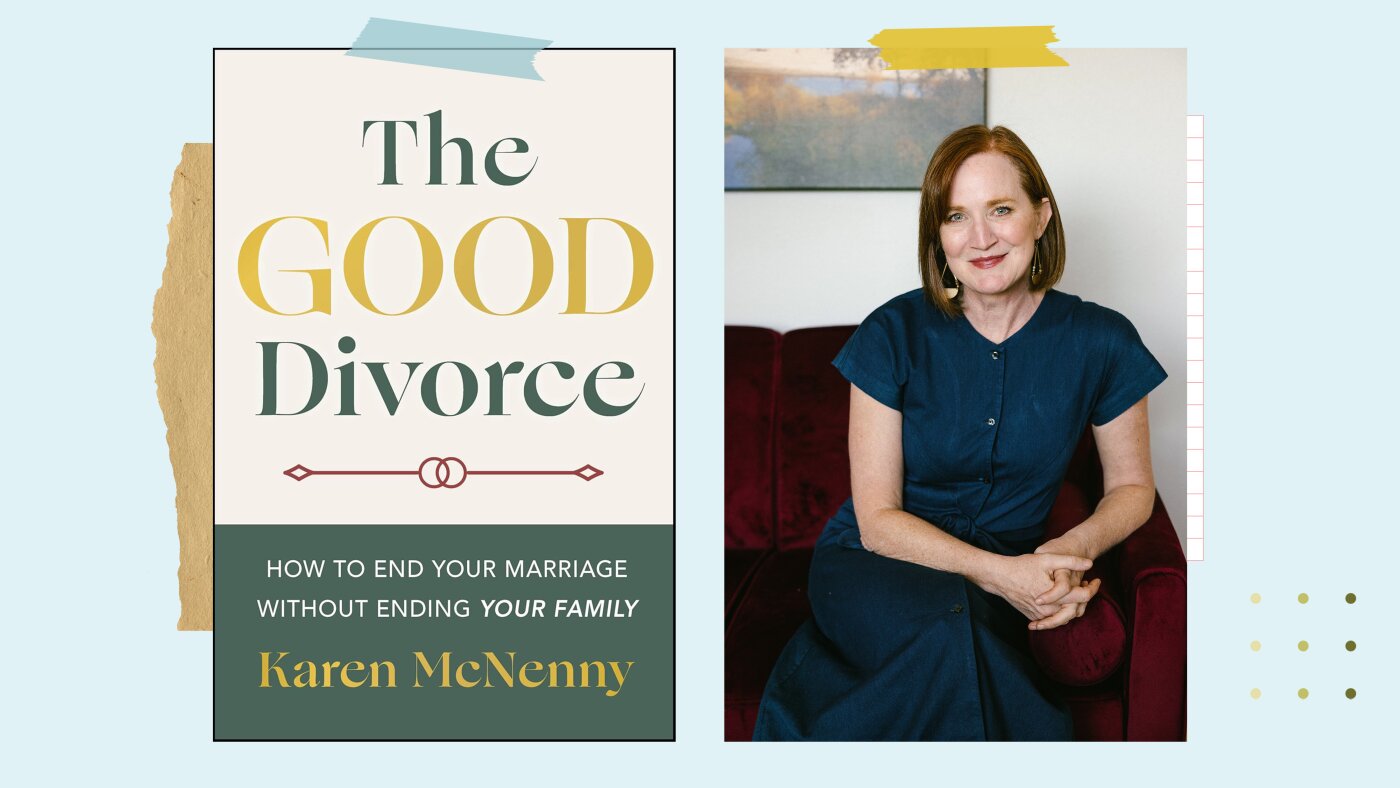
Karen McNenny is a certified divorce coach, certified co-parenting specialist and author of the book The Good Divorce: How to End Your Marriage Without Ending Your Family.
Wiley/Jossey-Bass/NPR, Nicole Wickens/NPR
hide caption
toggle caption
Wiley/Jossey-Bass/NPR, Nicole Wickens/NPR
When Karen McNenny was facing divorce about 15 years ago, she was afraid of what it would mean for her future: despair, debt and a lifetime of resentment, she says.
At the same time, she was thinking of her two children, she says. She didn’t want their father to become her enemy.
So she and her former husband chose to approach divorce differently as a couple. “We’re going to renovate and transform this family. We’re not going to destroy it,” she says. “The marriage is ending, not your relationship.”
For McNenny, a mediator, certified divorce coach and certified co-parenting specialist, divorce is a tool, not a weapon. She expands on this concept in The Good Divorce: How to End Your Marriage Without Ending Your Family, which came out this spring. The book offers guidance on how to maintain compassionate and respectful ties with a former spouse while also healing and moving forward.
According to Pew Research Center, a third of Americans who have ever been married had a first marriage that ended in divorce. For that reason, McNenny hopes her book becomes a must-read for couples before they get married. “The best time to talk about divorce is before you need to talk about it,” she says.
She shared insights from her book in a conversation with Life Kit. This interview has been edited for length and clarity.
The book is called The Good Divorce. What does that mean?
[For those with kids,] the good divorce is about protecting the future of the family while we dissolve the marriage.
After the paperwork is done and the assets have been divided, can you and your co-parent sit on the same side of the bleachers during the basketball game? Can you still see yourselves as a partnership, with the ability to have thoughtful conversations about your kids?
For those who don’t have kids, [the good divorce is] about protecting your health — your mental health and your physical health. If we are doubling down with resentment and bitterness, all of that gets stored in the body and shows up in different ways. You deserve a pathway that’s less destructive.
Let me also be clear: There are times when an amicable, collaborative process is not possible and maybe even inappropriate. For instance, where there’s active addiction, abuse, domestic violence, coercion or unmanaged mental health issues.
How do you get to a place where you don’t feel triggered by your partner, so you both can work together toward a good divorce?
That, my dear, does not happen overnight. That is more like a dimmer switch going up and down and up and down, and the gift of time helps to get there.
It’s a complex emotional journey because we do feel relief in walking away from our spouse and the challenges. But with it, there is extraordinary grief that comes with divorce that I think is often underestimated and undersupported.

If my spouse had died, people would’ve been checking in with me regularly. I never would’ve spent a holiday alone in that first year. There probably would’ve been a meal train.
But he didn’t die. My marriage died, my family structure died, my identity as a wife and a partner died. There’s so much grief through these transformations that come with divorce that we don’t see.
So supporting friends in all those ways that you would as if there had been an actual death is doing a lot for your friends who are going through divorce.
How do you let your friends, family and community know that you’re getting a divorce and that you might need support?
Put a communication strategy together. It’s not just for how we tell the kids. It’s also a communication strategy for the grandparents; to the circle of support around the kids, like teachers, coaches and mentors; and our shared community.
It’s extraordinary when a couple can write that message together, not unlike a marriage announcement. [You might say:] We’ve made a really difficult decision. We wanted to let you know. We’re not going to court. Don’t expect a battle. Please don’t ask us why. Just ask us how we’re doing. We’re on the same side as the kids. You don’t need to pick sides.
In doing so, we’ve given everyone the same information at once. It’s a unified message that comes from the parent team, and it allows your community to know how best to support you. And it takes out all the gossip and wonder about what is going on.
If you have kids and they’re splitting time between two homes, what are some ways to make that change easier for them?
Our kids were 5 and 7 when we divorced, so it was three or four nights at a time in each home. By the time they got to be about 8 or 10, it made sense to go a week in each residence. After COVID, the kids came to us and said, “Can we just have two weeks in a house? We wanna be able to settle in more.” [So we said] OK.
A lot of parents are so rigid about the schedule. There’s no flexibility. That doesn’t serve anyone. So I recommend liberating yourselves from the calendar and letting it grow and bend with your kids appropriately.
Knowing what you know now about divorce, what questions do you think couples should ask themselves before they get married?
So often when people arrive at the threshold of divorce, couples are like, “We don’t know what we’re doing.” Get educated about the business part of it.
There is no harm in having a prenuptial agreement. Even if you decided not to file it, have the conversation about the implications. What does it mean if we buy this house together? What does it mean if one of us works more and one of us works less?
We also underestimate what it means to be roommates. What are your value systems around cooking and cleaning? How much alone time do you need? It’s easy to fall in love and not know if you’re compatible.
Do you think you’d get married again?
I absolutely hope that I get to say yes to a lifelong commitment with a partner, as I believe we often are given the opportunity to become a better version of ourself through partnership.
The story was edited by Meghan Keane. The visual editor is CJ Riculan. We’d love to hear from you. Leave us a voicemail at 202-216-9823, or email us at LifeKit@npr.org.
Listen to Life Kit on Apple Podcasts and Spotify, and sign up for our newsletter. Follow us on Instagram: @nprlifekit.

In Alice and Steve, Jemaine Clement and Nicola Walker play long-time friends who turn on each other after he gets involved with her 26-year-old daughter.
Lara Cornell/Disney+
hide caption
toggle caption
Lara Cornell/Disney+
I grew up watching episodic shows on network TV, nearly all of them formulaic but some indelibly great. Then, like everyone else, I moved into the days of what my colleague David Bianculli dubbed Platinum TV, where series like The Sopranos and The Wire and Fleabag aspired to something higher. What both these eras had in common was that their shows were carefully crafted — they had an internal logic, and a tone, that held them together.
In recent years, though, there’s been a proliferation of shows that, possibly obeying some algorithm, care less for coherence than sensation. They lurch among tones, from cuteness to sentimentality to meanness, stirring in random plot twists along the way. Bouncing all over the emotional map, these shows depend on compelling actors and a few memorable scenes to make us overlook their loose construction.
A great example is Alice and Steve, an entertaining but sometimes exasperating six-part British comedy on Hulu about two 50-something best friends who turn on each other after he gets involved with her 26-year-old daughter.


While the premise is juicy, it’s also a tad yucky, and I mainly tuned in because its title characters are played by performers Jemaine Clement from Flight of the Conchords and Nicola Walker, whom I’ve raved up on this show more than once.
The series starts poorly with Steve and Alice going on a cutesy bender after a friend’s funeral. Now, I always hate drunk scenes, which are an invitation to overact. As Clement and Walker bray their lines, we learn that Steve’s a divorced celebrity hair stylist who can’t find a girlfriend while Alice is a clothes designer with a doting younger husband, nicely played by Joel Fry, a sweetie-pie of a teenage son — that’s Tyrese Eaton-Dyce — and, of course, that 26-year-old daughter, Izzy, who has inherited her mother’s willfulness. Played by Yali Topol Margalith, Izzy kickstarts the plot by flirting with Steve. Predictably, he succumbs.

Almost immediately, they think they’re in love. While the weak-willed Steve wants to hide their romance — he knows it’s inappropriate — Izzy just blurts out the facts to her mom. Alice flips. And from hereon out in this series where the women are as alpha as the men are hangdog, Alice drives the action. Betrayed and violently angry, she’ll do whatever it takes to break them up — no matter who gets hurt. Her antics unleash Steve’s own malice. We’re in Beef territory.
At its core, Alice and Steve hinges on the way that platonic friendships are often richer and more powerful than romantic ones. It’s a fascinating subject, which may be why I found the script by Sophie Goodhart so frustrating. I wanted her to dig deeper. While the show’s got some very funny bits — Alice’s sharp-tongued mother is a blast — it’s often annoyingly lax.

If Steve really does the hair of Charli XCX, how come he’s a clueless older guy whose pop culture references are Willie Nelson and Woody Allen? If Izzy truly adores her mother as she claims, why does she keep rubbing her relationship with Steve in her mom’s face? Halfway through, one character nukes the other’s career, but this life-shattering event has no real weight: It’s barely even mentioned for the rest of the series.
That said, Alice and Steve is worth seeing for scenes like the one in which Steve spinelessly sells Izzy out or the lacerating discussion between Alice and her husband when he fully grasps that he adores a woman who views him as a reliable but dull concierge, not a man she likes hanging with. Most touching of all may be the lovely sequence when Alice, wise for once, smooths a romantic crisis between her son and his would-be girlfriend, a pair who are the show’s emblem of hope. For once, we understand why people love her.

While most viewers will find Steve more likable than Alice — the show takes pains not to make him appear predatory or creepy — the role doesn’t give Clement a whole lot to do except play variations on shambolic dread and discomfort. The show gets its galvanizing zing from Walker, a beloved star in England with amazing, luminous eyes. Her Alice is the kind of complicated, volcanic heroine that you don’t see in movies and rarely see on TV, one who shows her apocalyptic rage freely and in many different forms.
At least once in every episode, something would lead me to say, “Man, is this show a mess.” But that wasn’t a deal breaker. I kept watching. After all, life is messy, too.


How to enter your Sporty Spice era.
Getty Images/quantic69/Olga Kurbatova/Anastasiia Zvonary/Photo Illustration by NPR
hide caption
toggle caption
Getty Images/quantic69/Olga Kurbatova/Anastasiia Zvonary/Photo Illustration by NPR
Reality dating and professional sports are not as different as you’d think.
Brittany is in her Sporty Spice era – she watched the NBA playoffs, she’s following World Cup games, and she’s watching the New York Liberty play their WNBA season. These games are daily – and so is the reality dating show Love Island. And she noticed that the two formats are not very different at all. Defector.com staff writer and co-owner Kelsey McKinney came to the same conclusion – so the two of them discuss why these games of athleticism and love can bring us together… and why they get valued differently in our culture.
For more episodes on sports and reality TV, check out:
Get rich or die trying: how sports betting is changing our love of the game
Is this the end of reality TV?
The ugly truth of America’s expensive homes
Support Public Media. Join NPR Plus.
Follow Brittany on Instagram: @bmluse
This episode was produced by Liam McBain. It was edited by Neena Pathak. Our Supervising Producer is Cher Vincent. Our Executive Producer is Barton Girdwood. Our VP of Programming is Yolanda Sangweni.
-

 North Carolina5 minutes ago
Manns Harbor Bridge repairs to be ‘most complete’ in decades | Coastal Review
-

 North Dakota12 minutes ago
Today in History: July 7, 1940 – War children routed to Grand Forks
-

 Ohio15 minutes ago
Car crashes into fitness center in Warren
-

 Oklahoma20 minutes ago
As World Cup inspires young players, Oklahoma City bets big on soccer’s future
-
Oregon27 minutes ago
Oregon Lottery Powerball, Pick 4 results for July 6
-

 Pennsylvania30 minutes ago
Boil water advisory in effect for some residents in Montgomery County
-

 Rhode Island35 minutes ago
R.I. food bank thanks Taylor Swift, Travis Kelce for pre-wedding donation
-

 South-Carolina42 minutes ago
South Carolina Lottery Powerball, Pick 3 results for July 6, 2026

