Lifestyle
The 10 best songs of Eurovision 2025 — and their chances to win


The grand final of Eurovision Song Contest takes place on Saturday in Basel, Switzerland. Above, Melody representing Spain performs in the semifinal on Tuesday.
Harold Cunningham/Getty Images
hide caption
toggle caption
Harold Cunningham/Getty Images
The grand final of this year’s Eurovision Song Contest, that annual celebration of melody, rhythm, fabulousness and glitter, takes place this Saturday, May 17, in Basel, Switzerland. In the U.S., it will stream live on Peacock at 3 p.m. ET.
It’s the 69th Eurovision, and if you think that simple numerical fact has not set off a cascade of lewd eyebrow-waggles across the European continent, you don’t know Eurovision. Several countries have sent songs crammed with winking, single-entendre lyrics, from Finland’s “Ich Komme” (“I’m Coming”) to Australia’s “Milkshake Man,” who’s got “a caramel banana that you’ve got to see.”
(Yes, Australia competes in Eurovision; it’s done so for a decade. Don’t get hung up on that. Eurovision is, at the end of the day, a vibe, more than anything else; as such is not beholden to the petty dictates of mere geography.)
Each of the 37 countries participating in this year’s Eurovision Song Contest submitted a song to the semifinals that took place already this week. Those semifinals whittled the field down to the 26 songs which will compete in Saturday’s grand final.

Dancers perform at the start of a dress rehearsal at the Eurovision Song Contest.
Sesbastien Bozon/AFP via Getty Images
hide caption
toggle caption
Sesbastien Bozon/AFP via Getty Images
Some countries qualify automatically every year, including the winning country from the previous year — in this case, Switzerland — but most have been determined by viewers watching at home, the so-called televote. Viewers will get another chance to vote for their favorites on Saturday, but this time those votes will only count for 50% of the final scores. The other half will be determined by national juries made up of music industry professionals in the participating countries.
Historically, the televoters embrace the blithe excess of Eurovision – they want visual spectacle, dazzling choreo, big pyrotechnics, walls of sound. For them, a bit of humor, if not outright goofiness, goes a long way. The juries, on the other hand, are more conservative, tending to prize more technical aspects like vocal precision, adroit songwriting and musical composition, plus a pared-down sound mix. They’re suspicious of humor, and hate goofiness.
What to expect on Saturday
During Saturday’s grand final, each performance must adhere to the following rules:
- Songs must be no more than three minutes in length.
- Lead vocals must be performed live.
- No live instrumentation of any kind is permitted.
- During a song, no more than six performers may be onstage at the same time.
I remind folks every year: They’re not kidding around about Rule 2. Eurovision is not and has never been a lip-syncing competition. These performers are singing live, though their instrumentation and backing vocals are pre-recorded. If on Saturday you find yourself beginning to doubt that fact, say during Poland’s entry “Gaja,” sung by a 52-year-old Justyna Steczkowska as she hurls herself through choreo that involves twirls, jumping jacks and what amounts to freaking burpees(!) all while holding a belted note(!), remind yourself that you’re not watching lip-syncing, you’re watching great breath control.
And as for Rule 3: Whenever a performance involves a “band” wailing away on their drums, guitars and/or violins while scowling intently, remind yourself you’re not watching them actually shred, you’re watching them mime. It’s cute.
Here’s how Saturday’s grand final will proceed.
First, all 26 countries perform their songs. Then the audience votes.
While the televotes get tallied, the jury votes are collected over a series of glorified Zoom calls to representatives in each participating country. Some of these representatives are local celebrities who proceed to waste absolutely everybody’s time by doing bits – busting out their putatively hilarious catchphrases, say. The calls are marked by video lags and audio dropouts. There will be long stretches of dead air as the Eurovision hosts wait to receive various juries’ votes while staring down the barrel of the camera dripping in flop-sweat.
The whole process of jury voting is labored, interminable – and freaking delightful.
Once the juries have voted, the reveal of the televotes begins, starting with the country that received the fewest jury votes. If you’ve nipped off to refill your drink or empty your bladder during the jury voting, get your butt back on the couch now, because this? This right here? This is where all the drama happens.

Ziferblat represent Ukraine with their song “Bird of Pray” at the Eurovision Song Contest.
Harold Cunningham/Getty Images
hide caption
toggle caption
Harold Cunningham/Getty Images
In mere seconds, countries who’ve been cruelly snubbed by the juries can surge up to within striking distance of the win. Meanwhile, rock-solid jury favorites who seem certain to make at least a top three showing can plummet to the sub-basement of 20th place or below. And each of these abrupt and sometimes humiliating twists of fate is accompanied by a shot of the performers in question, sitting in a booth, smiling wan, hopeful smiles while plaintively waggling tiny national flags. It’s wonderful.
Then the winner will be announced, a trophy will be handed out, and the winner will perform the winning song again. See you next year in [name of major city in winning country]! Good night!
Here are my favorite songs of Eurovision 2025, and my thoughts on their chances to take home the win.
10. Iceland: “Róa” by Væb
YouTube
Væb (it’s pronounced “vibe”) are two blond brothers in matching silver track suits and wraparound sunglasses who write and perform electronic music for the masses. “Róa” is a particularly ravenous earworm – a propulsive, high-energy, inescapably danceable sea shanty. Which makes sense, as it’s a song about “Rowing today, rowing tonight/Rowing to where the stars are bright.”
If you’re scoring at home, it’s one of two entries this year in which Nordic folks offer up jaunty paeans to their favorite recreational activities (see Sweden’s ode to sauna-going, below). Two’s a coincidence, but three’s a trend; fingers crossed next year Denmark submits a stirring ballad about competitive cheese-rolling.
Between the song’s TikTok-ready moves and clever staging, the televoters will eat these kids up, but they’ll be rowing against the current with the juries. (Eurovision juries, in keeping with their well-earned reputations for being snooty sticks-in-the-mud and general snuffer-outers of joy, historically hold electronic dance music in low esteem.)
9. Spain: “ESA DIVA” by Melody
YouTube
Spain had a four-year run back in the early aughts when it placed in the top 10 each year – but since then, its entries have tended to languish down among the twenties. Then suddenly came 2022, when Chanel’s stunning “SloMo” had just about everyone – me included – thinking they had a real shot at taking it all.
That didn’t happen – “SloMo” came in third. But Spain could taste how close they came, and after taking a year to look inward (their 2023 entry, Blanca Paloma’s moody, ethereal “Eaea,” came in 17th), they’ve started ruthlessly A-and-B-testing the “SloMo” formula: 1 (One) sexy diva + 2 to 5 hot dancers + lyrics of self-empowerment + flamenco guitar + disco + sequins.
It didn’t work last year – Nebulossa’s “Zorra” came in 22nd, despite some seriously caked-up backup dancers. But this year they’re tripling down with “ESA DIVA” – a song by a diva, about a diva, radiating sparkly, spangly waves of Big Diva Energy.
You can’t begrudge them chasing that “SloMo” dragon, and Melody’s an intensely charismatic performer who can sell everything this song has to offer. It all builds steadily to the climactic moment when she sings “Esa diva soy YO!” and proceeds to get spun in the air like a dang car-wash sign. You can’t help but think: No yeah I see it. Eres.
8. Germany: “Baller” by Abor & Tynna
YouTube
Layered synths, a reverb-heavy chorus and a beat you can feel in your sternum: Televoters will love it, but the juries will likely sit on their hands.
The lyrics are your standard Eurovision anthem of post-breakup defiance: “You put a dot after the sentence like you never knew me / So I change perfumes / And buy myself a new outfit.” But this brother-sister act (they’re a kind of Austrian, EDM version of Billie Eilish and Finneas), know their way into, out of and around a groove.
Plus there’s a bit of a backstory: Singer Tynna got laryngitis a couple weeks back, and has skipped the pre-contest performances in various cities that help generate buzz among Eurovision fans. But she nailed the vocals in Thursday’s semifinal.
So forget about the juries. When this song comes on, I’ll turn up the volume, close my eyes and dance around my living room, because I know it’s the closest I’ll ever come to getting past the bouncer at Berghain.
7. Netherlands: “C’est La Vie” by Claude
YouTube
A gentle bop, sung by a hot guy with a great voice, with a bit of cool choreo thrown in. That’s straight down-the-line Eurovision, right there; it’ll end up in the top 10. (Though he was a bit pitchy in his semifinal performance. The televoters were and will be forgiving, but Saturday’s juries will not be so easily taken in by the guy’s potent charisma.)
It’s this song’s language(s) that makes it so representative of where Eurovision stands in 2025.
37 countries are participating this year, and 19 languages including English are represented. Just a skosh over half of participants are singing, at least in part, in a language that isn’t English – the number hasn’t been that high for almost two decades. Among those, both the Netherlands and Israel are singing partly in French, and Estonia is singing partly in Italian. (Well. “Italian,” anyway. Long story.)
The fact that “C’est La Vie” features a mix of French and English reflects Claude’s personal history – his family fled the French-speaking Democratic Republic of the Congo for the Netherlands when he was nine, and the song recalls the words of wisdom his mother would sing to him, in French, as he was growing up.
6. Albania: “Zjerm,” by Shkodra Elektronike
YouTube
“Zjerm,” or “Fire,” is classic Eurovision – a Balkan ballad with a driving, insistent beat that pairs two performers whose vocals contrast and even contend with each other.
First, Beatriçe Gjergji’s soaring, plaintive voice lures you in with hopeful imagery of a land and a people who’ve finally turned a corner (“No ambulances / Roaming the streets,” “The skies still will be blue,” “Imagine a minute, try/Without soldiers/With no orphans crying”).
Then Kolë Laca’s raspy, sinister vocals slide in, sounding like the grinding of tectonic plates, to threaten disaster – fire, avalanches, stars trampled underfoot, knives piercing souls, etc.
Then Gjergji defuses these threats by taking up their challenge – and that soul-piercing knife. “Carve in me a clean heart,” she sings, “In the darkness I’ll send you the light.”
Don’t speak Albanian? Doesn’t matter – you can still feel the conflict at the heart of the song in your bones, along with its hard-won, healing-through-pain resolution. It’s all so unabashedly metal you could air-brush it onto the side of a van, and I love it.
If “Zjerm” seems a bit too dark to be embraced by people hearing it for the first time – i.e., by most televoters – just know that this song was made for the juries; it’ll end up doing very well.
5. Poland: “Gaja” by Justyna Steczkowska
YouTube
That voice! That timbre! That choreo! That breath control! That fetish gear!
As if the athletic performance itself weren’t powerful enough, Steczkowska represents returning Eurovision royalty, having competed for Poland exactly thirty years ago.
And just for good measure, she throws in a new-agey “chant for positive outcomes” at the end there (“Zargo!/Raga!/Urra!/Gara!/Jarga!/Jarun!/Era!/Czarodoro!”), which is kind of her signature thing.
Between her talent, her history and her calling on the universe for mystical aid, she’s sure to do very well. Plus, there’s what the song’s about: A beautiful, severe Mother Earth manifesting in tight black latex to berate humanity for its crimes against her (“You, who’ve been hurting me/And who has had my love for nothing/You marked me with your sins/And woke up the scream of loneliness/Within me”). I suspect there’s a non-zero percentage of voters who will, um, appreciate that. Acutely.
4. Latvia: “Bur Man Laimi” by Tautumeitas
YouTube
I love this one, but I’m worried about it. Juries don’t go for this kind of ethereal ethno-pop, and it may prove too gauzy and abstract to grab the televoters on first listen.
If this song has a chance, it will come down to its staging, which beautifully plays up the folklore/fey imagery of the song. And I have to imagine these gorgeous, insinuating six-part harmonies will prove too – well, magical, I suppose – for home viewers to ignore. The beat will help. The beat always helps; any ethnomusicologist will tell you that. (Several members of Tautumeitas studied ethnomusicology. But you guessed that already.)
3. Finland: “Ich Komme” by Erika Vikman
YouTube
Erika Vikman, like the song she’s bringing to the contest, cannot be denied. The song’s in Finnish, but the chorus (and the title) are in German, and it means exactly what you think it means.
“I am Erika,” she sings, “All eros and stamina,” which … sums it up nicely, I feel. Juries may sniff at “Ich Komme’s” unsubtle, four-on-the-floor power, but don’t worry about them. This song has been painstakingly engineered to drive the audience in the stadium, and at home, absolutely nuts. Will you find yourself getting up off your couch to scream “ICH KOMME! ICH KOMME!” along with her? Will you, in your fervor, spill your drink, send pretzels flying and startle the dog? Don’t rule it out.
But if any of that happens, take solace in the final words of the song: “Hey baby/This is how it is/When you fall to the lust trance.”
2. Malta: “Serving” by Miriana Conte
YouTube
Know this: When this joyously, groovily anthemic banger gets performed live at the grand final on Saturday, something magical is going happen inside that arena – something that requires a bit of context.
First, understand that the Maltese word for “singing” is “kant.” “Kant” was the original title for this song when it qualified for Eurovision. At that time, the chorus went, “Serving [Maltese word for ‘singing!’]/Do-re-mi-fa-s-s-serving [Maltese word for ‘singing!’]”
(You will perhaps recall what I said earlier about this year’s being the 69th Eurovision, and how this fact inspired some countries to get a bit cheeky with their submissions.)
At first, the European Broadcasting Union, which owns Eurovision, said the song was acceptable as is. Later they demanded changes to the lyrics. Conte agreed to make them. The title of the song is now “Serving.”
The new chorus goes: “Serving (Ah!)/Do-re-mi-fa-s-s-serving (Ah!)”.
Has the media-savvy Conte remained hilariously out in front of this controversy all Eurovision season long? Has she made a music video that saucily acknowledges, even embraces, the whole to-do? Yes and yes.
So, back to that magical moment: The diehard Eurovision fans who will fill Basel’s St. Jakobshalle arena on Saturday know all about this song’s history. When Conte gets to the chorus, she will dutifully sing the version with the redacted lyrics, as she agreed to do.
But the 12,400 folks in the venue have made no such agreement, and when the moment comes, they will, as one, scream the Maltese word for “singing” at the top of their fool lungs, live, for all the world to hear.
Magical.
1. Sweden: “Bara Bada Bastu” by KAJ
YouTube
Sweden is to Eurovision what the Yankees are to baseball. They win a lot. And when they don’t win, they do very well. They’re the overdogs. They throw a lot of resources at winning. As such, pulling for them risks marking you as a basic fan, a consensus follower, a bandwagon-jumper.
But I can’t help it: This song is an insanely catchy and cleverly staged hyper-super-mega-bop, and I hope it wins the whole thing.
The three-man comedy/music group KAJ is Finnish, but they’re competing for Sweden. Their song is about how great saunas are, and how neat it is to go to them. That’s it; that’s the song. And despite the 69th Eurovision being the horniest on record, this jaunty little number about getting hot and sweaty with other sauna-loving folk is maybe the year’s most wholesome entry.
KAJ just seem so … normal, in their tidy haircuts and dark brown suits. Like regional sales managers from the upper Midwest. Behind them, as they sing, a bunch of lumberjacks build a sauna, strip down to towels, don bucket hats and dance around waving tree branches. As you do.
The song itself mixes Nordic folk and German beer hall with the teensiest dash of disco, and just before it starts feeling repetitive, a key change (it ain’t Eurovision without a key change) fires up the crowd and propels us all toward the climax with big goofy grins on our faces.
Does it help that, between verses, one member of KAJ keeps turning to the camera to gravely intone the word “SAUNA!”? Brother, let me tell you: It doesn’t hurt.
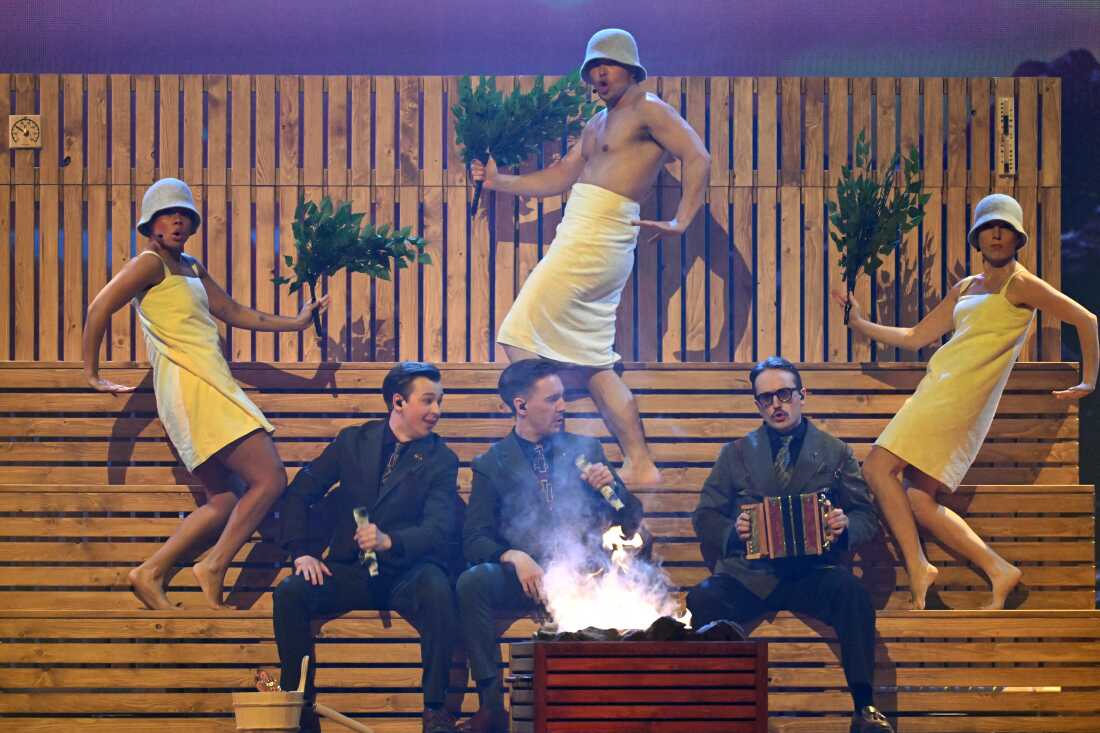
Finnish Group KAJ is representing Sweden at Eurovision with the song “Bara Bada Bastu.”
Sebastien Bozon/AFP via Getty Images
hide caption
toggle caption
Sebastien Bozon/AFP via Getty Images
This will be a clear televote favorite, given how assiduously it represents the epitome of pure, distilled, pharmaceutical-grade Eurovision. But I’m confident the juries will dig it too, because the songwriting is smart, the instrumentation is on point, and the sound mix is clean.
But wait! What about ….
There are a handful of other songs that Eurovision oddsmakers (yes, that’s a whole thing) think have a real shot at winning. I’m less convinced.
Austria’s “Wasted Love” by JJ takes a calculated risk by flipping the script on last year’s winner, Nemo’s “The Code.” Where that song offered up a club banger with a bit of opera drizzled over top like sauce, “Wasted Love” is just a great big bowl of opera sauce with a bit of club banger crumbled in. I like this song, but not until the beat drops – which happens 2 minutes and 15 seconds into a song that lasts 3 minutes.
France’s “Maman” by Louane has its vocal fans. It’s a lovely melody, well-sung, and the juries will love it – it just doesn’t have quite enough je ne sais quoi to single itself out for the televoters.
Finally: Never underestimate Ukraine – in Eurovision, or in life. Ziferblat’s “Bird of Pray” is fascinating, and the lead singer’s clear, piping voice is distinctive. But it’s six wholly different songs mashed together, and the moment it settles into one groove, it ditches that one for another. I don’t think the televoters will be able to hook into it, on first listen.
No, I stand by my picks. But there are plenty of songs in contention, so why not head over to the official Eurovision Song Contest YouTube page and check them out for yourself?
When you do, I’m confident you’ll reach the same inevitable conclusion I have, which is of course:
SAUNA!


The Kennedy Center on June 28, with its facade signage still covered by a tarp and scaffolding.
Alex Wroblewski/AFP via Getty Images
hide caption
toggle caption
Alex Wroblewski/AFP via Getty Images
On Wednesday, a federal appeals court denied President Trump’s request to stop the removal of his name from Washington, D.C.’s Kennedy Center. The signage on the building has been covered with tarp and scaffolding since June 13, but in a court filing last month, the center’s current executive director said that Trump’s name has been removed.
In their decision, three judges from the U.S. District Court of Appeals for the District of Columbia Circuit said that the president had failed to prove that the arts center would be “irreparably injured” without Trump’s name attached to it.

NPR requested comment from the Kennedy Center, but did not receive an immediate reply.
This latest round of court decisions is part of the ongoing litigation filed by Rep. Joyce Beatty, D-Ohio, against President Trump and the board of the Kennedy Center. In a statement emailed Wednesday to NPR, Beatty said: “Today’s ruling again affirms that this administration’s efforts to rename the Kennedy Center were unlawful. His name no longer desecrates this sacred memorial, which belongs to the American people. Now it is time for the Trump administration to accept this, comply with the law, and take the tarps down.”
In previous court filings, Trump’s legal team had asserted that removing the president’s name from the arts complex, both on the physical building and in its digital materials, would inflict irreparable harm in both time and money already spent. In the denial, the three judges — Patricia Millett, Robert Wilkins and Gregory Katsas — wrote that since Trump’s name has already been removed, “a stay would not avert those harms.”
Furthermore, Trump had claimed that without his name attached, future fundraising would be threatened “and [will] contribute to the financial decline of the Center.” In response, the appeals judges wrote: “Appellants, however, have failed to support this assertion with any specific facts or evidence. They offer only the conclusory assertions of the Kennedy Center’s Executive Director that were made in a factually unsupported declaration.” The center’s current executive director, Matt Floca, specializes in physical plant management.
The presiding judge in the case, Christopher R. Cooper, has ordered that the center provide him a status report on the center’s operation and programming before the end of this month. As of Wednesday, the center’s calendar lists a small roster of programs, including outdoor free movie screenings, workshops for children, and five free live performances in July on its Millennium Stage. In the past, the Kennedy Center presented over 2,000 arts and education events each year, including free daily Millennium Stage performances.
Lifestyle
A meal with an animated Mona Lisa? Immersive dining goes high tech — but will L.A. eat it up?

My dinner course is served. It is a Campbell’s-inspired soup can, lightly angled so strands of broccoli are peeking out. I lift the can to uncover a slow-braised short rib and mashed potatoes. An American dish to represent an American artist, here Andy Warhol.
The room is overtaken with projections, scenes of bustling New York traffic paired with bachelor-pad-like guitar riffs. Shown on a wall above a dinner table is a selection of Warhol silkscreens. It’s a Friday night in West Hollywood, and I’m surrounded by a mix of out-of-towners and those celebrating an anniversary. And while this is a special occasion, we’re urged to get a little messy with our food — to use our hands, to paint with a salad, to draw on a cookie.
The main course: A tomato soup can? “7 Paintings” is an immersive event that occasionally hides dishes in artist-inspired presentations.
(Christina House / Los Angeles Times)
Play is the primary side dish at “7 Paintings,” a tech-infused dinner theater that aims to be a crash course in fine art. That selection of veggies paired with multiple mini cups of colorful dressings? Guests are encouraged to mix and match the vinaigrettes into a mess of hues, a nod to abstractionist Jackson Pollock. And yellowfin tuna with dashes of avocado and taro chips? That’s an edible tribute to Banksy, of course. What does raw fish have to do with stenciled street art? It’s bold, heavily angled and has a short shelf life? Maybe? Perhaps don’t overthink it.

Even the paper is edible.
(Christina House / Los Angeles Times)
“Have you ever eaten a painting before?” says Nadine Beshir, the Dubai-based creator of “7 Paintings.” “We try to get people out of their comfort zones and eating paper. I want to bring out the child in them.”
“7 Paintings,” held at Sunset House L.A. through the end of August, is the latest example of immersive dining to arrive in this city. These experiences often involve guest participation and are accentuated with advanced multimedia technology and sometimes theatrical elements.
Worldwide, there have been standouts. For instance, Eatrenalin at Germany’s Europa-Park, a dining room-meets-ride where participants are whisked around the space on trackless “floating chairs,” has just received a coveted Michelin star. Ibiza’s Sublimotion has similar haute ambitions, pairing 12 diners together in a room that will come alive with otherworldly projections and performers. At times, diners will win don virtual reality headgear.
But tech-driven immersive dining experiences have never quite taken off in Los Angeles as a trend. Last year, the Gallery, where fantastical cityscapes and projections surrounded downtown L.A. diners, stood just a couple months before the concept was abandoned.

“7 Paintings” pairs food with art and music. It’s “fun dining, not fine dining,” says its founder.
(Christina House / Los Angeles Times)

Bartender Luca Famulari shakes a cocktail at the immersive dining event.
(Christina House / Los Angeles Times)
“The economics of a restaurant are not the same as the economics of theater and the challenge of combining the two lies in thinking outside the box with respect to pricing and cost structure, such that the customer perceives high value from both the food and the experience,” says the Gallery co-founder Daren Ulmer.
Entrepreneurs keep aiming for that careful balance. “Le Petit Chef and Friends” is currently running at Tangier at downtown’s Hotel Figueroa, an event in which a fully animated film is projected on our plates and tables. Long-running pop-up event Fork N’ Film leans more dinner and movie, pairing dishes directly inspired by what is happening on screen. Upcoming films include “Ratatouille” and “Lilo and Stitch.”
The field comes with challenges. “The costs are very high,” says Joanna Garner, an immersive designer and former creative director with experiential art firm Meow Wolf. Garner has been experimenting herself with communal, immersive dinner events, and her next, the flirtatious “Please Open Your Mouth,” is set for July 11. (No tech there, as Garner is after a more sensual, adult-focused gathering.) Tickets for her event are $150 and a spot in the “7 Paintings” dining room runs $175, priced on par with a number of city’s most acclaimed restaurants.
There is also the reality that all public dining is in some fashion immersive, usually requiring varying combinations of engagement, communication and presentation. And then, are all these added elements distracting?

An animated Mona Lisa sits on the wall as guests enjoy their meals. Throughout the dinner, the painting provides factoids on various artists.
(Christina House / Los Angeles Times)
Throughout “7 Paintings,” for instance, an animated Mona Lisa, situated on the wall next to the main dinner table, will provide brief biographical details of each artist represented.
“Being able to nail the food, and nail the story, those are two very difficult threads to weave,” Garner says. “I do think, ultimately, people come to a dinner table to talk to the people at the table and to have intimate experiences. To have an experience where you’re constantly being taken away from the food, I’m not so sure if that’s what people are looking for.”
Food is framed as a star of “7 Paintings” but tasting it is just one component. At one point, we must uncover a cheese course in a tiny treasure chest, the code for the lock hidden in the projections (don’t stress, it’s not a hard puzzle). Beshir highlights the Pollock-inspired salad course, which is accentuated with a jazz soundtrack, as the thesis of the evening.
1

2

1. A guest uses a silicon brush to apply sauces onto an entree, a nod to abstractionist Jackson Pollock. 2. Projections fill up the dining table during meals.
“This course is really about getting people to free their minds from preconceived ideas,” Beshir says. “Like, you have to eat with a fork and knife, or the salad comes and then the dressing. No, the dressing comes and then the salad, and it’s trying with big brushes to paint the way he did. A lot of people do not understand Abstract Expressionism, and they think it’s people just splashing colors around. But when you understand the link between the rhythm of the music and painting, you live it. We give you time to paint with your salad dressing.”
In L.A., Beshir has partnered with nightlife impresario Kim Kelly, who is plotting a “Sleep No More”-inspired walk-around theatrical show for the Sunset House venue later this year. “7 Paintings,” however, is fully seated, and purposefully a little silly. Beshir and Kelly have been evolving it during its L.A. run, recently adding a stronger painting component by giving guests their own canvas to work on throughout the evening. Each night crowns a winner.
“Everyone comes over to look at their art,” Kelly says. “It just kind of changed the whole thing, to be honest. People are now being creative throughout the entire evening. Instead of just watching and occasionally painting, you’re now painting the whole time.”
As for what, perhaps, soba noodles with edamame and mushrooms have to do with Pablo Picasso, or why Salvador Dali gets an unexpected dessert course of a white chocolate potato souffle, Beshir clarifies the goal of the evening. While the animated Mona Lisa will provide backstories on each painter, this isn’t an educational night. “It’s fun dining, not fine dining,” Beshir says.
And by the end of my night, strangers were socializing, showing off their painted cookie creations, sharing Banksy tidbits and asking for recommendations on various vinaigrette combinations. Ultimately, it’s an evening of discovery, packed with surprises like finding an entire course hidden under a canvas.

Darryl Mayes of Charlotte, N.C., left, and Taylor Smith of North Hollywood, right, uncover their course.
(Christina House / Los Angeles Times)
“We try not to have too much sophistication, like fried ants or something. I’m personally very adventurous in how I eat, but if I want to have this in 100 cities around the world, I cannot be too meticulous.”
And Beshir has big goals.
“I want this be your movie and dinner thing,” Beshir says. “I want people to be waiting for our next show, and to be able to afford to come every couple months.”
And to come home not with leftovers, but perhaps a painting of their own.
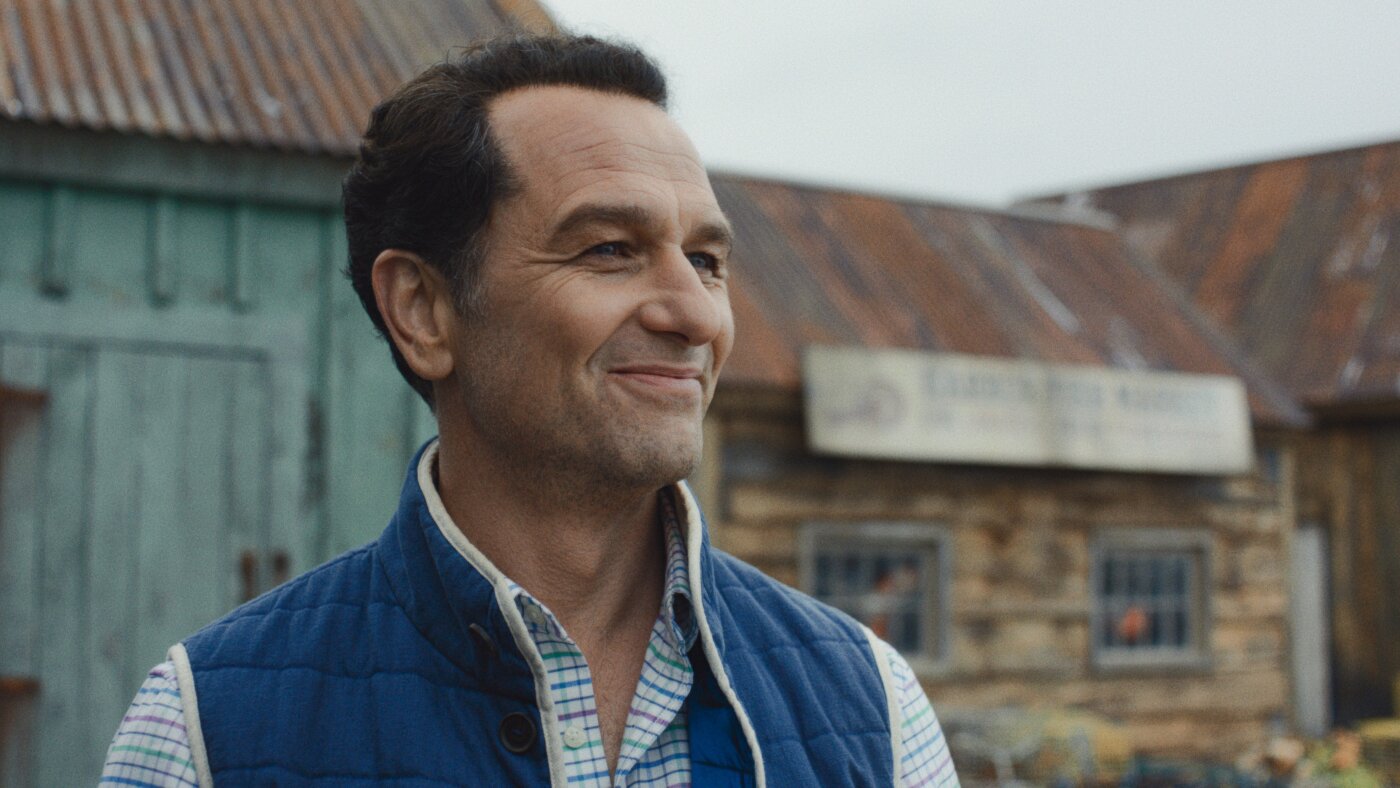
Matthew Rhys was nominated for his role in Widow’s Bay.
Apple TV
hide caption
toggle caption
Apple TV
The 2026 Emmy nominations are here. We’re unpacking the record-breaking nominations for Hacks, plus a big day for Widow’s Bay, The Pitt, and The Bear. We’ll also talk about the snubs and make some early predictions of who will win.
Connect with Pop Culture Happy Hour:
Letterboxd / Facebook
Our weekly newsletter
Support Pop Culture Happy Hour+
-
Lifestyle15 minutes ago
Appeals court denies Trump’s request to halt removal of his name from the Kennedy Center
-

 Technology23 minutes ago
Meta is reportedly working on smart glasses that would be recording all the time
-

 World30 minutes ago
Trump says ‘Iran lies and cheats’ as IRGC emerges as dominant force in negotiations with US
-

 Politics33 minutes ago
Who is Valli Geiger? Meet the Maine Dem that Platner urged to run for Senate
-

 Health38 minutes ago
Deadly Legionnaires’ disease outbreak sparks concern in major US city: Know the symptoms
-

 Sports45 minutes ago
Caitlin Clark’s return falls flat after Fever coach limits her in loss to shorthanded Sparks
-
Business53 minutes ago
Commentary: Trump wants to let companies make fewer disclosures, thus keeping investors in the dark
-
 Entertainment60 minutes ago
Justin Baldoni and wife break silence after ‘It Ends With Us’ legal battle with Blake Lively


