Lifestyle
Take a sneak peek into a legendary songwriter's creative process
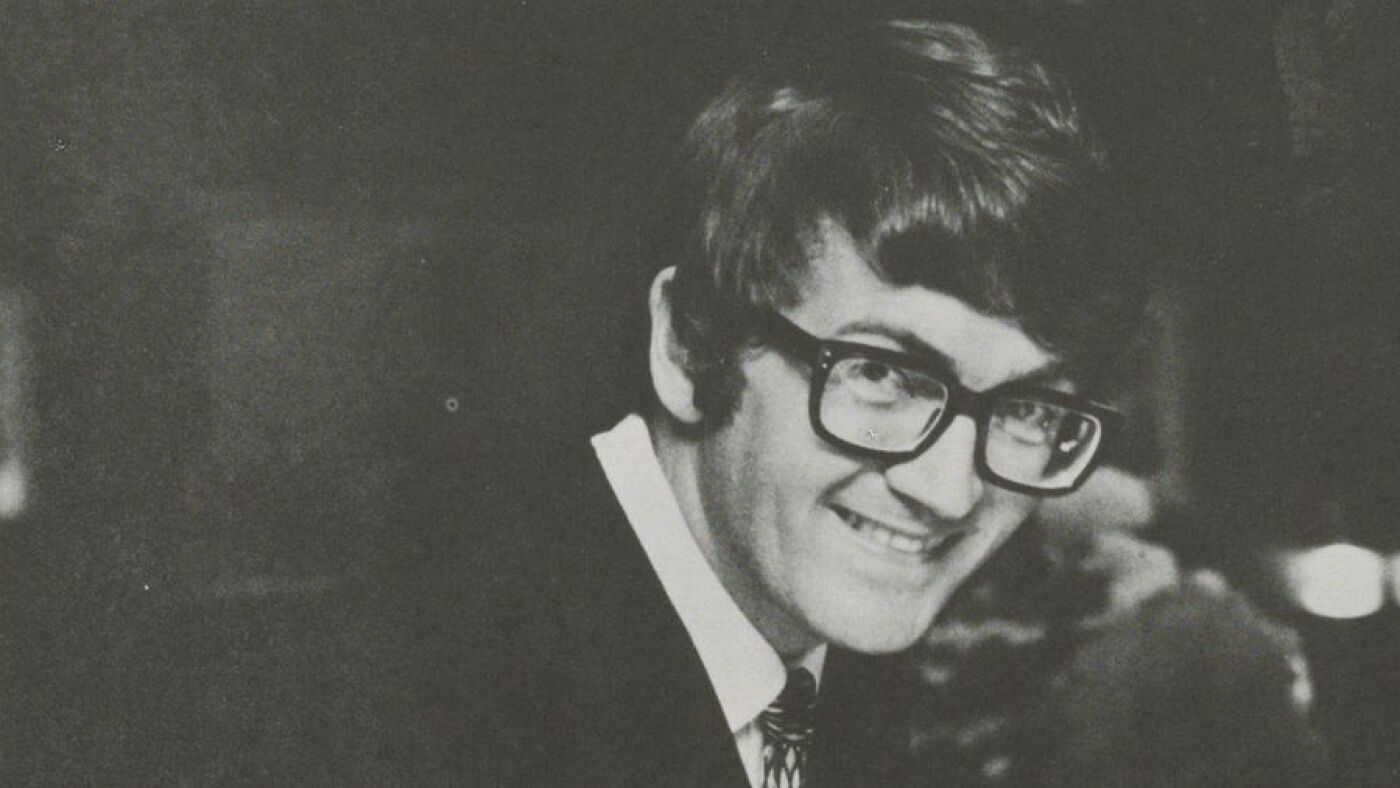
The Library of Congress acquired the papers of Leslie Bricusse an Academy Award-winning songwriter, earlier this year.
The Library of Congress
hide caption
toggle caption
The Library of Congress
You may not know the name Leslie Bricusse (pronounced Brick’-us), but you very likely hum some of the songs he’s written: “Pure Imagination,” “What Kind of Fool Am I?,” “Talk to the Animals,” Superman’s theme “Can You Read My Mind,” “Goldfinger.”
And remarkably, some 60 years after his heyday, the composer-lyricist is having a moment.
In A Quiet Place: Day One, a woman who may be the last human survivor on a Manhattan infested with aliens checks her iPod and pulls up Nina Simone singing “Feeling Good.” She needs a song to express defiance and how, as her world lies in ruins, she exults in being alive. Sentiments Bricusse put to music six decades ago seem perfect.
That same song popped up on the premiere of the Netflix series Obliterated to help a bomb defuser steady his hand. And family audiences spent last Christmas singing along with “Pure Imagination,” crooned by Timothée Chalamet’s Willy Wonka to tie him firmly with the Gene Wilder original.
Bricusse often wrote lyrics for other composers’ music. He wrote “Pure Imagination” and “Feeling Good” with Anthony Newley. At other times, he wrote both music and lyrics. He was a master of many styles, all of them entertaining, and it turns out that’s every bit as true of the papers his widow, actress Yvonne “Evie” Romain Bricusse, best known for co-starring with Elvis Presley in Double Trouble, donated recently to the Library of Congress.
Mark Eden Horowitz, a senior music specialist at the Library of Congress, where the Bricusse papers join those of Leonard Bernstein, Richard Rodgers, the Gershwins and others, says that in addition to the scripts, musical scores, notes for ideas on shows that never came together, recordings and other items, what’s remarkable about this particular collection is Bricusse’s notebooks.
“Just sort of drugstore notebooks,” he says, holding one out, “but he lived his life in these things.
“They’re beautifully calligraphed, most pages are numbered and often dated and indicate where he was in the world at the time, Acapulco on November third, 1986.” And then he does these amazing calendars.”
Calendars rendered in five or six colors, and necessary because “he’s constantly working on 10 or 12 projects at a time.”
Leslie Bricusse’s multicolored “Doctor Dolittle” calendar.
The Library of Congress
hide caption
toggle caption
The Library of Congress
Some of those, no one’s heard of. “For a long time, chuckles Horowitz, “he was working on a musical version of Henry VIII. I swear he considered 30 different titles, one of which was The King & I & I & I & I & I.”
There are lots of fun discoveries. Bricusse’s lyrics sound so natural that it’s hard to imagine they didn’t just spring from him that way, but the notebooks are where he polished them. Take page 58 in the one where he’s working on “Goldfinger.” He has heart of gold/this heart is cold….web of sin but don’t come in. But he has too many “golden”s, so in the notebook, he’s slashed through golden, in “the man with the golden touch” and replaced it with “Midas.”
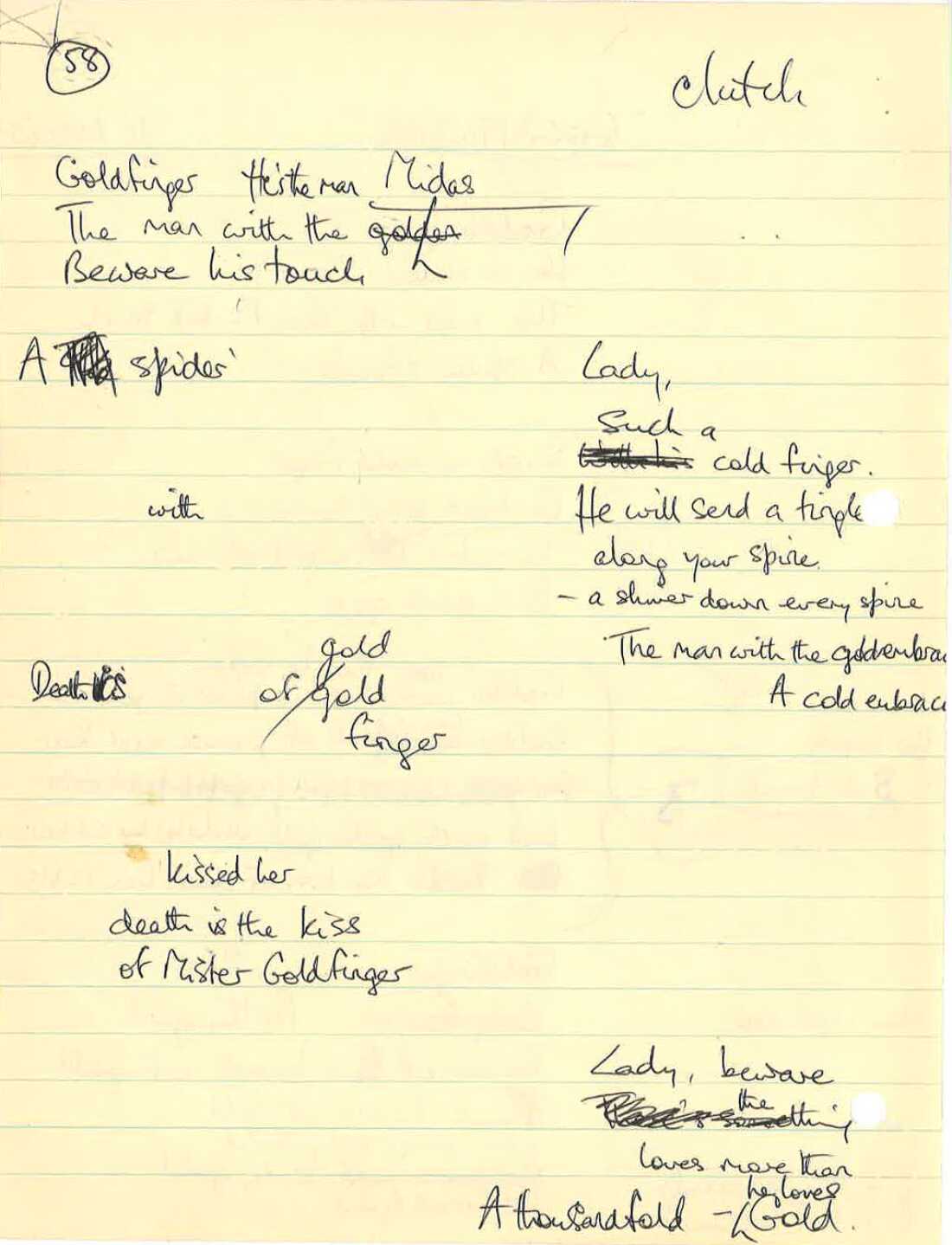
A sneak peek into Bricusse’s creative process as he worked on “Goldfinger.”
Library of Congress
hide caption
toggle caption
Library of Congress
That turned an OK line into a classic and goes much better with the next line that he already had: “A spider’s touch.”
That’ll be a fun find for somebody’s dissertation. Mixed in with that sort of thing is marginalia about theater, movies, budgets, life … seemingly whatever was on his mind.
“He asks himself questions,” says Horowitz, “he puts down what he’s thinking, asks himself should he be thinking that? Why is he thinking this? What should he do about it?” It’s his thoughts about everything that is ideal for researchers.
Asked whether George Gershwin did something similar, Horowitz almost laughs. “No. I’ve never seen a collection with this much-organized detail.”

A page from Leslie Bricusse’s notebooks.
The Library of Congress
hide caption
toggle caption
The Library of Congress
So, it is a treasure trove, but also one in which those details are sometimes puzzling — blocks of letters, say, in some of the margins. It turns out that’s how Bricusse wrote out the melodies — not with musical notes on sheet music as most composers do, but using the alphabetical letters that represented the notes. C, A, B-flat, and so on. Horowitz figured out how to read them and how to play the melodies if asked.
These pop songs were Leslie Bricusse’s life work. The notebooks, decorated, colorized, wildly ornate, feel — perhaps inadvertently — like art, themselves.
Horowitz, noting that Bricusse’s widow is an artist and that they collaborated on some things together, agrees. “Clearly, yes, he has a sense of design, and color, and he seems to want to keep things lively and interesting and attractive.
“I think he’s an entertainer in every sense. He wants people to be bubbling joyous; I think he’s always looking for the rainbow, for the magic.”
Judging from the notebooks that have found a new home in the Leslie Bricusse Collection at the Library of Congress, he found it.

Lifestyle
Firings at CBS’ ’60 Minutes’ reflect the fight for media control in the age of Trump
Correspondents of CBS’ 60 Minutes pose for a portrait in 2023. From left to right, they are Sharyn Alfonsi, L. Jon Wertheim, Bill Whitaker, Lesley Stahl, Scott Pelley, Cecilia Vega, and Anderson Cooper. Former Executive Producer Bill Owens sits on the far right. Only Wertheim, Whitaker and Stahl remain at the program.
CBS Photo Archive/CBS via Getty Images/CBS
hide caption
toggle caption
CBS Photo Archive/CBS via Getty Images/CBS
Stay up to date with our Up First newsletter sent every weekday morning.
When CBS fired Scott Pelley on Tuesday night, the new 60 Minutes executive producer, Nick Bilton, told Pelley it was for insubordination at a staff meeting the day before.
The veteran correspondent argues he was defending the DNA of 60 Minutes and the integrity of its journalism.
The battle royale over the network’s most prestigious and profitable news program is part of a broader fight over the direction of CBS News.
And given CBS’s acquisition by a billionaire family whose business interests have become intertwined with the political interests of President Trump, it reflects a larger war over control of the media in the current moment.

That father and son, Larry and David Ellison, bought CBS’ parent company, Paramount, last summer. In January, they became co-owners of TikTok’s U.S. operations. Now they’re seeking approval from Trump’s regulators to buy Warner Bros. Discovery, the parent company of CNN.
A glamorous show shorn, for now, of most its stars
CBS fired Cecilia Vega, a correspondent, and Tanya Simon, the executive producer, from 60 Minutes last week. They are shown in this photo at the 2026 White House Correspondents’ Association Dinner on April 25, 2026 in Washington, D.C.
Kristina Bumphrey/Variety via Getty Images/Variety
hide caption
toggle caption
Kristina Bumphrey/Variety via Getty Images/Variety
But the specifics of this individual episode matter — for 60 Minutes, CBS, its audience of millions, and even the news business itself.
The program has been the most glamorous post in broadcast news. The correspondents are the stars of the show. And now, there are just three of them.
Anderson Cooper left last month, concerned over the direction of the network’s coverage. Last week was a virtual bloodbath: correspondents Cecilia Vega and Sharyn Alfonsi were fired. So were a producer and two show executives — including Tanya Simon, a longtime staffer who had stepped up as executive producer when her predecessor resigned in protest before the Ellisons’ takeover.

With Pelley’s ouster, only correspondents Lesley Stahl, Bill Whitaker, and Jon Wertheim remain. Now they are considering whether to resign, according to two associates with knowledge.
Their brand-new boss, Bilton, was previously a tech reporter for The New York Times and an investigative reporter for Vanity Fair. He executive-produced a documentary for Netflix about a couple accused of laundering Bitcoin and has been a producer on several other films.
Notably, he has no experience in television news.
Neither does Bari Weiss, whom David Ellison installed as the network’s editor in chief last October. The Ellisons also bought her center-right views-and-news site, The Free Press.
She has maintained that the network of Walter Cronkite needs a makeover for the digital moment. She has also contended for years that CBS, along with the rest of mainstream media, is too reflexively anti-Trump, anti-Israel, and too woke.
A rejection of CBS News executives’ overtures
The new executive producer of 60 Minutes, Nick Bilton, has been a tech journalist and documentary filmmaker, but lacks experience in broadcast news.
Matt Winkelmeyer/Getty Images/Getty Images North America
hide caption
toggle caption
Matt Winkelmeyer/Getty Images/Getty Images North America
Bilton attempted to set a conciliatory tone at Monday’s meeting — his first with the show. Pelley, a formidable veteran correspondent and former CBS Evening News anchor, wasn’t having it.
Pelley called Bilton unwelcome and unqualified. And Pelley said that Weiss was attempting to “murder” the program.
In firing Pelley on Tuesday, Bilton said the journalist had hijacked the meeting and rejected overtures to work constructively through their differences. (NPR obtained a copy of the firing notice.) Bilton wrote that Pelley’s “antipathy to the future of the show came through loud and clear.”
In his own statement late Tuesday evening, shared with NPR, Pelley accused CBS’s new news leadership of killing 60 Minutes‘ DNA and pushing him “to inject falsehoods and bias into a politically sensitive story” and “to include assertions that are unverified.”
The accusations, to which CBS has not yet responded, echo those made by Alfonsi and Vega, the two correspondents fired last week.
Earlier this year, Alfonsi publicly complained after Weiss held one of her stories at the last minute, and kept it frozen for weeks, demanding an on-camera interview with a Trump White House official that never played out. It ran, unchanged from the intended version, with additional statements from the administration tacked on to the end.
After being fired, Vega said in a statement obtained by NPR that her team had “experienced efforts to insert political bias into our stories.”
“Let’s call this what it is: censorship, both censorship and self-driven” Vega continued. “It is dangerous for the show and dangerous for democracy.”
Weiss previously rejected Alfonsi’s and Vega’s allegations. (CBS said Vega’s claims, for example, were “not based in reality” while expressing appreciation for her work.)
Weiss and Bilton say digital threat requires a 60 Minutes overhaul now
In a meeting this morning, Weiss said that Pelley chose his own path — that is, to be fired rather than to find a way to work through his concerns, according to attendees. The network and Weiss have not yet publicly addressed Pelley’s accusations of interference.
Bilton and Weiss say they respect the show’s traditions, its accomplishments and its legacy of enterprise reporting, extended interviews and visual storytelling. It rose in the ratings 9% over the past season under Simon.
The two news leaders say, however, 60 Minutes needs to be overhauled before it becomes increasingly irrelevant in the era of streamers and other sources of news, information and entertainment in the digital age.
Interviews with 12 current and former CBS News staffers, from producers to executives, suggest great reservations and suspicions remain about Weiss’ judgment and her ability to handle the prominent and even famous journalists on whom her division relies.
Weiss had initially sought to reinvent the CBS Evening News, dropping a two-anchor format that had sagged in the ratings. Cooper turned down Weiss’ overtures to anchor it and left the network altogether, concerned about her approach, according to associates. (They spoke on condition of anonymity because Cooper has not chosen to speak publicly on the matter.)
David Ellison became chairman and CEO of CBS’ parent company, Paramount, after buying it last year.
Noam Galai/Getty Images for Paramount/Getty Images North America
hide caption
toggle caption
Noam Galai/Getty Images for Paramount/Getty Images North America
The ratings have continued to sag under new anchor Tony Dokoupil. And some CBS journalists, including producers who have left the Evening News, have publicly accused Weiss of making editorial decisions driven by politics. She has rejected those claims.
The decision to take on overhauling two key shows — one listing, one highly profitable, both high profile — carries significant risks for Weiss and the network, even apart from other considerations.
But the Ellisons’ presence cannot be ignored.

When Shari Redstone was negotiating the sale of CBS’s parent company, Paramount, to the Ellisons’ Skydance Media last year, the network announced the end of Stephen Colbert’s late night show. He had been one of the president’s most biting and acerbic critics.
David Ellison also made a series of concessions directly to Trump’s chief broadcast regulator, Federal Communications Commission Chair Brendan Carr, gutting CBS’s diversity, equity and inclusion initiatives and appointing a conservative ombudsman to field complaints of bias against its news reporting.
Carr and other regulators approved the Paramount deal last summer.
The accommodations echo those made by other media titans.
Amazon and Blue Origin founder Jeff Bezos remade the editorial pages of the Washington Post, which he owns, into a far more hospitable zone for Trump at the outset of his second term. So did Los Angeles Times owner Dr. Patrick Soon-Shiong, a noted medical device inventor. Amazon and Blue Origin have multi-billion dollar contracts with the federal government. Soon-Shiong’s medical research firm routinely has patent applications up for review with federal regulators. One was approved Tuesday.
The Ellisons are hoping to win approval from federal regulators next month for their purchase of Warner Bros. Discovery in a deal valued at more than $110 billion. It would include Warner Bros. Studio, HBO and CNN, among other properties.
As Weiss routs CBS News’ old guard, the question of what role she might play at CNN — and what changes that portends at CBS — hangs over journalists at the two networks. The fate of 60 Minutes serves as a high-stakes case study for both.
Lifestyle
We’re having a main character summer. Are you? : It’s Been a Minute
Lifestyle
Vintage-obsessed millennial parents are driving L.A.’s booming kids’ clothing resale market
Kids’ vintage clothing sales are experiencing a remarkable boom at in-person markets and online, where prices for clothes for little ones have shot up on websites including Depop and Poshmark. Millennial parents are looking to outfit their kids in the clothes and TV and film characters they loved (or coveted) when they were kids.
The result? There’s a new generation of kiddos hitting the playground looking incredibly cool. Take Amari Case, a SoCal toddler who spent a Sunday afternoon this spring ambling around a vintage market in a West Hollywood warehouse clad in baggy jeans and a ’90s-era tee emblazoned with the “Dragon Ball Z” character Son Goku.
When she wasn’t scribbling on a Lorax coloring sheet, she’d been cruising around the market with her dad, Aaron Munoz Case, snapping up new pieces destined to make her the flyest kid at the preschool playground.
Neil Wright, from left, Kristine Nite Scalzo and Brandon Rosenblatt, co-founders of Elemeno Kids Vintage Market.
Showing off Amari’s new vintage satin L.A. Raiders jacket and tiny teal Grant Hill Detroit Pistons jersey, Munoz Case, who was also impeccably dressed, noted that while Amari went through a phase at about 18 months where she wanted to dress herself, eventually she gave up and went back to letting her dripped-out dad dictate her wardrobe.
Munoz Case found Amari’s first vintage piece at the Rose Bowl Flea Market and got the bug, going back every month to pick up something to add to his little’s wardrobe.
Trendspotters and researchers say Munoz Case isn’t alone in his quest. The market for kids’ vintage clothing has heated up precipitously over the last few years, perhaps hitting a boiling point in January when an Eeyore romper from the ’90s sold for over $3,000 on EBay. (It was new with tags, but one without tags still went for almost a grand about a month later.)
The thirst for tiny throwbacks is so popular that first-ever, all-kids market Elemeno — named after the “L-M-N-O” bit of “The Alphabet Song” and where Amari was toddling and shopping — drew 17 vendors and over 2,000 attendees over a single weekend in March. (There are plans for another Elemeno Kids Vintage Market pop-up later this year in New York, as well as plans to bring the event back to L.A. sometime next year.)
1. Cameron Scalzo, wearing a vintage McDonald’s T-shirt from the ‘90s, and mom Kristine Nite Scalzo. 2. Cameron Scalzo rocks an Avirex jacket from the ‘90s.
Eye Speak Vintage’s Kristine Nite Scalzo, who co-organized the event and is opening an all-kids vintage store in Pasadena this month, says she fell under the kids vintage spell in 2020 when she was pregnant with her son. She’d always been a vintage shopper for herself, so she knew she wanted to pass the passion down to the next generation. She started filling up her son’s closet, and soon enough, she found herself selling her other finds out of a bodega in her garage.
She has a by-appointment space in Pasadena now, where she draws everyone from Rihanna’s stylist to out-of-town moms who make a point to stop by on their way to Disneyland. “The community around kids vintage has really skyrocketed on Instagram over the past six years,” Scalzo says. “We want to know who we’re buying from. We want to know that we’re doing good with buying secondhand. And it’s a hobby for people that can turn into a possible business on the side. Because knowing there’s a big group that’s interested in vintage kids clothes, you can always pass an item [your kid outgrows] to someone else or resell it.”
Scalzo says some parents are out digging through bins at the Goodwill Outlet looking for the perfect piece, while others are content to pay up for, say, a ’90s Simpsons T-shirt or a mini-size Harley-Davidson jacket. Scouring the racks at the Elemeno market, most pieces cost $15 to $40, though there were special pieces pulled to the side in some booths with price tags that could make a parent’s eyes pop. (Think $275 for a set of well-worn Spider-Man overalls from the ’00s or $150 for a pair of Cross Colours denim shorts from the ’90s.)
In kids and adult vintage alike, mint condition is highly valued. No matter the era in which they were raised, kids tend to be messy. They get strawberry juice on their shirts or scuff up the knees on their Bugle Boy jeans. Vintage kids clothes that look pristine are more expensive, and while plain kids clothes do sell, items with characters on them or cool prints tend to draw more attention and dollars.
Brandon Rosenblatt, another of the Elemeno organizers, says he’s had his eye on a specific kids “Back to the Future” shirt for some time, but notes that it typically sells for about $1,000. He’s partial to McKids clothes for his daughter, from McDonald’s short-lived kids clothing brand, noting that he’s even snagged her a vintage official McDonald’s-themed aloha shirt from Hawaii, something he says he’s never seen anywhere else.
1. Siblings Amora and Milo Castilo wear vintage cowboy hats, jackets and chaps. 2. Thalia Castilo and her kids Amora and Milo.
Other collectors, he says, might be a little less obscure, leaning into mainstream characters such as Strawberry Shortcake or from ’80s and ’90s properties including “The Land Before Time” and “Rugrats.”
“A lot of millennials are having kids — like everyone who’s in their 30s and 40s — and they all want to put their kids in the same IP they grew up in,” Rosenblatt says.
“It’s the thrill of the hunt that gets everyone so excited,” Scalzo says. “Once you find that perfect nostalgic piece, you’re like ‘Holy s—,’ and you just want to chase that feeling again and again.”
Mia De La Rosa, a reseller who was at the Elemeno market, says that like Scalzo, she started buying kids vintage clothes when she was pregnant with her daughter, Liv, who’s 6 now, very into everything on PBS Kids and has a closet full of thrifted vintage garb covered in characters such as D.W., the annoying little sister from the ’90s show “Arthur.”
Everything Liv wears is “completely her style,” De La Rosa says. “She dresses herself every day and she gets compliments on what she’s wearing at school all the time.”
Other vintage-wearing kids — and in particular younger ones — might simply be sporting what their parents like or might just like the look of the shirt even if they don’t know what it’s advertising. (An 8-year-old boy at the Elemeno market, for instance, chose to wear a pristine T-shirt highlighting the ’90s Jim Carrey movie “The Mask” because it featured his favorite color: green.)
Derrick Broaster, a vintage enthusiast turned full-time reseller, says that while he chooses to put himself in clothes from the ’60s and ’70s, he outfits his two sons in clothes from the 2000s. (“How Bow Wow used to dress when he was a kid,” he says.)
Although his younger son tends to rebel against Broaster’s vintage picks, opting for whatever Spider-Man shoes happen to be in his eyeline, his older son has leaned in, letting his dad advise him on what vintage pieces could work and what would be the most stylish.
1. Julian, left, and Javier Gutierrez show off their vintage clothing. Javier says his mom always tells him to keep his vintage outfits clean. 2. Mom Priscilla Guzman, clockwise, Dad Javier Gutierrez and sons Julian and Javier Gutierrez enjoy the vibe of vintage clothing. Guzman says she’s been buying and selling kids’ vintage since her oldest son was born eight years ago.
Rosenblatt says a good portion of what vintage finds he sees in the market now has returned to the U.S. from places in Central America and South America or Asia where those pieces were likely sent decades ago after they were donated or given away.
“There’s a real underbelly of this vintage game with rag houses getting access to bulk product overseas and letting people sort through it,” he says. “There are companies now that rip through 20, 30 or 40,000 pieces of vintage clothing a week. It’s a really interesting ecosystem.”
For many kids vintage sellers, finding their stock is just as fun and interesting as getting it back into consumers’ hands. “Anywhere we can find clothes, we’re there,” says Matthew Carlos, owner of Long Gone Youth. He started selling vintage clothes 11 years ago, when he was 15, switched to kids vintage at 20 and has spent the last six years scouring flea markets, websites and swap meets.
“The kids market is definitely growing,” he says, “but I still feel like we haven’t even gotten close to where we can go. It’s just getting popular now, but the more events [like Elemeno] we can do, the more it’ll go mainstream.” Even now, some major brands like Gap and OshKosh B’gosh have recognized the interest in some of their styles from the ’80s and ’90s, moving to re-release the looks in limited runs.
Jackie and Frank Oropeza with daughter Rumi Mae shop at Elemeno Kids Vintage Market.
Kids resale is also leaning into streetwear culture. Rosenblatt, who worked in the streetwear industry, says that he’s noticed that a good portion of those interested in kids vintage — particularly, male shoppers — tend to be fans of streetwear brands like Supreme, Fear of God Essentials and Bape. At Elemeno, for instance, a good portion of the parents we saw pushing strollers were well-dressed dads seemingly on solo missions, something you don’t always see at kid-centric events.
“I just want my son to feel like I did as a kid,” said Justin Nguyen, while watching his toddler, Jayden, play with bubbles. “I want him to be happy, carefree and joyful, and I want to be able to spend time with him. My mom and dad were always working, even on the weekends. Now that I’m a dad, taking my son out on weekends to do stuff like this just seems like a blessing.”
-
News3 minutes agoNational Guard has done little to reduce violent crime in D.C., a new study finds
-
Los Angeles, Ca1 hour agoMan claiming to be armed robs Culver City bank, gets away with $10,000
-
Detroit, MI2 hours agoFired Detroit TV anchor Taryn Asher files sex discrimination lawsuit against old station, claims new GM protected men
-
San Francisco, CA2 hours agoSan Francisco family devastated as they face nearly 90% rent increase
-
Dallas, TX2 hours agoWings’ top pick Azzi Fudd hosts clinic as Cash App donates to Dallas nonprofit
-
Miami, FL2 hours agoPatients left scrambling for care after Miami-Dade woman accused of operating an unlicensed surgery recovery center
-
Boston, MA2 hours agoClover plans to reopen some locations after sudden closure, thanks to an anonymous investor
-
Denver, CO2 hours agoNew report finds Denver metro home buyers and sellers experiencing ‘unattainability fatigue’