Lifestyle
Sunday Puzzle: -IUM Pandemonium


Sunday Puzzle
NPR
hide caption
toggle caption
NPR

On air challenge
The suffix -IUM ends the names of most metallic elements. But it’s also the ending of other words that aren’t elements. Answer these clues for them.
Ex. Boredom –> TEDIUM
1. Size between small and large
2. Fish tank
3. Skull
4. Platform for a speaker
5. Large hall for physical exercise
6. Sun room
7. Building in which the stars of the night sky are projected on the ceiling
8. Individually owned apartment
9. Payment to a speaker
10. State of acute mental confusion
11. Garden flower also known as a cranesbill
12. Thousand years
Last week’s challenge
Last week’s challenge came from Alan Hochbaum, of Duluth, Ga. Think of two hooved animals. Take all the letters of one of them and the last three letters of the other, mix them together, and you’ll get the first and last names of a famous actress. Who is it?
Answer:
Bo Derek
Winner
Anthony Baio of San Diego, CA.
This week’s challenge
This week’s challenge comes from Michael Schwartz, of Florence, Ore. Name something in 7 letters that’s designed to help you lose weight. Insert the letters EP somewhere inside this word to get a two-word phrase naming things that are likely to add weight. What words are these?




A screenshot from the all-out winner of the 46th annual Razzie Awards, War of the Worlds, starring Ice Cube.
Amazon Prime Video
hide caption
toggle caption
Amazon Prime Video
A surveillance industry take on HG Wells’ 1898 classic sci-fi novel War of the Worlds starring Ice Cube cleaned up at the 46th Annual Golden Raspberries, or Razzie Awards.
The Razzies are a parody of the Academy Awards, and celebrate Hollywood’s most embarrassing efforts every year ahead of the mainstream ceremony on Oscars weekend.
War of the Worlds won five Razzies in total: worst remake, worst actor, worst screenplay, worst director, and worst picture. Critics panned the movie; it scored abysmally low ratings on Rotten Tomatoes.
In a news release about its selections, members of the Golden Raspberry Foundation, a voting body of more than 1,200 movie fans, journalists, and film industry professionals from the U.S. and around the world, described the direct-to-video War of Worlds remake as a “cult hate-watch classic” and “a near sweeper of our $4.97 trophy.”
Razzie voters awarded Ice Cube with the Worst Actor award for his role as a Department of Homeland Security surveillance expert in this film. They also anointed Australian star Rebel Wilson Worst Actress for her “not-quite-believable performance as an action hero in Bride Hard with weaponized curling irons.”
Neither the Worst Actor nor Worst Actress winners immediately responded to NPR’s requests for comment about these dubious honors.
The Razzies for worst supporting cast went to Scarlet Rose Stallone for Gunslingers, and all seven of the CGI-enhanced dwarves in Disney’s live-action Snow White remake. “It cost a fortune and lost a fortune,” the Razzie press release said of the latter. (According to Forbes, the film lost $170 million of its massive $300 million budget.) “Perhaps cursed by Walt himself for having ignored his dying wish for it never to be remade.”
The winner of this year’s Redeemer Award – an accolade bestowed upon a previous Razzie nominee or winner for making a critical or commercial comeback – went to Kate Hudson for her Oscar-nominated performance in Song Sung Blue. Hudson’s name has shown up on Razzie hit lists over the years for her performances in My Best Friend’s Girl (2008), Mother’s Day (2016) and Music (2021).
The Razzies were launched in 1981 by Hollywood publicist John J. B. Wilson to “celebrate” the least compelling movies of 1980. The top prize winner that year was Can’t Stop the Music.
Full list of 46th Razzie Award Winners:
WORST PICTURE – War Of The Worlds (2025)
WORST ACTOR – Ice Cube / War Of The Worlds (2025)
WORST ACTRESS – Rebel Wilson / Bride Hard
WORST SUPPORTING ACTRESS – Scarlet Rose Stallone / Gunslingers
WORST SUPPORTING ACTOR – All Seven Artificial Dwarfs / Snow White
WORST SCREEN COMBO – All Seven Artificial Dwarfs / Snow White
WORST PREQUEL, REMAKE, RIP-OFF or SEQUEL – War of the Worlds (2025)
WORST DIRECTOR – Rich Lee / War Of The Worlds (2025)
WORST SCREENPLAY – War Of The Worlds (2025) / Kenny Golde, Marc Hyman
RAZZIE REDEEMER AWARD – Kate Hudson / Song Sung Blue

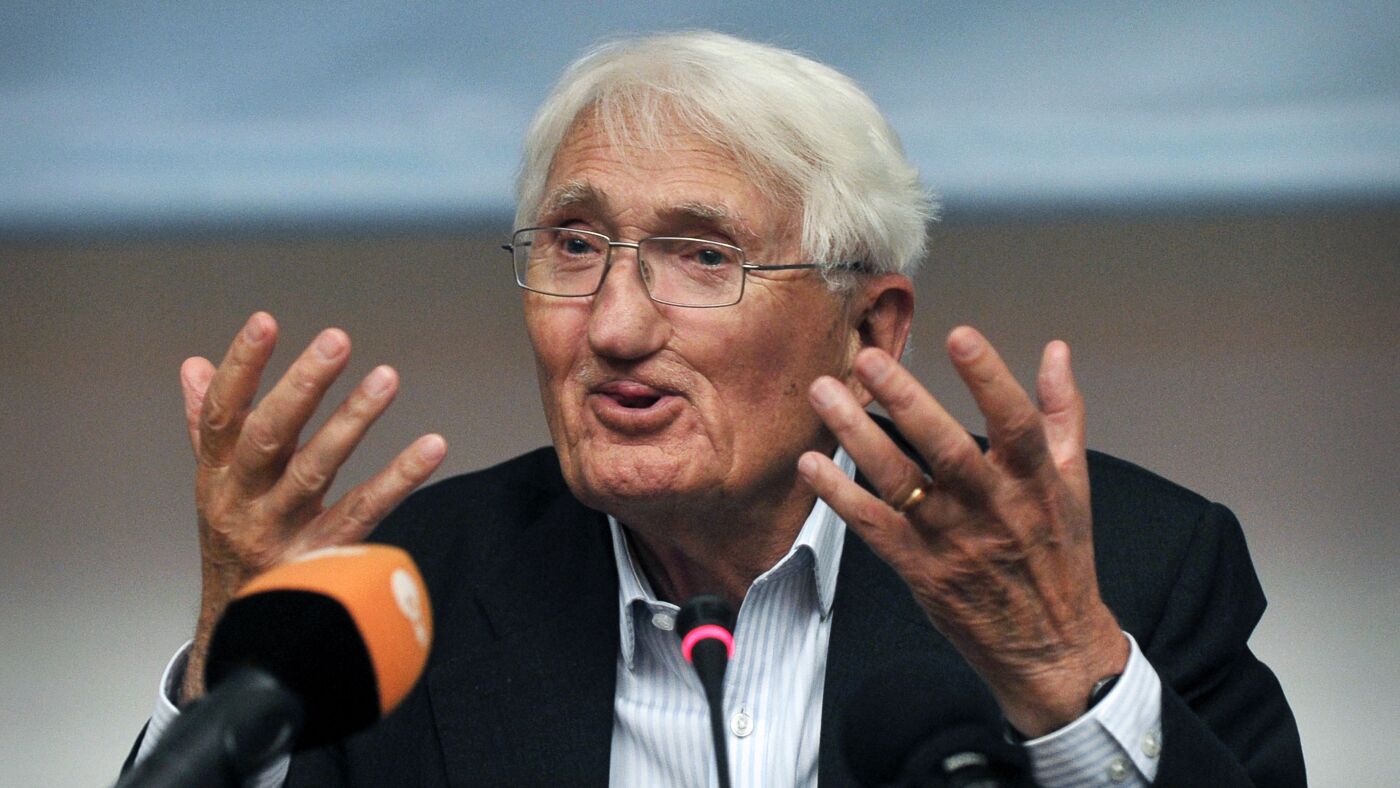
Internationally renowned German philosopher Juergen Habermas speaks to journalists in an auditorium of the Philosophical School of Athens in 2013.
Louisa Gouliamaki/AFP via Getty Images
hide caption
toggle caption
Louisa Gouliamaki/AFP via Getty Images
The German philosopher and influential thinker on modernity and democracy Jürgen Habermas died Saturday in Starnberg, Germany at the age of 96.
Habermas’ death was confirmed in a statement on the website of his Berlin-based publisher, Suhrkamp Verlag.
“His work, published by Suhrkamp since the 1960s and translated into more than 40 languages, continues to resonate worldwide,” said the head of the publishing house, Jonathan Landgrebe, in the statement. “We mourn the loss of a significant philosopher, ever-present advisor, and dear friend.”
For more than 60 years, Habermas helped shape the political discourse in Germany, particularly during the postwar and post-reunification eras.
He was perhaps best known for introducing the concept of the “public sphere” – a space for public discourse beyond state control, and therefore essential to a healthy democracy.
“Germany and Europe have lost one of the most significant thinkers of our time,” noted German Chancellor Friedrich Merz.
Habermas shot to prominence in the mid-20th century as a member of the Frankfurt School, which was critical of capitalism, fascism, communism, and orthodox Marxism.
Throughout his career, he stressed the importance of confronting the Nazi era as uniquely criminal, insisting that postwar-German democracy must recognize and reckon with its guilt.
Friedrich Ernst Jürgen Habermas was born in 1929 in Düsseldorf into a middle-class Protestant family. Like many children of his generation, he joined the Hitler Youth as a boy and was drafted into the German military in 1944. He soon became a strong critic of the Nazi regime.
After the war, he studied philosophy, history, psychology, German literature, and economics in Göttingen, Zurich, and Bonn. As a student at Göttingen University, Habermas criticized Martin Heidegger, the greatest living German philosopher of the time, for a remark Heidegger had made nearly two decades earlier and never retracted concerning “the inner truth and greatness of the Nazi movement.”
“Habermas was a modern day Aristotle or Hegel for whom no precinct of culture or science was alien and a gifted polemicist and partisan in the great German political debates of the postwar and post-reunification era,” said Matthew Specter, an intellectual historian at Santa Clara University, in an email to NPR. “He was a philosopher who taught Europeans how to ‘learn from disaster’ by committing to the practice of reason and a radical liberal whose thought remains a resource for resisting illiberalism, nationalism and authoritarian currents worldwide.”
Habermas’s lectures and books were famously dense. He taught at, among other institutions, the Universities of Heidelberg and Frankfurt am Main, as well as the University of California, Berkeley, and was director of the Max Planck Institute for the Study of the Life-Conditions of the Scientific-Technical World in Starnberg.
His “Theory of Communicative Action” published in 1981 is perhaps his best known work and is considered a foundation of 20th-century critical theory.
“Habermas has been able to go into discussions in political theory and sociology and psychology and legal theory and a dozen different disciplines and become one of the dominant voices in each one,” said former Georgetown University president John DeGioia when introducing the influential thinker before a lecture in 2012.
The philosopher won many awards, such as the prestigious Erasmus Prize in 2013, bestowed by the Dutch Praemium Erasmianum Foundation to individuals or institutions for exceptional contributions to European culture, society, and social science.
As lionized as he was, Habermas’s ideas also came under severe scrutiny. Among other issues, he has been criticized over the years for espousing an idealized theory of communication that ignores power imbalances and practical realities.
Habermas never lost his sense of unbridled hope and insistence on democratic ideals. “Democracy depends on the belief of the people that there is some scope left for collectively shaping a challenging future,” he wrote in a 2010 article for The New York Times.

Fans fill the stands at Denver’s Ball Arena for professional women’s hockey game, hope for a home team

Photos: Emerald City goes green for St. Patrick’s Day Parade on Seattle’s waterfront

Men’s March Madness Snubs: San Diego State, Auburn Left Out of NCAA Tournament Field

Blizzard warning closes Milwaukee Public Schools and these other districts in Milwaukee area

Atlanta leaders celebrate 100th birthday of civil rights icon Rev. Ralph David Abernathy

Florida High School Football Rankings: Top 25 teams – Oct. 21

How old is Bo Nix? What to know about Oregon quarterback ahead of 2024 NFL Draft

Cleary's 21 help Le Moyne down Central Connecticut State 69-64 in OT

99th annual Pony Swim held in Virginia

Indiana Members Credit Union announced as new anchor tenant at Bottleworks District

Top California librarian questioned about missing $650K tied to Dolly Parton child literacy program

Jamal Rayyan, the first face of Al Jazeera, dies at 73

These are the casualties and cost of the war in Iran 2 weeks into the conflict

Trump-backed Potomac sewage cleanup complete after massive spill ahead of summer America250 celebrations

Russian strikes kill at least four people in Ukraine’s Kyiv region
-

 Detroit, MI1 week ago
U.S. Postal Service could run out of money within a year
-

 Oklahoma1 week ago
OSSAA unveils Class 6A-2A basketball state tournament brackets, schedule
-

 Michigan6 days ago
Operation BBQ Relief helping with Southwest Michigan tornado recovery
-

 Southeast6 days ago
‘90 Day Fiancé’ alum’s boyfriend on trial for attempted murder over wild ‘Boca Bash’ accusations
-

 Health1 week ago
Ancient herb known as ‘nature’s Valium’ touted for improving sleep and anxiety
-

 Oklahoma1 day ago
Family rallies around Oklahoma father after head-on crash
-

 Nebraska3 days ago
Wildfire forces immediate evacuation order for Farnam residents
-

 Tennessee1 week ago
Lady Vols fall to Alabama in SEC Tournament for seventh loss in row