Lifestyle
'Splinters' is a tribute to the love of a mother for a daughter


When Leslie Jamison’s daughter was 13 months old, she and her husband, the baby’s father, C, separated.
Splinters: Another Kind of Love Story, the famed essayist’s newest book, follows this rupture — some of what preceded it but mostly what came after. The book has received plenty of advance buzz, much of which positions it as being about her relationship with C and their divorce, which I found puzzling; C is certainly a part of the book, but a small one, flitting in and out of view, never coming into full focus. His privacy is kept intact — Jamison mentions a child from his first marriage and acknowledges that she and C agreed she wouldn’t write about them — to the point where he presents as somewhat of a cypher. Which is to say that readers looking for a juicy narrative mired in the throes of marital drama will be disappointed. Those who take the book’s subtitle seriously, however, will find much to admire and enjoy in its pages, which are, more than anything else, a tribute to the rapturous love Jamison has for her daughter, as well as her attempts to love, or at least accept, the parts of herself that thrive in intensity and turmoil.
Jamison briefly narrates the whirlwind relationship she and C had, how he casually proposed to her while they were lying in bed in a garret in Paris. She’s aware, at least in hindsight, that she agreed to the marriage less because she wanted to commit to him, specifically, or to the life that the two of them as particular individuals could build. Instead, she admits: “I said yes, because I was in love with him, and because I wanted my whole self to want something, no questions asked.” When they married shortly thereafter in Las Vegas, she hoped she “could become a person who didn’t change [her] mind. That sounds ridiculous when you say it plainly, but who hasn’t yearned for it? Who hasn’t wanted a binding contract with the self?” This is the book’s second major thread — in addition to her daughter — the desire for consistency, and the stories the author tells herself or tries to fit herself into, in order to find it.
There is a circularity to Splinters; over and over again, in different variations of her signature, beautifully frank language, Jamison writes about her fantasy of stability and her uncertainty as to whether it’s a dream she actually wants fulfilled. Is it easier for her to simply want some kind of solidity? Is the yearning itself providing a steadiness all its own? The question becomes somewhat moot when her daughter is born; an infant and later a toddler’s need for their parent is nothing if not consistent, ongoing, and inescapable.
Other aspects of Jamison’s life don’t remain particularly steady. Over the course of the book, she begins to date again and becomes completely infatuated with a man with whom she knows she will never settle down since he’s not the settling type, a fact he makes clear early on. Later, once the intensity of this love affair is over, she begins dating someone who is in some ways the ideal of security, a man who works at a hedge fund and paints abstract art on the side. He also brings out Jamison’s painful self-minimizing tendencies; she wants to impress him, to be the kind of person he wants her to be, to gain and keep his approval. She recognizes this — but self-awareness alone is rarely enough to get most of us to change behaviors we’ve become uncomfortably comfortable with.
Throughout the book, Jamison brings in the work of other artists and writers that she admires, merging her creative and parental roles by bringing her infant daughter to museums with her, or by discovering how other parent-artists brought their own children into their artwork — or didn’t. There’s no waxing poetic over the way having a child brings so much more inspiration into one’s life, but there’s also no doom-and-gloom prophecies about a child bringing to an end one’s creative endeavors, a balance which I personally found especially pleasing as a writer and expecting parent myself. Elsewhere Jamison knows she has trouble dwelling in the gray areas, preferring the certainties of extremes, but in caring for her daughter, she finds — at least on the page — a way to live with it all, the sleeplessness and the joy, the rapture and the frustration, the immense love and the wish to have a single moment alone.
Splinters doesn’t provide a unifying revelation, and even though it’s relatively linear, Jamison doesn’t end up in a place that’s so different from where she started out. This can be easy to overlook, as she’s a master at closing nearly every paragraph with what lands as an epiphany: “There was a clarity to him — to his passion, and even to his anger — that felt clean and stark, like a rugged landscape with all the fog burned off” or “The moral of the story was: Forget about the story. Just take care of your daughter” or “I wasn’t sure anyone would root for me, if she wasn’t my friend or my mom. I wasn’t sure what narrative arc I was tracking, or what ending I deserved.”
But in truth, Jamison knows from the very start of the book what she struggles with, and what the grand challenge of her life has been, and might well continue to be: “To stop fetishizing the delusion of pure feeling, or a love unpolluted by damage. To commit to the compromised version instead.” It’s easier said than done, of course; but Splinters is a beautiful tribute to the continued failure as well as the worthy ongoing attempt.
Ilana Masad is a fiction writer, book critic, and author of the novel All My Mother’s Lovers.



In central London’s Waterloo Place, a life-size statue that emerged overnight in late April has been creating a stir. When I visited a few weeks after it was erected, local authorities had already set up protective barriers around it.
The installation — signed by the famed street artist Banksy — depicts a man in a suit hoisting a flag as he strides over a precipice. As he marches on, the flag blows backward to cover his face, leaving him unaware he’s only a step away from a perilous fall.
Set among grand monuments celebrating Britain’s past, the “flag man” takes on a particular visual irony at a time when the country — and much of the world — is debating its path forward.
Like many viewers there, I found myself wondering whether this statue is Banksy’s warning about the consequences of uncritical nationalism, or simply a reflection on human shortsightedness. Or, perhaps, it is just prompting us to ponder a broader question: What happens when devotion to a symbol prevents us from seeing what lies ahead?
Whatever the message, the work feels remarkably attuned to the current moment.
For more Far-Flung Postcards, click here.
Lifestyle
Wait, it’s a candle? Her beeswax fruit and veggie ones look so real, you’ll want to take a bite
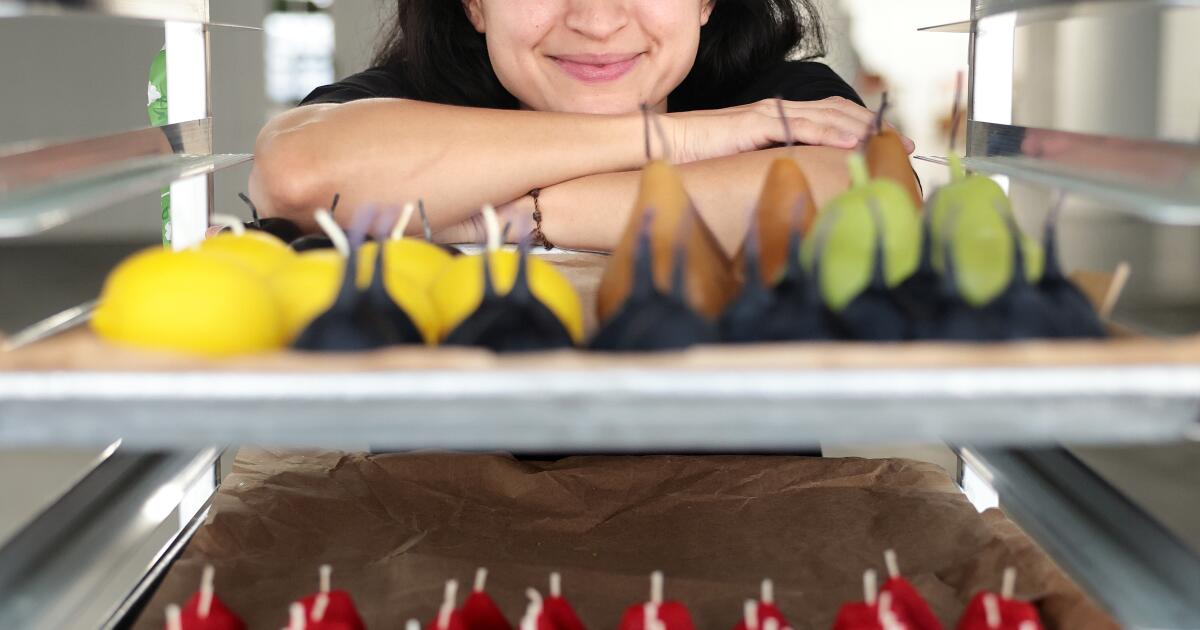
Jessica Gonzalez hustles behind her booth at the recent Renegade Craft Fair, frantically ringing up sales, answering questions and packaging her beeswax candles.
It’s hot on the grounds of the Los Angeles State Historic Park in April, but 35-year-old Gonzalez and her fiancé, Jordan Colindres, keep their cool as a crowd gathers to admire her Happy Organics candle collection, a homage to her family’s produce company in the Central Valley that looks like real fruits and vegetables.
“I love doing in-person events because it’s so fun to see people’s reactions,” she said a few months later. “It makes me feel good to see other people finding joy in my candles. They often say, ‘Oh, that’s really funny.’ And it is funny to have a cherry candle on top of your birthday cake.”

3

1. A staff member pulls a beeswax corn candle, $26, out of its mold at Happy Organics’ studio in downtown Los Angeles. 2. Each Beeswax Mixed Berry Birthday Candles set is cast from real mixed berries — strawberries, raspberries, blackberries, blueberries and cherries. A set of 10 is $30. 3. Bartlett green pears and heirloom tomatoes, $24 to $40.
Judging by the smiles and charmed looks on shoppers’ faces, her produce-inspired candles are less about illuminating rooms and more about sharing the joy she sought when she first started the company in 2018.
In this series, we highlight independent makers and artists, from glassblowers to fiber artists, who are creating original products in and around Los Angeles.
But then, it’s hard not to smile at the playfully elegant Bosc pears, puckered mandarins and green-and-purple asparagus taper candles which range in price from $12 to $40. Some are molded into corn on the cob, celery and rhubarb shapes. Others are made to look like mushrooms, figs, tomatoes and snap peas. The most popular are the small birthday candles shaped like raspberries, cherries and blackberries, packed in molded-pulp baskets just like you’d find at the grocery store or farmers market.

-
Share via
Gonzalez didn’t start out as a designer. The youngest of nine children, she was born in 1991 in Salinas and later moved to Merced, where she grew up on a 10-acre farm. She studied computer science at Mills College, then worked in tech consulting in the Bay Area and eventually became the CTO of an ag-tech company. When her mother, Angela, became ill in 2016, she returned to Merced to be with her family.
When her mom died suddenly soon after she moved home, Gonzalez left the tech industry. “I wasn’t connected with what I was doing,” she said. “I wanted to find something more meaningful; something I loved. I didn’t want my ego to keep me stuck in what I studied in college. I decided to let myself try new hobbies and passions and look for joy again.”
After her mother’s death, she began working with her father, Salvador, and her uncles at the family’s apiary, where they managed more than 30 hives. (Her grandfather was also a beekeeper in Michoacán, Mexico.) Soon, she began selling their raw honey at local farmers markets. In a heartbreaking turn, her father was diagnosed with cancer a year later, so she started making cannabis-infused honey, balms and chocolates to help ease his pain.
When she saw that the beeswax candles, which last significantly longer than paraffin candles, were selling faster than the honey, she decided to focus on making candles from the leftovers from her uncles’ hives.
She was only 25, but it was a turning point. “It was one of those moments where I felt like I needed to change my path,” she said. “I needed to change everything in my life.”

Jessica Gonzalez and her father Salvador on their family farm in Merced. (Gonzalez family)

Gonzalez at Happy Organics’ studio in downtown Los Angeles. (Christina House / Los Angeles Times)
When her father died in 2018, she inherited his bees and started Happy Organics, although she hadn’t planned on starting a business. After experiencing so much loss, making candles became a kind of therapy. “It felt great to work with my hands again, something I thought I’d never have time for,” she said.
Her oldest sister, Sonia Gonzalez, said Gonzalez reminds her a lot of their father, who reinvented himself many times over the years.


The nopal cactus is cast from a real nopal and hand-poured in 100% pure beeswax in the Los Angeles studio.
“He grew up as a village boy in the rural mountains of Michoacán, Mexico, and went on to work in restaurants, cut down Christmas trees and pick strawberries and broccoli in the fields of Salinas,” she wrote in an email. “From there, he started selling produce door-to-door, then at flea markets and eventually built his own produce distribution business from the ground up. As the youngest of nine kids from a working-class family, Jessica’s always been incredibly resourceful, responsible, and amazing at reinventing herself.”
Like a lot of millennials, Gonzalez taught herself how to make candles by watching YouTube videos. She started with hand-dipped tapers, working in the garage on the farm that helped her feel safe and connected to her parents. “It was a really nice environment to try something new and creative,” she said.
Inspired by her family’s produce, she cast real corn, strawberries and cherries in plaster, then made a silicone mold to create copies. Even when using the same mold, color can vary from batch to batch, and how it cools also affects the result. “That’s just how handmade things are,” she said. “There’s always some variation.”

Cherry molds make cherry candles at Happy Organics’ studio in downtown Los Angeles.

A variety of fruit and veggie candles.
When she moved to Los Angeles in 2023 to be with Colindres, her business took off. “L.A. is a great place to grow,” she said. “There’s so much opportunity here. When I go to a farmers market, I never know who I’ll meet.”
She sold her candles in person at craft shows, the Hollywood Farmers’ Market and most recently, during a residency at the P.F. Candle Co. showroom in Echo Park.

2

3

1. A staff member trims the wicks on a pair of carrot birthday candles, $22. 2. Gonzalez passes by shelves of candles at Happy Organics’ studio in downtown Los Angeles. 3. Asparagus taper candles, $30.
“I have a lot of respect for her as a fellow candle maker (making molds is not easy), but getting to know her story more and how her choice of foods and wax is reflective of her family’s history gave it so much meaning,” P.F. Candle Co. founder and creative director Kristen Pumphrey said in an email. “It’s been a tough couple of years for L.A. businesses, so we gotta stick together — there’s this wonderful sense of community hosting a local brand that’s so passionate about their work.”
As her business has expanded, her products are now available at Terrain, Joan’s on Third and the MoMA Design Store in addition to her website. She has also had to source beeswax from other vendors across the country to keep up with demand.
Kimberly Curtis, owner of Hide & Seek Vintage in Studio City, said Gonzalez’s strawberry and cherry birthday candles “flew off the shelves last year” during the holidays. “Our customers love them,” she added.

Gonzalez holds a cabbage candle.
Still, Gonzalez stays connected to her Central Valley roots. Everything she and her small team make in downtown Los Angeles is handmade and “takes time,” she said, describing the steps involved in crafting quality candles. Right now, her favorite is the Nopal Cactus candle, which she made using a clipping from an employee’s yard. While others help her with production, wholesale management and packaging, she focuses on sales, content and all-new product development.
When asked if she has advice for others who want to start their own business, Gonzalez admits she sometimes feels overwhelmed.

In 2013, Gonzalez and her family gathered at their Merced ranch to celebrate her parents’ anniversary.
(Gonzalez family)
“The biggest thing that has gotten me through the toughest spots is my why or my reason for starting,” she said. “I think that has to be really strong. That’s what brought me a lot of comfort when I felt like quitting: going back to the beginning and remembering why I started this.”
For Gonzalez, her reason is always close to her heart. “I wanted to feel connected to my parents in some way,” she said. “This was a good representation of my upbringing.”

The Kennedy Center, the facade of which remains covered with a tarp, is seen in Washington, DC, on June 28, 2026. A US federal judge asked on June 24 for an explanation for why a tarpaulin continues to cover the facade of the Kennedy Center where President Donald Trump’s name was recently removed. District Judge Christopher Cooper gave the board of trustees of the performing arts venue until the end of July to explain “the purpose for and status of the tarp and scaffolding that Defendants have erected on the front portico of the Center.”
ALEX WROBLEWSKI/AFP via Getty Images
hide caption
toggle caption
ALEX WROBLEWSKI/AFP via Getty Images
More than two weeks ago, President Trump’s name was removed from the Kennedy Center facade though it is still covered by a tarp and the legal battle continues.
On Monday, a U.S. Department of Justice filing on behalf of the Kennedy Center included some surprises. The document was submitted in response to issues raised by lawyers for ex-officio board member Rep. Joyce Beatty of Ohio who is suing to remove President Trump’s name from the center and stop its closure for renovations.
Among the revelations, the Kennedy Center admitted that, during a board meeting on December 18, 2025, Beatty had been “muted and prevented from speaking.” It was at that meeting that the board voted to add President Trump’s name to the center. The filing later acknowledges the congresswoman was “prevented from voicing her opposition.”
The John F. Kennedy Center for the Performing Arts is a living memorial to its namesake. The guidelines for how the theatre complex spends federal dollars are very specific. Among other rules, it states that “no additional memorials or plaques shall be designated or installed.” Beatty argues adding Trump’s name runs afoul of those rules and that any change requires approval from Congress.
According to one of Beatty’s filings, “There was no advance notice in the agenda that the Board would be considering a name change,” a statement the Kennedy Center now does not deny. The center admits that, prior to voting, there was “no discussion about potential risks or downsides of the vote to adopt a secondary name for the Center.” Nor was there a board discussion “about any potential conflict of interest that might result from the vote.”
The center’s lawyers previously contended that if Trump’s name were to be removed, it would “lose money from donors who support” him and “impede the Center’s fundraising efforts.”
Closing for renovations
Earlier this year, Trump announced on social media that the Kennedy Center would close for two years for renovations. He wrote that he made the decision after “a one year review” with “Contractors, Musical Experts, Art Institutions, and other Advisors and Consultants.”
But, according to the center’s lawyers, Trump’s announcement “was made without presenting any plans, analyses, timelines, or funding information to his cotrustees and without any Board vote.”
The Kennedy Center has long denied reporting by The Washington Post that ticket sales plummeted after President Trump became the Center’s board chair. In Monday’s legal filing, the Center admits that, by October 2025, “nearly half of the Center’s tickets were going unsold.”
-

 Texas48 seconds ago
SCHEELS CEDAR PARK
-
Utah8 minutes ago
Lakers trade for center Walker Kessler from Utah, make their big swing with rush of signings
-

 Vermont11 minutes ago
In Post-pandemic Vermont, The High-end Destination Wedding Industry Has ‘exploded’
-

 Virginia16 minutes ago
Virginia’s Clean Slate Law takes effect, sealing records of certain convictions, offenses
-

 Washington23 minutes ago
Where can you watch fireworks in Washington DC on the Fourth of July?
-

 Wisconsin26 minutes ago
9-year-old drowns at western Wisconsin water park, sheriff says
-

 West Virginia31 minutes ago
Save Women’s Sports Act now the law of the land – WV MetroNews
-

 Wyoming38 minutes ago
Young bull moose captured wandering Laramie, relocated by Game and Fish

