Lifestyle
'South Park' creators renovate a beloved restaurant, and find nostalgia is pricey


¡Casa Bonita, Mi Amor! follows Trey Parker and Matt Stone as they renovate a dilapidated, inauthentic, 1970s Mexican restaurant. The labor of love becomes a money-pit as they chase the landmark’s former glory.
Paramount
hide caption
toggle caption
Paramount
Maybe because most of us come from somewhere else, Americans just love replicas of foreign places — William Randolph Hearst’s faux European castle in San Simeon, Calif.; Paris Las Vegas with its half-size Eiffel Tower and mini Louvre; or the mock Alpine village you find in, of all places, Helen, Ga. Creating a giddy atmosphere that Umberto Eco dubbed “hyperreality,” such crazily ambitious simulacra fill nearly everyone with childish delight.
This includes Trey Parker and Matt Stone of South Park and The Book of Mormon fame. Although notorious for their cynical humor, both harbor a profound affection for one of the places they adored as kids: Casa Bonita, a 50,000 square foot attraction in a Lakewood, Colo., strip mall that has been dubbed the Disneyland of Mexican restaurants. It’s an Anglo businessman’s fantastical riff on an old Mexican village, one decked out with Old West outlaws, volcanoes, cliff divers and even a gorilla that runs through caverns studded with stalactites.

More than half a century after opening in 1974 — complete with TV ads featuring Ricardo Montalban! — this once-spectacular crowd-puller had fallen on such desperate times that it was doomed to close. Then it was bought out of bankruptcy “as is” by Stone and Parker, who vowed to save the beloved Colorado landmark and return it to its former glory.
Their battle to do so is the subject of the enjoyable new documentary ¡Casa Bonita, Mi Amor! Directed by Arthur Bradford and produced by MTV Documentary Films, the movie’s a treat, weaving together great archival footage, excerpts from South Park and Elvis’ movie Fun in Acapulco, plus countless scenes of Parker and Stone’s amused horror when they hear the latest reason why their labor of love is becoming a money-pit.
After a zippy capsule history of Casa Bonita, with its Pepto-Bismol-pink facade and blue fountain out front, the movie returns to the present to show everything it takes to recreate a mecca whose true meaning lay in the feelings it once induced. Because the original Casa Bonita was legendary for lousy food, they bring on an executive chef, Dana Rodriguez, who’s been nominated for James Beard Awards. She takes Parker to Oaxaca so he can soak up the atmosphere and get inspired.
Yet wondrous inspiration bumps into un-wondrous reality. Turns out that their new property is a dilapidated death trap in which everything — electricity, plumbing, air conditioning — must be redone. A renovation originally budgeted at $6 million suddenly balloons to a new estimate of $20 million plus.
Now, as ¡Casa Bonita Mi Amor! chronicles the high price of nostalgia, it also offers an offhand glimpse at one of pop culture’s signature creative teams. It doesn’t take long to spot the differences between the two longtime friends — Parker is clearly the dreamy, creative one; Stone the shrewd whetstone on which he sharpens his ideas. What you may find surprising is the secret sentimentality of guys whose comedy takes such pride in finding nothing sacred. Parker, in particular, betrays a sweetness in his romantic attachment to the innocent pleasures of childhood. He’s also a perfectionist. We see his artistic process, fussing over and tweaking every creative detail of the project.

As their crew desperately races to have everything perfect by opening day — spending even more millions along the way — it becomes clear that Parker and Stone are chasing a ghost or maybe a paradox. The original Casa Bonita was a 1970s inauthentic version of 19th-century Mexico, but to recapture its magic this new version can’t be the same Casa Bonita that Parker remembers so fondly. Just as Indiana Jones’ movies had to use top-drawer talent to emulate cheap, old movie serials, so their restaurant has to meet today’s expectations — tastier food, sharper entertainment — or visitors won’t find it as thrilling as the original. To feel the same, it has to be different.
By the time Casa Bonita finally reopens — there is a happy ending — Parker and Stone have done something that could hardly be more quintessentially American: They’ve spent a fortune to make a copy of a Mexican-themed restaurant that’s actually better than the original.



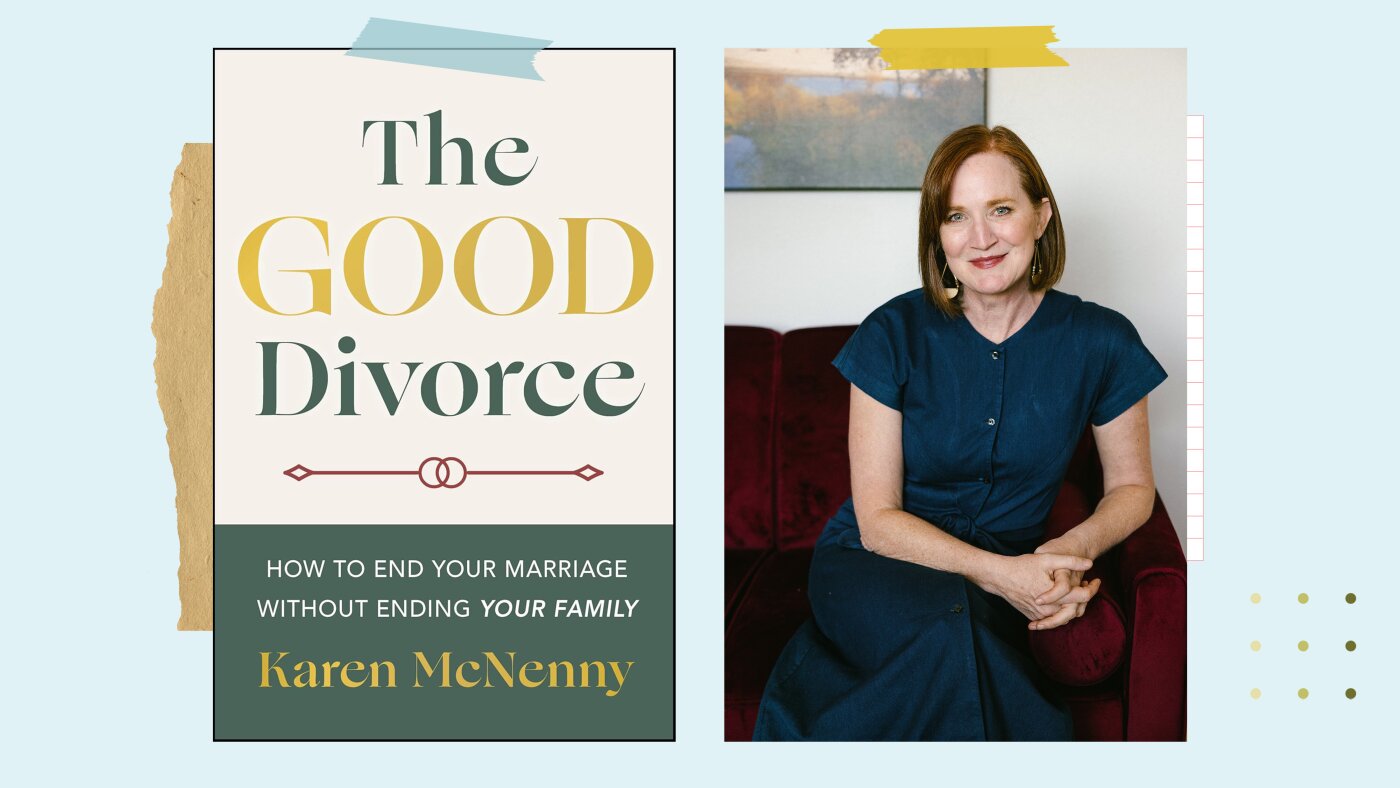
Karen McNenny is a certified divorce coach, certified co-parenting specialist and author of the book The Good Divorce: How to End Your Marriage Without Ending Your Family.
Wiley/Jossey-Bass/NPR, Nicole Wickens/NPR
hide caption
toggle caption
Wiley/Jossey-Bass/NPR, Nicole Wickens/NPR
When Karen McNenny was facing divorce about 15 years ago, she was afraid of what it would mean for her future: despair, debt and a lifetime of resentment, she says.
At the same time, she was thinking of her two children, she says. She didn’t want their father to become her enemy.
So she and her former husband chose to approach divorce differently as a couple. “We’re going to renovate and transform this family. We’re not going to destroy it,” she says. “The marriage is ending, not your relationship.”
For McNenny, a mediator, certified divorce coach and certified co-parenting specialist, divorce is a tool, not a weapon. She expands on this concept in The Good Divorce: How to End Your Marriage Without Ending Your Family, which came out this spring. The book offers guidance on how to maintain compassionate and respectful ties with a former spouse while also healing and moving forward.
According to Pew Research Center, a third of Americans who have ever been married had a first marriage that ended in divorce. For that reason, McNenny hopes her book becomes a must-read for couples before they get married. “The best time to talk about divorce is before you need to talk about it,” she says.
She shared insights from her book in a conversation with Life Kit. This interview has been edited for length and clarity.
The book is called The Good Divorce. What does that mean?
[For those with kids,] the good divorce is about protecting the future of the family while we dissolve the marriage.
After the paperwork is done and the assets have been divided, can you and your co-parent sit on the same side of the bleachers during the basketball game? Can you still see yourselves as a partnership, with the ability to have thoughtful conversations about your kids?
For those who don’t have kids, [the good divorce is] about protecting your health — your mental health and your physical health. If we are doubling down with resentment and bitterness, all of that gets stored in the body and shows up in different ways. You deserve a pathway that’s less destructive.
Let me also be clear: There are times when an amicable, collaborative process is not possible and maybe even inappropriate. For instance, where there’s active addiction, abuse, domestic violence, coercion or unmanaged mental health issues.
How do you get to a place where you don’t feel triggered by your partner, so you both can work together toward a good divorce?
That, my dear, does not happen overnight. That is more like a dimmer switch going up and down and up and down, and the gift of time helps to get there.
It’s a complex emotional journey because we do feel relief in walking away from our spouse and the challenges. But with it, there is extraordinary grief that comes with divorce that I think is often underestimated and undersupported.

If my spouse had died, people would’ve been checking in with me regularly. I never would’ve spent a holiday alone in that first year. There probably would’ve been a meal train.
But he didn’t die. My marriage died, my family structure died, my identity as a wife and a partner died. There’s so much grief through these transformations that come with divorce that we don’t see.
So supporting friends in all those ways that you would as if there had been an actual death is doing a lot for your friends who are going through divorce.
How do you let your friends, family and community know that you’re getting a divorce and that you might need support?
Put a communication strategy together. It’s not just for how we tell the kids. It’s also a communication strategy for the grandparents; to the circle of support around the kids, like teachers, coaches and mentors; and our shared community.
It’s extraordinary when a couple can write that message together, not unlike a marriage announcement. [You might say:] We’ve made a really difficult decision. We wanted to let you know. We’re not going to court. Don’t expect a battle. Please don’t ask us why. Just ask us how we’re doing. We’re on the same side as the kids. You don’t need to pick sides.
In doing so, we’ve given everyone the same information at once. It’s a unified message that comes from the parent team, and it allows your community to know how best to support you. And it takes out all the gossip and wonder about what is going on.
If you have kids and they’re splitting time between two homes, what are some ways to make that change easier for them?
Our kids were 5 and 7 when we divorced, so it was three or four nights at a time in each home. By the time they got to be about 8 or 10, it made sense to go a week in each residence. After COVID, the kids came to us and said, “Can we just have two weeks in a house? We wanna be able to settle in more.” [So we said] OK.
A lot of parents are so rigid about the schedule. There’s no flexibility. That doesn’t serve anyone. So I recommend liberating yourselves from the calendar and letting it grow and bend with your kids appropriately.
Knowing what you know now about divorce, what questions do you think couples should ask themselves before they get married?
So often when people arrive at the threshold of divorce, couples are like, “We don’t know what we’re doing.” Get educated about the business part of it.
There is no harm in having a prenuptial agreement. Even if you decided not to file it, have the conversation about the implications. What does it mean if we buy this house together? What does it mean if one of us works more and one of us works less?
We also underestimate what it means to be roommates. What are your value systems around cooking and cleaning? How much alone time do you need? It’s easy to fall in love and not know if you’re compatible.
Do you think you’d get married again?
I absolutely hope that I get to say yes to a lifelong commitment with a partner, as I believe we often are given the opportunity to become a better version of ourself through partnership.
The story was edited by Meghan Keane. The visual editor is CJ Riculan. We’d love to hear from you. Leave us a voicemail at 202-216-9823, or email us at LifeKit@npr.org.
Listen to Life Kit on Apple Podcasts and Spotify, and sign up for our newsletter. Follow us on Instagram: @nprlifekit.

In Alice and Steve, Jemaine Clement and Nicola Walker play long-time friends who turn on each other after he gets involved with her 26-year-old daughter.
Lara Cornell/Disney+
hide caption
toggle caption
Lara Cornell/Disney+
I grew up watching episodic shows on network TV, nearly all of them formulaic but some indelibly great. Then, like everyone else, I moved into the days of what my colleague David Bianculli dubbed Platinum TV, where series like The Sopranos and The Wire and Fleabag aspired to something higher. What both these eras had in common was that their shows were carefully crafted — they had an internal logic, and a tone, that held them together.
In recent years, though, there’s been a proliferation of shows that, possibly obeying some algorithm, care less for coherence than sensation. They lurch among tones, from cuteness to sentimentality to meanness, stirring in random plot twists along the way. Bouncing all over the emotional map, these shows depend on compelling actors and a few memorable scenes to make us overlook their loose construction.
A great example is Alice and Steve, an entertaining but sometimes exasperating six-part British comedy on Hulu about two 50-something best friends who turn on each other after he gets involved with her 26-year-old daughter.


While the premise is juicy, it’s also a tad yucky, and I mainly tuned in because its title characters are played by performers Jemaine Clement from Flight of the Conchords and Nicola Walker, whom I’ve raved up on this show more than once.
The series starts poorly with Steve and Alice going on a cutesy bender after a friend’s funeral. Now, I always hate drunk scenes, which are an invitation to overact. As Clement and Walker bray their lines, we learn that Steve’s a divorced celebrity hair stylist who can’t find a girlfriend while Alice is a clothes designer with a doting younger husband, nicely played by Joel Fry, a sweetie-pie of a teenage son — that’s Tyrese Eaton-Dyce — and, of course, that 26-year-old daughter, Izzy, who has inherited her mother’s willfulness. Played by Yali Topol Margalith, Izzy kickstarts the plot by flirting with Steve. Predictably, he succumbs.

Almost immediately, they think they’re in love. While the weak-willed Steve wants to hide their romance — he knows it’s inappropriate — Izzy just blurts out the facts to her mom. Alice flips. And from hereon out in this series where the women are as alpha as the men are hangdog, Alice drives the action. Betrayed and violently angry, she’ll do whatever it takes to break them up — no matter who gets hurt. Her antics unleash Steve’s own malice. We’re in Beef territory.
At its core, Alice and Steve hinges on the way that platonic friendships are often richer and more powerful than romantic ones. It’s a fascinating subject, which may be why I found the script by Sophie Goodhart so frustrating. I wanted her to dig deeper. While the show’s got some very funny bits — Alice’s sharp-tongued mother is a blast — it’s often annoyingly lax.

If Steve really does the hair of Charli XCX, how come he’s a clueless older guy whose pop culture references are Willie Nelson and Woody Allen? If Izzy truly adores her mother as she claims, why does she keep rubbing her relationship with Steve in her mom’s face? Halfway through, one character nukes the other’s career, but this life-shattering event has no real weight: It’s barely even mentioned for the rest of the series.
That said, Alice and Steve is worth seeing for scenes like the one in which Steve spinelessly sells Izzy out or the lacerating discussion between Alice and her husband when he fully grasps that he adores a woman who views him as a reliable but dull concierge, not a man she likes hanging with. Most touching of all may be the lovely sequence when Alice, wise for once, smooths a romantic crisis between her son and his would-be girlfriend, a pair who are the show’s emblem of hope. For once, we understand why people love her.

While most viewers will find Steve more likable than Alice — the show takes pains not to make him appear predatory or creepy — the role doesn’t give Clement a whole lot to do except play variations on shambolic dread and discomfort. The show gets its galvanizing zing from Walker, a beloved star in England with amazing, luminous eyes. Her Alice is the kind of complicated, volcanic heroine that you don’t see in movies and rarely see on TV, one who shows her apocalyptic rage freely and in many different forms.
At least once in every episode, something would lead me to say, “Man, is this show a mess.” But that wasn’t a deal breaker. I kept watching. After all, life is messy, too.


How to enter your Sporty Spice era.
Getty Images/quantic69/Olga Kurbatova/Anastasiia Zvonary/Photo Illustration by NPR
hide caption
toggle caption
Getty Images/quantic69/Olga Kurbatova/Anastasiia Zvonary/Photo Illustration by NPR
Reality dating and professional sports are not as different as you’d think.
Brittany is in her Sporty Spice era – she watched the NBA playoffs, she’s following World Cup games, and she’s watching the New York Liberty play their WNBA season. These games are daily – and so is the reality dating show Love Island. And she noticed that the two formats are not very different at all. Defector.com staff writer and co-owner Kelsey McKinney came to the same conclusion – so the two of them discuss why these games of athleticism and love can bring us together… and why they get valued differently in our culture.
For more episodes on sports and reality TV, check out:
Get rich or die trying: how sports betting is changing our love of the game
Is this the end of reality TV?
The ugly truth of America’s expensive homes
Support Public Media. Join NPR Plus.
Follow Brittany on Instagram: @bmluse
This episode was produced by Liam McBain. It was edited by Neena Pathak. Our Supervising Producer is Cher Vincent. Our Executive Producer is Barton Girdwood. Our VP of Programming is Yolanda Sangweni.
-

 Minnesota2 minutes ago
Minnesota Lynx bested by Connecticut Sun 90-89
-

 Mississippi9 minutes ago
Mississippi Lottery Mississippi Match 5, Cash 3 results for July 6, 2026
-
Missouri12 minutes ago
Missouri teachers push back on governor’s A-F school grading plan
-

 Montana17 minutes ago
The Record is Clear: The Wilderness Society, Greater Yellowstone Coalition, and Montana Wilderness Association have Consistently Undermined the Roadless Rule
-

 Nebraska24 minutes ago
Pine-Richland receiver Khalil Taylor pulls hat trick, picks Nebraska over Penn State
-

 Nevada27 minutes ago
Nevada Youth Sports estimates $250K in damage after Fourth of July firework fire
-

 New Hampshire32 minutes ago
Suspected gunman in Hampton Beach shooting was in U.S. Navy
-

 New Jersey39 minutes ago
I took my kids to this New Jersey hotel and stopped making fun of the state (for now)

