Lifestyle
Saving Houston’s LGBTQ history through thousands of hours of radio archives


An image from the 1984 Houston Pride parade. Archivists at the University of Houston are working on archiving 30 years worth of local LGBTQ radio programming.
J. D. Doyle
hide caption
toggle caption
J. D. Doyle
For years, hundreds of fragile cassette tapes sat quietly aging in a storage locker in Houston, Texas. Each plastic case contained hours of radio shows, made for and by LGBTQ people.
The first shows aired in the mid-1970s. They continued, off and on, for more than 30 years — a period that included the AIDS crisis, the women’s liberation movement and the rise of LGBT civil rights. A pair of archivists, Emily Vinson and Bethany Scott, have been working on preserving the programs, thousands of hours of them, online.
“Houston is not maybe the first place you think when you think LGBTQ history,” Vinson says during a meeting in the main library at the University of Houston. In her black outfit and chic glasses, she looks like an archivist from central casting. “You think maybe New York or San Francisco,” she continues. “But a lot was happening here. I mean, you can imagine what it meant to be on the radio in 1977, identifying as a gay person.”

The shows aired on KPFT (90.1), Houston’s Pacifica station. One of them, Wilde ‘n’ Stein (named for Oscar Wilde and Gertrude Stein) started in 1975 and ran through the early 1990s. A late night show, After Hours, ran from 1987 until the early 2000s.
In one June 1979 episode of Wilde ‘n’ Stein, you can hear prominent activists Larry Bagneris and Charles Law reflecting on their experiences as Black gay men in Houston. Then, an interview with Houston resident Tony Lazada, the former manager of the Stonewall Inn. Lazada was on the scene when the famous Stonewall riots broke out in New York’s Greenwich Village. Ten years later, he was running a Houston gay bar called Dirty Sally’s.
“I run a clean club,” Lazada informed his interviewer. “I don’t allow any dope. I don’t allow any sexual things happening in our place. And I don’t allow drag queens to come in. I’m friendly with everyone. It’s just I’m trying to run a legit club where I don’t have any problems like I had in New York. I don’t want another Stonewall.”
A Houston city ordinance at that time banned “a person from appearing in public dressed with the intent to disguise his or her sex as that of the opposite sex.” Police used the ordinance to harass and arrest LGBTQ people, especially drag queens, butch lesbians and transgender people.
Over the years, the producers and hosts of these radio shows brought their listeners live street coverage of Pride parades, music that celebrated LGBTQ experiences and interviews with city council members, activists, local arts luminaries, and public health officials. Because it was on the radio, often late at night, closeted people could listen quietly and discreetly, without the fear of discovery that printed material might bring.
Carl Han, a young Vietnamese-American, listened to the station’s LGBT programming at the lowest possible volume, as he told the radio show After Hours in 1992.
“That’s how I discovered the Montrose [LGBT] community,” he said. “At the age of 15, I hit upon KPFT one night and turned it down real low so no one can hear.” He would go on to be a leading local activist, who at the time of the broadcast was the secretary of Asians and Friends, a community group serving Houston’s LGBTQ Asian Americans.
Such content came as a revelation to 20-year-old Andrea Hoang. As an undergraduate at the University of Houston, one of her campus jobs was to help digitize and transcribe the shows. Hoang, who identifies as queer, was thrilled to discover the voices of Asian-American activists, including Han and After Hours host Vivian Lee, in broadcasts from before she was born.
“They had so many people of color coming onto this show and spearheading these local movements,” she marvels, adding that she also loved learning about the vibrant LGBT music played on the programs so much, she made this Spotify playlist honoring it.
The digitization of this audio history, says Vinson, would not be possible without three Houstonians who safeguarded the cassettes for so many years. Judy Reeves cofounded the Gulf Coast Archive and Museum of Gay, Lesbian, Bisexual, and Transgender History. JD Doyle maintains an extensive website documenting local LGBT history. Jimmy Carper was a longtime host and producer of After Hours. (He died of complications from HIV in 2014, at the age of 66.)
“They understood how important it was and they saved it,” Vinson says. “Radio is not the kind of thing that just gets saved by itself. Nothing disintegrated on us, thankfully. We’re very lucky, especially in Houston, because the environment is against us here. Humidity is like the enemy of audiotape.”
“That was part of the motivation for the project,” adds her co-archivist Bethany Scott. “If we aren’t getting it off this these old carriers now, we might not have a chance to do it in the future. And we really focus on this as a part of Houston history. Listening to the recordings, hearing the themes that they talked about, it’s not like some distant past.”



Once rivals on the tennis court, Martina Navratilova, left, and Chris Evert have become close friends in retirement. They are pictured above at the French Open in 1986.
Trevor Jones/Getty Images Europe
hide caption
toggle caption
Trevor Jones/Getty Images Europe
Chris Evert and Martina Navratilova were the most successful women’s tennis champions of their generation. Both were 18-time Grand Slam tournament winners — and each other’s greatest rivals.
Evert, a Florida native, became a tennis star in her teens. Navratilova was born in communist Czechoslovakia, and emerged as a player after Evert was established. They first faced off during a match in Akron, Ohio, in 1973, when Evert was 18, and Navratilova was 16. Evert won, but Navratilova left an impression.
“I remember thinking to myself, holy cow, when this young girl gets into better shape, she is going to be a force to be reckoned with,” Evert says. “She had so much talent. Her hands were quick, she had a big first serve, she had a big forehand, and she just was so powerful.”

Two years later, on the day she lost a semifinals match to Evert at the U.S. Open, Navratilova defected to the U.S. In the years that followed, her tennis game improved. Though she and Evert had initially been friendly, the friendship cooled as their rivalry heated up.
“Playing Chris was difficult because how can you not like Chris? What’s not to admire?” Navratilova says. “She was like the epitome of cool.”
The new Netflix documentary Chris & Martina: The Final Set tells the story of how Evert and Navratilova re-established their friendship and how they both faced cancer in retirement. Evert was diagnosed with ovarian cancer in 2021; Navratilova was diagnosed with throat and breast cancer in 2022.
“I can’t get away from her,” Evert jokes. “We had a 15-year career, and then we got cancer at the same time. It really is freaky, but I always say: If I want someone to be in the trenches with me, it’s Martina because she has been so supportive and so understanding.”

Navratilova agrees: “We have such a level of trust that we know whatever we say to each other, it stays there. We give each other the best advice we know how to. And there is no ulterior motive, no playing games.”
At the time that this interview was taped, Evert and Navratilova were both in remission from cancer. But late last week, Evert disclosed she’d recently been diagnosed with a recurrence of ovarian cancer.

“We know whatever we say to each other, it stays there,” Martina Navratilova says of her friendship with Chris Evert.
Netflix
hide caption
toggle caption
Netflix
Interview highlights
On supporting each other through cancer
Evert: There are a lot of phone calls between us. … I don’t cook, but Martina would bake bread for me, and her wife Julia would cook, make some chicken soup. … I got a lot of food from Martina. She got a necklace from me.
Navratilova: I get jewelry from Chris, she gets food from me.
Evert: Martina’s and my relationship — because we’ve had one for 50 years — is not the type where we have to talk to each other every day to maintain the closeness. I always knew she was there. She always knew I was there if we needed to talk, and that was that.
On the weakness they experienced with cancer
Navratilova: Chris’ diagnosis and treatment was much more life-threatening than mine, percentage wise, but my treatment was more difficult physically. … I was in New York for seven weeks and I literally sat on a yoga mat, maybe half an hour of the seven weeks, and did some stretching. I couldn’t even do the down dog pose because I would have fallen down. I had absolutely zero strength left.
Evert: The chemo kicked my butt, let’s put it that way. … It left me very weak, very, very weak. After chemo I would have three or four days of intense nausea and I just would feel tingling in my body and it just wasn’t nice. I didn’t have the energy. To walk six blocks was a big deal for me. And it was foreign. You know, it felt like it wasn’t my body, for sure.
On watching the old footage of their matches together for the documentary
Navratilova: For me, it was fun watching with Chris, because we had different reactions to what happened on the court. But what impressed me is how well we played with those wooden rackets. Because you know what? Those rackets are not easy to play with. But you try to put yourself in there physically, what it was like, mentally, what it is like. And it’s like, “Oh, I should have gone down the line,” or, “I can’t believe I missed that shot.” Or “Chris, you had such a great pass.” It was amazing. So it was impressive. … I wish I could still have that six-pack, but anyhow.

Evert: I remember feeling genuinely happy for her. I remember it was her first Wimbledon. That’s always been her dream since she defected. Her family couldn’t be there to watch her. She was all alone. And I just was happy for it. And I knew that this was gonna be one of many for her to win.
On defecting to the U.S. in 1975 when she was 18 years old
Navratilova: I was thrilled to be in the States. I always loved American cars. And when you ordered a ham sandwich, you got, like, two inches of ham and two slices of bread. Whereas growing up, you had thick bread and one slice of ham. So I thought I was in heaven. And it was $2.30 for that sandwich. I still remember it. I couldn’t believe how much ham I was getting.
Lauren Krenzel and Nico Gonzalez Wisler produced and edited this interview for broadcast. Bridget Bentz, Molly Seavy-Nesper and Beth Novey adapted it for the web.


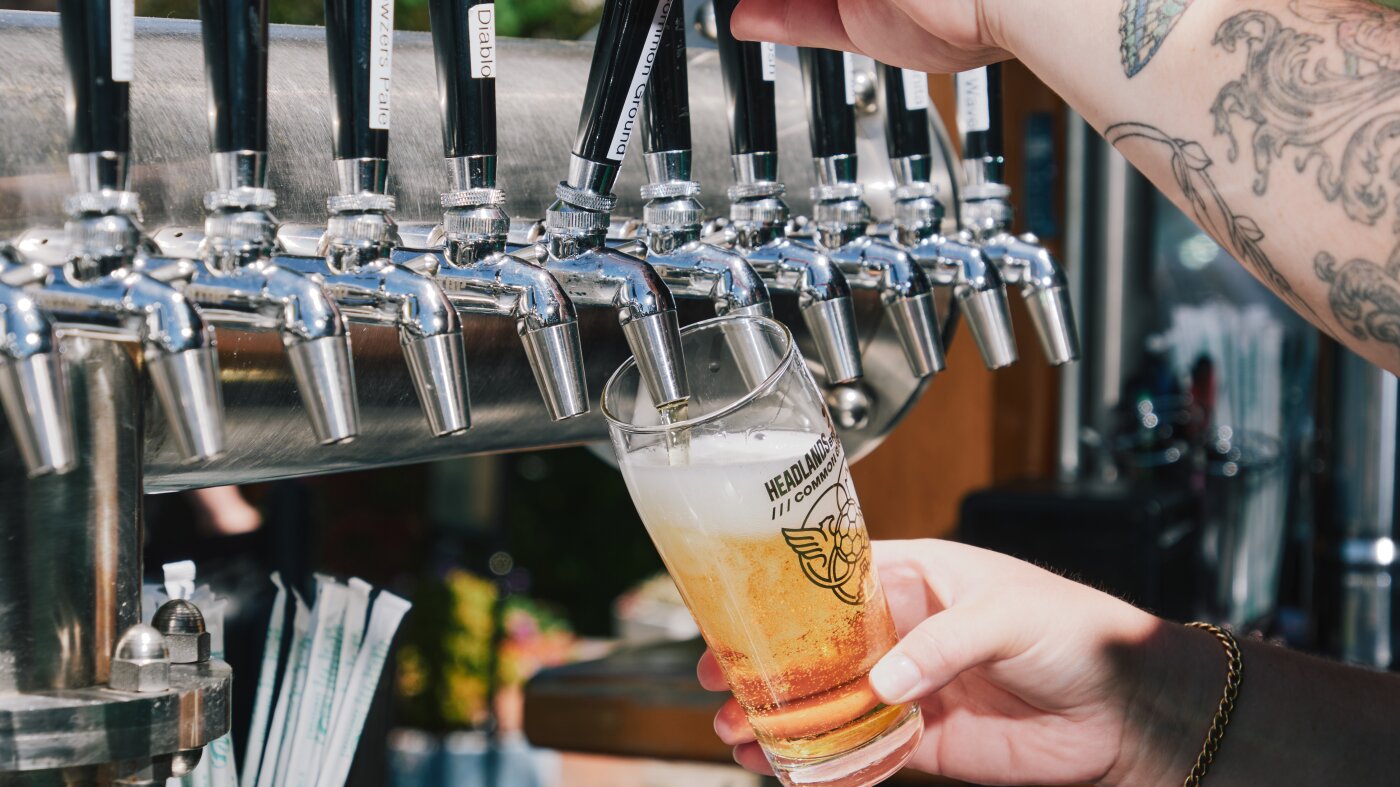
Headlands Brewing launched its World Cup-themed beer Common Ground ahead of the first World Cup game in June.
Justin Gellerson for NPR
hide caption
toggle caption
Justin Gellerson for NPR
The British betting company William Hill predicts that soccer fans will throw back more than 5 million pints of beer in stadiums and fan zones during this year’s World Cup. And that number doesn’t even account for the millions of pints being poured in bars as fans tune in to the global soccer event.
But while international soccer crowds are focusing on goals and penalties, a trio of craft breweries from the tournament’s three host nations are using the tournament to brew something increasingly rare: cross-border solidarity.

A shared recipe with local spin
The collaboration began months ago over a flurry of video chats and emails. The beermakers at Rey Árbol Brewing Co. in Mexico, Headlands Brewing in the United States, and Cabin Brewing Co. in Canada set out to design a single, unified recipe representing the brewing traditions of all three nations.
“It’s a Mexican lager,” said Alejandro Gomez, founder of Rey Árbol.
“That’s like a West Coast IPA,” said Ryan Frank, chief operating officer and brewmaster for Headlands.
“And up in Canada, most of our beers are hop driven,” said Haydon Dewes, co-founder of Cabin. “So we thought, let’s go for a dry-hopped Mexican lager.”
While all three breweries share the exact same recipe, each is giving the final product a distinct local spin, including unique, regionally designed labels. A four-pack of the U.S version costs $15.99. Frank said Headlands has produced about 130 cases of the limited-run brew.
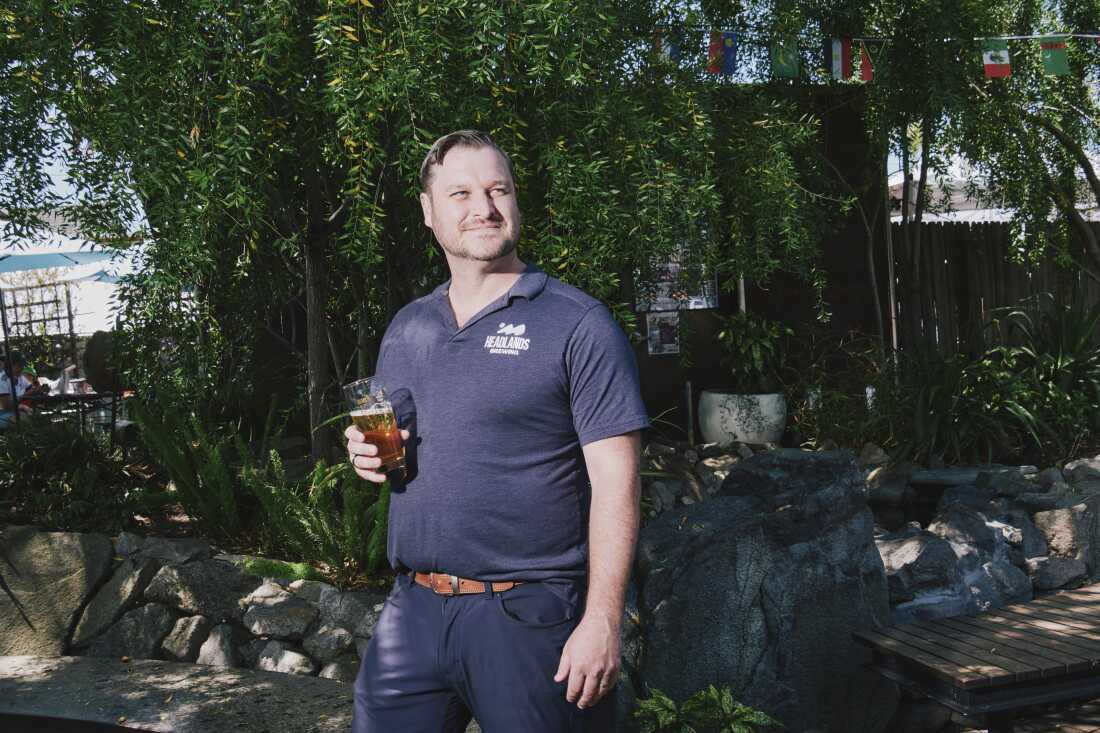
Headlands Brewing COO and brewmaster Ryan Frank drinks a Common Ground beer in Berkeley, Calif., on June 11.
Justin Gellerson for NPR
hide caption
toggle caption
Justin Gellerson for NPR
For the brewers, however, the project is less about marketing and more about connection: They named the multinational beer “Common Ground.”
“When I go to California or Canada, they will treat me like family,” Gomez said.
“It makes the world feel so much smaller,” said Dewes.
“It’s about building bridges and knowing what’s important in life,” said Frank. “And for us, that’s soccer and beer.”
Geopolitical friction in the taproom
The official rhetoric surrounding World Cup 2026 mirrors the brewers’ optimism, with promotional materials promising a tournament where billions are “united as individuals, united as billions.”
Yet this idealistic messaging stands in sharp contrast to a prickly geopolitical reality. Tensions between the U.S., Mexico and Canada have mounted over trade tariffs and auto manufacturing standards as the three nations renegotiate long-standing trade agreements.
The independent brewers behind Common Ground are feeling that friction firsthand through the rising costs of aluminum cans and raw ingredients.
“There are 15% tariffs slapped on any European-grown hops, which are really critical to some of our core brands,” Frank said.

Headlands Brewing brewmaster Ryan Frank and CEO Austin Sharp share a Common Ground beer in Berkeley, Calif., ahead of the first World Cup game on June 11.
Justin Gellerson for NPR
hide caption
toggle caption
Justin Gellerson for NPR
The political discord hasn’t just been confined to trade boards.
When signing an executive order to establish a White House Task Force for the World Cup in March 2025, President Trump suggested that cross-border hostilities might actually benefit the tournament. “Oh, I think it’s gonna make it more exciting,” the president said.
A bittersweet reminder
Tension on the soccer field is one thing; between nations, it’s another.
“It’s true that when it comes to the actual soccer, we’ve developed a very healthy, vibrant rivalry between the three countries,” said Andrés Martinez, the author of The Great Game: A Tale of Two Footballs and America’s Quest to Conquer Global Sport and co-director of Arizona State University’s Great Game Lab, which studies the intersection of sports, media and geopolitics. “But we’re also linked together in this very symbiotic relationship.”
Martinez said that when the U.S., Canada and Mexico initially launched their collaborative bid to host the World Cup back in 2017, the political climate was warmer.
“It was meant to showcase these tight bonds that had developed between the three countries,” Martinez said.

The makers of Common Ground used a shared recipe, but all created their own distinct packaging for the beer: Canada’s Cabin Brewing Co.; Mexico’s Rey Árbol Brewing Co.; the United States’ Headlands Brewing.
Cabin Brewing Company, Rey Árbol Brewing Company, Headlands Brewing
hide caption
toggle caption
Cabin Brewing Company, Rey Árbol Brewing Company, Headlands Brewing
But relations have soured since then, making cross-border business collaborations like Common Ground an anomaly rather than the norm for this tournament.
“To see craft beers across the three countries coming together like this, it’s a bittersweet reminder of what we were hoping to see a lot more of,” Martinez said.
Finding the real common ground
If trade wars and political posturing are looming large in Washington, D.C., Ottawa and Mexico City, they feel a world away at Headlands Brewing’s busy North Berkeley location.
As fans gathered to watch a crucial match between Mexico and South Africa at the start of the tournament, the sunny patio erupted into cheers and shrieks of “Goal!” when Mexico found the back of the net.

Headlands Brewing hosts a screening of the first World Cup game on June 11 in Berkeley, Calif.
Justin Gellerson for NPR
hide caption
toggle caption
Justin Gellerson for NPR
Hovering over a pint of the collaborative brew, soccer fan Roberto Mandujano reflected on the cross-border experiment.
“Three different ways, three different taste buds come together to make something cool,” he said.
When asked about the underlying political tensions between the host nations, Mandujano shrugged off the discord.
“We live in a world where everyone wants to make everything political,” Mandujano said. “But I think we’re all here for soccer. So I guess that’s the common ground.”
-

 Texas48 seconds ago
Texas Lands Major Commitment From In-State DL
-

 Utah4 minutes ago
Utah firefighter fears job loss after answering wildfire call
-

 Vermont9 minutes ago
Police searching for missing Troy woman
-
 Virginia16 minutes ago
Virginia to allow recreational marijuana to be sold in retail stores beginning in 2027
-
Washington19 minutes ago
Port Washington weekly vigils honor community members arrested by ICE
-

 Wisconsin23 minutes ago
3 dead after crash involving UTV, truck in western Wisconsin
-

 West Virginia31 minutes ago
Judge blocks West Virginia SNAP soda ban, restoring benefits for soft drinks
-
 Wyoming34 minutes ago
At 6,000-year-old crossing, Gov. Gordon OKs Wyoming’s first-ever designated pronghorn migration route

