Lifestyle
Oscars 2024: A night of 'Oppenheimer,' quiet protest, and Ryan Gosling just being Ken


Christopher Nolan, winner of the best directing award and the best picture award for Oppenheimer poses in the press room during the 96th Annual Academy Awards.
Arturo Holmes/Getty Images
hide caption
toggle caption
Arturo Holmes/Getty Images
The 2024 Oscars weren’t long on surprises. Oppenheimer won best picture, a tight race between Lily Gladstone and Emma Stone for best actress went to Stone in the end, and the Billie Eilish Barbie song beat out the Ryan Gosling Barbie song.
Most of the takeaways from the evening are modest rather than revolutionary, suitably reassuring for a year when Hollywood saw some high-earning movies that were reviewed well, too.

Oppenheimer rolled, but not quite as much as it might have.
It’s hard to look at a night when Oppenheimer won a bunch of major awards, including best picture, and realize how much room was left for other films. But before it won its first Oscar, Poor Things beat it in three straight categories: production design, costumes and makeup/hairstyling. It also lost the award for best adapted screenplay to Cord Jefferson’s script for American Fiction. So while it certainly had a huge night, there was room to share the wealth.
The economics of the industry are inescapable.
In the monologue, which was otherwise pretty unremarkable, Jimmy Kimmel offered support and solidarity to the members of IATSE, the union representing many crew members, which is currently in contract negotiations that are expected to be difficult. IATSE was a key ally to the writers and actors during their 2023 strikes, and observers are watching closely to see whether those two unions return that support when the time comes. Kimmel’s gesture was at least some indication that they will.
But perhaps more specifically provocative was Cord Jefferson’s speech. Accepting his adapted screenplay award for American Fiction, Jefferson said that although he knew Hollywood to be risk-averse, there might be a different way forward. Instead of making a $200 million movie, he suggested, how about ten $20 million movies? Or even 50 $4 million movies? For a writer to be this assertive about industry issues in a speech is certainly not unprecedented, but between this and the mentions of the strikes that have passed and the one that could still be coming, it’s clear that while everyone is relieved to be back at work, profound concerns about the state of play in Hollywood continue.
YouTube
It was a good-spirited good show.
With the exception of the In Memoriam segment, there wasn’t a lot to grouse about in terms of production. There weren’t as many awkward bits built around Jimmy Kimmel as there sometimes are. There weren’t a lot of boring montages. And when there was shtick, it wasn’t nearly as bad or as long as it sometimes is. John Cena’s masterful and brief (har har) appearance to present the award for costumes, in which he was skillfully set up to look quite convincingly naked, was a bit that only he could pull off with such flair.
YouTube
The pacing was good, too. Lots and lots of glamorous famouses were on screen. The musical performances soared, from the drumming of “Wahzhazhe (A Song for My People)” to the breathy “What Was I Made For?”, peaking with the over-the-top Ryan Gosling take on “I’m Just Ken.”
YouTube
As for that In Memoriam segment, well … they always seem to have a hard time not focusing on the staging in the theater, which in this case included dancers, when all people want to be looking at is the faces and names of the people being remembered. It’s vexing how often the Academy gets this part wrong, but I suppose it means there’s always something to aspire to.
An earlier start meant more room to breathe.
The ceremony was moved back from an 8:00 p.m. start to a 7:00 p.m. start (Eastern time, that is), and it ended at 10:30, making the officially planned broadcast three-and-a-half hours. In the past, it’s often been scheduled for three hours, and it will dribble over that limit by whatever amount, but this time, it made its deadline comfortably. Some combination of ending a little earlier and making sure there was enough time made the whole thing breathe a little easier.
Some of the extra time, it seemed, was devoted to the introductions of nominated actors by peers who have been nominated in the same category. That made for long segments, for sure. But it added substantially to the number of stars who spoke on stage, which is fun (Rita Moreno! Charlize Theron! Matthew McConaughey! Regina King!), and it meant that nobody went unremarked upon. This is a structure this ceremony has used before, and it can get uncomfortable when it just feels like someone is delivering a bland hagiography. But it can also infuse the night with feeling, as when people with an established tie to each other share a moment that is, for at least one of them, enormously important. Or even, as when Rita Moreno spoke the name “America” while introducing America Ferrera, in cases where the connection seems to arise serendipitously.
Protest was sporadic, but it was there.
There were a lot of questions before the ceremony about whether political protest, especially about the violence in Gaza, would make an appearance at the Oscars. For the most part, the ceremony didn’t convey much about what’s in the news in Gaza or elsewhere, but there were exceptions. Jonathan Glazer’s speech for his win for The Zone of Interest as best international feature explicitly tied the violence in Israel and Gaza to the events of his film, which is set just outside the walls of Auschwitz. And the lapel pins that got the most attention over the course of the evening were red ones, handed out and worn in support of a cease-fire. They were worn by celebrities including Mark Ruffalo, Billie Eilish and Ramy Youssef.
Director Ava DuVernay wears an “Artists4Ceasefire” pin, calling for de-escalation and ceasefire in Gaza and Israel, as she attends the 96th Annual Academy Awards.
Frederic J. Brown/AFP via Getty Images
hide caption
toggle caption
Frederic J. Brown/AFP via Getty Images
Mstyslav Chernov, the Ukranian director of the winning documentary feature 20 Days in Mariupol, started his acceptance by saying he wished he’d never made the film. That’s because it documents the early stages of the Russian invasion that eventually devastated the city. Chernov went on to speak of the many people who have been killed as a result of the invasion. “Slava Ukraini,” he said – “Glory to Ukraine.”
YouTube
Not a flashy night, but a successful one
So for a night with relatively few surprises but some very enjoyable winners (hooray for Robert Downey, Jr. and Da’Vine Joy Randolph!), it was a solid show that honored an awful lot of good movies, and movies that drew significant audiences, too. And next year, we will all be back to do it again.

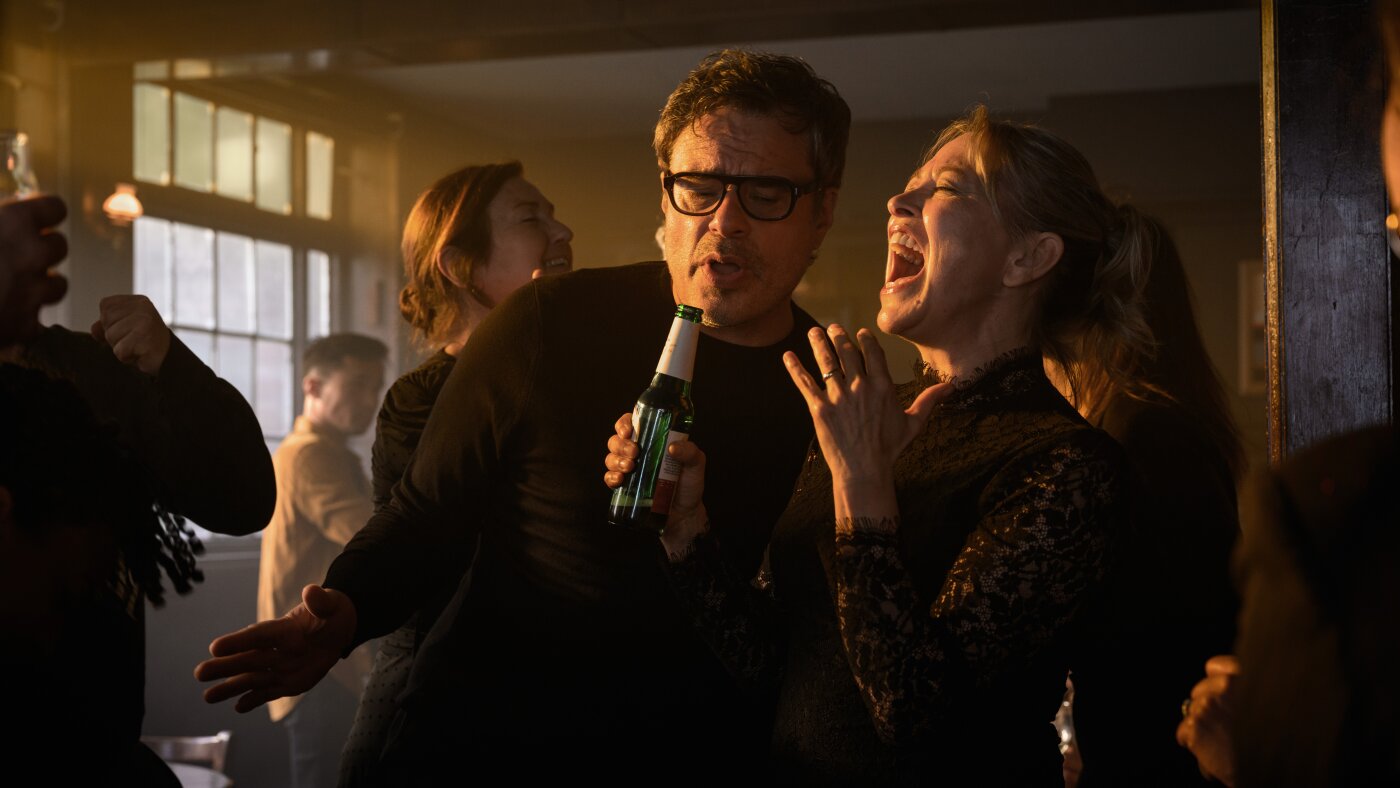
In Alice and Steve, Jemaine Clement and Nicola Walker play long-time friends who turn on each other after he gets involved with her 26-year-old daughter.
Lara Cornell/Disney+
hide caption
toggle caption
Lara Cornell/Disney+
I grew up watching episodic shows on network TV, nearly all of them formulaic but some indelibly great. Then, like everyone else, I moved into the days of what my colleague David Bianculli dubbed Platinum TV, where series like The Sopranos and The Wire and Fleabag aspired to something higher. What both these eras had in common was that their shows were carefully crafted — they had an internal logic, and a tone, that held them together.
In recent years, though, there’s been a proliferation of shows that, possibly obeying some algorithm, care less for coherence than sensation. They lurch among tones, from cuteness to sentimentality to meanness, stirring in random plot twists along the way. Bouncing all over the emotional map, these shows depend on compelling actors and a few memorable scenes to make us overlook their loose construction.
A great example is Alice and Steve, an entertaining but sometimes exasperating six-part British comedy on Hulu about two 50-something best friends who turn on each other after he gets involved with her 26-year-old daughter.


While the premise is juicy, it’s also a tad yucky, and I mainly tuned in because its title characters are played by performers Jemaine Clement from Flight of the Conchords and Nicola Walker, whom I’ve raved up on this show more than once.
The series starts poorly with Steve and Alice going on a cutesy bender after a friend’s funeral. Now, I always hate drunk scenes, which are an invitation to overact. As Clement and Walker bray their lines, we learn that Steve’s a divorced celebrity hair stylist who can’t find a girlfriend while Alice is a clothes designer with a doting younger husband, nicely played by Joel Fry, a sweetie-pie of a teenage son — that’s Tyrese Eaton-Dyce — and, of course, that 26-year-old daughter, Izzy, who has inherited her mother’s willfulness. Played by Yali Topol Margalith, Izzy kickstarts the plot by flirting with Steve. Predictably, he succumbs.

Almost immediately, they think they’re in love. While the weak-willed Steve wants to hide their romance — he knows it’s inappropriate — Izzy just blurts out the facts to her mom. Alice flips. And from hereon out in this series where the women are as alpha as the men are hangdog, Alice drives the action. Betrayed and violently angry, she’ll do whatever it takes to break them up — no matter who gets hurt. Her antics unleash Steve’s own malice. We’re in Beef territory.
At its core, Alice and Steve hinges on the way that platonic friendships are often richer and more powerful than romantic ones. It’s a fascinating subject, which may be why I found the script by Sophie Goodhart so frustrating. I wanted her to dig deeper. While the show’s got some very funny bits — Alice’s sharp-tongued mother is a blast — it’s often annoyingly lax.

If Steve really does the hair of Charli XCX, how come he’s a clueless older guy whose pop culture references are Willie Nelson and Woody Allen? If Izzy truly adores her mother as she claims, why does she keep rubbing her relationship with Steve in her mom’s face? Halfway through, one character nukes the other’s career, but this life-shattering event has no real weight: It’s barely even mentioned for the rest of the series.
That said, Alice and Steve is worth seeing for scenes like the one in which Steve spinelessly sells Izzy out or the lacerating discussion between Alice and her husband when he fully grasps that he adores a woman who views him as a reliable but dull concierge, not a man she likes hanging with. Most touching of all may be the lovely sequence when Alice, wise for once, smooths a romantic crisis between her son and his would-be girlfriend, a pair who are the show’s emblem of hope. For once, we understand why people love her.

While most viewers will find Steve more likable than Alice — the show takes pains not to make him appear predatory or creepy — the role doesn’t give Clement a whole lot to do except play variations on shambolic dread and discomfort. The show gets its galvanizing zing from Walker, a beloved star in England with amazing, luminous eyes. Her Alice is the kind of complicated, volcanic heroine that you don’t see in movies and rarely see on TV, one who shows her apocalyptic rage freely and in many different forms.
At least once in every episode, something would lead me to say, “Man, is this show a mess.” But that wasn’t a deal breaker. I kept watching. After all, life is messy, too.


How to enter your Sporty Spice era.
Getty Images/quantic69/Olga Kurbatova/Anastasiia Zvonary/Photo Illustration by NPR
hide caption
toggle caption
Getty Images/quantic69/Olga Kurbatova/Anastasiia Zvonary/Photo Illustration by NPR
Reality dating and professional sports are not as different as you’d think.
Brittany is in her Sporty Spice era – she watched the NBA playoffs, she’s following World Cup games, and she’s watching the New York Liberty play their WNBA season. These games are daily – and so is the reality dating show Love Island. And she noticed that the two formats are not very different at all. Defector.com staff writer and co-owner Kelsey McKinney came to the same conclusion – so the two of them discuss why these games of athleticism and love can bring us together… and why they get valued differently in our culture.
For more episodes on sports and reality TV, check out:
Get rich or die trying: how sports betting is changing our love of the game
Is this the end of reality TV?
The ugly truth of America’s expensive homes
Support Public Media. Join NPR Plus.
Follow Brittany on Instagram: @bmluse
This episode was produced by Liam McBain. It was edited by Neena Pathak. Our Supervising Producer is Cher Vincent. Our Executive Producer is Barton Girdwood. Our VP of Programming is Yolanda Sangweni.

-

 San Francisco, CA9 minutes ago
Terrified passengers film Waymo autonomous vehicle driving into live fireworks in San Francisco
-

 Dallas, TX12 minutes ago
WATCH: USA vs. Belgium watch party at FIFA Fan Festival Dallas
-

 Miami, FL17 minutes ago
Tim Hardaway Jr. returns home as Miami Heat sign veteran guard:
-

 Boston, MA24 minutes ago
‘Enough is enough’: Weekend violence in Boston sparks calls for change, from more police to community investment – The Boston Globe
-

 Denver, CO24 minutes ago
Kalshi Promo Code DENVER: Trade $10, Get $10 World Cup Bonus for USA-Belgium – Denver Stiffs
-

 Seattle, WA32 minutes ago
Fans take over Seattle for USA-Belgium World Cup match
-

 San Diego, CA33 minutes ago
Elite California city set for mass illegal street vendor expansion as judge issues stunning verdict
-

 Milwaukee, WI39 minutes ago
Milwaukee police officers injured in separate holiday weekend incidents

