Lifestyle
Opinion: Think you have a rough travel story? Try 52 days stuck in space


NASA astronauts Butch Wilmore and Suni Williams wave as they prepare to depart the Neil A. Armstrong Operations and Checkout Building at Cape Canaveral Space Force Station in Florida to board the Boeing CST-100 Starliner spacecraft on June 5.
Miguel J. Rodriguez Carrillo/AFP via Getty Images
hide caption
toggle caption
Miguel J. Rodriguez Carrillo/AFP via Getty Images
Think you have a rough travel story? Millions of Americans do this summer. But it’s difficult to top, and I mean the word in all ways, the predicament of Barry “Butch” Wilmore and Sunita “Suni” Williams.
They’re the astronauts who rocketed into space aboard the Boeing Starliner capsule on June 5 for what was supposed to be about a week in orbit on the International Space Station. As of today, they have been circling the earth for 52 days.
Just before liftoff, NASA unloaded luggage that contained some personal items, like their changes of clothing, because the space agency needed the space for a new pump to help recycle liquid waste into drinkable water. Think about that over your morning coffee.
Sure, your space suit might look a little wrinkled in a week. But who’s going to see you — E.T.? Besides, you’ll be back home soon. Oh, wait …
Boeing’s Starliner has had helium leaks and thruster failures during its inaugural trip to the ISS. The battery aboard the craft is rated to last 90 days. Time is running out for engineers to diagnose the problem and repair the Starliner, if the astronauts are to ride it home.
To be clear, Astronauts Williams and Wilmore are not stranded. They are in residence aboard the ISS, with other astronauts and cosmonauts. If the Starliner can’t return to Earth, the astronauts may have to come back in a SpaceX Dragon capsule … another embarrassment for Boeing.
Williams and Wilmore can handle the changes in plan. Both are military and space flight veterans. Williams has been on seven spacewalks.
But it’s tempting this weekend to imagine a sitcom in space that studios might now be planning. Like, say, Nine’s Company: “Two astronauts can’t get home when their spacecraft blows a gasket, and they have to bunk aboard the ISS. But wait — who has the Hello Kitty toothbrush?”
Or the Netflix rom-com Lost and Found in Space. “Two astronauts are cooped up together on the ISS. Jordan is neat and methodical, Drew scattered and impulsive. Jordan listens to Mozart; Drew likes Nicki Minaj. Jordan reads James Joyce and Marcel Proust; Drew watches ramen recipes on TikTok. But as they circle Earth 3,000 times, their eyes meet across the module, they see each other float in the starlight. And…”


When Julio Miranda-Martin began his apartment search, he had one nonnegotiable: He wanted a dedicated dining room to entertain his friends. He was scouring Zillow in 2025 when a listing for a railroad-style, one-bedroom on the edge of West Hollywood came up that included the requisite dining room. It was also walking distance to his part-time job as a marketing coordinator at furniture store Lawson-Fenning. More importantly, at $2,500 a month it was within his budget.
-
Share via
Miranda-Martin met with his landlord the same day he found the listing, who told him he looks like his son. Feeling like finding this 950-square-foot apartment was kismet, Miranda-Martin signed the lease and set about creating a sophisticated and color-saturated sanctuary. Miranda-Martin decided he needed to make two major investments before moving in: painting the walls and changing the lighting. “I was finally able to move into a place that I actually like, not just out of necessity. I was like, let’s make it feel like my own,” says Miranda-Martin, who refers to the space as his “living canvas.”

In this series, we spotlight L.A. rentals with style. From perfect gallery walls to temporary decor hacks, these renters get creative, even in small spaces. And Angelenos need the inspiration: Most are renters.
The apartment is on the second floor of a fourplex, up a windowless staircase. Miranda-Martin embraced the lack of light and painted it a high-gloss crimson. Without natural light, he hard-wired sconces found on Facebook Marketplace that recall ornamental 18th century candlesticks. They cast a dim but moody light throughout the staircase, ending with an ornate mirror at the top. The mirror shows a glimpse of the apartment’s interior in its reflection when Miranda-Martin opens the door. “Every time people walk in, especially at night, it’s such a dramatic entry,” he explains. “It’s very cinematic,” agrees friend and co-worker Kristin Reeder, who is often a guest at his soirees, “like something from ‘Eyes Wide Shut.’ ”
1

2

3

1. Julio Miranda-Martin’s apartment decor starts in the bold staircase that leads to his door. 2. A mirror at the top of the staircase offers extra depth. 3. Julio Miranda-Martin fills the bookshelf in his dining room with books and treasures.
In contrast, the living room offers a calmer palette of sky blues and earthy browns. Miranda-Martin tends to choose paint colors based on the light. The living room, with abundant west-facing windows brings in soft, bright light. Miranda-Martin painted it with Benjamin Moore’s Navajo, a flat white, as a backdrop to the softer hues of the furniture he designed at his furniture and lighting company, Studio MM. “It adds a stillness,” he says.
The room is anchored by a large velvet couch in a rich brown. The modular couch is anchored on each side with Art-Deco influenced side tables, lamps and light blue slipper chairs he designed, setting up a cozy tableau for hosting his friends. Pale pink cushioned ottomans provide additional seating that can easily be moved around the room to accommodate additional guests.

A velvet couch acts as a statement piece in the apartment living room.
(Etienne Laurent/For the Times)
French doors separate the living room from the dining room. The chartreuse-infused dining room returns to a more dramatic colorway. With less natural light, Miranda-Martin wanted to play up the idea of dining-room-as-treehouse, reflecting the second-floor foliage visible from the small windows. Rather than trying to brighten the room, he leaned into the moodiness by buying inexpensive, USB battery-powered spotlights that are mounted on the ceiling with magnets. Taking an alcohol marker, he tinted the lights a soft amber, allowing him to highlight the art in the room without adding harsh overhead lighting.

The dining room is meant to reflect the foliage just outside the window.
(Etienne Laurent/For the Times)
A shell-adorned mirror anchors the wall facing the windows and built-in shelving, making the room feel larger. Miranda-Martin sourced two shell-shaped sconces that flank the mirror at an estate sale in San Francisco. Most of the art and home decor comes from Facebook Marketplace and Craigslist, or is thrifted from local stores. Estate sales are also a source, though Miranda-Martin feels the rising popularity of these sales in Los Angeles has led to an increase in pricing. “They’ve gotten so over the top now in L.A. [They’re] super expensive. You’re not really gonna find a deal,” he laments, citing the armed security checking bags recently at some of the hottest estate sales.
In addition to changing the lighting and painting the walls, Miranda-Martin prioritized the window treatments, with pinch pleat curtains from Ikea. “Drapery can just make a space feel super elevated,” he advises. He prefers a mix of new and vintage decor, balancing both for an eclectic but deeply personal look to his home. He tries not to overthink his aesthetic choices. “I think it’s very instinctual. I’m not really thinking, ‘Is this in good taste or is this going to be weird?,’ ” he says.
Down the hall, the bedroom’s mostly white design theme returns to a more serene composition, providing a quiet sanctuary. Miranda-Martin removed the headboard from his bed, making it seem like it’s floating between the night tables he designed. “Everything feels sort of streamlined and smooth,” says Miranda-Martin. Like the living room, the bedroom is painted the same flat white but the quality of the eastern light filtering into the bedroom casts a buttery glow.
1

2

3

1. Ceramics fill inset shelves in the kitchen. 2. A glass case in the apartment corridor between the dining room and the bedroom. 3. With its lighter decor, the bedroom was meant to be a sanctuary.
The small kitchen retains its midcentury charm, but open shelving above the counter provides an airier, more contemporary cupboard to show off Miranda-Martin’s dish and glassware collection. The easier access comes in handy when he’s entertaining. His apartment is the perfect pre-game space for him and his friends before a night on the town. He tries to make sure he pre-batches cocktails before his guests arrive.
He also likes to host more elaborate dinner parties and game nights. He attributes his love of entertaining to his upbringing as an only child in Downey. “I like hosting because I enjoy being around more people than when I was growing up,” explains Miranda-Martin. His goal, ultimately, is to bring together disparate groups of people from different spheres in a space everyone will feel comfortable in. Dinner parties at Miranda-Martin’s “feel like an event,” says Reeder. “It’s something you’re excited for and you want to get dressed up for.”
“I’m kind of going through a phase right now where I need to be around people,” admits Miranda-Martin. “I think I just hate being alone.”

Ryan Benk and Ryan Ricciardi are married by their friend Cesar Garcia this year.
Christopher Di Ruggiero
hide caption
toggle caption
Christopher Di Ruggiero
Gone is the traditional wedding officiated only by a rabbi, a priest, an imam, a pastor or an archbishop.
In a recent survey by the wedding website The Knot, 67% of couples are getting married by a friend. The share has skyrocketed since 2009, when The Knot started tracking who officiates weddings. That year, 27% of couples used a friend for their ceremony.
“Gen Z culture is really infiltrating the wedding industry, and they just do not do things in a standard, traditional way,” said Esther Lee, The Knot’s editorial director.
“They are scrutinizing every aspect of the wedding day in a sense of ‘How do I make this speak to my story?’” she said.
As people swap traditional vows for more personalized weddings, friends and family are filling many more roles beyond just bridesmaids and groomsmen. The wedding officiant is a really big one.
If you’re asked to perform a wedding for a couple, “take the role seriously,” Lee suggested. “Put a lot of hours and thought into how the ceremony will go.”
An officiant with a close tie to a marrying couple can bring a beautiful intimacy to the ceremony. But Lee warned, “Don’t wing it. You can’t wing it.”
First of all, weddings have a lot of stage directions. And the officiant is in charge of telling everyone in the congregation what to do.
“Part of the proceedings is having everyone be seated at a certain time,” said Shelby Wax, a contributing weddings editor at Vogue. She would know. “I’ve been at a wedding where we have stood up too long because an officiant forgot to say that.”
Wax suggested that officiants keep the proceedings moving without making too many jokes or doing anything to draw attention to themselves and away from the couple.
Ask the couple ahead of time for their vision of the ceremony, and find out some of the special things that draw them together and make them want to commit to marriage. And be sure to find out how long they want the ceremony to last.
You’ll also need to get any necessary credentials for legally officiating a wedding. Some jurisdictions require that wedding officiants be ordained ministers. That can be just a few clicks and is often free. The Universal Life Church ordains ministers online and boasts that it has ordained 20 million people.
“Sometimes you have to register with the state and the county and have all the forms ready to go for them to sign afterwards and mail them afterwards,” Wax said.
If the hassles and the responsibility of planning a ceremony and conducting a wedding are too much, bow out right now. The sooner the better.
But Wax suggested that you consider the invitation carefully. It’s an honor that your loved ones want you to marry them. “You know, if I was asked, I would absolutely make the time to do it,” she said.
Even if weddings have become less traditional, the event is still a joyous milestone and evokes a certain dreaminess in the people who get to witness it.
“I do feel that magic and that hope, similar to a child being born,” said Alisa Allred Mercer, a school board member in Davis County, Utah. She has officiated the weddings of a brother, two nieces, a nephew and many, many others.
If people are willing to give love a try, she said, she is happy to help.
“Each time that I am able to perform a wedding, I think the greatest thing that I’m able to give is to pour out my hope and my faith in their relationship to them,” she said.
Mercer had one final piece of advice: After you pronounce the couple married and tell them to kiss, get out of the picture.
“They do not want you in that photo — they want a photo of the two of them,” she said. “So step out of the way.”
The Knot estimates that more than 2 million couples will get married this year, and we’re not even halfway through wedding season. So if you find yourself sitting at a wedding this summer, maybe offer your silent wishes and prayers not just for the couple, but for the officiant too.

As Al Michel and Mike Sugerman tell it, the first rendition of their L.A. softball team was overflowing with “geeks,” “nerds” and “goofs.”
So they took a name straight out of National Lampoon, a humor magazine that featured “Doc Feeney’s Scrapbook of Sports Oddities,” showing outfielders making catches 40 feet in the air and providing tips to swimmers on proper drowning maneuvers.
“I’m thinking, we’re not a bunch of athletes — we’re a bunch of geeks,” said Michel, the team’s co-founder, current coach and catcher, reflecting on the loose band of UCLA law students, aspiring actors, accountants and other semi-athletic misfits. “Sports oddities? I thought, well, that’s not going to work… Let’s go with ‘All Stars.’”
And thus, in the spring of 1976, Doc Feeney’s All Stars was born. Fifty years and thousands of runs later, six of the original players still take to the diamond nearly every Sunday, swinging for the fences. And if out-of-towners are visiting, the ranks of the older timers swells a few more.
On a recent humid Sunday afternoon, the score was 16-16 going into the final inning. A booming home run at the bottom of the sixth by Aaron Krug — at 36, a youngster by Doc Feeney standards — had tied the game against the Six Pack at the Sepulveda Basin Sports Complex in Encino, one of the many fields across L.A. the Feeneys have graced in the last half-century. The cohort of mostly 70-something players in the dugout rejoiced, waving their caps and hollering.
This wasn’t any old Sunday matchup in the L.A. Municipal Softball League: The Feeneys’ jerseys featured black patches embroidered with “JBK” for Jamie Bailey Krug, the first of the original founders to make it back to home base in the sky.
This game was a memorial dedicated to Krug, the patch a reminder that being a Feeney has never really been about sport anyway.
“Jamie taught me what a best friend was,” said second baseman Richie Greenberg, another Feeney progenitor. “I never knew a best friend was someone you’d never get tired of, or never stopped missing.”
Jeff Koppelman, 72, 48 years on the team, delivers a pitch during a slowpitch softball game against Six Pack at the Sepulveda Basin Sports Complex in Encino.
(Gary Coronado / For The Times)
Jamie’s son, Aaron, belongs to a new generation of All Stars — some of whom grew up watching their fathers’ games from kiddie strollers or their mothers’ arms.
“Every city in this country has a group of morons who get together every Sunday and who have done it for a lifetime, who love each other and love each other’s kids, and who, for some miraculous reason, believe that this will continue with the next generation,” Greenberg said. “We are bound to this thing… It sustains us.”
Feeney history, as told by the founders
The first season of Feeney ball was a resounding success, despite all the strikeouts and bobbled catches in between. The championship game was a struggle of lawfare: Michel, then an attorney in training, noticed that one of the opposing team’s hitters was using a baseball bat instead of the regulation softball bat with a smaller barrel. He kept this fact close to his chest, until the other team went up in the seventh, the last inning.
“The other team is celebrating, thinking they won the championship, high-fives all around,” Michel said. “We call a time out, point out the bat, and the ump comes over and says, ‘Oh yeah, that’s illegal’… It counts as an out and we win the game.”
“The only way to win like a Feeney,” Sugerman added.

Doc Feeney’s All Stars pose for a team photo, circa late 1970s.
(From Doc Feeney’s All-Stars )
Another season, outfielder Craig Simon, knowing he was weak at the plate, intentionally struck out so he could avoid an impending double play, much to the dismay of the opposing team.
“Another Feeney classic,” Greenberg said.
Nobody expected that the Feeneys would go on for half a century, but every winter and spring that passed, the team would be back on the diamond, albeit with a rotating cast.
Krug, Michel and Greenberg were near Sunday constants; Sugerman moved to San Francisco to become an award-winning correspondent on Bay Area radio, but always got a spot when he visited; Howard Lesner and Matt Kaplan became regulars in the 1980s; and other Feeneys faded to time, stuck as a memory of whichever decade they called it quits.
In L.A. Municipal Softball, there is a grading system to facilitate fair competition. The Feeneys oscillated between C and B over the years, a plus or minus coming depending on how much time had passed since the founding. A decade or so back, the team was blown out by a B-minus team in their first game after being upgraded, realizing that the elder’s eyes could no longer keep up with the heat coming off the B-minus bats.
“Couldn’t even see it coming,” Michel said.

Doc Feeney’s All Stars players, from left, Jonny Ehrich, 36, Richie Greenberg, 72, Joel Gerson, 37, and Aaron Krug, 36, warm up before a slowpitch softball game. Greenberg has been a mainstay on the team for 49 years.
(Gary Coronado / For The Times)
Because the team has survived so long, every Feeney has had their day: double plays, home runs and batting averages — think .450 — that would make Shohei Ohtani look like a Triple-A backup. But that’s not what kept players coming back.
“I’ve had a great life and an enjoyable life, but no sense of bond and family,” Kaplan said between innings as dust from home plate lingered about, tears welling up from who-knows-what. “This became my family… This gave me what I was missing.”
The legends surrounding the team can, at times, become muddled. On a recent day outside of the Apple Pan burger joint — a Krug favorite — Michel, Greenberg and Sugerman, all nearly halfway into their 70s, litigated Feeney history:
“Who was it that got kicked off the team for being too competitive?”
“Did he marry the girl in this picture?”
“He never hit a home run in his life.”
“That guy was kind of a jerk.”
“You think so? I thought he was nice.”
But all of these questions led to the same, inevitable conclusion.
“Who cares, he was a Feeney.”
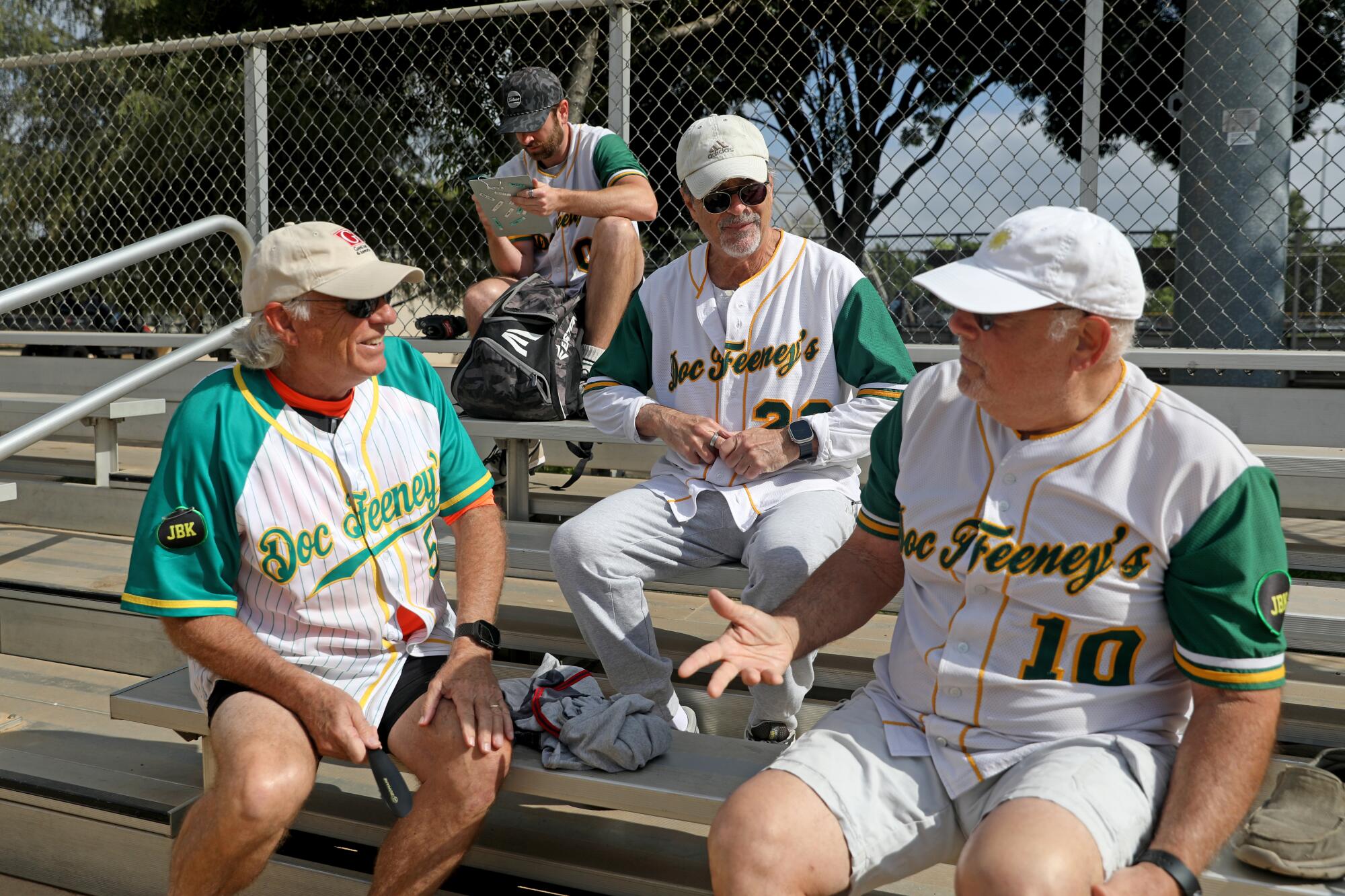
Doc Feeney’s All Stars veterans, Richie Greenberg, from left, Todd Lesner and Jeff Koppelman, all 72, sit together as team rookie Matt Michel, 33, works on the lineup. The trio has played on the team for nearly 50 years.
(Gary Coronado / For The Times)
The new generation of All Stars
The weekend he died last May, Jamie Krug had planned to play Sunday after attending his grandson’s musical performance Friday and going out to dinner with his wife, Simone, and friends Saturday. Krug heard the music and enjoyed a lovely night out, but he never made it to Sunday’s game.
The All Stars won, but learned Monday that Krug had gone to sleep and never woken up. Heart complications.
Family and friends remember Krug as many things: a reliable laugh, a saint of a father, a hell of a second baseman, a competitive but altruistic coach. At his funeral, his wife recalled, almost every speaker called him their “best friend.”
While some of the wives wouldn’t bother coming to games every Sunday, Michel said, many of the children saw the Feeney fathers as proper heroes. When she finally turned 14, Krug’s daughter, Ali, broke Municipal League barriers when she became the first woman to make an appearance as an All Star.
“My whole childhood was centered around baseball,” Ali said, recalling playing with her dad. “He’d set up these scenarios that were like, two outs, bottom of the ninth, World Series, bases loaded; he’d hit a huge fly ball and I’d catch it.”
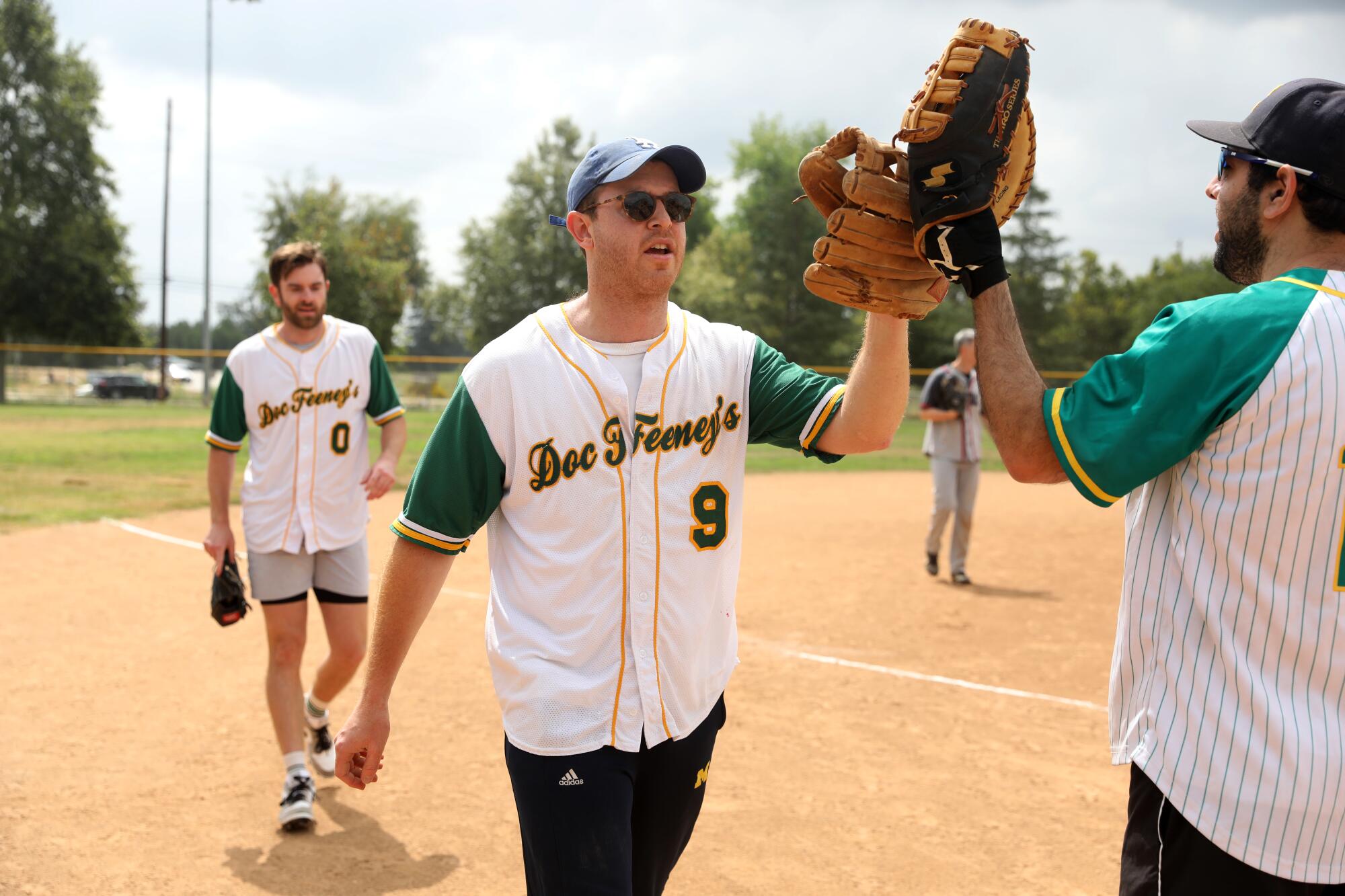
From left, Matt Michel, 33, Aaron Krug, 36, and Joel Gerson, 37, high-five after a Doc Feeney’s slowpitch softball game. Michel’s father, Al, and Krug’s late father, Jamie, are both original members of the team.
(Gary Coronado / For The Times)
Aaron — whose homer brought the Feeneys back into the memorial game — also joined the team at 14, playing alongside his father whenever he wasn’t too busy with his own sports schedule.
“Playing with your dad,” he said. “It’s hard to not get romantic about it.”
Michel’s son, Matt, has sought to modernize the team with a score-keeping app that has proved more reliable than Michel’s antiquated paper method.
“They used to pay me $20 to keep score,” Matt said. “I don’t have to pretend anymore, though.”
The game plan in a modern Feeney game revolves around strategically placing the elders in the batting lineup to avoid having two quick strikeouts or slow runners on base. Even though the Feeneys have gotten more competitive under the junior Michel’s management, the rascal-on-the-field ethos of the original team still prevails.
“The combined age of every Feeney in the infield could be 350 at any given time,” Lesner said before heading to the infield.
Winning like a Feeney
Due to some sloppy defensive errors from the silver-haired infield, the Feeneys allowed more runs in the top of the seventh. The Six Pack led, 18-16.
The Feeneys were in precarious waters as Greenberg stepped up to the plate with two outs. For the memorial game, the Feeneys had reverted to their old batting order, so after Greenberg, the lineup would be wholly composed of Feeney elders.
For the first time the whole game, all the players glued their eyes to the plate, conversations and catch-ups stopped mid-sentence.
Greenberg tried his best to ignore an irritating ankle injury that had plagued him the last couple of weeks and grimaced under the hazy sunlight as the pitcher, probably 20 or more years his junior, stared him down.
The high-arc pitch went up.

Jeff Koppelman, 72, drives a single during a slowpitch softball game. He has been a member of Doc Feeney’s All Stars for 48 years.
(Gary Coronado / For The Times)
Greenberg yanked his bat back, looking like a young Ken Griffey Jr. He struck the ball hard, but sent a one-hopper straight toward a third baseman no older than 40. Greenberg made it only about halfway up the basepath.
Out at first.
The Jamie Krug memorial game ended in a loss.
But instead of kicking up dust, breaking bats or throwing fits, the Feeneys coalesced in a green-and-yellow mass behind the dugout. They all high-fived, asked about each other’s families and went to dote on Ali’s 1-year-old daughter — Krug’s granddaughter, Eloise — who wore a shirt that traversed 50 years of family and friendship. It reads: “Littlest Feeney.”
-
 Entertainment5 minutes ago
Review: A mesmerizingly vulnerable Angelina Jolie fails to fully redeem ‘Couture’
-
Lifestyle12 minutes ago
He turned his one-bedroom West Hollywood apartment into an entertainer’s paradise
-
 Politics15 minutes ago
Quicker count, bigger turnout: L.A. County certifies 2026 primary election ballots
-
 Science20 minutes ago
Water from Boyle Heights warehouse fire carries foam into L.A. River, sparks testing
-
 Sports27 minutes ago
Cameron Carr on Lakers acquiring him draft night: ‘It didn’t feel real’
-

 World35 minutes ago
Why is Crimea critical to the Russia–Ukraine war?
-
 News60 minutes ago
As Supreme Court expands Trump’s immigration power, experts warn of steeper U.S. population decline
-

 Los Angeles, Ca2 hours ago
About 20 detained after armed suspect call sparks LAPD response in Koreatown

