Lifestyle
Novelist John Green says OCD is like an 'invasive weed' inside his mind


DAVID BIANCULLI, HOST:
This is FRESH AIR. I’m David Bianculli. Today we feature our interview with the writer John Green. He has a huge following, mostly among teenagers who are fans of his young adult novels. His best-selling 2017 novel, “Turtles All the Way Down,” has been adapted into a new film. It premieres on the streaming service Max next week. Green’s previous young adult novel, “The Fault in Our Stars,” sold over 23 million copies, was on the bestseller list for 24 weeks and also was adapted into a film.
His young adult novels wrestle with the kind of issues you’d expect from someone like Green, who had considered joining the seminary and worked at a children’s hospital as a student chaplain. “The Fault in Our Stars” is about two teenagers with cancer who fall in love. “Turtles All the Way Down” is about a 16-year-old named Aza, who’s still getting over the death of her father. She’s also dealing with OCD, obsessive compulsive disorder, which leads to intrusive thoughts that get in the way of her day-to-day life. Her thoughts also interfere with her relationship with her best friend and with her ability to have a boyfriend. Her obsession is with all the micro-organisms that live on and in her body and her fear that she will become infected with a deadly bacteria. Here’s a clip from the new film, in which Cree Cicchino, as Aza’s best friend, Daisy, is trying to convince Aza, played by Isabela Merced, that it’s safe to kiss her boyfriend.
(SOUNDBITE OF FILM, “TURTLES ALL THE WAY DOWN”)
CREE CICCHINO: (As Daisy Ramirez) You know what? I bet that if you guys actually kissed, you would not be thinking about…
ISABELA MERCED: (As Aza Holmes) Eighty million microbes.
CICCHINO: (As Daisy Ramirez) Ooh. What if his microbes are better than yours? Right? Like, maybe if you guys made out, you’d get healthier.
MERCED: (As Aza Holmes) Maybe.
CICCHINO: (As Daisy Ramirez) What if you got superpowers from his microbes? Yes. Oh, my God. She was a normal girl until she kissed a billionaire, and then she became Microbe Bianca, queen of the microbe.
BIANCULLI: John Green drew on his own experiences with OCD, which he’s dealt with since childhood. Terry Gross spoke with John Green in 2017, when “Turtles All the Way Down” first was published.
(SOUNDBITE OF ARCHIVED NPR BROADCAST)
TERRY GROSS: John Green, welcome to FRESH AIR. I’d like you to start by reading from your new book, but first, since her obsession is fear of getting C. difficile, aka C. diff, why don’t you describe what this really horrendous disease is?
JOHN GREEN: Sure. C. diff is a disease that is usually associated with antibiotic use in hospitals. And basically, there’s this bacteria in your gut, and if it grows out of control, you can become very, very sick. And this is something that Ayeza worries about all the time, and she uses kind of compulsive behaviors, including checking the internet to – for symptoms, to try to manage this worry that she has.
GROSS: And just to get a little bit more graphic, I mean, C. diff leads to, like, really extreme diarrhea, and in some people, particularly in elderly people, you can die if it’s not treated. So it’s a very serious and a very problematic infection. And you’re also going to refer, in the reading I’m about to ask you to do, to the microbiome, which is the collection of, you know, bacteria and micro-organisms in the gut, and so the goal is to always have a healthy microbiome.
GREEN: Yeah. I mean, one of the really weird things about being a person is that about half of the cells inside of your body are not yours. They’re microbes, and that’s also something that is of some concern to Aza and, for that matter, to me.
GROSS: Oh, I know. It’s a remarkable thing when you think about how your whole body – your skin, your gut – everything is just, like, populated with these micro-organisms, which is scientifically fascinating. But the more you think about it, the kind of creepier it is. And for her, it’s more than creepy. It’s disturbing. It’s very deeply disturbing. So I want you to do a reading, and this is from, like, a little more than midway through the book. And she has been friends with and is kind of starting to become girlfriend-boyfriend with a teenage boy. They’re starting to kiss a little bit, and because of this whole microbiome thing, it’s making her really uncomfortable. And some of what we’re going to be hearing is her intrusive OCD, her obsessive compulsive thoughts interfering with the rest of her thoughts. So some of what you’re saying is written in italics, and all the italicized parts are those intrusive thoughts interfering in her mind. OK.
GREEN: Right.
GROSS: Would you do the reading?
GREEN: (Reading) I told myself to be in this moment, to let myself feel his warmth on my skin. But now his tongue was on my neck, wet and alive and microbial. And his hand was sneaking under my jacket, his cold fingers against my bare skin. It’s fine. You’re fine. Just kiss him. You need to check something. It’s fine. Just be normal. Check to see if his microbes stay in you. Billions of people kiss and don’t die. Just make sure his microbes aren’t going to permanently colonize you. Come on. Please stop this. He could have Campylobacter. He could have non-symptomatic E.coli that you could get, and then you’ll need antibiotics. And then you’ll get C. diff, and boom – dead in four days. Please just stop. Just check. Make sure. I pulled away. You OK, he asked. I nodded. I just need a little air.
(Reading) I sat up, turned away from him, pulled out my phone and searched, do bacteria of people you kiss stay inside your body, and quickly scrolled through a couple pseudoscience results before getting to the one actual study done on the subject. Around 80 million microbes are exchanged on average per kiss and, quote, after a six-month follow-up, human gut microbiomes appear to be modestly but consistently altered. His bacteria would be in me forever, 80 million of them breeding and growing and joining my bacteria and producing God knows what. I felt his hand on my shoulder. I spun around and squirmed away from him, my breath running away from me, dots in my vision. You’re fine. He’s not even the first boy you’ve kissed – 80 million organisms in you forever. Calm down – permanently altering the microbiome. This is not rational. You need to do something. Please. There is a fix. Please get to a bathroom.
(Reading) What’s wrong, he asked. Nothing, I said. I just need to use the restroom. I pulled my phone back out to reread the study but resisted the urge, clicked it shut and slid it back into my pocket. But, no, I had to check to see if it had said modestly altered or moderately altered. I pulled out my phone again and brought up the study – modestly. OK. Modestly is better than moderately. But consistently – I felt nauseated and disgusting but also pathetic. I knew how I looked to him. I knew that my crazy was no longer a quirk. Now it was an irritation, like it was to anyone who got close to me.
GROSS: Thank you for reading that. That’s John Green reading from his new novel, which is called “Turtles All the Way Down.” So of all the obsessive compulsive thoughts you could have given your main character, Aza, why did you give her this obsession with C. diff?
GREEN: Well, partly because I can relate to it. I mean, I needed a place where I could make a connection with Aza in order to write about her, I think, and I’ve long had a fear of contamination from micro-organisms. That’s long been one of the kind of focuses of my particular version of obsessive compulsive disorder. And so I think that was partly it, but also, it’s something that we live with all the time. It’s something that surrounds us, you know? Like, in a way, bacteria are overwhelming us. We are the dominant species on the planet until and unless you start considering bacteria.
GROSS: So one of the things that she has are these thought spirals. I’m going to ask you to describe a thought spiral.
GREEN: Well, the thing about a spiral is that if you follow it inward, it just keeps going forever. It just gets tighter and tighter, and it never actually ends. And that’s kind of how Aza experiences her thoughts when she gets stuck into this kind of looping, turning, twisting series of thoughts about how she’s definitely going to get C. diff and she’s definitely going to die, and then she has to use these behaviors that she’s developed to try to manage that fear. And there really is no way for her to pull out of the thought spiral. And that’s part of what makes it so frightening to her, is that once she’s in it, it doesn’t feel like a thought spiral. It just feels like thought. It just feels like the way of the world. It feels like she’s not wrong when she’s afraid of this infection or the other things that she fears. And that’s really terrifying. It’s also really isolating for her because she struggles to be able to describe it with language. She struggles for the words that would help other people understand what she’s going through.
GROSS: She uses the word invasives to describe the kind of thoughts that you can’t control and that take over. Is that your word, or did you get that from therapy?
GREEN: I think it’s my word. When I was first told about OCD, I was told that these thoughts are called intrusives, but I actually heard the word invasives, for some reason, and that is what it’s like for me. It’s like there’s an invasive weed that just spreads out of control. You know, it starts out with one little thought, and then slowly, that becomes the only thought that you’re able to have, the thought that you’re constantly either forced to have or trying desperately to distract yourself from.
GROSS: So at what point did you decide that you would write a novel with a main character who has, as you do, obsessive compulsive disorder?
GREEN: In some ways, the choice was made for me because I couldn’t write about anything else. I tried to write a few other novels after “The Fault In Our Stars” came out, and I ended up having to abandon them. And then eventually, I got really sick and coming out of that period of being really unwell…
GROSS: OCD sick?
GREEN: Yeah. Yeah. I just had a really poor period of mental health where for a few months, I wasn’t able to feel like I was in any control over what I was thinking about, and coming out of that period, this was kind of the only thing that I felt like I could write about, and so that became the story that that I ended up writing.
GROSS: So you’ve said that you have OCD. Tell us more about what form it has taken in your life.
GREEN: Well, I guess the sort of dominant form that it’s taken in my life is that I get worried, I get afraid of having an illness or having some kind of contamination inside of my body, and then I become unable to stop thinking about that, and the worry begins to consume me. And, you know, in the face of that, you develop – or I have developed – compulsive behaviors to try to manage that and deal with that. But for me, it starts – there’s a reason the O comes first in OCD. Like, in the popular imagination, we always see people doing their compulsive behaviors because they’re so visual, and they’re often so strange and eccentric. But for me, it’s the problem of my thoughts that is the problem. The compulsive behaviors are a way of trying to manage the kind of overwhelming fear that the obsessiveness causes me.
GROSS: So what are the things you’re most afraid of contaminating you?
GREEN: I mean, there’s a reason – you know, I’m being super-intentional about not saying that.
GROSS: Oh, OK. OK.
GREEN: So…
GROSS: That’s fine. I don’t want to tread on that.
GREEN: Yeah. That’s the only thing that I can’t – I can’t talk directly about it ’cause I get squirmy.
GROSS: You get what? Squirmy?
GREEN: Yeah.
GROSS: Would it be awkward, too, for us all to know – like, say we met you in person sometime – would it be awkward for you to have everybody know what that most vulnerable point was?
GREEN: Yes.
GROSS: Yeah. Understandable.
GREEN: Yeah. That’s why.
GROSS: Yeah, yeah, yeah.
BIANCULLI: Writer John Green speaking to Terry Gross in 2017 – more after a break. This is FRESH AIR.
(SOUNDBITE OF THE WEE TRIO’S “LOLA”)
BIANCULLI: This is FRESH AIR. Let’s get back to Terry’s 2017 interview with John Green. His bestselling novel “Turtles All the Way Down” has been made into a new film, which premieres next week on the streaming service Max.
GROSS: So in the novel, there’s a physical manifestation as well as obsessive compulsive thoughts. The physical manifestation has to deal with digging the fingernail of one finger into the finger pad of another. Would you describe that physical manifestation of OCD?
GREEN: Yeah. So one of the ways – she’s been doing this since she was a little kid, and she just digs her thumbnail into her finger pad. Initially, it was a way – she would ask her mom, why do I know that I’m real? How do I know that I’m really real? And her mom would say, well, if you pinch yourself, you know it’s not a dream, and so it began as that. It began as a way of feeling real. But over the years, it became kind of a locus of her obsession as well. And so this callus has developed on her finger pad, and now it’s really easy for her to open up – to crack open that callus. And she gets worried that there’s an infection underneath that callus. She covers it up with a Band-Aid ’cause she’s very embarrassed about it, but she often has to kind of open that up and try to drain the wound because she’s worried that there’s an infection there.
GROSS: And, of course, the more she does, the more she risks infection.
GREEN: Of course. Yeah. I mean, this is not uncommon. These are not rational behaviors, so, you know, I find that, like, trying to apply logic – at least in my own life, like, trying to apply logic to it is fairly ineffective.
GROSS: So have you had a physical manifestation like that, too?
GREEN: Yeah. Not exactly that, but I count on my fingers as a way of calming myself. And so I think that’s probably why I started thinking about it, and then I liked the idea that, you know, it’s literally affecting her fingerprint. You know, it’s affecting who she is in a pretty profound way.
GROSS: For Aza, your main character, the OCD leads to a form of self-obsession, which makes her self-absorbed and not tuned into other people, and her best friend calls her out for it. Her best friend basically says, you probably don’t even – you know, she lists things that she assumes Aza doesn’t even know about her because she’s so absorbed with herself. Was there a point in your life where you felt that your OCD was actually making you self-absorbed in a way that you didn’t want to be, that you were neglecting other people, that you were losing a sense of empathy ’cause you were looking within so much?
GREEN: It has definitely affected my real-life relationships over the years in profound ways. I also wanted Aza to struggle with her ability to observe the world outside of herself because I think that is true to my experience, and it is not true to the kind of narrative of the obsessive detective that we have in the popular imagination. Obsessiveness is often linked to this, like, genius of observation that just is not my experience at all. Like, I find that my OCD makes me a terrible detective.
GROSS: Because you’re focused on the wrong thing obsessively.
GREEN: Yeah, because I can’t notice the world outside of myself in the way that I want to because I’m so deeply and irrationally focused on stuff that’s happening kind of within me.
GROSS: So the characters in your new book are also dealing with the deaths of parents, and in “The Fault in Our Stars,” the two main characters are dealing with cancer that is likely to be terminal. So, you know, death plays, like, a major role in your books, and I’d be interested in hearing why.
GREEN: Well, I think it’s a big problem. It’s a big question. And one of the things I like about teenagers…
GROSS: (Laughter) Yes.
GREEN: …Is that they’re looking – yeah, I mean, it’s a big theme.
GROSS: It’s a problem.
GREEN: (Laughter) Right, yeah. I mean, I’m concerned about it. That’s probably one of the reasons. But also, one of the things I like about teen characters is that they’re grappling with the kind of questions around death and the problems that death creates for the first time sort of separate from their parents, and so they’re asking, you know, is there an afterlife? And what are the implications for what we think about the afterlife? They’re asking, like, is meaning in human life changed by the fact of death? And I’m still really interested in those questions, and I like the way they approach them. Like, there’s a lack of irony and a passion for those questions that I found really appealing when I was a teenager and that I still find really appealing.
GROSS: When was the first time you dealt with the death of somebody who you knew?
GREEN: When I was in high school, a classmate of mine died. And it was – I went to a very small school, and it was devastating to the whole school.
GROSS: How did the classmate die?
GREEN: She was in a car accident.
GROSS: What was your way of talking to your friends about it in order to get through it? Like, how did you – do you remember any of those conversations in which you tried to talk through not only the loss that you were experiencing but also, like, why do these things happen?
GREEN: Yeah. I mean, I think when you’re in that position, those questions about meaning in life and what meaning you’re going to find in life – they stop being rhetorical questions, and they become matters of life and death. They become the questions that you need answers to if you’re going to figure out how to go on. And so we had a lot of those conversations. You know, we had a lot of conversations where we were looking for meaning in life that could hold up against reality as we found it. And I’ve never found a lot of comfort in the straightforward answers to those questions that, like, everything happens for a reason or that sort of answer. And I think that did start in high school, and it did start with those conversations with my friends.
GROSS: Was there any kind of, like, religious service that provided answers that you either found comforting or, you know, just, like, bromides that were not helpful?
GREEN: There were a lot of bromides that weren’t helpful. I mean, I’m Episcopalian, and I worked briefly as a student chaplain at a children’s hospital. You know, I thought about going to divinity school. Religion has been part of my life for a long time. But at the same time, I don’t find the answers to those questions in my religious tradition, to be honest with you, or at least not answers that satisfy me. I don’t find a satisfactory answer for, you know, the problem of theodicy, as they call it in the world of religious studies – like, the problem of evil in the world. I don’t have a good answer for why there is so much deep, profound injustice in the world and why, you know, the world behaves as if it were random. So if it isn’t random, it’s behaving as if it were.
GROSS: Are you still Episcopalian, and if so, what do you find in your spiritual tradition?
GREEN: I like going to church. I don’t know that much about why. But, yeah, I’m still Episcopalian, and I do find – and I like the outward focus of it. I like turning outward for an hour each week, and I like the focus on service and, you know, the activism. Those parts of my church are really important to me.
BIANCULLI: Writer John Green speaking to Terry Gross in 2017. After a break, we’ll continue their conversation, and film critic Justin Chang reviews the new film “Challengers,” set in the world of tennis. I’m David Bianculli, and this is FRESH AIR.
(SOUNDBITE OF JULIAN LAGE’S “PRESLEY”)
BIANCULLI: This is FRESH AIR. I’m David Bianculli, professor of television studies at Rowan University, in for Terry Gross. Let’s return to Terry’s 2017 interview with John Green. He’s famous for his young adult novels, including “The Fault In Our Stars,” which was about two teenagers with cancer who fall in love. His latest novel, “Turtles All The Way Down,” has been adapted into a new film, which premieres on Max next week. Green says he’s drawn to writing young adult novels because his readers, like the characters in his stories, are experiencing so many things for the first time, such as losing a loved one or falling in love.
GROSS: You know, as I mentioned, in your last two novels teenagers are dealing with death, death of their parents or the possibility of their own death because they have cancer. So you spent some time working as, what, an assistant chaplain at a children’s hospital? Is that what you said?
GREEN: Yeah, a student chaplain, I think, is the technical term, but yeah, either way.
GROSS: So what were you exposed to there?
GREEN: You know, you’re with people on the worst day of their lives. And people who work in children’s hospitals for longer than the few months that I was there are real heroes to me because you see the worst things that can happen to people every day. And it was really difficult for me. I was not – you know, I couldn’t do that work. I couldn’t let it go. I still can’t let it go 15 years later. And it was very hard. It was very hard to see that.
GROSS: Were you mostly talking with the parents or the children?
GREEN: Mostly with the parents. But I did hang out a lot with some teenagers who were sort of there long-term for various chronic health problems, mostly playing video games, to be honest (laughter). I was 22 at the time.
GROSS: That was probably really helpful
GREEN: Yeah. And so if somebody had an Xbox, I would play video games with them.
GROSS: Did it feel awkward to be 22 and trying to help parents through a period when their child was, you know, dying or possibly dying? Did you feel like, who am I to help them – I’m 22?
GREEN: Yeah, of course. I did, yeah. I felt unqualified in every possible way. But, you know, interestingly, I’m now 40 and I think I would still feel unqualified in every possible way. And if anything, I might be worse at the job now. I think I was a pretty poor chaplain all those years ago, but I think I would be much worse at it now because now that I have – I just think that I would identify more and it would be even more difficult for me, you know, to be there for people in the way that they need when they’re in that situation.
GROSS: Because you’re a father now?
GREEN: Yeah.
GROSS: Are you surprised that so many teenagers want to read stories about teenagers who have the kind of problems that make you feel different from everyone else, like OCD, or like having lost a parent who died, or like having cancer and maybe dying yourself? I mean, so many teenagers are just absorbed with, you know, school, finding a new boyfriend or girlfriend, just, like, having friends, figuring out how to make your way without being bullied or hated by other kids (laughter). But, I mean, you’re dealing with really major problems in your book, not to make light of those other problems ’cause when you’re a teenager those other problems are really big.
GREEN: Right. No, I think that’s actually the answer, though, is that when you’re a teenager, no matter what your experience is, the problems are big and they’re in many cases new. In many cases, it’s the first time you’ve had this problem. So, you know, when I fell in love with my wife – you know, we have a great, awesome marriage. But I was also like, this is like the other times I fell in love. Like, I understood what was happening to me. But when I fell in love for the first time, I was like, what is this completely unprecedented thing that has never existed in human history before?
GROSS: (Laughter).
GREEN: And so I think there’s – you know, that intensity to the first-ness of all these experiences that teenagers are going through, I think, is part of what makes them connect to people who feel – who are going through really unusual experiences.
GROSS: Do you remember your first girlfriend, your first crush, and can you tell us about it? Or would you rather not?
GREEN: Oh, yeah. Sure.
GROSS: (Laughter).
GREEN: I mean, my first crush was in third grade. And I wore, like, matching OP, like, shorts and a shirt to ask her to go with me, which was the parlance of the day. And I remember, like, you know, just feeling so incredibly nervous, as if the stakes were actually high and I wasn’t 9 years old and asking her to go with me. And she said yes. And I was, like, this is incredible. But then I had no idea, like, what the next step was. You know, like, I had no idea, like, how do we proceed from here? So we eventually exchanged phone numbers and had a few phone conversations over the next few weeks. And then, I don’t think there was ever an official breakup, I think it just was sort of understood that this wasn’t going to end in marriage.
GROSS: (Laughter) Did you tell your parents?
GREEN: Oh, yeah. Yeah, I definitely told my parents. I was like, I have a girlfriend. And they were like, why?
(LAUGHTER)
GROSS: Did you kiss?
GREEN: No, no. No, I don’t even think we held hands, actually.
GROSS: So what did it mean to have a girlfriend?
GREEN: Nothing.
GROSS: (Laughter).
GREEN: I mean, yeah, I think it must have been borne from the stories I was reading. Like, I was really into, like, series books like “Sweet Valley High” and “The Babysitters Club.” And so it must have come from those stories that, like, this is what you do. And I was like, all right, I’ll give it a try.
GROSS: Do you remember the first time you fell in love for real?
GREEN: Oh, yeah, yeah. That was in college.
GROSS: Did the OCD get in the way of that?
GREEN: It got in the way of it in the sense that it’s really difficult, I think, for anyone who is close to someone who’s in terrible psychic pain to be near that pain for a lot of reasons. One, you want to take it away. Two, it’s just difficult. And so it was a problem especially – we dated for a few years, and I think it was a problem especially at the end of our relationship because I would lose a lot of myself, my ability to pay attention to the world outside of myself, to these, you know, thought spirals. And I wouldn’t be able to pull myself out of it enough to be a good partner or to be a good friend, even. And that was definitely a problem.
BIANCULLI: Writer John Green speaking to Terry Gross in 2017. More after a break. This is FRESH AIR.
(SOUNDBITE OF THE MOUNTAIN GOATS SONG, “PEACOCKS”)
BIANCULLI: This is FRESH AIR. Let’s get back to Terry’s 2017 interview with John Green, whose latest young adult novel, “Turtles All the Way Down,” had just been published. It’s now been made into a movie, premiering next week on the streaming service Max.
GROSS: “The Fault in Our Stars,” the one where it’s written from the point of view of a teenage girl who has – is it stage 4, I think, cancer?
GREEN: Yeah.
GROSS: So my understanding is that’s based in part on one of your fans who actually was dying of cancer.
GREEN: Yeah, my friend Esther Earl. She died of cancer in 2010, when she was 16, and she was a really involved member of the community that grew up around the videos that my brother and I made and was really involved in our charity projects and became a friend of mine. And – yeah, and she died in 2010, and I kind of wrote “The Fault in Our Stars” mostly in the two years after her death.
GROSS: What were some of the things you took away from her life and death that you put in the book?
GREEN: Esther was just uncommonly empathetic. I don’t know that that was because she was sick. I think it was partly because she was – you know, some people are just extraordinary. She was incredibly – in the same way that Aza can’t pay attention to the world outside of herself, Esther was extremely tuned in to the world outside of herself. You know, the other question, I guess, that emerged for me in the wake of Esther’s death was whether a short life can still be a good and a fulfilling life, and I needed to feel like it could be. You know, I needed to feel like Esther had had a good life. And I wrote the book, in some ways, I think, in that hope, almost like a prayer that a short life can still be a good life.
GROSS: Did writing the book convince you?
GREEN: That’s a good question. Yeah. I mean, I don’t know that writing the book convinced me, but I do believe that.
GROSS: You have two children. Is your point of view when you’re writing shifting a little bit from the teenager to the parent? I mean…
GREEN: Yeah.
GROSS: The parent in the new novel is very – I find her a very sympathetic character. I mean, she clearly, like, loves her daughter so much and is trying so hard not to be the intrusive parent, you know, to have the right amount of connection and distance. But, you know, it’s always hard to find, and as Aza says to her at one point – Aza says to her mother, I’m doing my best, but I can’t stay sane for you.
GREEN: Yeah. I mean, I think as parents, we desperately want to take pain away from our kids, and we want to – I want to save my kids from all the hurt that the world has in it, and you can’t. And there’s so – that’s so difficult. It’s so hard to reconcile yourself to that. I do think that I have become much more interested in parents as characters since I became a parent. Like, I used to shuffle all the adults out of my books as quickly as possible, and now I’m like, hold on a second. Let’s listen to your mother first. Your mother might have a point here.
GROSS: (Laughter).
GREEN: And I do think that is probably a result of this change in my life that has caused me to suddenly be tremendously sympathetic to the parental point of view.
GROSS: And your kids aren’t even teenagers yet.
GREEN: No. God, no. They’re 7 and 4, so I have a long way to go.
GROSS: I kept thinking about the parent in the book because Aza’s father died years ago, and so Aza’s mother is a widow, and now she’s worried she’s going to lose her daughter to mental illness or lose her to other problems. I’m trying not to give too much away here.
GREEN: Yeah.
GROSS: So – and I really just kind of sympathized with her and admired how hard she was trying to have the right amount of connection with her daughter without being too pushy or smothering her or being overprotective.
GREEN: Yeah, it’s really hard. I think it’s so – you know, parenting a teenager – I can only imagine how hard it is. The great thing about having little kids is that at least you can solve their problems. You know, at least you know how to change a diaper. It’s really, really hard, and in many cases, you can’t solve the problems of your teenage kids. That’s something that I think Aza’s mom is having to learn and accept, but it’s so difficult ’cause, you know, also, I think her daughter’s in terrible pain. And, you know, when you see someone you love in pain, you feel it, too.
GROSS: I want to quote something that Aza, your teenage character, says in the book or thinks in the book. (Reading) I hated my body. It disgusted me – its hair, its pinpricks of sweat, its scrawniness, skin pulled over a skeleton, an animated corpse. I wanted out, out of my body, out of my thoughts, out. But I was stuck inside of this thing like all of the bacteria colonizing me.
Is this a feeling you understand, of, like, hating your body and feeling kind of disgusted by it?
GREEN: Yeah, definitely. I mean, for much of my life, I felt like I had to carry around this skin-encased bacterial colony in order to have a mind and a consciousness, you know? And also, I’ve often felt like my body is trying to control my consciousness or dictating what I can think about or what I can feel, and that feels really frustrating. I have to say that in the last few years, I’ve come around to the body a little bit, partly through exercise, partly through cognitive behavioral therapy techniques. And I don’t see my body anymore as the opposite of me, but I do still feel at times frustrated by the fact that I’m stuck inside of just this one vessel, you know? So I don’t know. I’m grateful – I’m very grateful for for my body now. But at the same time, I do rather wish that, you know, like, it could go on forever and never hurt.
GROSS: Sure. And there’s times you probably want to trade in your brain also, right?
GREEN: Absolutely, yeah. No, I mean, there’s probably more times when I want to trade in my brain.
GROSS: Clean out the obsessive thoughts. Yeah.
GREEN: Yeah. To be completely honest, like, it would be great to be able to, like, turn my brain into the mechanic and, like, have them just, like, fix some stuff up and then give it back to me.
GROSS: Yeah.
GREEN: That would be great.
GROSS: So I read that you said you were bullied when you were in – I don’t know – junior high or high school – anything in particular you were bullied for, you know, that you were mocked for?
GREEN: I mean, I don’t really know. They don’t seem to need a great reason.
GROSS: They don’t tell you as they’re reading you up.
GREEN: Right. Yeah. It wasn’t – that would have been nice, though, if they could have, like, sent a note that just explained, like, here are the three things you’re being bullied for. And if you could work on these three things, then we’ll stop. I think I was different. I was very nerdy. I struggled socially, partly because I was really stuck inside of myself. And I think I was at times kind of an annoying kid because I was, you know, a little obsessive and perpetually nervous. But none of that justifies the bullying that happened. Yeah. It was difficult. And the middle school years especially were extremely difficult for me. And I did have friends, and I was very grateful for those friends, but the bullying was scary and difficult.
GROSS: Did you fight back?
GREEN: No. This is going to surprise you, Terry, but I’m not really super-able to fight back.
GROSS: I never would have expected that.
GREEN: Yeah. I’m not a boxer.
GROSS: And when did you realize you wanted to write?
GREEN: Well, I always liked writing, but I thought of it like being an astronaut or being a professional athlete or something. I never thought of it as a realistic career goal. And in some ways, I still have a day job, and I like having a day job. I like going into the office in the afternoon and working on the online video stuff that we make. But after I decided not to go to divinity school, I started working at this magazine called Booklist. I was an assistant there, mostly doing data entry. But Booklist reviews, like, 400 books every two weeks. And, you know, all those books were written by somebody. And so that’s when I started to feel…
GROSS: But were they read by anybody is the question.
GREEN: Well, yeah, not all of them, certainly. But that’s when I started to feel like, OK. Well, being – it’s not quite like being a professional athlete or being an astronaut. Like, this is something that regular people do. Lots of people write books. And that’s when I started to feel like maybe I could write a book. And at the same time, I started reading a lot of young adult books, and I really loved them. And I thought, well, that would be a great place – like, that would be such a cool place to publish. And so when I was writing my first novel, I was kind of hoping that that’s where it would end up. And it did.
GROSS: Why were you starting to read a lot of young adult books then?
GREEN: I think partly because I was the youngest person at Booklist, so I was the closest thing they had to a young adult.
GROSS: Oh, they asked you to read the young adult books.
GREEN: Yeah. Yeah, but I also think…
GROSS: So you were reviewing young adult fiction and then decided you wanted to write it, too.
GREEN: Yeah, yeah.
GROSS: That makes sense. Why does that seem like a good fit?
GREEN: Well, I mean, there are a bunch of reasons, I think. I like the way that young adult books are published. I like that science fiction and mystery and romance all live on the shelf together, you know, that they’re – the genre separations that you see in books for grownups aren’t there in the same way. Also, YA books tend to hang around because of support from librarians and teachers, and that was really appealing to me. But in terms of character and readers, it’s just – you know, it’s a privilege to have a seat at the table in somebody’s life when they’re forming their values. And that’s, for me, what my experience was as a teen reader. And, you know, I hope that my books can be part of that conversation for teen readers today.
GROSS: John Green, it’s been great to talk with you. Thank you so much.
GREEN: Oh, thank you.
BIANCULLI: John Green speaking to Terry Gross in 2017. His best-selling young adult novel, “Turtles All the Way Down,” has been made into a film which premieres May 2 on the streaming service Max. Coming up, film critic Justin Chang reviews the new movie “Challengers,” set in the world of tennis. This is FRESH AIR.
(SOUNDBITE OF THE BAMBOOS’ “THE BAMBOOS THEME”)
Copyright © 2024 NPR. All rights reserved. Visit our website terms of use and permissions pages at www.npr.org for further information.
NPR transcripts are created on a rush deadline by an NPR contractor. This text may not be in its final form and may be updated or revised in the future. Accuracy and availability may vary. The authoritative record of NPR’s programming is the audio record.



In central London’s Waterloo Place, a life-size statue that emerged overnight in late April has been creating a stir. When I visited a few weeks after it was erected, local authorities had already set up protective barriers around it.
The installation — signed by the famed street artist Banksy — depicts a man in a suit hoisting a flag as he strides over a precipice. As he marches on, the flag blows backward to cover his face, leaving him unaware he’s only a step away from a perilous fall.
Set among grand monuments celebrating Britain’s past, the “flag man” takes on a particular visual irony at a time when the country — and much of the world — is debating its path forward.
Like many viewers there, I found myself wondering whether this statue is Banksy’s warning about the consequences of uncritical nationalism, or simply a reflection on human shortsightedness. Or, perhaps, it is just prompting us to ponder a broader question: What happens when devotion to a symbol prevents us from seeing what lies ahead?
Whatever the message, the work feels remarkably attuned to the current moment.
For more Far-Flung Postcards, click here.
Lifestyle
Wait, it’s a candle? Her beeswax fruit and veggie ones look so real, you’ll want to take a bite
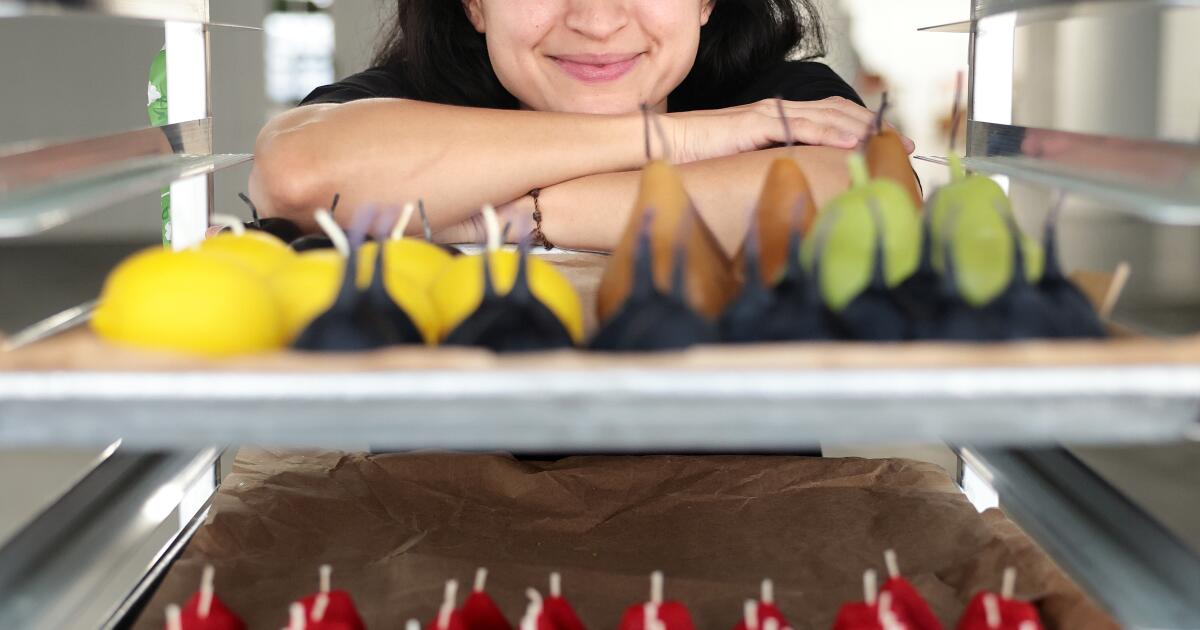
Jessica Gonzalez hustles behind her booth at the recent Renegade Craft Fair, frantically ringing up sales, answering questions and packaging her beeswax candles.
It’s hot on the grounds of the Los Angeles State Historic Park in April, but 35-year-old Gonzalez and her fiancé, Jordan Colindres, keep their cool as a crowd gathers to admire her Happy Organics candle collection, a homage to her family’s produce company in the Central Valley that looks like real fruits and vegetables.
“I love doing in-person events because it’s so fun to see people’s reactions,” she said a few months later. “It makes me feel good to see other people finding joy in my candles. They often say, ‘Oh, that’s really funny.’ And it is funny to have a cherry candle on top of your birthday cake.”

3

1. A staff member pulls a beeswax corn candle, $26, out of its mold at Happy Organics’ studio in downtown Los Angeles. 2. Each Beeswax Mixed Berry Birthday Candles set is cast from real mixed berries — strawberries, raspberries, blackberries, blueberries and cherries. A set of 10 is $30. 3. Bartlett green pears and heirloom tomatoes, $24 to $40.
Judging by the smiles and charmed looks on shoppers’ faces, her produce-inspired candles are less about illuminating rooms and more about sharing the joy she sought when she first started the company in 2018.

In this series, we highlight independent makers and artists, from glassblowers to fiber artists, who are creating original products in and around Los Angeles.
But then, it’s hard not to smile at the playfully elegant Bosc pears, puckered mandarins and green-and-purple asparagus taper candles which range in price from $12 to $40. Some are molded into corn on the cob, celery and rhubarb shapes. Others are made to look like mushrooms, figs, tomatoes and snap peas. The most popular are the small birthday candles shaped like raspberries, cherries and blackberries, packed in molded-pulp baskets just like you’d find at the grocery store or farmers market.

-
Share via
Gonzalez didn’t start out as a designer. The youngest of nine children, she was born in 1991 in Salinas and later moved to Merced, where she grew up on a 10-acre farm. She studied computer science at Mills College, then worked in tech consulting in the Bay Area and eventually became the CTO of an ag-tech company. When her mother, Angela, became ill in 2016, she returned to Merced to be with her family.
When her mom died suddenly soon after she moved home, Gonzalez left the tech industry. “I wasn’t connected with what I was doing,” she said. “I wanted to find something more meaningful; something I loved. I didn’t want my ego to keep me stuck in what I studied in college. I decided to let myself try new hobbies and passions and look for joy again.”
After her mother’s death, she began working with her father, Salvador, and her uncles at the family’s apiary, where they managed more than 30 hives. (Her grandfather was also a beekeeper in Michoacán, Mexico.) Soon, she began selling their raw honey at local farmers markets. In a heartbreaking turn, her father was diagnosed with cancer a year later, so she started making cannabis-infused honey, balms and chocolates to help ease his pain.
When she saw that the beeswax candles, which last significantly longer than paraffin candles, were selling faster than the honey, she decided to focus on making candles from the leftovers from her uncles’ hives.
She was only 25, but it was a turning point. “It was one of those moments where I felt like I needed to change my path,” she said. “I needed to change everything in my life.”

Jessica Gonzalez and her father Salvador on their family farm in Merced. (Gonzalez family)

Gonzalez at Happy Organics’ studio in downtown Los Angeles. (Christina House / Los Angeles Times)
When her father died in 2018, she inherited his bees and started Happy Organics, although she hadn’t planned on starting a business. After experiencing so much loss, making candles became a kind of therapy. “It felt great to work with my hands again, something I thought I’d never have time for,” she said.
Her oldest sister, Sonia Gonzalez, said Gonzalez reminds her a lot of their father, who reinvented himself many times over the years.


The nopal cactus is cast from a real nopal and hand-poured in 100% pure beeswax in the Los Angeles studio.
“He grew up as a village boy in the rural mountains of Michoacán, Mexico, and went on to work in restaurants, cut down Christmas trees and pick strawberries and broccoli in the fields of Salinas,” she wrote in an email. “From there, he started selling produce door-to-door, then at flea markets and eventually built his own produce distribution business from the ground up. As the youngest of nine kids from a working-class family, Jessica’s always been incredibly resourceful, responsible, and amazing at reinventing herself.”
Like a lot of millennials, Gonzalez taught herself how to make candles by watching YouTube videos. She started with hand-dipped tapers, working in the garage on the farm that helped her feel safe and connected to her parents. “It was a really nice environment to try something new and creative,” she said.
Inspired by her family’s produce, she cast real corn, strawberries and cherries in plaster, then made a silicone mold to create copies. Even when using the same mold, color can vary from batch to batch, and how it cools also affects the result. “That’s just how handmade things are,” she said. “There’s always some variation.”

Cherry molds make cherry candles at Happy Organics’ studio in downtown Los Angeles.

A variety of fruit and veggie candles.
When she moved to Los Angeles in 2023 to be with Colindres, her business took off. “L.A. is a great place to grow,” she said. “There’s so much opportunity here. When I go to a farmers market, I never know who I’ll meet.”
She sold her candles in person at craft shows, the Hollywood Farmers’ Market and most recently, during a residency at the P.F. Candle Co. showroom in Echo Park.

2

3

1. A staff member trims the wicks on a pair of carrot birthday candles, $22. 2. Gonzalez passes by shelves of candles at Happy Organics’ studio in downtown Los Angeles. 3. Asparagus taper candles, $30.
“I have a lot of respect for her as a fellow candle maker (making molds is not easy), but getting to know her story more and how her choice of foods and wax is reflective of her family’s history gave it so much meaning,” P.F. Candle Co. founder and creative director Kristen Pumphrey said in an email. “It’s been a tough couple of years for L.A. businesses, so we gotta stick together — there’s this wonderful sense of community hosting a local brand that’s so passionate about their work.”
As her business has expanded, her products are now available at Terrain, Joan’s on Third and the MoMA Design Store in addition to her website. She has also had to source beeswax from other vendors across the country to keep up with demand.
Kimberly Curtis, owner of Hide & Seek Vintage in Studio City, said Gonzalez’s strawberry and cherry birthday candles “flew off the shelves last year” during the holidays. “Our customers love them,” she added.

Gonzalez holds a cabbage candle.
Still, Gonzalez stays connected to her Central Valley roots. Everything she and her small team make in downtown Los Angeles is handmade and “takes time,” she said, describing the steps involved in crafting quality candles. Right now, her favorite is the Nopal Cactus candle, which she made using a clipping from an employee’s yard. While others help her with production, wholesale management and packaging, she focuses on sales, content and all-new product development.
When asked if she has advice for others who want to start their own business, Gonzalez admits she sometimes feels overwhelmed.

In 2013, Gonzalez and her family gathered at their Merced ranch to celebrate her parents’ anniversary.
(Gonzalez family)
“The biggest thing that has gotten me through the toughest spots is my why or my reason for starting,” she said. “I think that has to be really strong. That’s what brought me a lot of comfort when I felt like quitting: going back to the beginning and remembering why I started this.”
For Gonzalez, her reason is always close to her heart. “I wanted to feel connected to my parents in some way,” she said. “This was a good representation of my upbringing.”

The Kennedy Center, the facade of which remains covered with a tarp, is seen in Washington, DC, on June 28, 2026. A US federal judge asked on June 24 for an explanation for why a tarpaulin continues to cover the facade of the Kennedy Center where President Donald Trump’s name was recently removed. District Judge Christopher Cooper gave the board of trustees of the performing arts venue until the end of July to explain “the purpose for and status of the tarp and scaffolding that Defendants have erected on the front portico of the Center.”
ALEX WROBLEWSKI/AFP via Getty Images
hide caption
toggle caption
ALEX WROBLEWSKI/AFP via Getty Images
More than two weeks ago, President Trump’s name was removed from the Kennedy Center facade though it is still covered by a tarp and the legal battle continues.
On Monday, a U.S. Department of Justice filing on behalf of the Kennedy Center included some surprises. The document was submitted in response to issues raised by lawyers for ex-officio board member Rep. Joyce Beatty of Ohio who is suing to remove President Trump’s name from the center and stop its closure for renovations.
Among the revelations, the Kennedy Center admitted that, during a board meeting on December 18, 2025, Beatty had been “muted and prevented from speaking.” It was at that meeting that the board voted to add President Trump’s name to the center. The filing later acknowledges the congresswoman was “prevented from voicing her opposition.”
The John F. Kennedy Center for the Performing Arts is a living memorial to its namesake. The guidelines for how the theatre complex spends federal dollars are very specific. Among other rules, it states that “no additional memorials or plaques shall be designated or installed.” Beatty argues adding Trump’s name runs afoul of those rules and that any change requires approval from Congress.
According to one of Beatty’s filings, “There was no advance notice in the agenda that the Board would be considering a name change,” a statement the Kennedy Center now does not deny. The center admits that, prior to voting, there was “no discussion about potential risks or downsides of the vote to adopt a secondary name for the Center.” Nor was there a board discussion “about any potential conflict of interest that might result from the vote.”
The center’s lawyers previously contended that if Trump’s name were to be removed, it would “lose money from donors who support” him and “impede the Center’s fundraising efforts.”
Closing for renovations
Earlier this year, Trump announced on social media that the Kennedy Center would close for two years for renovations. He wrote that he made the decision after “a one year review” with “Contractors, Musical Experts, Art Institutions, and other Advisors and Consultants.”
But, according to the center’s lawyers, Trump’s announcement “was made without presenting any plans, analyses, timelines, or funding information to his cotrustees and without any Board vote.”
The Kennedy Center has long denied reporting by The Washington Post that ticket sales plummeted after President Trump became the Center’s board chair. In Monday’s legal filing, the Center admits that, by October 2025, “nearly half of the Center’s tickets were going unsold.”
-

 North Dakota36 seconds ago
WATCH LIVE: Trump speaks in North Dakota ahead of July Fourth
-
Ohio5 minutes ago
Children found in ‘deplorable’ Ohio home were part of same family
-

 Oklahoma13 minutes ago
Oklahoma opens Taiwan Regional Trade Office at State Capitol
-

 Oregon15 minutes ago
Strict fire restrictions in effect on BLM lands in Washington, Oregon ahead of July 4
-
Pennsylvania21 minutes ago
From Chocolate Avenue to the World Cup, how Hershey, Pennsylvania, shaped Christian Pulisic
-

 Rhode Island28 minutes ago
Christ on a Crackuh! Liz McGraw Is Leaving RHORI.
-

 South-Carolina31 minutes ago
South Carolina Lowcountry Community Calendar of Events
-

 South Dakota43 minutes ago
Transparency, data protection laws take effect July 1

