Lifestyle
Looking to upgrade your home with designer touches? Here’s a start


If you buy a product linked on our site, The Times may earn a commission. See all our Coveted lists of mandatory items here.
JK3D Limited Lake Edition Flora Decanter, $1,375
Given the color of the glass and the sand-looking base, JK3D’s Flora Decanter was born in Los Angeles to make a statement. Whether you keep this treasure on display on a shelf or put it to use at a dinner party, your guests certainly won’t forget seeing it — that’s for sure. Julia Koerner, who specializes in computational design and 3D printing, and Austin Fields, who’s known for her experimental glassblowing techniques, found inspiration in flora and fauna, light, the ocean and California landscapes when they created the Flora Decanter. The Limited Lake Edition decanter comes in turquoise, deep blue and amber, and its digitally crafted and 3D-printed base is available in ash and sand. This limited-edition version of the decanter was created for the 2023 millstART exhibition in Austria. It was made with sustainable plant-based renewable material in Los Angeles for North America and in Vienna for Europe and other international markets.
Purchase 👉🏽 here.
Tom Ford Oud Wood candle, $135

Maybe it’s time for a break from the world — a chance to get cozy in your favorite space at home. If that’s the case, turn up your favorite track from “The Tortured Poets Department,” pour another glass of sauvignon blanc and light your Tom Ford Oud Wood candle. The candle, with its scent of wood and spices, is based on the brand’s fan-favorite Oud Wood fragrance, which has a rich woodsy scent featuring notes of cardamom, patchouli and amber. (When you’re finished cocooning, you can wear the scent into the world via the new Oud Wood parfum ($445 for 50 milliliters) or the beloved eau de parfum ($195 for 30 milliliters).
Purchase 👉🏽 here.
Carl Hansen Children’s Wishbone Chair, $845

Danish architect and furniture designer Hans J. Wegner was a prolific and innovative force behind Danish Modernism, and among his pieces for Carl Hansen & Son is the Wishbone Chair, which was designed in 1949 and has remained in continuous production since 1950. To celebrate the 110th birthday of the godfather of Danish Modernism in April, Carl Hansen released a children’s version of the classic Wishbone Chair. The mini version is made from solid oak and woven paper cord and involved more that 100 production steps to produce. It’s available at various retailers, including Design Within Reach, 8612 Melrose Ave., West Hollywood , and the Carl Hansen & Son flagship store in San Francisco.
Visit the Carl Hansen website to find a dealer.
Roche Bobois Apex Outdoor ottoman, $2,005

Bring the indoors outdoors with this adorable outdoor ottoman from the spring and summer collection from Roche Bobois. It was designed by French product designer Sacha Lakic and comes in colors including vert d’eau (light blue), forêt (green), nuit (dark blue) and tangerine. Pro tip: This ottoman, which is made with fast-drying foam, looks just like a scrumptious popover or a delicious jelly candy. With that said, you might want to have a tray of snacks, drinks and other accoutrements for relaxing on hand in case you and your guests get hungry while you’re lounging by the pool.
Visit the Roche Bobois website for showroom details.
Kelly Wearstler Studio Echo Collection bench, $7,995

The Kelly Wearstler Studio continues to indulge the sensibilities — this time, with its new Echo Collection of homewares. Inspired by California landscapes, the collection, with pieces ranging from $5,500 to $20,000, is made up of eight pieces: a handcrafted dining table, a drinks table, benches, a totem, a side table and stool. Each piece in the collection has repetitive organic forms as part of its design and comes in white gesso, natural Douglas fir and ebonized Douglas fir. Also, the Echo Collection is made at the Kelly Wearstler Studio near downtown Los Angeles, with each piece carved by one artisan who’s an expert in timber and has a background in sculpture.
Purchase 👉🏽 here.
Opame Collective Benton Box, $4,995

Sometimes you need the perfect designer spot to hide all of your treasures (and deep, dark secrets). That’s where Opame Collective’s lovely Benton Box factors into your life. Reminiscent of a ceremonial box, this sculptural bronze-cast box, which has a separate lid, might be at home on a living-room or office shelf or close by you — say, on your nightstand. It can be purchased through various retailers including Fred Segal Home, and there’s a limited edition of eight available.
Purchase 👉🏽 here.
Francesca Grace Somme bed collection, $3,500 and up

Are you looking for a dreamy upgrade to your current bed — one with a touch of whimsy, character and French inspiration? If so, you’re in luck thanks to Los Angeles home stager and celebrity interior designer Francesca Grace, who has designed the lovely Somme collection of five beds with names such as Cosette, Penelope, Amélie, Estelle and Colette. The bed-frame options come with walnut wood-trim headboards, satin or velvet upholstery and bullion fringe around the base. (The frames don’t require box springs.) Prices range from a twin at $3,500 to a spacious California King at $7,700.
Purchase 👉🏽 here.
Casa Branca x Nine Fair backgammon board, $2,500
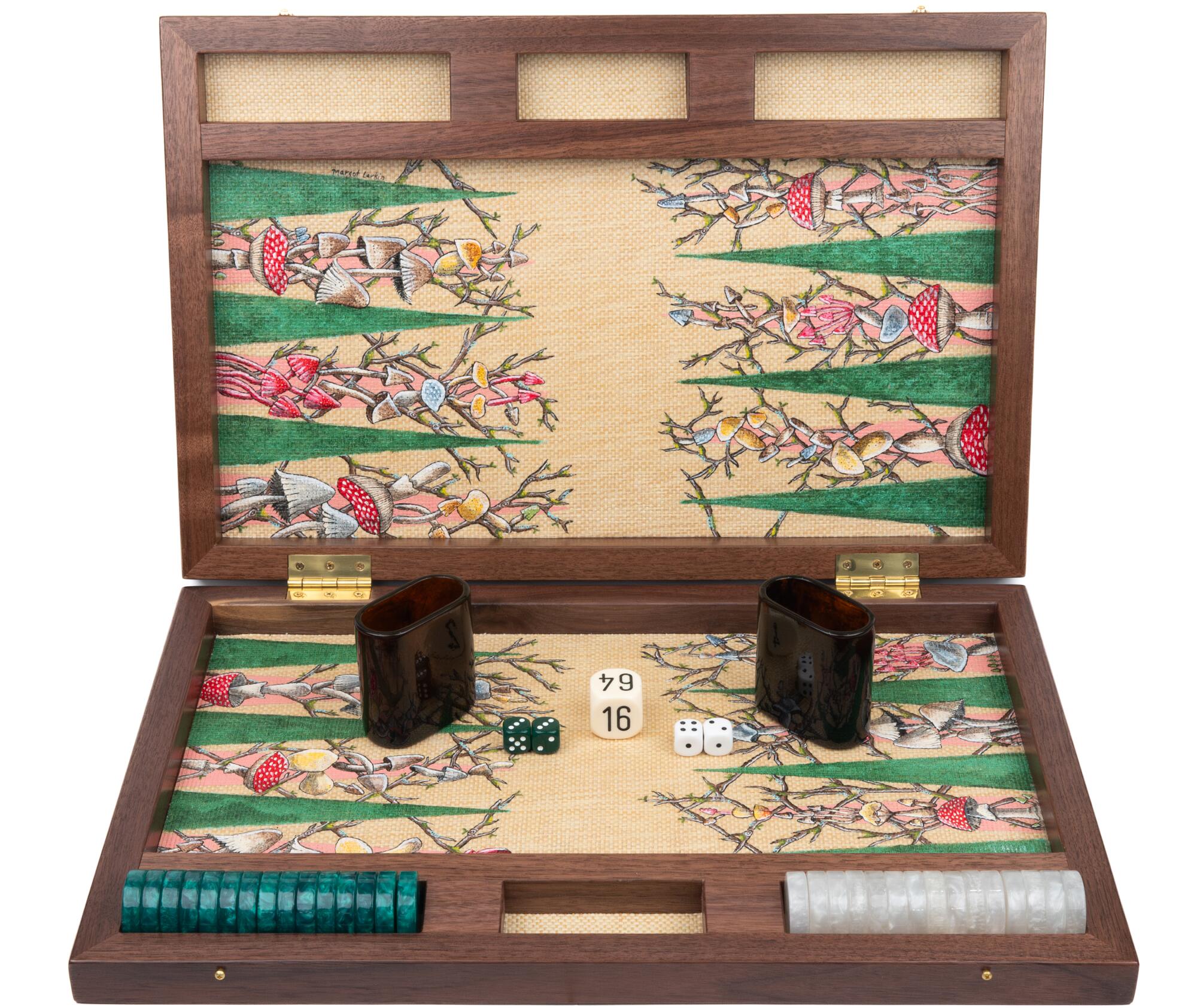
It’s the perfect time to learn backgammon and other board games thanks to a host of fashion and lifestyle brands producing them with colorful designer touches this season. Take for example Casa Branca x Nine Fair’s fun and festive backgammon board collaboration. (We particularly like the mushroom design and we can’t stop thinking about the Apple TV+ show “Palm Royale” whenever we look at these boards.) Produced by Nine Fair, the boards were hand-painted by artist and Casa Branca collaborator Margot Larkin. They come in three fresh designs: malachite, mushrooms and what’s being called a graphic version of wicker.
Purchase 👉🏽 here.



The Kennedy Center, the facade of which remains covered with a tarp, is seen in Washington, DC, on June 28, 2026. A US federal judge asked on June 24 for an explanation for why a tarpaulin continues to cover the facade of the Kennedy Center where President Donald Trump’s name was recently removed. District Judge Christopher Cooper gave the board of trustees of the performing arts venue until the end of July to explain “the purpose for and status of the tarp and scaffolding that Defendants have erected on the front portico of the Center.”
ALEX WROBLEWSKI/AFP via Getty Images
hide caption
toggle caption
ALEX WROBLEWSKI/AFP via Getty Images
More than two weeks ago, President Trump’s name was removed from the Kennedy Center facade though it is still covered by a tarp and the legal battle continues.
On Monday, a U.S. Department of Justice filing on behalf of the Kennedy Center included some surprises. The document was submitted in response to issues raised by lawyers for ex-officio board member Rep. Joyce Beatty of Ohio who is suing to remove President Trump’s name from the center and stop its closure for renovations.
Among the revelations, the Kennedy Center admitted that, during a board meeting on December 18, 2025, Beatty had been “muted and prevented from speaking.” It was at that meeting that the board voted to add President Trump’s name to the center. The filing later acknowledges the congresswoman was “prevented from voicing her opposition.”
The John F. Kennedy Center for the Performing Arts is a living memorial to its namesake. The guidelines for how the theatre complex spends federal dollars are very specific. Among other rules, it states that “no additional memorials or plaques shall be designated or installed.” Beatty argues adding Trump’s name runs afoul of those rules and that any change requires approval from Congress.
According to one of Beatty’s filings, “There was no advance notice in the agenda that the Board would be considering a name change,” a statement the Kennedy Center now does not deny. The center admits that, prior to voting, there was “no discussion about potential risks or downsides of the vote to adopt a secondary name for the Center.” Nor was there a board discussion “about any potential conflict of interest that might result from the vote.”
The center’s lawyers previously contended that if Trump’s name were to be removed, it would “lose money from donors who support” him and “impede the Center’s fundraising efforts.”
Closing for renovations
Earlier this year, Trump announced on social media that the Kennedy Center would close for two years for renovations. He wrote that he made the decision after “a one year review” with “Contractors, Musical Experts, Art Institutions, and other Advisors and Consultants.”
But, according to the center’s lawyers, Trump’s announcement “was made without presenting any plans, analyses, timelines, or funding information to his cotrustees and without any Board vote.”
The Kennedy Center has long denied reporting by The Washington Post that ticket sales plummeted after President Trump became the Center’s board chair. In Monday’s legal filing, the Center admits that, by October 2025, “nearly half of the Center’s tickets were going unsold.”


Paul Tremblay has made a career of pushing the horror genre – and the novel format – in strange and exciting new directions.
In his latest, Dead but Dreaming of Electric Sheep, the author offers an amalgamation of genre elements that can be best described as psychological-dystopian-science-fiction horror. It’s a mouthful, but the narrative does all of that and more in a way that defies categorization.
Julia Flang is a former semiprofessional gamer working two mediocre jobs she dislikes and living in a modest ranch house in a San Fernando Valley suburb with her retired uncle, whom she calls Uncle Fun. Julia likes movies and gaming but there’s little else going on in her life, so when her estranged mother, the CFO of a large tech company, contacts her with a possible job offer – a “once-in-a-lifetime thing” that pays handsomely just for doing the interview – she hesitantly agrees.

The job is relatively simple and perfect for someone with gaming skills: using a controller built into a phone to get a man, who is stuck in a vegetative state, from California to the East Coast. It will require her to learn how to control his body – walking, moving, sitting, standing, using his arms – so she can maneuver him out of the facility where he is located and into cars and planes and through crowded airports. A fan of movies, Julia decides to call the man Bernie – after the movie Weekend at Bernie’s. When the ethics of the job start to bother her, Julia realizes it’s too late and she must go through with it. However, she’s soon contacted by people interested in sabotaging the whole thing, people who, like her, don’t align with the shady interests of conglomerates and those set to make “gobs of money” from this new, somewhat inhuman technology.

As with every Tremblay novel, any synopsis barely scratches the surface. The novel’s chapters alternate between Julia and you (yes, you). Julia’s chapters are “normal” in the sense that they obey a chronological order and have action, basic descriptions of movement and places, and dialogue. The chapters in second person are like fever dreams from a shadow world; the desperate experiences of a man trapped inside his own body with no control of it, no clue what’s happening to him, and only a few fragmented memories of his life. Also, Tremblay uses a similarly fragmented style of storytelling (including words and sentences trapped in boxes and/or “moving” on the page) to keep things interesting but also confusing and creepy.
This novel operates on several different levels and – planes of existence? Bernie has a head full of AI that controls his body, but his consciousness is still there and struggling to regain control, struggling to remember things. There are monsters, leeches, mysterious rabbits, and eerie shadows in his world, but the true horror comes from the lack of control, from being moved around against his will and having no clue what comes next. Bernie is the embodiment of losing control to AI, and when taken together with the commentary of creativity and AI and the meta interludes in which the author takes a wrecking ball to the fourth wall and addresses readers, this is the best anti-Generative AI story horror has produced so far.
Despite the horror of it, this is a very funny novel. Julia is sarcastic and struggles to keep her comebacks in line, but the conversations she has and messages she writes are always entertaining. However, the humor is far from the crown jewel here. That title belongs to a plethora of big ideas Tremblay juggles. The nature of life, death, and consciousness, the evils of conglomerates, inhuman practices in the name of capitalism, and AI, and even what it means to be human are all explored here: “Is Bernie alive? Is he feeling pain? Is he experiencing everything as a prisoner looking through the bars of his body? Has his consciousness been winnowed to a metaphysical keyhole? Where does consciousness begin or end?” There are no definite answers here, but the way Tremblay infuses humanity, love, the importance of relationships, and humor throughout the narrative provides the kind of answers that can’t and don’t need to be spelled out.
A genre-bender full of big ideas that constantly switches between a world full of real or uncomfortably plausible nightmares and a bizarre hellscape in which loss of self, memory, and autonomy are only the tip of the proverbial iceberg, Dead but Dreaming of Electric Sheep is a horrific and terrifyingly disorienting novel that invites readers to consider a future that already started. Tremblay has always been an innovator, but this beautifully written collection of real and imagined grotesqueries cements him not only as one of the most original and exciting voices in horror but also as one of the smartest, most engaging authors in contemporary fiction.
Gabino Iglesias is an author, book reviewer and professor living in Austin, Texas. Find him on X, formerly Twitter, at @Gabino_Iglesias.

-

 Seattle, WA9 minutes ago
Seattle’s solution for the middle-class housing squeeze: government housing | CNN Business
-

 San Diego, CA12 minutes ago
An Apprentice Program for Commercial Fishing
-
Milwaukee, WI17 minutes ago
Connecting Milwaukee teens to summer work
-

 Atlanta, GA24 minutes ago
Conference offers safe space for gay men to unpack the stigmas, challenges of adoption and surrogacy
-

 Minneapolis, MN27 minutes ago
Westbound I-94 reopens in Minneapolis after fatal crash
-

 Indianapolis, IN32 minutes ago
Edwards Checks Out At Indianapolis – SPEED SPORT
-

 Pittsburg, PA34 minutes ago
Analysis: Here’s why the Pittsburgh Symphony’s budget just jumped by $7 million to $42 million
-

 Augusta, GA39 minutes ago
Augusta’s role in the American Revolution: An underdog story 250 years in the making

