Lifestyle
L.A. is too ugly now to host the Olympics. Here's how we can fix it before 2028

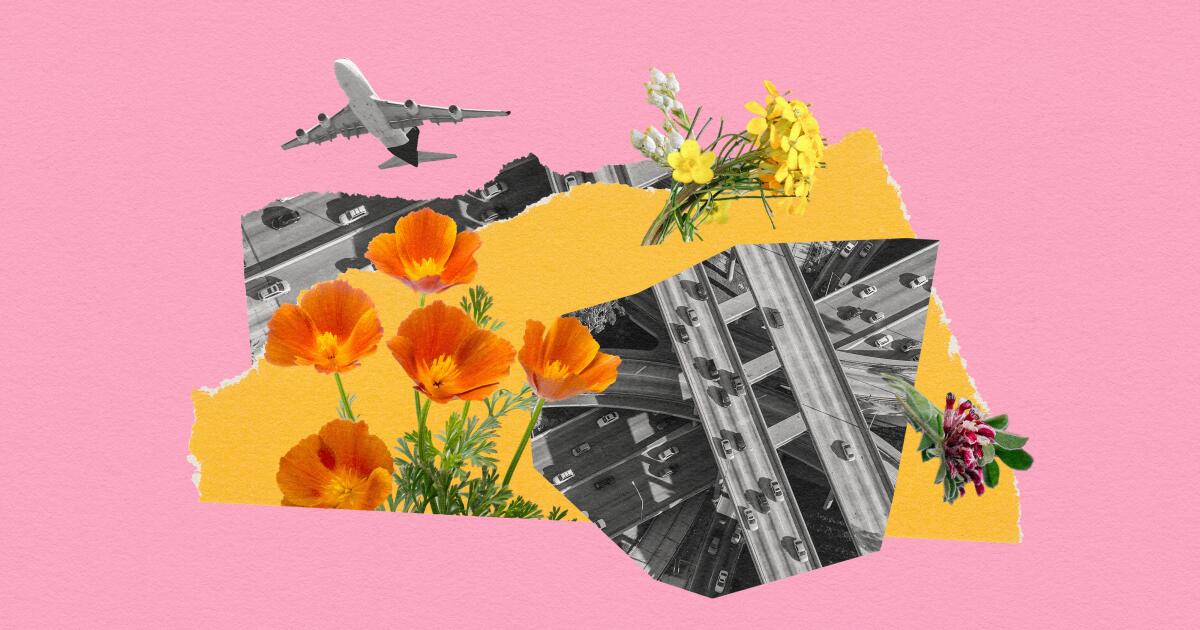
If you overlook the polluted Seine, Paris looks so pretty on TV, so quintessentially Parisian, that it raises the question: How will Los Angeles compare when it hosts the 2028 Olympics?
We can rhapsodize about our fabulous mountains and beaches, gorgeous parks and gardens, and many breathtaking residential drives. But that’s not what people see when they first arrive to Los Angeles or what we encounter most days as we go about our business.
Instead, it’s long bleak corridors of concrete and traffic, off-ramps and intersections choked with weeds and trash, blocks of faceless (or defaced) buildings and front yards with boring (or dying) swaths of lawns.
Things are especially grim at the entry point for most visitors — that interminable construction zone known as Los Angeles International Airport, where the main message after leaving the terminal appears to be “Welcome to Hell.”
We can do better, we must do better, not only for our visitors but ourselves. And the 2028 Olympics are a golden opportunity to make some substantial changes that will not only beautify our city, but celebrate our unique natural history while supporting our threatened pollinators and wildlife.
Imagine our parkways lined with stunning stands of California buckwheat (Eriogonum fasciculatum) instead of weeds.
(Marie Astrid Gonzalez)
Here’s the plan: Let’s create a campaign to line our yards, our streets and even our airport thoroughfares with the beautiful and fragrant plants that grow natively in this region. And let’s get started in the coming year, so by 2028, when the city is hosting athletes and guests from around the world, the plantings will be mature and thriving.
Otherwise, our international guests might notice that L.A.’s public landscapes are embarrassing, “with horribly topped trees, artificial grass and really drab plants,” said Evan Meyer, executive director of the Theodore Payne Foundation, one of the region’s premier nurseries and education centers for California native plants.
Forget speed-planting ornamentals for TV close-ups. Creating a native plant landscaping campaign around the Olympics is a better way to extol the region’s ecological heritage while giving Los Angeles a badly needed sprucing up, Meyer said.
“The big question is: What story does Los Angeles want to tell about itself?” Meyer said. “Are we going to be an environmental leader and show the world what California has to offer from a botanical perspective? Or are we going to talk about artificial grass?”
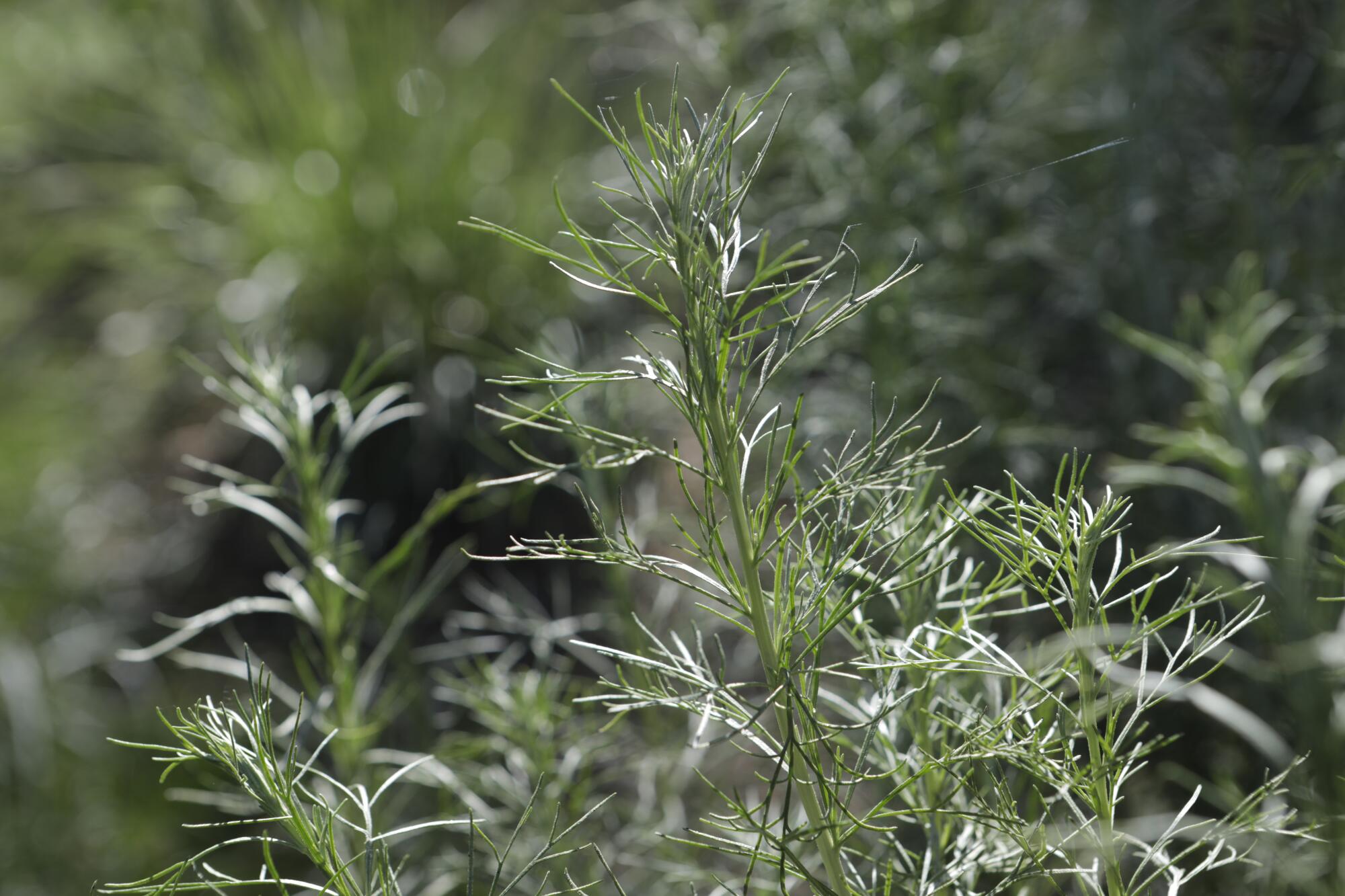
Wispy California sagebrush leaves capture the light and are so fragrant the plant has earned the nickname “cowboy perfume.”
(Katie Falkenberg / Los Angeles Times)
Good thing L.A. is full of all kinds of storytellers — starting with our indigenous people who can advise us on the historic uses of these plants for food, tools, shelter and medicine, said Bob Ramirez, president of the Gabrielino Tongva Springs Foundation’s Kuruvungna Village Springs in Sawtelle, a natural spring used by Native Americans for thousands of years.
California is one of the world’s top 10 biodiversity hot spots, with plants that grow nowhere else, Ramirez said. And Native people incorporated those plants into their lives for generations. “It‘s important that people understand the history that was here before the Spaniards,” he said. “People go to Europe to see the ruins of early empires, but they don’t know about the ancient history of our region, and native plants can provide a context for that.”
We have plenty of time to get this done. “It’s just a question of planning,” said horticulturist Carol Bornstein, former director of the nature gardens at the Los Angeles County Natural History Museum and co-author of “California Native Plants for the Garden,” one of the region’s most definitive books about native plant landscaping.
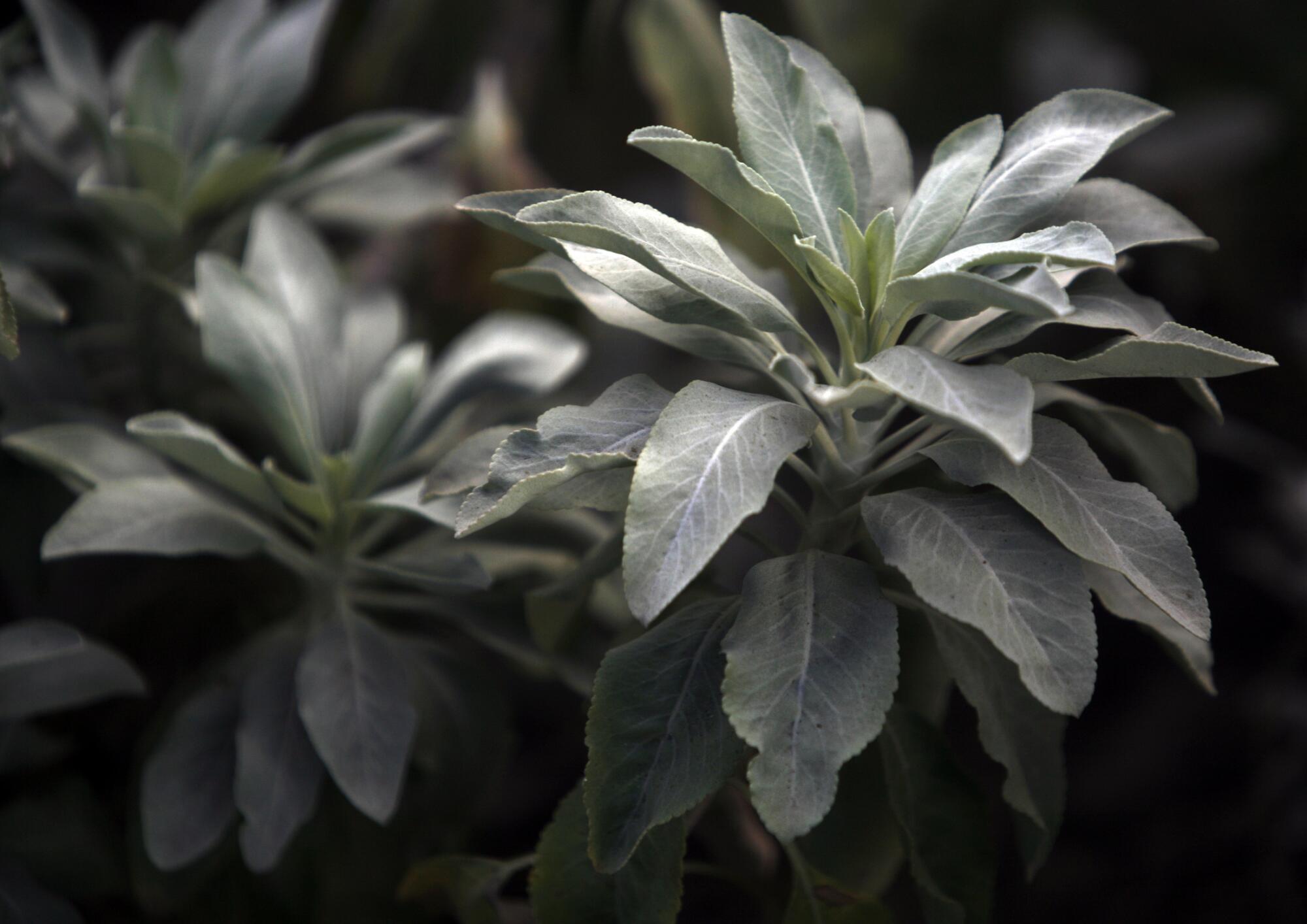
White sage only grows in Southern California and northern Baja, so it will feel right at home in most landscapes around L.A.
(Francine Orr / Los Angeles Times)
A native plant landscaping campaign isn’t just about beautifying the city for the Olympics. “It’s about reflecting who we are as Southern California,” she said. “It’s a way to puff up our chests, so to speak, to show what we are doing in preserving and enhancing our biodiversity.”
To help tell this story, Bornstein suggests using graceful desert willow trees, which bloom profusely in the summer and are small enough to live in containers, and two perennial natives, Gran Canon Baja bush snapdragon and De La Mina verbena, that bloom almost year-round and do very well in pots.
Tim Becker, horticulture director of the Theodore Payne Foundation, said the push for more native plantings could expand L.A.’s identity beyond Hollywood and giant traffic jams. His plant suggestions for a campaign would include using California sagebrush, bush sunflower, California fuchsia and fairyduster.
“The plants are the easy part; they’re beautiful, they attract beneficial pollinators and they create a sense of place,” he said. “The hard part is getting a seat at the table. How do we [native plant advocates] inject ourselves into that decision-making process?”
City officials have supported green initiatives on paper, “but now is the time to get these plants in publicly visible spaces,” he said.
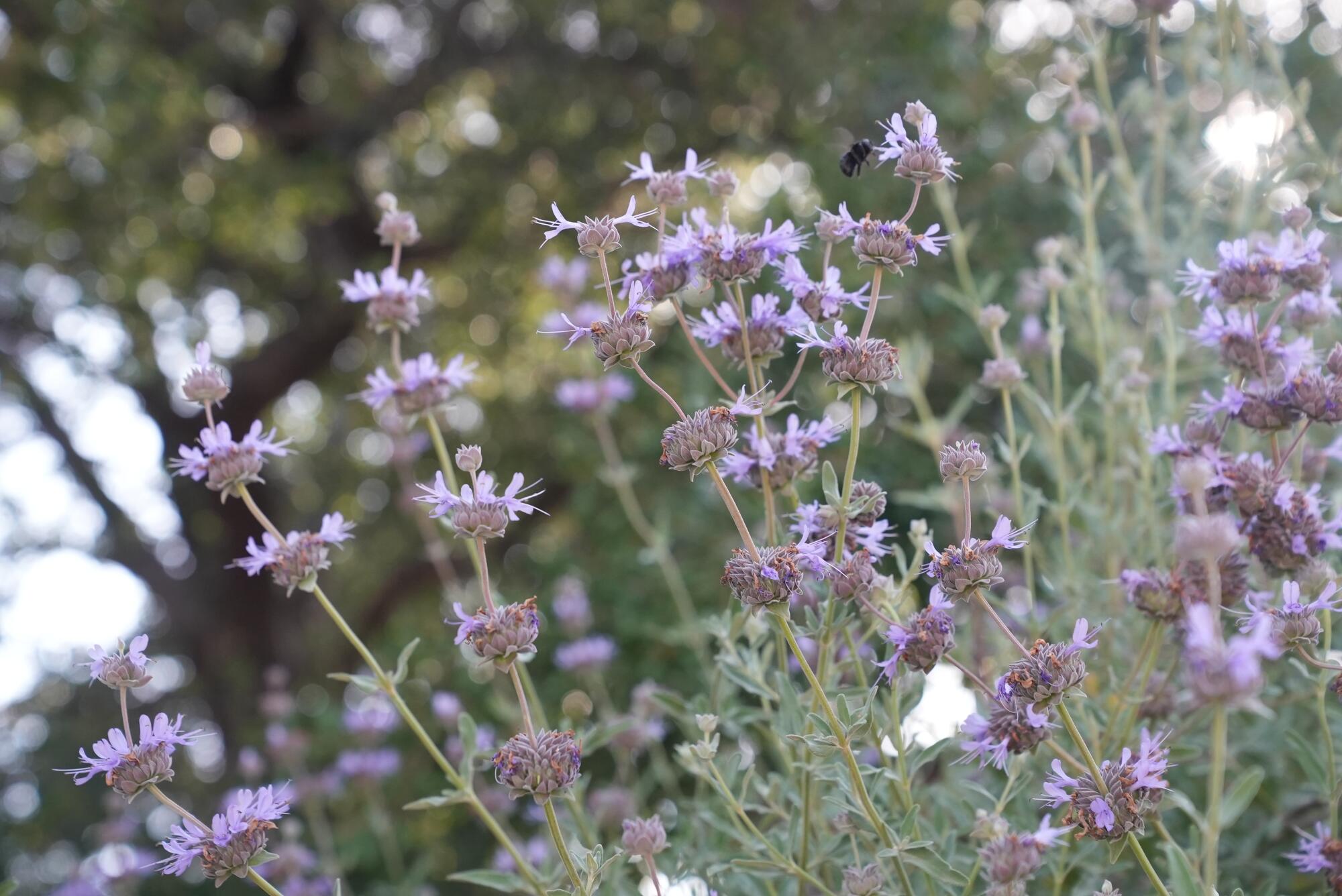
Cleveland sage’s frilly wands of flowers tower over the plants gray-green leaves and turn into sculptural brown spikes in late summer. Bonus: This native plant stays powerfully fragrant year-round.
(Marie Astrid Gonzalez / Los Angeles Times)
What Angelenos decide now can have a huge effect on the region’s image, now and in the future. Just consider how the beautification work for the 1932 Olympics changed L.A.’s skyline.
Palms trees were already a SoCal gardening craze around the turn of the 20th century, according to the PBS history show “Lost LA.” But starting in March 1931, the city cemented their future as L.A.’s iconic trees by planting some 40,000 palms along 150 miles of streets, according to the show, in part to prepare for the Olympics, but also to provide jobs for 400 unemployed men during the Great Depression.
That Olympics’ beautification project happened more than 90 years ago, and it’s still reverberating today. Palm trees, which feed into the tourism fantasy that Southern California is a tropical paradise, provide zero shade, their heavy fronds are a dangerous nuisance and keeping them trimmed is a large municipal expense.
Landscapes with native plants, on the other hand, will require less water use, less pollution from gas-powered lawn mowers and better support for our threatened birds and insect pollinators.
Tree planting and creating a consistent tree canopy is an overarching suggestion in the city of Los Angeles Public Works Committee’s LA 2028 Olympics Legacy Street Improvement Plan, but the document doesn’t list what trees should be included. Why not go with suggestions from native plant experts such has Mike Evans, who started his Tree of Life native plant landscaping company and nursery in San Juan Capistrano nearly 50 years ago?
Evans’ list of native plant suggestions is long, but highlights include using two of the region’s keystone trees — coast live oak and Western sycamores — for shade and any variety of ceanothus and manzanitas (both of which come in many shapes and sizes).
Angelenos need to understand that diversity — at least 15 to 20 species of plants — is key to creating a natural landscape, especially if they hope to help pollinators and other wildlife. “It’s not enough to just plant a row of ceanothus,” Evans said. “We have a traditional culture of spending time outdoors, and we should celebrate that in our gardens with native plants, because they tell the story of our land.”
No one is suggesting a native plant mandate or advocating that Angelenos rip out existing non-native landscapes (well, except maybe for water-thirsty lawns), but there are so many shade trees that need planting, intersections that need weeding and replanting and businesses that need something besides concrete. Why can’t we set some community goals around using native plants?
Actually, we shouldn’t wait for the city to do all the cleanup work. The city’s Office of Community Beautification offers resources to help community members volunteer for cleanups around their neighborhoods.
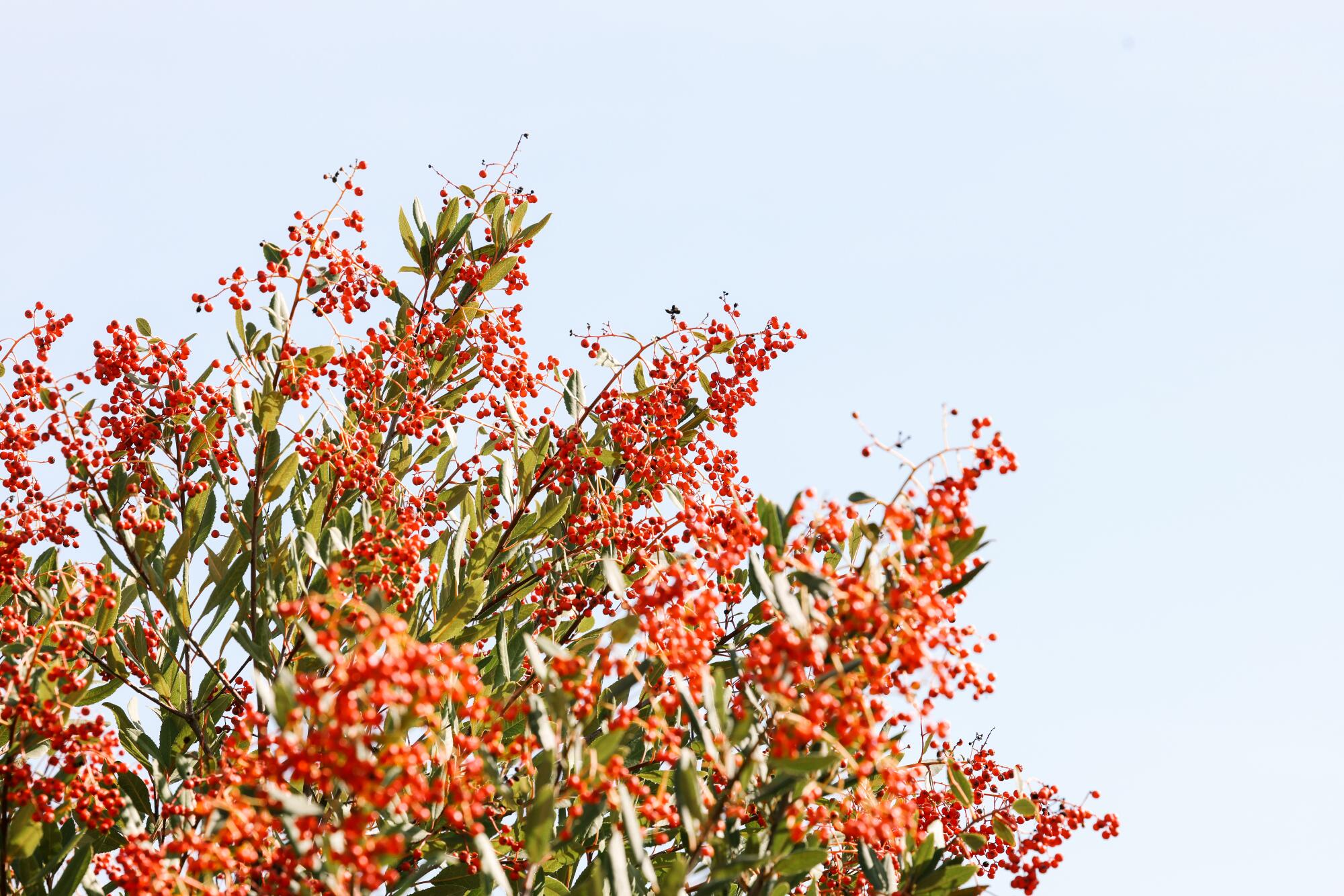
Toyons have handsome green holly-shaped foliage in the summer, bright flowers in the spring and cheerful sprays of red berries in the winter.
(Dania Maxwell / Los Angeles Times)
Meyer suggested that Angelenos consider a Victory Garden approach for sprucing up their yards, balconies or business fronts. During World War II, families helped the war effort by planting vegetable gardens in their yards to free up farm-produced food for our soldiers overseas — except in this case, we’d be growing Olympic gardens to help Los Angeles tell its story through native plants.
He also advocates planting native milkweeds like narrow leaf and woollypod, summer bloomers that will attract lots of pollinators, especially the endangered Western monarch butterflies.
Chaz Perea, a horticulture professor at Mount San Antonio College and landscape manager at Dodger Stadium, is transforming the grounds of the stadium with predominately native plantings. The stadium has nearly 20 round concrete planters four feet tall and four feet in diameter, which can be moved with forklifts, that might work for a citywide native plant campaign, he said.
The stadium’s containers are planted with native toyons. “They’re dark green and easy to grow and they create a wall of healthy lush plant material,” Perea said. Plus, they flower in the spring and provide clusters of decorative red berries in the winter beloved by birds.
Perea also likes the idea of growing native Roger’s Red grapes on trellises in large containers to provide summer greenery, fall color when the leaves turn red and gold, and sculptural vines in the winter. He also recommends planting lemonade berry and pink flowering sumac to replace non-native hedges.
“I see plants as unifiers,” said Brandy Williams of Garden Butterfly in Vermont Knolls. She weaves native plants, Mediterranean climate plants, succulents, vegetables and herbs into her landscape designs. One way to honor the athletes, she said, would be to create plantings from the five different Mediterranean climates, recognizing the countries from each region.
California native plants would still be featured prominently, she said, to support local pollinators. Her recommendations include multiple buckwheats, including California buckwheat and Yankee Point ceanothus, an evergreen groundcover that has beautiful spring flowers. After it blooms, the plant’s dark green branches still look lovely in the ground or spilling out of a pot.
Plants can bring us all together, said Williams, “and featuring California native plants is just another unique way to showcase unity. When people come to our gardens, they can better understand our culture.”


Sydney (Ayo Edebiri) and Carmy (Jeremy Allen White).
FX
hide caption
toggle caption
FX
There has always been a metaphorical parallel between The Bear, the television show, and The Bear, the fictional restaurant on the television show. Even as Carmy (Jeremy Allen White) and Sydney (Ayo Edebiri) transformed the Italian beef joint into the fancy restaurant of their dreams and wished for a Michelin star, there were undoubtedly locals who thought, “This is great and all, and I’m sure the food is good, but … I liked the beef sandwiches.” There’s still a window at The Bear to get them, but the focus is certainly elsewhere.
When it started, The Bear was mostly about the work that took place in the kitchen. The stresses of too many orders, territoriality from Richie (Ebon Moss-Bachrach), the arrival of Sydney, and the tightly wound but undeniably talented Carmy, making everybody both extremely stressed and significantly better. Over time, it shifted and grew, putting together beloved departure episodes like “Fishes” in Season 2, which introduced a boatload of guest stars for a flashback story of a disastrous family dinner before Mikey (Jon Bernthal) died. It spent time with Sydney’s family, it explored the way Tina (Liza Colón-Zayas) and Mikey originally met, it followed Marcus (Lionel Boyce) to Copenhagen, and it went with Richie to work for Andrea (Olivia Colman). All these episodes were excellent. And there was still a kitchen. But the focus seemed to be elsewhere.

At times, the show seemed to have disappeared up its own nose, to the point where you weren’t watching the show The Bear as much as you were watching the phenomenon The Bear. There were too many real-life chef cameos, until it seemed like those chefs were checking a box on a list of “things all the cool kids do.” There were too many other cameos, culminating in a rare miss from the reliably charismatic John Cena. The show placed a lot of narrative weight on Carmy’s love interest, Claire (Molly Gordon) — weight that the underwritten character couldn’t support. But even if every experiment and every diversion had worked, viewers couldn’t be blamed for missing the close focus on the kitchen and the camaraderie — for thinking, “This is all really special, but I do miss the beef sandwiches.”
The fifth and final season dispenses with the departure episodes, and it mostly dispenses with cameos. It all takes place on one day, just after Carmy tells Richie and Sydney that he wants to step back from the restaurant and give it to them and Sugar (Abby Elliott) to run, and it mostly takes place right there at The Bear. Now that the clock set by Jimmy (Oliver Platt) has run out, his money has run out as well, and a series of cascading disasters puts Sydney, Carmy and Richie behind the 8-ball from very early in the day, not least because of the tension hanging over all three of them as they prepare to tell the staff about Carmy’s decision to leave.

Tina (Liza Colón-Zayas).
FX
hide caption
toggle caption
FX
We spend this day mostly with the people we know best: our three leads, along with Sugar, Tina, Marcus, and the rest of the staff — including Luca (Will Poulter), who has stayed around to keep working with Marcus. Jimmy is running around with Computer (Brian Koppelman) and a young apprentice of his named Cheese (Elsie Fisher of Eighth Grade), trying to figure out what to do about his finances since it is Jimmy, and not just the restaurant, who’s out of money.
This day takes a while to get cooking, so to speak. The first three episodes of the season are slow, the first two in particular. It’s pouring rain outside, the lighting is dim, and the score maintains the same contemplative melancholy for a long, long time. For about two and a half episodes, it feels like one extended, low-energy scene.
But after that, there’s a shift in tone as the staff looks to get through service, and through seven episodes (FX did not make the finale available in advance for critics), the rest of the season is terrific. What you see is the core story of The Bear, which is people trying to serve food and overcome problems, but through the lens of everything that has happened over the show’s run: Carmy’s retreat from his obsessiveness, Richie’s expansive (and inspiring) discovery of his gift for hospitality; Sydney’s stepping forward from second-in-command to leader; Tina’s complex relationship with the restaurant and her grief over Mikey; Sugar and Carmy’s relationship with Donna (Jamie Lee Curtis); the arrival of Marcus as a high-end pastry chef.
The question the show asks over the last four episodes is: Given all those digressions and flashbacks, given all those visits with families and others, given everything we know about where all these people have been and what they’ve experienced, how does a high-pressure service — of the same kind we used to see in that first season — look now? How do they behave differently, and how does their behavior read differently? How are they the same people we have always known, but at a different juncture, in a different context? How do their wins mean more to them, and to the audience?
On the one hand, making a season this way, there are fewer surprising grace notes, like “Napkins,” the Tina/Mikey flashback episode in Season 3, or “Worms,” the episode in Season 4 where Sydney hung out with her cousin (Danielle Deadwyler) and her cousin’s kid. The Bear feels less daring and more conventional.
But oh, when they have victories under pressure? Victories, large or small? It is immensely, richly satisfying. There’s also more comedy other than just the goofy Faks family than we’ve had in a few seasons; Richie is perhaps the MVP of the season, and that’s partly because of how often he gets to be really funny. Ayo Edebiri continues to be the show’s best reactor, showing Syd eternally a little bit surprised (dismayed?) that she’s chosen to throw in her lot with these people.
There are a couple of questions yet to answer in the finale, both little plot items and broader character resolutions. Over these seven episodes, though, there is much to cheer.


Lifestyle
John Cena wanted to step away from the WWE ring before he became ‘too slow for the show’ : Wild Card with Rachel Martin

A note from Wild Card host Rachel Martin: First a confession: I have never watched a WWE match in its entirety. Don’t get me wrong, I appreciate the athleticism and the performance, it’s just not my thing. But there is something about John Cena I’ve never been able to shake.
Yes, he is a wrestling legend, but he has built a career as an entertainer that transcends the ring. The first time I saw him lead a cast was the 2019 family movie “Playing with Fire” and his rapport with kids in that film didn’t seem like acting at all. The man contains multitudes!
He co-stars with Eric Andre in his newest film, “Little Brother.”
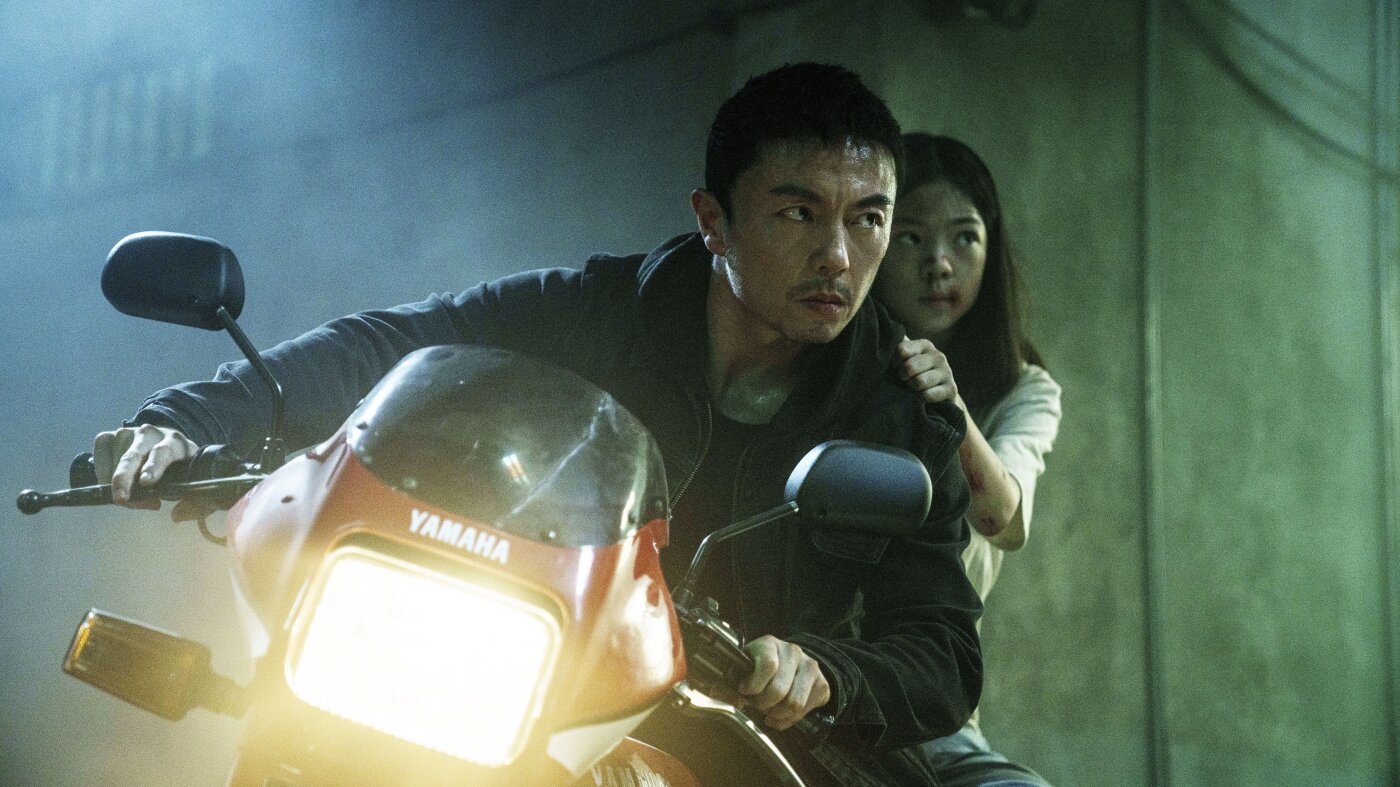
Xie Miao and Yang Enyou in The Furious.
Norachai Kajchapanont/Lionsgate
hide caption
toggle caption
Norachai Kajchapanont/Lionsgate
There have been some fantastic movies released this year, and we know you can’t see them all. So we’re recommending four recent movies we missed that you should add to your watchlist: The Furious, Tuner, She’s The He, and Heresy.
If you need a few more fun film recommendations, check out these episodes:
Fun movies you may have missed
Our favorite movies on Tubi
We debate the best movies to watch on an airplane
Connect with Pop Culture Happy Hour:
Letterboxd / Facebook
Our weekly newsletter
Support Pop Culture Happy Hour+
-
 Idaho4 minutes ago
Eagle Road’s long-awaited variable speed signs one step closer to operation
-

 Illinois7 minutes ago
Illinois Lt. Gov. candidates focus on affordability in pitch to Rockford voters
-

 Indiana12 minutes ago
Indiana Fever President Addresses Player Safety After Alyssa Thomas' Suspension
-

 Iowa19 minutes ago
Iowa City Regina baseball finds winning formula under new leadership
-
 Kansas22 minutes ago
Video shows disruption during Osawatomie City Council meeting with data center developer
-

 Kentucky27 minutes ago
Kentucky Lottery Cash Ball, Pick 3 Evening winning numbers for June 25, 2026
-

 Louisiana34 minutes ago
Guest Column: To win in manufacturing, the U.S. needs La. energy and improved permitting
-

 Maine37 minutes ago
High bacteria advisories reported at multiple Maine swimming spots

