Lifestyle
L.A. Affairs: How did our date begin? He removed his saliva-drenched teeth aligners

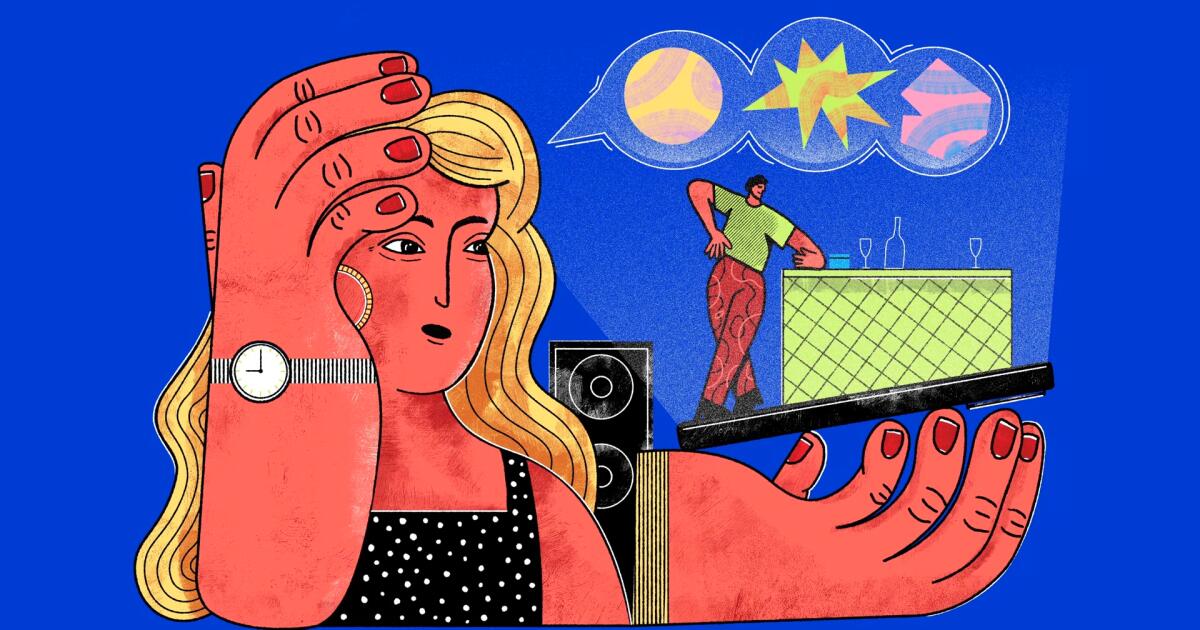
His Bumble bio and photos were appealing. He traveled frequently and loved to dance. Over the phone, he came across as dorky to me. But when he suggested that we go salsa dancing for our first date, I decided dorky was doable. I love dancing too. There was a lesson at 9 p.m. followed by live music from a band.
Despite my challenges with dating in L.A., I responded enthusiastically: “Sounds nice! I’m looking forward to it.”
“Great,” he said. “Let’s meet at 8:30. We can have a drink and then you can join the lesson.”
He emphasized the word “you.” With a playfulness in my voice, I countered: “Well, we will both do the lesson.”
The nerd suddenly morphed into a snob. “I’m an expert salsa dancer. I don’t need the lesson.”
I remained bubbly. “But this is a date. We will do the lesson together since it’s fun. Plus, there are never enough men. You’ll have to join.”
His attitude surfaced again. “As I said, I’m an expert salsa dancer. I don’t need the lesson. That’s for you as a novice.”
Firmly I said, “You are doing the lesson with me. See you Friday.”
I had been hesitant and fearful when I jumped into the online dating world a year-and-a-half after my longtime partner’s suicide. I had wanted to take it slowly. I wasn’t at all ready to find Mr. Right and was intimidated by the prospect of even finding Mr. Right Now. I was also full of dating questions, like “How do I talk about my most recent relationship?” or “Is it better to meet for coffee or dinner?”
In putting myself out there since my boyfriend’s death, I’ve found mind-boggling material that I’ve shared with my friends who are eager to support my dating adventures. Sometimes they’ve even picked up dating insights based on my bizarre encounters, which have turned out to be plentiful.
After all, there was the guy who asked on our first outing if I was “taken care of down there,” waving his hands toward my nether region. There was the bed-breaker. There was the guy who barked orders at hotel staff. (He insisted we eat in a conference room that was reserved for a corporate luncheon.)
My hope was that things might go better with Mr. Salsa.
At 8:30 p.m. on date night, I walked into the Warehouse Restaurant bar in Marina del Rey. It was empty except for my date.
When his beer arrived, he opened his mouth widely to brutishly remove his aligners. I watched as he stuck both fists in his face to remove the saliva-drenched hardware, which he then placed in a little blue box.
He wiped his hands on his jeans, smiled broadly and pointed to his teeth. “I wear Invisalign on the top and bottom.”
An entire conversation about aligners ensued as another dialogue was happening in my head. I thought to myself, Seriously, Mr. Salsa? Did you really just remove your hardware within five minutes of meeting me? Why are you taking them out at the bar? Why not in the car before you got here? Why do you have to take them out at all? You’re just drinking a beer! Why are we engaging in a long conversation about how to lessen the cost by getting three sets made at once?
I wanted to go home but would feel bad about bailing. I am always too nice.
The salsa lesson was about to start, and sure enough, my date refused to join. I happily participated and was relieved I didn’t have to interact with him. Eventually the teacher dragged him onto the dance floor. As I had predicted, the women-to-men ratio was not close to being even.
After the lesson, I danced with Mr. Salsa. I’ll admit it: He was a good partner and a fantastic lead. But he was impossible to tolerate. He uttered, “You aren’t too terrible. I can probably work with this.”
He led me back to the bar. Just as I was about to thank him and wish him a nice rest of the evening, he looked me up and down, pointed toward the dance floor and bluntly said: “I’m going back out there. But you’re pretty. I’m sure someone will ask you to dance.”
I watched in bewilderment as he walked onto the floor to introduce himself to a beautiful brunette in a red dress.
That was my cue to head for the door. As I turned to go, a new dance partner grabbed my elbow. His shirt was unbuttoned to his belly button. Gold chains adorned his chest. In my heels at 5-foot-3, I towered over him.
After our quick dance, I bumped into the original Mr. Salsa. Ever so politely, I tried the gentle letdown. “This was fun, but I better head home.”
He said, “Amazing night. I’ll give you a ride.”
This time I was more forceful. “Oh. No. Really, you stay. Enjoy yourself. But thank you.”
He texted the next morning about a second date, but I held firm. There would be no second date.
Mr. Salsa was added to my list of bad dates.
As for me, I had assumed my baggage would be too heavy to bring on dates after all the turmoil with my boyfriend, his mental illness and eventual suicide and my subsequent grief, trauma and devastation. For so long, there have been questions surrounding my boyfriend’s death. I will never have all the answers, and I’m OK with that. But in terms of the dating scene, I’ve realized that despite everything I’ve been through, I’m in a far better state than most of the potential suitors I keep meeting in L.A.
Because on the other side of my years-long, to-hell-and-back healing process, which is best described as daunting, challenging and uncomfortable, has been recovery and growth. I also have continued to trust that despite my often disastrous and discouraging dating stories, an excellent partner awaits.
In the words of Mr. Salsa, I’m going back out there.
The author is an L.A. native and nonprofit executive. She is working to publish her memoir about life and lessons after suicide, including tales from the L.A. dating scene. She’s on Instagram: @nicole_lise
L.A. Affairs chronicles the search for romantic love in all its glorious expressions in the L.A. area, and we want to hear your true story. We pay $400 for a published essay. Email LAAffairs@latimes.com. You can find submission guidelines here. You can find past columns here.



Once rivals on the tennis court, Martina Navratilova, left, and Chris Evert have become close friends in retirement. They are pictured above at the French Open in 1986.
Trevor Jones/Getty Images Europe
hide caption
toggle caption
Trevor Jones/Getty Images Europe
Chris Evert and Martina Navratilova were the most successful women’s tennis champions of their generation. Both were 18-time Grand Slam tournament winners — and each other’s greatest rivals.
Evert, a Florida native, became a tennis star in her teens. Navratilova was born in communist Czechoslovakia, and emerged as a player after Evert was established. They first faced off during a match in Akron, Ohio, in 1973, when Evert was 18, and Navratilova was 16. Evert won, but Navratilova left an impression.
“I remember thinking to myself, holy cow, when this young girl gets into better shape, she is going to be a force to be reckoned with,” Evert says. “She had so much talent. Her hands were quick, she had a big first serve, she had a big forehand, and she just was so powerful.”

Two years later, on the day she lost a semifinals match to Evert at the U.S. Open, Navratilova defected to the U.S. In the years that followed, her tennis game improved. Though she and Evert had initially been friendly, the friendship cooled as their rivalry heated up.
“Playing Chris was difficult because how can you not like Chris? What’s not to admire?” Navratilova says. “She was like the epitome of cool.”
The new Netflix documentary Chris & Martina: The Final Set tells the story of how Evert and Navratilova re-established their friendship and how they both faced cancer in retirement. Evert was diagnosed with ovarian cancer in 2021; Navratilova was diagnosed with throat and breast cancer in 2022.
“I can’t get away from her,” Evert jokes. “We had a 15-year career, and then we got cancer at the same time. It really is freaky, but I always say: If I want someone to be in the trenches with me, it’s Martina because she has been so supportive and so understanding.”

Navratilova agrees: “We have such a level of trust that we know whatever we say to each other, it stays there. We give each other the best advice we know how to. And there is no ulterior motive, no playing games.”
At the time that this interview was taped, Evert and Navratilova were both in remission from cancer. But late last week, Evert disclosed she’d recently been diagnosed with a recurrence of ovarian cancer.

“We know whatever we say to each other, it stays there,” Martina Navratilova says of her friendship with Chris Evert.
Netflix
hide caption
toggle caption
Netflix
Interview highlights
On supporting each other through cancer
Evert: There are a lot of phone calls between us. … I don’t cook, but Martina would bake bread for me, and her wife Julia would cook, make some chicken soup. … I got a lot of food from Martina. She got a necklace from me.
Navratilova: I get jewelry from Chris, she gets food from me.
Evert: Martina’s and my relationship — because we’ve had one for 50 years — is not the type where we have to talk to each other every day to maintain the closeness. I always knew she was there. She always knew I was there if we needed to talk, and that was that.
On the weakness they experienced with cancer
Navratilova: Chris’ diagnosis and treatment was much more life-threatening than mine, percentage wise, but my treatment was more difficult physically. … I was in New York for seven weeks and I literally sat on a yoga mat, maybe half an hour of the seven weeks, and did some stretching. I couldn’t even do the down dog pose because I would have fallen down. I had absolutely zero strength left.
Evert: The chemo kicked my butt, let’s put it that way. … It left me very weak, very, very weak. After chemo I would have three or four days of intense nausea and I just would feel tingling in my body and it just wasn’t nice. I didn’t have the energy. To walk six blocks was a big deal for me. And it was foreign. You know, it felt like it wasn’t my body, for sure.
On watching the old footage of their matches together for the documentary
Navratilova: For me, it was fun watching with Chris, because we had different reactions to what happened on the court. But what impressed me is how well we played with those wooden rackets. Because you know what? Those rackets are not easy to play with. But you try to put yourself in there physically, what it was like, mentally, what it is like. And it’s like, “Oh, I should have gone down the line,” or, “I can’t believe I missed that shot.” Or “Chris, you had such a great pass.” It was amazing. So it was impressive. … I wish I could still have that six-pack, but anyhow.

Evert: I remember feeling genuinely happy for her. I remember it was her first Wimbledon. That’s always been her dream since she defected. Her family couldn’t be there to watch her. She was all alone. And I just was happy for it. And I knew that this was gonna be one of many for her to win.
On defecting to the U.S. in 1975 when she was 18 years old
Navratilova: I was thrilled to be in the States. I always loved American cars. And when you ordered a ham sandwich, you got, like, two inches of ham and two slices of bread. Whereas growing up, you had thick bread and one slice of ham. So I thought I was in heaven. And it was $2.30 for that sandwich. I still remember it. I couldn’t believe how much ham I was getting.
Lauren Krenzel and Nico Gonzalez Wisler produced and edited this interview for broadcast. Bridget Bentz, Molly Seavy-Nesper and Beth Novey adapted it for the web.

-
World5 minutes ago
Pope issues last-ditch appeal, begs breakaway traditionalist group to back off bishop consecrations
-
Lifestyle43 minutes ago
How should we behave online? : It’s Been a Minute
-

 Technology53 minutes ago
After a great start, DC’s new cinematic universe is already slowing down
-

 World58 minutes ago
UK asylum seekers could have to pay government $13K before applying for settlement
-

 Politics1 hour ago
Fetterman unleashes on ‘dirtbag’ wing of Dems after far-left victories: ‘Orgy of socialism’
-

 Health1 hour ago
Doctors thought man had brain cancer — they found live tapeworms instead
-

 Sports1 hour ago
Paraguay stuns four-time World Cup champions Germany in penalty shootout after controversial call
-
 Business1 hour ago
Comcast is spinning off NBCUniversal media and entertainment assets

