Lifestyle
Jodie Foster plans more French roles after ‘A Private Life’


Jodie Foster has her first solo lead role entirely in French in A Private Life.
Jérôme Prébois/Sony Pictures Classics
hide caption
toggle caption
Jérôme Prébois/Sony Pictures Classics
After dozens of films over a storied six-decade career, Jodie Foster is trying something new, playing the lead role in a French film for the very first time.
There’s hardly a trace of an American accent in Foster’s turn as Parisian therapist Lilian Steiner in A Private Life (Vie privée) and she appears to be very much at home.
The character she plays is an American woman who built her career in France. So director Rebecca Zlotowski added some small asides — and swearing — in English because of Foster’s brisk and fluent French. “People suddenly were just completely confused that I wasn’t a French person,” the actress said.
All apparent ease aside, “I have a different personality in French than I do in English,” Foster told Morning Edition host Leila Fadel during a recent visit to NPR’s New York studios.
Her voice has a higher pitch in French, something she attributes to the French ladies who taught her at the private school she attended, Le Lycée Français de Los Angeles. Foster also had some smaller roles in three French films prior to A Private Life, including in 2004’s A Very Long Engagement.
“I’m just much more insecure and kind of vulnerable because I never know whether I’m communicating properly. And, you know, am I going to find that word at the last minute?” Foster said.
This frustration is also built into the script itself. When we first meet Steiner, she’s constantly frazzled, barely listening to her patients and hardly sparing a minute for her newborn grandson.

Lilian Steiner (Jodie Foster) and Gabriel Haddad (Daniel Auteuil) find love again — for each other — years after their divorce in A Private Life.
Jérôme Prébois/Sony Pictures Classics
hide caption
toggle caption
Jérôme Prébois/Sony Pictures Classics
Then, her eyes start watering constantly, something someone more grounded would call crying, but not Steiner, who grows increasingly frustrated that water is coming out of her eyes.
It turns out to be especially fitting for someone who is a Freudian psychoanalyst. “In true Freudian fashion [she] is having a physical demonstration of a psychic ill,” Foster explains.
That psychic ill is caused by the death of a patient (the Franco-Belgian social drama star Virginie Efira), purportedly by suicide.
But Steiner suspects her patient has been murdered and launches her own — inconclusive, darkly comedic — investigation, enlisting help from her ex-husband (played by Daniel Auteuil, a mainstay of French cinema), and rekindling their old flame in the process.
YouTube
All of those disparate plot lines play into the film’s French title, Vie privée, which Foster explains is a double entendre: “So private life, meaning everything that you think that would mean the opposite of a public life — an internal life. But private also means has been deprived of, so somebody who has been deprived of life, meaning somebody who’s died potentially.”
In her own life, Foster said she’s had to fight for privacy, ferociously. “I had to say I will go to Disneyland and I will not have a film crew following me… I will go to college and I will not give everything to the public eye, in order to make sure that I survived intact,” she explained.
After a frenetic pace of filming in her teens and twenties, Foster says she became more deliberate about the roles she accepted so that she could bring more depth to the screen. “I really was careful to make sure that I had real life and I worked more sporadically than most other actors,” she said.

In a hallucinatory dream sequence while under hypnosis, Lilian (Jodie Foster), left, is transported to WWII-era Paris, where she and her present-day patient Paula Cohen-Solal (Virginie Efira) were lovers.
Jérôme Prébois/Sony Pictures Classics
hide caption
toggle caption
Jérôme Prébois/Sony Pictures Classics
Today, she’s especially excited about working with women directors. She also directs herself. Recounting that she only worked with one female director — Mary Lambert for 1987’s Siesta — in the first four decades of her career, Foster said she’s now working more with women.
“It’s been a shift that’s a long time coming… But it came very, very late,” she added, noting that the prevailing bias against women directors has only “recently” changed in mainstream cinema.
Foster also hopes to take part in more French movies, maybe even direct a film in France. “That’s something I’ve always wanted to do and something that would be a great challenge for me,” she said.

Director Rebecca Zlotowski, shown here on the set of A Private Life, says she had long dreamed of directing a film featuring Jodie Foster.
Jérôme Prébois/Sony Pictures Classics
hide caption
toggle caption
Jérôme Prébois/Sony Pictures Classics
She urged American audiences to embrace learning to speak languages other than English.
“It’s surprising how Americans don’t hear other languages… how you can go your whole life without really hearing other languages spoken in your state,” she said. “We have to make an effort to connect to a wider world and understand that we’re all part of the same universe.”
The broadcast version was produced by Julie Depenbrock. The digital version was edited by Treye Green.


Can you say no to a friend’s wedding?
Getty Images/Getty images
hide caption
toggle caption
Getty Images/Getty images
Are we spending too much on other people’s weddings?
Going to a friend’s weddings can be so fun and meaningful… but it can also really hurt your wallet. A survey by LendingTree found that 31% of people who had been to a wedding in the past five years had accrued debt to attend. So what’s driving up the cost of weddings for guests? And what makes it so hard to say no to these expenses?
Brittany breaks it down with Allyson Rees, senior analyst at trend forecasting firm WGSN, and Annie Joy Williams, assistant editor at The Atlantic.
This episode was produced by Liam McBain, with additional support from Corey Antonio Rose. It was edited by Neena Pathak. Our Supervising Producer is Cher Vincent. Our Executive Producer is Barton Girdwood. Our VP of Programming is Yolanda Sangweni.
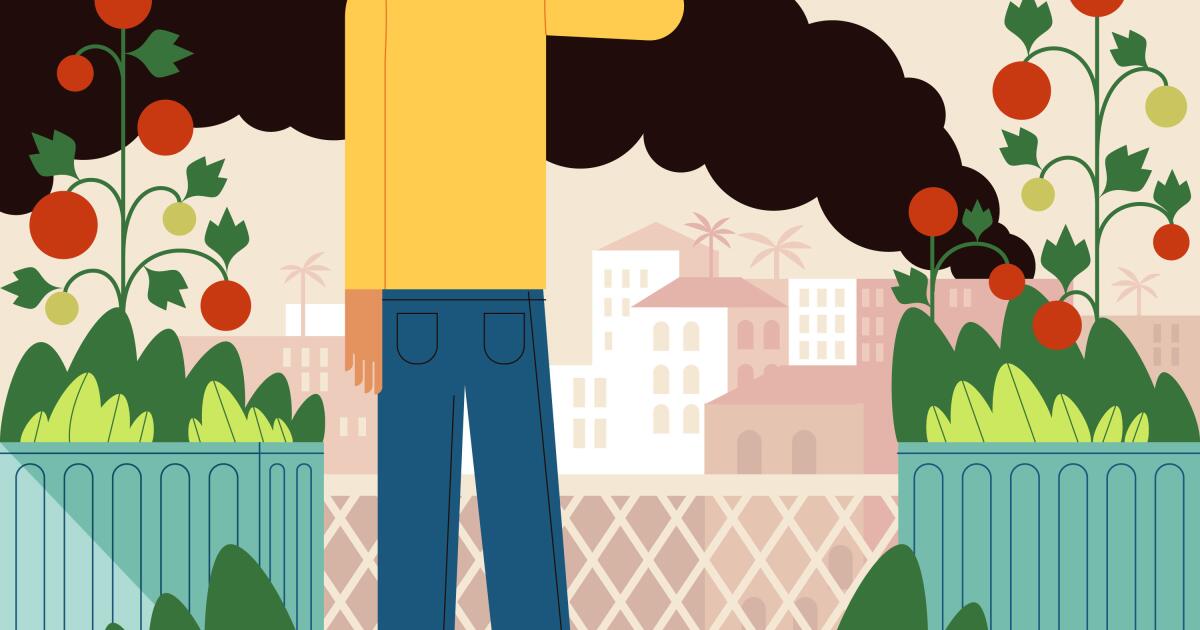
After the eight-day-long fire in a 500,000-square-foot Boyle Heights warehouse, eastern Los Angeles residents are contending with putrid smells, soot and potentially hazardous airborne chemicals after heavy plumes of smoke spread throughout the city. But those who grow food in nearby neighborhoods may also be wondering: How will the fires affect the plants and produce in my garden?
The Boyle Heights warehouse, owned by Lineage — a global temperature-controlled storage facility operator — housed 85 million pounds of frozen food and other products. In the days since the fire, local emergency visits for smoke inhalation and throat pain spiked while agencies still scramble to measure the amount of PM 2.5 — harmful fine particles — and heavy metals, like lead and arsenic, in the air.
According to researchers, any toxic airborne chemicals would likely stem from the charred foam insulation, metal exterior, burned solar panels and any lithium batteries that might have been present inside the warehouse.
After a fire, heavy metal particles can spread through ash and smoke over gardens and inhibit growth, said Olukayode Jegede, an agricultural toxicologist and assistant professor at UC Davis. Since the warehouse fire is so recent and cleanup has just begun, Jegede said the precise impact on gardens can’t be measured until comprehensive soil tests are conducted in the area.
While the L.A. city government hasn’t announced plans for soil testing, the Contaminant Level Evaluation and Analysis for Neighborhoods project at USC is offering free contaminant testing for Boyle Heights and East L.A. residents. Residents can collect soil samples and deliver them to Boyle Heights City Hall and other locations for an evaluation of lead, arsenic, chromium and mercury levels.
The good news is produce, plants and roots can still be preserved. According to Jegede, many of the soil tests conducted last year in the Altadena area after the Eaton fire showed that gardens and poultry were not as contaminated as one might expect.
“Quite a number of the soils we tested [in Altadena] were not really contaminated,” Jegede said. “We weren’t seeing many soils with concerning elevated levels of metal, so gardeners should not be too alarmed when these things happen.”
Nevertheless, there are several measures that gardeners can take to keep themselves, their children, plants and produce safe from potentially harmful contaminants stemming from the fire. Researchers, gardening experts and horticulturists offered some guidance on the handling, recultivation and cleanup that can keep you and your garden in good health.
How do I remove ash and contaminants from my garden?
Altadena horticulturist Leigh Adams said Boyle Heights plants and produce already live in a difficult environment, surrounded by industrial warehouses that spread contaminants daily.
“That area has been used industrially for 100 years, and the soil is impacted by many, many, many things,” Adams said. “Low-income neighborhoods and gardens usually don’t have a lot of resistance against dominant manufacturing.”
This means that the contamination of gardens in eastern L.A. won’t be as catastrophic as compared with those in Altadena, a more suburban environment, Adams said. But fallen ash still poses major health risks if ingested or inhaled.
An advisory from University of California Agricultural and Natural Resources last year recommended suiting up in an N95/KN95 mask, long sleeves, pants, close-toed shoes and gloves before attempting to deal with ash in the garden to limit exposure to potentially toxic contaminants. The advisory added that individuals should make sure all of this gear is cleaned thoroughly before bringing it back inside.
Once in the proper gear, Adams recommends removing the top two inches of topsoil from gardens, where the highest concentration of contaminants will settle after a fire. Using a plastic bag to collect the soil and disposing of it in the garbage — not green yard waste bins — will help to reduce the spread of airborne chemicals.
Gardeners with raised beds are advised to remove approximately six inches of soil, because excess ash can raise the pH level and prevent nutrients from soaking into the soil bed.
After this, watering the garden gently but plentifully will help to promote soil health and get rid of most of the ash present on plant leaves and stems. Adams said replacing the top two inches of soil with store-bought mulch or straw will help to contain any remaining ash and prevent it from spreading any further.
Experts say to avoid using leaf blowers if ash is present in the garden because they can send particles airborne. Doing so will increase the likelihood of heavy metal particles, which can carry lung irritants and carcinogens, being spread and inhaled.
A Boyle Heights resident keep a watchful eye on the fire at the 5,000-square-foot commercial building, which stores 85 million pounds of frozen food.
(Genaro Molina / Los Angeles Times)
Is it safe for me to eat produce from my garden?
Several studies, including one from the UC Cooperative Extension of Sonoma County, have shown that consuming produce in a fire-affected area poses minimal health risks.
Jegede said most root vegetables like potatoes and carrots, along with any fruit that has an outer layer, can be washed to remove potential contaminants, even if they were covered in ash. Peeling the outer layer of your produce can also help to reduce potential risks, he said.
Lettuce and other leafy foods with multiple layers pose a higher risk of contamination, but with a vigorous wash and peeling the outer layers, even the greens can be saved. The County of Los Angeles Department of Public Health recommends soaking leafy produce and fuzzy fruits like peaches in a 10% white vinegar and 90% water mixture.
Jegede said if the leaves or fruit are too delicate to wash or ash is still visible, it would be best to dispose of the produce.
How can I tell if my soil is contaminated?
After ridding your garden of visible ash, you might wonder how to tell if your plants will still thrive in the soil.
At-home soil tests that measure for alkaline, fertility and pH levels are widely available and can be purchased for $15 to $100 (for more detailed results) online. But Jegede said these tests can’t tell the full story of soil health.
Comprehensive soil testing is “something you can’t do properly at home,” Jegede said. “In labs, we are testing for metals like lithium and zinc, stuff that an at-home test will not show … If it comes to the point that you’re worried about your soil, I would just send it out to a lab.”
Wallace Laboratories in El Segundo, Babcock Laboratories in Riverside, Waypoint Analytical in Anaheim and other labs offer more detailed soil tests that measure heavy metal particles in addition to other fertility factors. Prices at Wallace Laboratories can range from $115 to $295 for a complete compost test.
The soil below two inches should be unharmed, Adams said, so long as new compost is set and plants are watered plentifully, which will promote natural biological cycles.
“What you’re doing is capping the soil, so that moisture stays in there, and instead of being dirt, it’s a living system called soil,” Adams said. “The more carbon we can get into our soil, the better.”
What can I do to help my soil recover?
For the last 12 years, Adams has been working with Metabolic Studio, a Los Angeles-based art and research hub focused on environmentalism, on methods for bioremediation, the practice of using additional fungi, plants and compost to decontaminate ash and break down contaminants.
Adams said straw, mushrooms, corn, rye and sunflowers are great bioremediators that can help to repair damage to soils. She said certain samples she’s worked on with Metabolic Studio have gone from testing at high heavy metal levels to nearly contaminant-free.
But for a more immediate fix, wash your produce, water your plants and have a little patience during ash cleanups. Your garden should look better in no time, Adams and Jegede said.

Inde Navarrette and Michael Johnston in Obsession.
Focus Features
hide caption
toggle caption
Focus Features
Two big horror films, Obsession and Backrooms, just smashed all box office expectations. So much of their success has been driven by Gen Z, which is now the biggest moviegoing demographic. But what makes a movie a Gen Z movie? Today we’re bringing you an episode of NPR’s It’s Been a Minute. Host Brittany Luse talks about this trend with Sam Adams and Reanna Cruz.
If you want to hear more about these movies, check out these episodes:
In ‘Obsession,’ love hurts. It really, really, really hurts.
‘Backrooms’ brings YouTube horror to the big screen
Zendaya brings ‘The Drama,’ we bring the spoilers
Connect with Pop Culture Happy Hour:
Letterboxd / Facebook
Our weekly newsletter
Support Pop Culture Happy Hour+
-

 Mississippi37 seconds ago
Mississippi’s first Dutch Bros now open in Pearl
-

 Missouri6 minutes ago
UPDATE: Suspect wanted in Kansas captured near Columbia; Missouri State Highway Patrol aircraft plays key role | 93.9 The Eagle
-

 Montana13 minutes ago
Butte gears up for Montana Folk Festival, which starts Friday
-
 Nebraska15 minutes ago
Supreme Court will hear Nebraska’s fight over access to Colorado’s South Platte River
-

 Nevada21 minutes ago
As temperatures rise, HELP of Southern Nevada continues homeless outreach efforts
-

 New Hampshire28 minutes ago
New hampshire set to approve world’s first $100 million bitcoin-backed municipal bond
-

 New Jersey31 minutes ago
Police conclude investigation at Walmart in Cherry Hill, officials say
-

 New Mexico36 minutes ago
Monsoon high shifts slightly west but rain is still possible Wednesday in New Mexico

