Lifestyle
Inside the Most Politically Charged Met Gala in Years


Last October, when the Metropolitan Museum of Art’s Costume Institute announced its next fashion show, “Superfine: Tailoring Black Style,” the political landscape looked very different.
Kamala Harris, the first female vice president and the first Black woman ever to top a major-party ticket, was in the final weeks of her campaign for the White House. The show, the culmination of five years of work by Andrew Bolton, the Costume Institute’s curator in charge, to diversify the department’s holdings and shows in the wake of the racial reckoning brought about by George Floyd’s murder, seemed long overdue.
On Monday, however, when it finally opens to the starry guests at its signature gala, the splashiest party of the year, it will do so in a very different world. One in which the federal government has functionally declared war on diversity, equity and inclusion, as well as programming related to race — especially in cultural institutions.
In February, President Trump seized control of the Kennedy Center, promising to make its programming less “woke.” Then, in late March, he signed an executive order targeting what the administration described as “improper, divisive, or anti-American ideology” at the Smithsonian museums and threatened to withhold funds for exhibits that “divide Americans by race.”
Against that backdrop, the Met’s show, one devoted for the first time entirely to designers of color, which focuses on the way Black men have used fashion as a tool of self-actualization, revolution and subversion throughout American history and the Black diaspora, has taken on an entirely different relevance.
Suddenly the Met, one of the world’s wealthiest and most established museums, has begun to look like the resistance. And the gala, which in recent years has been criticized as a tone-deaf display of privilege and fashion absurdity, is being seen as what Brandice Daniel, the founder of Harlem’s Fashion Row, a platform created to support designers of color, called a display of “allyship.”
Especially because Anna Wintour, the Met Gala’s mastermind, a powerful democratic fund-raiser and the chief content officer of Condé Nast, said on “The Late Late Show” in 2017 that the one person she would never invite back to the fete was Mr. Trump.
The collision of cultural and current events means the Met is now sitting at the red-hot “center of where fashion meets the political economy,” said Tanisha C. Ford, a history professor at the City University of New York Graduate Center.
“This feels way bigger than just fashion,” said Louis Pisano, a cultural critic and the writer of the newsletter Discoursted. “Putting Black style front and center sends a real message.”
“I didn’t think I would see it in my lifetime,” said Sandrine Charles, a publicist and co-founder of the Black in Fashion Council.
That has left the companies sponsoring the show and the gala, including Instagram and Louis Vuitton — both of which are owned by corporations actively courting the Trump administration — walking a precarious tightrope. It has raised the stakes around what has become known as “the party of the year.” And it has turned a pop culture event into a potential political statement.
So Who’s Going?
This year, more Black designers are expected to be worn on the opening party’s red carpet, more Black stylists are dressing celebrities, and more Black celebrities are expected to attend than ever in the gala’s 77-year history. Along with Ms. Wintour, the gala’s co-chairs are ASAP Rocky, Lewis Hamilton, Colman Domingo and Pharrell Williams; the honorary chair is LeBron James.
“It’s important that we don’t sit this one out,” Mr. Pisano said. “Not when Black fashion is finally being centered in an institution that has historically excluded it.” He was talking about both the show and the gala. “I’m already bracing for the conservative backlash once they pay attention to it, and that’s why it’s especially important that people show up,” he continued.
Though few specifics are known about the guest list, which is controlled by Ms. Wintour and kept secret until the event, there have been some leaks and confirmations.
Mark Zuckerberg, the chairman of Meta, who has been wooing the president, is not attending the gala this year. Adam Mosseri, however, the chief executive of Instagram, which is owned by Meta, will be there, as he has in the past.
Bernard Arnault, the chairman of LVMH, who was at the Trump inauguration, will sit the event out, as he has since 1996, but Pietro Beccari, the chief executive of Louis Vuitton, an LVMH brand, is attending. Jeff Bezos and his fiancée, Lauren Sánchez, who attended last year, are not expected to be there this year, nor is Mr. Trump’s right-hand man, Elon Musk, who attended three times before, most recently in 2022. Michael R. Bloomberg, who gave $50 million to support Ms. Harris in the last election, will be attending — and rumor has it Ms. Harris, currently mulling her political future, might as well.
The irony, Ms. Wintour said, is that “the show was never about politics, not in conception, not now.” Rather, she added, it was about “self-determination, beauty, creativity and holding up a lens to history.”
At the same time, she acknowledged, “the Met recognizing and taking seriously the contributions of Black designers and the Black community in fashion has a heightened meaning in 2025.”
Always Fraught for Different Reasons
Back in 2021, when Mr. Bolton first started thinking about the exhibition, which is based on a 2009 academic text called “Slaves to Fashion” by Monica L. Miller, a Barnard professor whom he also enlisted as co-curator of the show, there were other concerns about how it might be received. Specifically, whether the Costume Institute — a department that has never had a Black curator, and part of a museum with its own history of racism — would botch an exhibition about the sartorial reclamation of the Black male body and the use of fashion as a tool of liberation.
Adding further complications was the fact that Ms. Wintour, the department’s greatest champion (it was renamed the Anna Wintour Costume Center in 2014), had in the past faced her own allegations of creating a racially insensitive workplace at Vogue. Not to mention that, despite the many D.E.I. initiatives after 2020, the fashion world has seemingly failed to make good on those promises; of the more than 15 appointments at the top of major brands this year, not a single one was a designer of color.
Mr. Bolton and Ms. Wintour were “self-aware enough to know that they could not pull this off without the deep involvement and advice of the community involved,” said Gabriela Karefa-Johnson, a stylist and Vogue’s former global contributing editor at large (she left in 2023).
That meant bringing in not just Professor Miller but the modern dandy Iké Udé as a consultant. It meant working with a who’s-who of prominent Black creatives: Torkwase Dyson on the show space, Tanda Francis on the mannequins, Tyler Mitchell on the catalog and Kwame Onwuachi on the menu. It meant having the first “host committee” since 2019, and holding special advance panel discussions at the Apollo Theater in Harlem and the Billie Holiday Theater in Bed-Stuy.
There were also some concerns about whether “Hollywood would understand the assignment,” Professor Ford said, referring to worries about how certain guests might dress for the gala. “Would there be people who perhaps misrepresented Black culture and Black dress?” she went on.
Ms. Karefa-Johnson put it more dryly. “I just really don’t want to see any floor-length durags or pimp canes,” she said. (Still, she called the fact the show is happening in the current climate “poetic.”) Jeffrey Banks, a designer whose work is included in the exhibition, called it “revolutionary.”
“I have immense respect for the fact they’ve decided to have this conversation and stand strong in the face of that risk,” Téla D’Amore of Who Decides War, a brand also featured in the exhibition, said of the Met.
Still, unlike the Smithsonian, the Met’s dependence on government funds is negligible. As a private institution, the Met is not subject to the government’s anti-D.E.I. policies. The museum’s diversity statement is still posted on its website for all to see. (A 13-point “antiracism and diversity plan” unveiled in 2020 was incorporated into the museum’s strategic plan in 2022, according to a spokeswoman and is no longer available.)
Its most significant relationship with the government may be through the federal Art and Artifacts Indemnity Program, an initiative administered by the National Endowment for the Arts that insures art that travels to or from American museums, providing peace of mind for lenders that their masterpieces are protected by the government, and defraying institutional costs. The Met has its own insurance, but it applies for federal indemnity for its largest, most high-value shows, giving the government some leverage.
Which is why many involved with ”Superfine” are focused not just on the gala evening, with all its star-studded glamour, or the exhibition’s reception, but on what happens next.
“Does it swing all the way back next year?” asked Maxwell Osborne, the designer of anOnlyChild. “Like, you know, we had Obama for two terms, and then we go all the way back.”



Universal Studios Hollywood has begun peeling back the curtain — or opening the garage? — on its new “Fast & Furious”-inspired coaster coming to the park this summer.
The coaster will feature four heavily detailed miniature cars as ride vehicles. These four-seaters — mimicking a Dodge Charger, Mazda RX-7, Nissan Skyline GT-R and Toyota Supra, all complete with pull-down lap-bars and working taillights — were unveiled at a media event Wednesday.
But perhaps the most exciting news out of the event is just how meaty of a coaster Fast & Furious: Hollywood Drift looks to be.
Fast & Furious: Hollywood Drift will launch this summer at Universal Studios Hollywood and boast ride vehicles that are miniatures of actual cars. The show building is themed like a warehouse with a vibrant, spray-painted mural.
(Todd Martens / Los Angeles Times)
The attraction, the second outdoor coaster at the park after the more kid-focused “Harry Potter” ride Flight of the Hippogriff, was timed at running about two minutes around the track, which goes over and under the park’s famed hillside escalators. Hollywood Drift will reach a top speed of 72 mph.
While a representative for the company said the coaster is intended to reach that 72-mph milestone at various points on the ride, it’s worth noting that it’s still in testing mode and the final speeds and run-time may change. Still, the fact that Universal has been able to pack such a mighty experience into a tight piece of real estate should be positive news for coaster enthusiasts.
By comparison, the family coaster Flight of the Hippogriff is only about a minute, whereas Disney California Adventure’s Incredicoaster comes in at more than 2 and a half minutes. It’s not uncommon for modern coasters today, due to their increasing emphasis on speed and thrills, to last only about a minute.

A look at the ride vehicles and inside mural in the passenger load area of Fast & Furious: Hollywood Drift.
(Todd Martens / Los Angeles Times)
Though packing storytelling into a fast-moving outdoor ride is always a theme park challenge, Universal is doing what it can to make guests feel as if they’re sitting in actual tiny, authentic cars. Check, for instance, the brightly orange Supra, or the black, vintage-style Charger. Each car will be equipped with onboard audio and has unique details, right down to the different placement of the odometers on the dashboard.
One question: Do those odometers actually work and measure speed? A Universal rep declined to answer, but no matter, as most guest will likely be focused on the scenery outside the vehicle, such as the next-door golf course or bird’s-eye views of the park.

An artist rendering of Universal Studios Hollywood’s Fast & Furious: Hollywood Drift, the park’s first high-speed outdoor coaster.
(Universal Studios Hollywood)
The coasters will board two at a time inside the red brick, warehouse-themed show building, which features spray-painted murals from artist Tristan Eaton. Each coaster train holds four cars. There will be a single rider line for solo guests, and the coaster will boast 360-degree rotation, which is meant to create the sensation of a car drifting. The track is 4,100 feet and will take guests on a hillside journey between the park’s upper and lower lots.
The “Fast & Furious” saga spans 11 films, and will soon be recognized with an exhibit at the Petersen Automotive Museum. “A Fast & Furious Legacy: 25 Years of Automotive Icons” opens March 14 and will feature various movie-used vehicles and stunt cars. Among the cars on display will be an early ‘90s Supra driven by Paul Walker’s character Brian O’Conner, one of the vehicles Universal mimicked for the roller coaster.

Norris karate chopped and kickboxed his way through more than a dozen action films in the 1980s, before leaping to TV in Walker, Texas Ranger. He’s pictured above in California in October 2003.
Jeff Golden/Getty Image
hide caption
toggle caption
Jeff Golden/Getty Image
Martial arts star Chuck Norris, who fought his way to fame in such 1980s action movies as The Delta Force, Code of Silence, and a trilogy of Missing in Action films, has died. He was 86.
In a fight, Norris tended to lead with his right…foot.
He all but trademarked a roundhouse kick that villains never seemed to see coming. He’d plant a heel in someone’s gut, spin once to knock him off balance with a boot to the chest, spin again to catch the guy’s shoulder with his instep, maybe throw in a punch just to vary the rhythm, and finish him off with a high kick to the head.
It was art, and widely imitated, but it did not kick off his career at first. He was knocking around martial arts competitions and teaching celebrity clients in Hollywood, including Priscilla Presley, Bob Barker, and Donny and Marie Osmond, when his pal Bruce Lee gave him his break in films by inviting him to play one of many villains in 1972’s The Way of the Dragon.
The film fetishized Norris’ hairy chest opposite Lee’s smooth one, and he gave a little smirk when he flattened Lee with a roundhouse kick early on. But it was Lee’s film, and by scene’s end, Norris was toast.
That could’ve been it, if one of Norris’ celebrity students, Steve McQueen, hadn’t suggested he take acting lessons. Norris did, and scored the leading role of a put-upon trucker in Breaker! Breaker!, an action flick shot in just 11 days.
It made money, and in a string of indie hits that followed, Norris established himself as America’s first homegrown martial arts movie star. At which point, Hollywood studios came calling with bigger budgets, and titles like Forced Vengeance, Silent Rage, Lone Wolf McQuade, and Invasion U.S.A. In that one, Norris played a mercenary combatting a Soviet-led terrorist army that lands in Florida at Christmastime, taunting foes with lines like, “If you come back in here, I’m gonna hit you with so many rights, you’re gonna beg for a left.”
He karate chopped and kickboxed his way through more than a dozen action films in the ’80s before leaping to TV, where he played Sergeant Cordell Walker, a decorated Vietnam veteran with Cherokee ancestry who championed the “Code of the Old West” in about 200 episodes of Walker, Texas Ranger.
Though a mostly non-verbal tough guy was his go-to role on screen, offscreen he established philanthropies for children and veterans, became a nationally-syndicated health and fitness columnist, got active in Republican politics, and wrote about 10 books including not just martial arts manuals, but two memoirs, two novels, and a conservative activist handbook called Black Belt Patriotism: How to Reawaken America.
At his home in Texas, he continued to work out and train well into his 80s. And though mostly retired in recent years, he was amused to find himself the subject of internet memes, “Chuck Norris Facts” that celebrated his supposed toughness with hyperbole and exaggeration.
“Did you know that I got bit by a king cobra?” he asks in one video, adding with a chuckle, “and after five days of agonizing pain, the cobra died.”
Digital edited by Jennifer Vanasco; audio edited by Matteen Mokalla.

Phil Rosenthal likes to sit at the counter of Max & Helen’s, the diner he recently opened with acclaimed chef Nancy Silverton, and chat with people while they eat.
“I sometimes feel like the mayor of Larchmont,” Rosenthal says over the phone as he greets diners who notice him at the counter. “When people come in and realize I’m involved, they’re always surprised to see me. It’s a bit like being at Disneyland and running into Goofy.”

In Sunday Funday, L.A. people give us a play-by-play of their ideal Sunday around town. Find ideas and inspiration on where to go, what to eat and how to enjoy life on the weekends.
Rosenthal is probably best known for creating the popular TV show “Everybody Loves Raymond” and hosting Netflix’s “Somebody Feed Phil,” which is moving to YouTube in 2027, but he is more than just a famous foodie. He’s now touring the country for his live show, “An Evening With Phil Rosenthal,” and he recently published his second children’s book, “Just Try It! Someplace New!,” which he wrote with his daughter Lily. (They’ll sign books at Barnes & Noble at the Grove on March 14.)
“The book series started when my daughter called and said, ‘Kids love your show. Why don’t you do a kids’ book?’ “ he says, before adding with a laugh: “I told her, ‘Yes, if you’ll do it with me.’ That’s a dad trick to get more time with your daughter.”
Rosenthal believes stories about kids feeling nervous or afraid to try new things connect with both children and adults. “When you write a kids’ book, you realize that it is not just a kids’ book,” he says. “It’s really a book for everyone.”
Although he travels a lot, Rosenthal likes to spend Sundays close to home. He enjoys walking his dog Murray to Larchmont Village and hosting movie night with friends at his place in Hancock Park.
Here’s what his perfect Sunday in L.A. looks like, with lots of good food along the way, of course.
This interview has been lightly edited for length and clarity.

7:45 a.m.: Coffee with Murray and neighborhood friends
Every Sunday morning, I walk my dog Murray to Larchmont Village and stop at Go Get Em Tiger. It’s our daily ritual. Over time, we’ve built a great community there, and I always invite others to join us. We sit outside, talk and have become close friends. I usually post a photo of Murray on Instagram each day. He’s a rescue mutt, and I like to joke he’s part Pyrenees, part psychopath.

9 a.m.: Shop for produce at the Larchmont Village Farmers’ Market
After about an hour, I head across the street to the Larchmont Village Farmers’ Market, which is held on Wednesdays and Sundays. I usually pick up some fruit for the house. It’s a great community spot.
9:30 a.m.: Breakfast at Max and Helen’s
Next I walk down the street to Max and Helen’s, the diner my family opened. I’m about to order the L.E.O., which is Gingrass Smoked salmon lox, three eggs and onions. So if I sound like my mouth is full, you’ll know why.
One of my favorite things on the menu is the sourdough waffle Nancy [Silverton] created, topped with butter mixed with maple syrup. I also love the hot chocolate, and the tuna melt is a special, more romanticized version of the classic. If you eat there every day, it’s smart to pick something healthy, like I’m having today — high protein and no carbs.

11 am: Browse titles at a neighborhood bookstore
I love visiting Chevalier’s Books, the oldest independent bookstore in Los Angeles. I’ve been going there since I moved to Los Angeles from New York in 1989. It’s just two doors down from the diner and feels like our community bookstore.

Noon: Hit the gym
Afterwards, I walk home and fit in a workout. I have to exercise every day because I eat a lot. If I didn’t walk everywhere, I’d probably weigh 300 pounds. My gym is simple — just some weights and a bench — but it works for me. Since I travel often, I stick to a routine I can do anywhere.
1 p.m.: Enjoy a surprising meal at a Michelin-noted restaurant
If I weren’t hosting movie night, I’d love to stop by République. It’s an amazing place, maybe the best restaurant in L.A. Every menu is great. I usually eat just about anything there, and sometimes I ask them to surprise me. It’s an all-day restaurant and I’ve gone for breakfast, lunch and dinner. Their egg dishes are excellent, the burger is top-notch and the roasted chicken, which is cooked over an open fire in the kitchen, is superb. I often let the chef decide what to bring me, especially when I’m with a group. It’s fun to be surprised and try shareable dishes.
I also really enjoy Connie and Ted’s in West Hollywood, Michael Cimarusti’s casual spot. The seafood is just as good as it is at Providence, his fine dining place. Their fresh Maine lobster roll is excellent, and they have the best oysters in L.A. It’s pretty awesome. Check before you head over there, though, as I’ve heard it’s for lease.

3 p.m.: Go for a hike
I used to hike more before I started traveling so much, but I still enjoy it. After all, this is L.A. While other places deal with bad weather, we get to be outside. I love hiking in Runyon Canyon and Griffith Park. It’s great to make the most of the outdoors here.

6 p.m.: Movie night and Pizzeria Mozza at home
On Sundays, we host movie nights at home. We have a dedicated screening room, a wood-burning pizza oven in the kitchen and a chef from Pizzeria Mozza, who comes over to make pizza. The best part is that someone connected to the film often joins us. Sometimes we watch new movies, other times old favorites. Aaron Sorkin came for “The Social Network,” and when we screened “Tootsie,” Elaine May, Dustin Hoffman and Bill Murray joined us. We usually have about 25 to 30 people.
I really love my neighborhood and the people in it. One of the best things about traveling so much is that it makes you appreciate home even more.
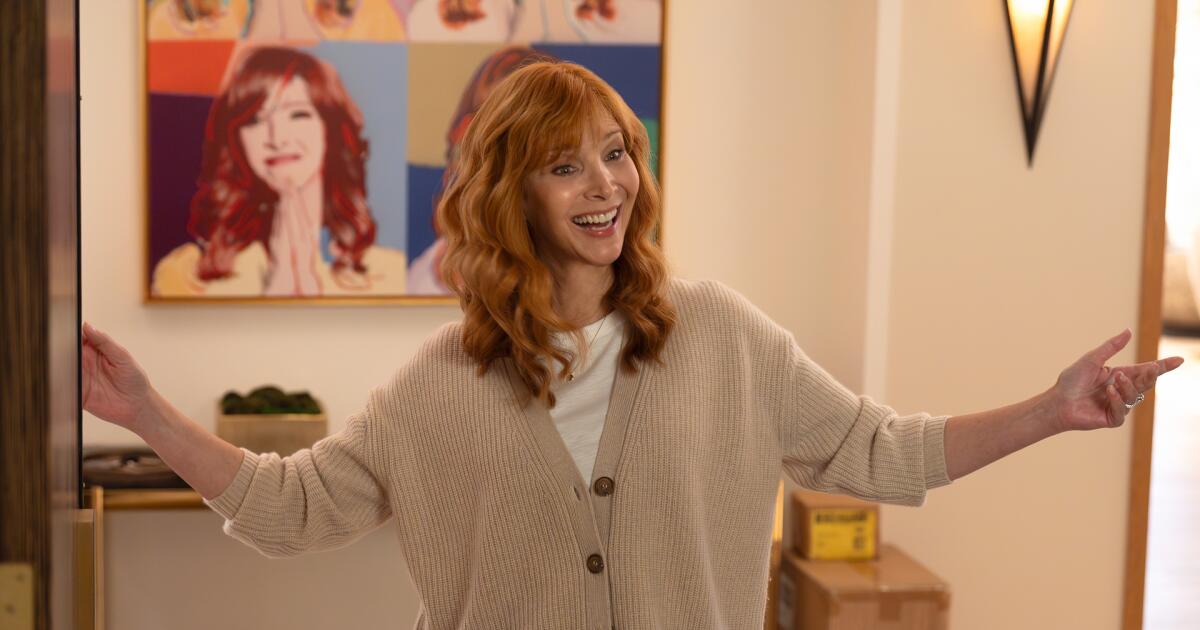
Review: After more than a decade, Lisa Kudrow and ‘The Comeback’ make a timely, final return
New details: Universal Studios’ ‘Fast & Furious’ coaster is almost ready to ride

Commentary: California can have both easy voting and quicker election results. Here’s how.

As mosquitoes go year-round in L.A., a promising fix hits a snag

Boys’ basketball player of the year: Maxi Adams of Sierra Canyon

Florida High School Football Rankings: Top 25 teams – Oct. 21

How old is Bo Nix? What to know about Oregon quarterback ahead of 2024 NFL Draft

Cleary's 21 help Le Moyne down Central Connecticut State 69-64 in OT

99th annual Pony Swim held in Virginia

Indiana Members Credit Union announced as new anchor tenant at Bottleworks District

‘Risk of escalation is extremely high as Iran shows it can retaliate’

Immigration agents deploying to airports under border czar as TSA staffing falls short | CNN Politics

Video: Former F.B.I. Director Robert Mueller Dies at 81

Trump gives Iran 48-hour ultimatum to reopen Strait of Hormuz or face strikes on power plants

Macron pushes tougher EU digital action ahead of key votes
-

 Detroit, MI4 days ago
Drummer Brian Pastoria, longtime Detroit music advocate, dies at 68
-

 Oklahoma1 week ago
Family rallies around Oklahoma father after head-on crash
-

 Nebraska1 week ago
Wildfire forces immediate evacuation order for Farnam residents
-

 Georgia6 days ago
How ICE plans for a detention warehouse pushed a Georgia town to fight back | CNN Politics
-

 Alaska1 week ago
Police looking for man considered ‘armed and dangerous’
-
 Science1 week ago
Federal EPA moves to roll back recent limits on ethylene oxide, a carcinogen
-
 Science1 week ago
H5N1 bird flu spreads to sea otters and sea lions along San Mateo coast, wildlife experts say
-

 Movie Reviews3 days ago
‘Youth’ Twitter review: Ken Karunaas impresses audiences; Suraj Venjaramoodu adds charm; music wins praise | – The Times of India